End of the line

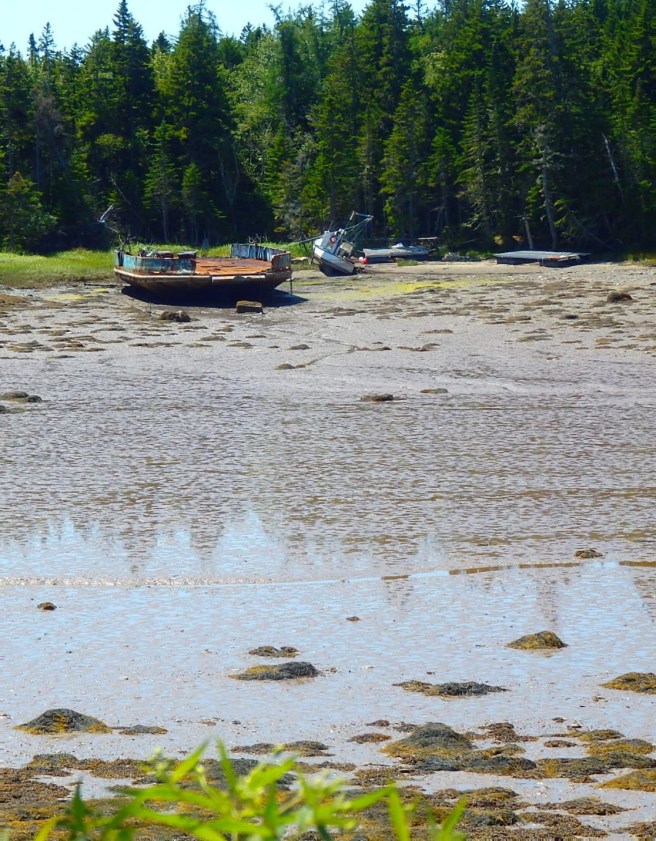
I do wonder about this scuttled auto ferry seen from a trail at Roque Beach State Park. It’s far from any center of population, and there’s no remaining top structure.

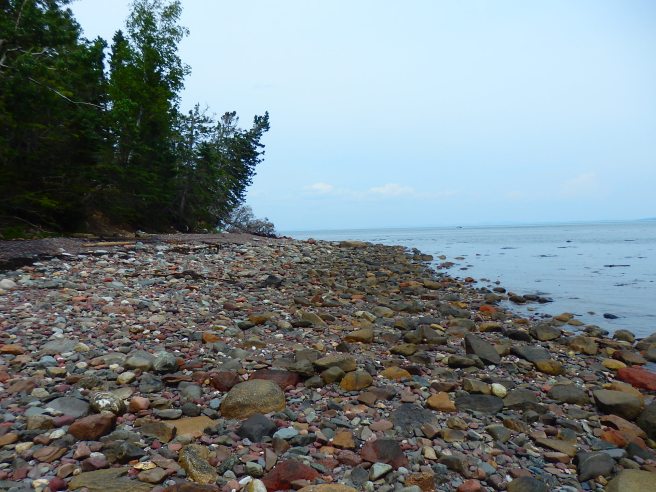
As seen at low tide.

Was it scavenged before being abandoned? Or even after? Did it fall victim to fire? Or a storm? Somehow it was run aground along what’s now thick forest.


Anticipating the fall foliage

It’s a common topic of conversation this time of year in New England.

How’s the foliage shaping up?

Are drought or wetness, heat or cold, or any number of other factors impacting it negatively?

Or is it going to be another banner month across the six-state region?

Vermont and New Hampshire tourism tries to capitalize the most from the colorful outburst, but they’re hardly alone in sometimes dazzling displays. New York and Pennsylvania can also be memorable.

So here we are, trying to make the most of the outdoors before winter cold sets in all too soon.

What’s it like where you are?


Some of the most successful farms around here are out on the water

As many fish stocks dwindle precariously, salmon farming and related aquaculture are hailed as a viable alternative.

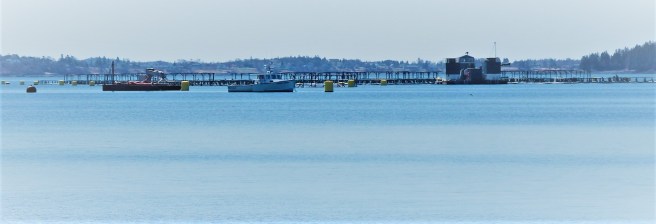
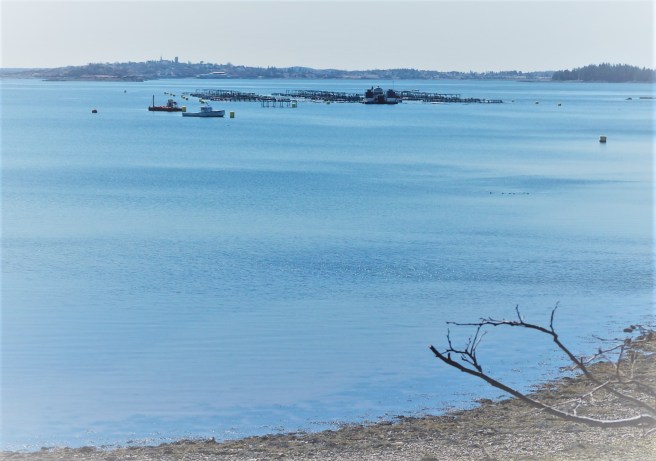
Salmon pens at Broad Cove.

Young salmon are placed in the circular enclosures when they’re about six inches long, where they leap and splash under netting that protects them from eagles, osprey, cormorants, and gulls. In about two years, they grow to a harvestable size of about two feet and ten pounds. A specially designed vessel sucks the mature fish from their pens and its conveyor stream immediately cleans and guts them.

Lubec rises in the distance.

Cooke Aquaculture, based in Blacks Harbour, New Brunswick, manages 15 pens in Deep Cove and Broad Cove, operating from a former fertilizer plant on Estes Head. A feeding barge sits amid the pens, which house about 450,000 salmon. About one-third of the pens are left fallow at any time.

A pen like this can hold 25,000 fish. The netting protects the salmon from osprey, eagles, and other predators.

From our upstairs windows, we can see other salmon farms at Campobello Island across the channel.

As for recipes? I’ll often make mine as sashimi.


We’re getting a glimpse of a most incredible cruise ship

We were anticipating the expedition cruise ship Roald Amundsen’s arrival at the Breakwater today after it had circled Alaska, crossed the Arctic Ocean, and visited Greenland and Baffin Bay on an intrepid voyage from Vancouver, British Columbia, across the Northwest Passage – albeit from the west.  But when that itinerary was halved, and the second leg shortened, we were crossed off the ports of call. At least we were then added to a shorter round of New England stopovers that followed.

So now the Amundsen is expected to show up today and you can bet that the locals will be lined up for a personal look. This is not any floating resort.

With global warming, Northwest Passage trips are being offered each year for bold, well-healed, bucket-list travelers desiring to go where few have ventured before. This opportunity requires ice-breakers, not just any cruise ship. The Norwegian-flagged Amundsen is one with style and luxury.

The visit should heighten our anticipation of its return next September as part of a remarkable 94-day Pole-to-Pole adventure that will continue to Antarctica.

Sounds like a historic journey to me.

Here are ten more facts.

  1. In 2019, the new, 530-passenger, 459-foot, stylish state-of-the-art vessel joined Hurtigruten Expeditions’ fleet.
  2. It is propelled by environmentally sustainable, innovative hybrid technology that reduces fuel consumption and CO2-emissions by 20 percent.
  3. The ship is specially constructed for voyages in polar waters, where it serves as a comfortable base camp at sea.
  4. Unlike a typical vacation cruise, an expedition is for curious minds and explorers, focusing on the geography, biology, cultures, and histories along the way. To serve that aim, the Roald Amundsen has a science center packed with banks of stereoscope microscopes and related laboratory gear, as well as touch screens, lecture spaces, a small library, and areas for workshops in photography, biology, and similar interests as guests, staff, and crew mingle and generate a heightened understanding of the landscapes being explored.
  5. It’s not your utilitarian research vessel but posh, with all cabins having outside views. Half even have private balconies. Aft suites include private outdoor hot tubs for enjoying spectacular views.
  6. Its three restaurants are inspired by Nordic and Norwegian heritage.
  7. The ship is named after the first explorer to reach both the North and South Poles.
  8. Passage through the Panama Canal takes roughly 12 hours.
  9. Arrival in Antarctica will be late spring there, when the Gentoo and Chinstrap penguins will be at the start of their courting season, while the Adélie penguins may have already laid their eggs and be nesting.
  10. Fares for this expedition started at $57,000 – or $600 a day. I doubt that any of those are left.

If you had the money, is this something you’d love to do?

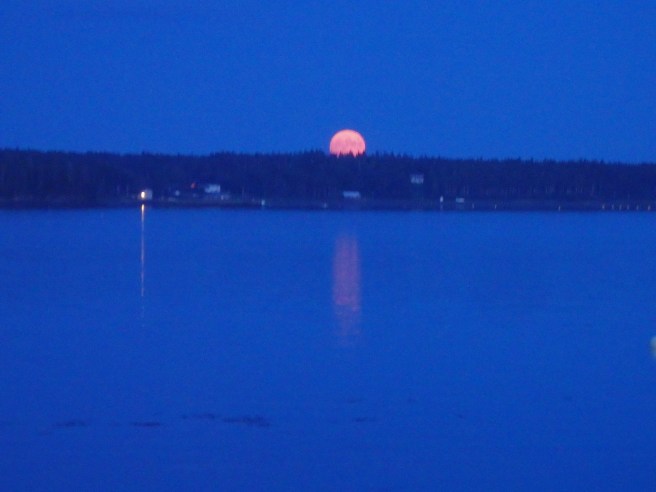
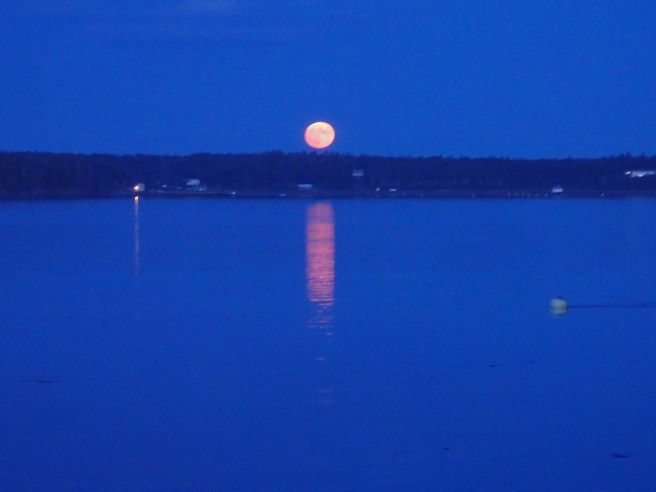
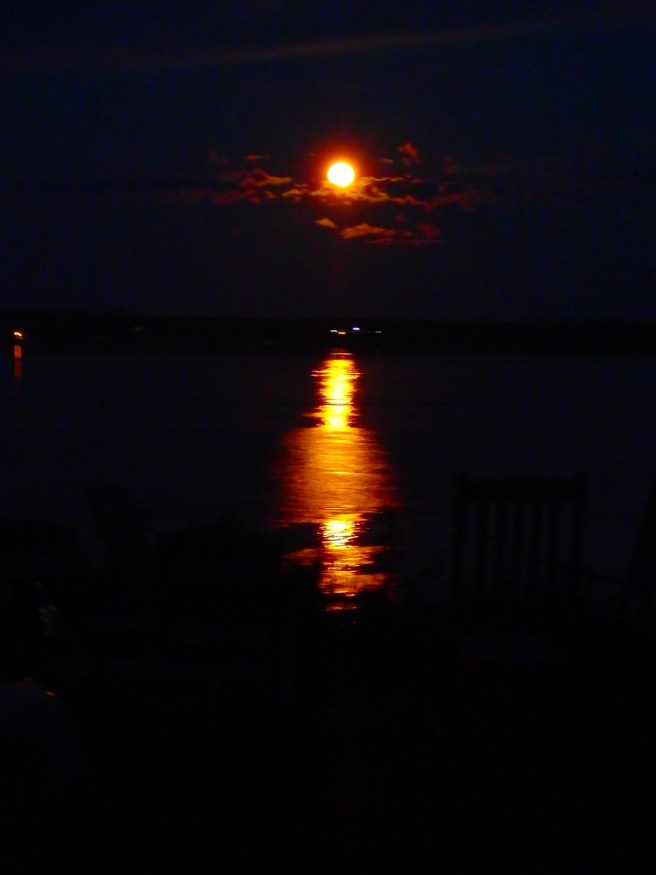
Full moon rising

Refined Japanese, I’m told, would gather with sake to watch the full moon rise. First there’s only the crown of the head, and then the brow and cheeks and chin before the moon lifts altogether in the air. The passage is both slow and fleet, maybe five minutes, if that.

The event would be celebrated with the writing of hokku on the spot.

Here’s how it happened one summer night in Eastport, looking over Campobello Island. And this is what you get rather than a cocktail or poem.


The trip had nothing to do with landing on another planet, though it felt that way

According to the map, it looked like a good road. I had just taken a lovely, very smooth one a few miles to the east, so I expected to enjoy more of the same. But when the pavement abruptly ended, I kept going. After fifteen or twenty miles of encountering no house or other vehicle, I finally came out on the state highway – one of three paved roads running east-west across the county. I did have to back up at one point and try the one intersecting logging road I encountered. Good thing my little Sonic has a compass on the dashboard array. It’s easy to get disoriented in hilly wilds.

Welcome to Washington County, Maine.

The drive had me remembering forays into the logging back country of the Pacific Northwest or even a “shortcut” in the ’50s along Devil’s Ridge in southern Indiana that was pure hillbilly, uh, perfection. I think that route’s long since been covered in asphalt. What a shame – it was timeless.

Long ago, I learned you can’t always trust maps, no matter how much you need them. A tourist site like a commercial cavern might be indicated on the wrong side of the road, or there might be a circle for a village that today is no more than a trio of houses.

Still, they’re pretty essential. As I said, there was one intersection on this trek where my car’s compass had me confounded. Checking the map, I realized I should have turned left and headed south, so I turned about and course-corrected. Good thing, too. According to the map, I would have spent the rest of the day heading into the sunset on a rocky dirt lane.

If I keep this up, I really will need to get a battered pickup or four-wheel-drive SUV.
You can hike and camp on Treat Island, but you get there only by boat

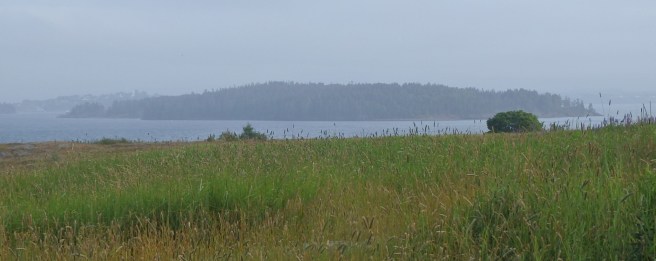
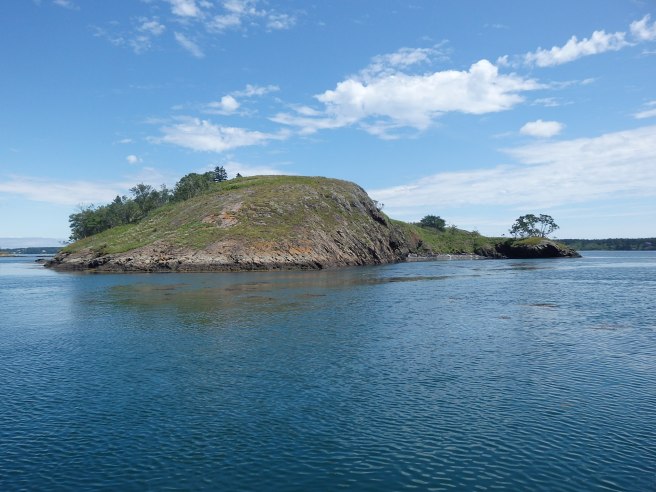
Named for Upham Stowers Treat, the island once housed a fishing hamlet and then a Civil War battery. Today, as one of the Maine Coastal Heritage Trust preserves, it’s open to the public and has a 1.2-mile network of trails offering stunning views of the surrounding bays.

As seen from Eastport’s South Side.


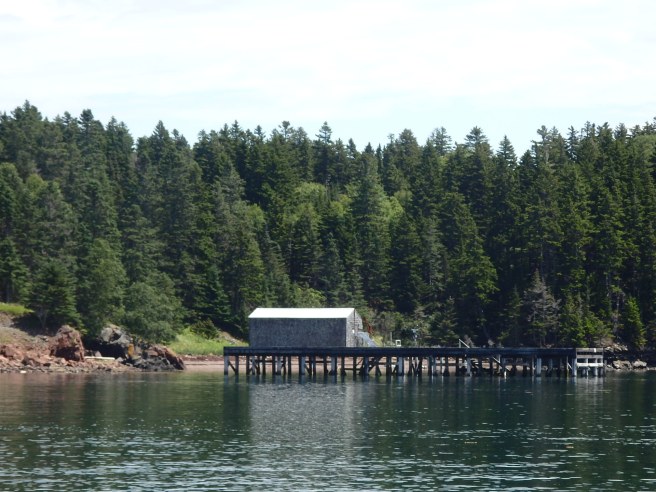
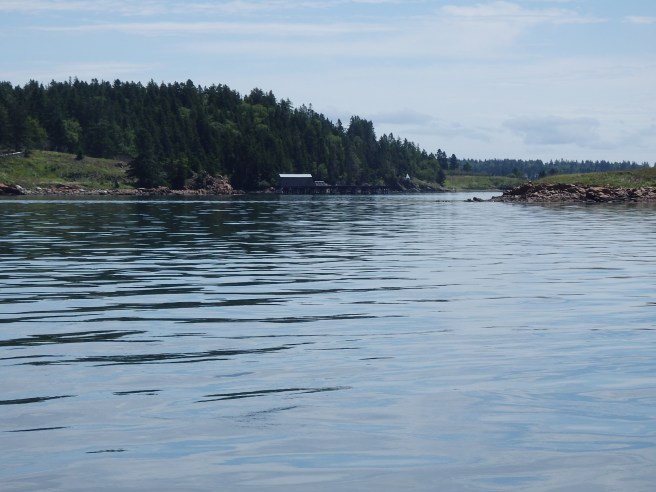
The Army Corps of Engineers operates a marine concrete testing station on three acres on Treat Island’s northwest side.
Officially, it’s the largest uninhabited island within the city of Eastport.
Dudley Island adjoins Treat.

Kayakers are advised to get a guide who knows the waters’ treacherous currents.