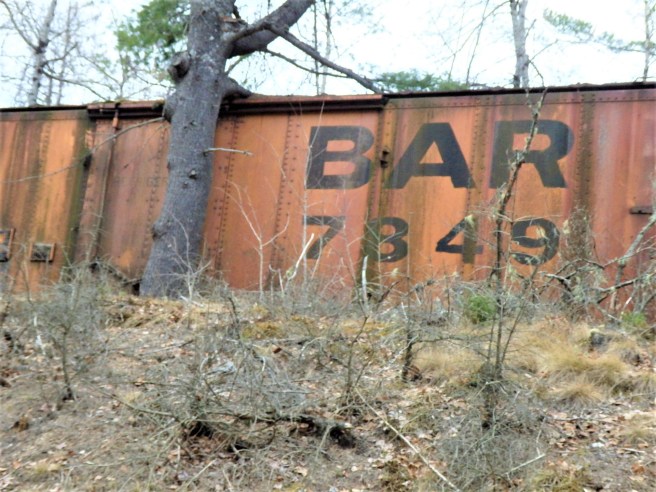
BAR cars stuck in the woods

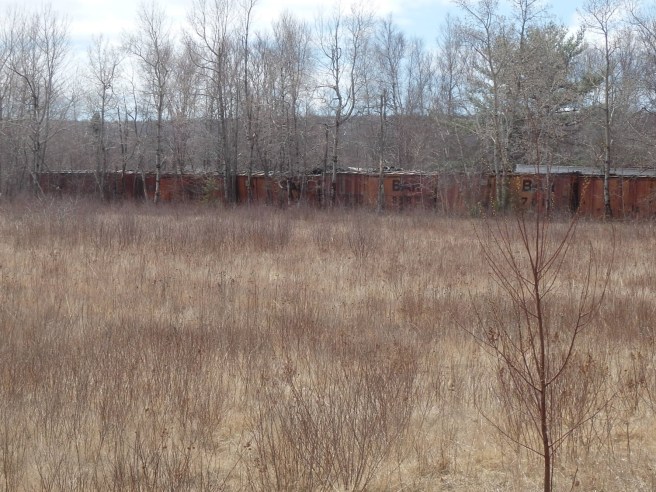
Seeing railroad boxcars away from the tracks around here no longer surprises me. Many of them stand beside farmhouses and sheds or even businesses, where they serve as extra storage space, presumably cheap or for the taking.

But this sight along State Route 191 always grabs me.

Like they simply stopped in time.
It’s like the trees are trying to pull the cars back into the earth itself.

The Bangor and Aroostook Railroad served Washington County as well as the Penobscot Bay region and the spud country up north.

Why Yankee mariners wintered in the woods

You might think the ideal time to work in a forest would be spring or fall, but that’s not how it’s turned out in logging in the great northern forests of New England and New York state. Instead, the time to be out harvesting trees is deep winter. Yup, below zero around here.

I first learned of this when trying to order firewood after an uncommonly warm winter in New Hampshire. Because the ground hadn’t frozen hard enough long enough, the cutters hadn’t been able to access much of the woods with their heavy equipment. The result was a marketplace shortage.

For contrast, mud season can be notorious, so much so that come spring, logging roads are closed to prevent destruction. Much of Maine, in particular, is either standing water, once the ice melts, or boggy, including soft peat bogs. And in late spring and early summer, hoards of nasty black flies swarm about – the defenders of wilderness, as some contrarians contend.

~*~

Folklorists examining the songs of Maine have noticed that many of the songs from the old lumberjack camps originated at sea. You know, as shanties and the like. At first, these scholars were puzzled, but then they realized that winter was a treacherous time to be out on the water. Many sailors instead headed for the forests, to work in the camps for the season. Somehow, though, any songs originating in the woods failed to travel the other direction.

Historically, the logs were stacked along streams, awaiting the spring melting and surging high waters that the timber could ride to ride millponds. That, in turn, could be exciting, demanding, and deadly work where mariners would continue.

From there, the sailors went back out on the ocean.

Mechanization has changed much of that, on land and sea, but not the reality of mucky soil.

We’ll see what global warming does to the industry.

Looking ahead to the year 2050

I’ve been part of a study group that’s been trying to envision a sustainable future for our small corner of the globe.

It’s been an exciting exercise, actually, looking for ways we can enhance what we have in conjunction with neighboring communities.

But it’s also terrifying, when we look more broadly.

Nine billion population, up from one billion when I was born. Can the globe really carry that load? I’m doubtful, but maybe.

Let’s start with increasing urbanization. I was blown away by the fact that 75 percent of Britain is considered urbanized today.

Add to that global warming. The regions where population is booming will be scrambling for food and water. Yes, water becomes essential. As well as ways to earn a livable income.

Now consider the automation of many jobs, something that points toward income readjustment, which is being largely ignored in public discussion.

Get political, and Republicans are in utter denial about all this, something I find deeply troubling. Engage, intelligently, will you? The future of humanity is at stake. Or are you really dinosaurs, just looking only for your next meal?

According to the projections, I’m in a good place to survive this – or at least my descendants are. Yeah, the ocean will be closer to our doorstep, even if we are higher than the downtown we adore. Still, the directions on the charts point to a lot of turbulence ahead, especially desperation and violence.

Here, in these workshops, we’ve been looking at the enhanced value of tourism, seeing our place as a pocket of natural wonder. As much as I love that projection, I doubt things will be that easy.

Will Florida actually be off the map by then, along with all of its reactionary politics? Or maybe those partisans will still be denying global warming would ever happen.

Where do you see the world in just 30 years?

Or even in just six, 2030?
 

It doesn’t always have to be spectacular

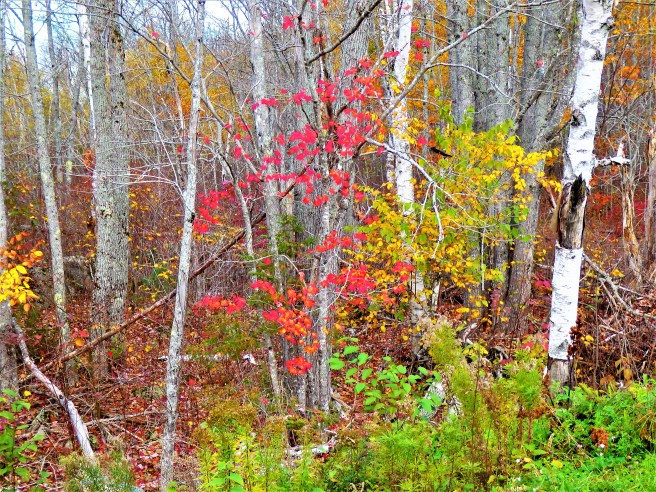
A fringe of intense red in swampy ground is often a vanguard of the changing foliage.

Let me be honest and admit that the most amazing fall foliage I’ve seen was in 1970 in the Susquehanna Valley of New York and neighboring Pennsylvania. I’m not sure how it would stack up today, if I had a way of reviving the actual color, but the experience was unlike any before or since.

I was fresh out of college – free of being cooped up on campus and indoors. I had my own wheels and a job that had me free by midafternoon, when the angular sunlight was kicking in. And the local forests blended the species of New England with those of the middle Appalachians. What I had known before was Ohio and Indiana, without the big foothills that propped the forests up before my eyes like giant canvases or, from the crests, arrayed them below me like vast quilts punctuated with villages and farm fields and meadows.

I suspect another major factor was a killing frost by late September, which would intensify the color and make, officially, Indian summer. With global warming, that frost has been delaying until all of the leaves have fallen.

All the same, living in New England for nearly half of my life now, I recognize how profoundly the autumn change strikes the region. My in-depth reflections and accompanying photos from New Hampshire are found in the archives of my Chicken Farmer blog. Do go there, if you can. The posts and slideshows appear in the New England Spirit category from August through October 2013.

What I’m now encountering is Coastal Downeast Maine, with its own variations. The forest is largely evergreen, which of course stays green. But it does provide a solid background for the deciduous trees as they change.

Having written that, I encounter an early morning drive across stretches where everything is perfect. The foliage is prime, a full range of the palette, nothing holding back. The temperature’s still chill, so maybe they’ve already had that hard frost up here. Better yet, the sunlight’s brilliant buttery and straight-on, rather than overhead, illuminating the leaves from the side facing me.

It reminds me of other “oh, wow!” epiphanies in northern New England that no doubt would equal or even surpass the year further south that set the standard.

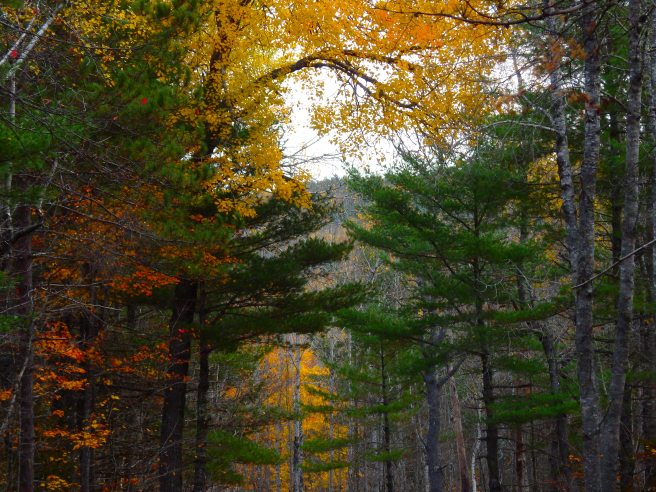
So here’s a taste of how it happens around here.

The trees don’t all change color at the same time.
Evergreens do provide a strong background.
A few dramatic splashes.
It’s not always the panoramic view that counts.
On the other hand, when you’re faced with this at a bend in the road, how can you not be awed?