Tag: Ohio
Wilbur and Orville weren’t the only Wright Brothers
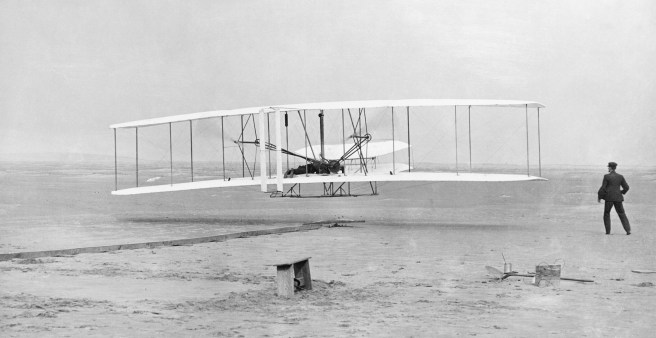
THEY WERE “PKs,” meaning “preacher’s kids,” a difficult role for nearly every child put in its unwanted spotlight. Beyond that, theirs does appear to be a tight-laced family, even with its strong strain of moral and social progress. We can even wonder what the brothers’ diagnosis would have been today; there are speculations of “somewhere on the spectrum.”
Still, they did put humans into the air and, more importantly, brought them down safely.
We’ll put their technological breakthroughs aside today and instead focus on the more personal surroundings of Wilbur (1867-1912) and Orville (1871-1948), sons of Bishop Milton Wright and Susan Catherine Koerner Wright.
Like me, they were both born in Dayton, Ohio, and we were members of a congregation their father had founded. (He also founded a seminary.)
And, gee, a photo of the house they grew up in looks almost identical to my grandparents’.
Here are ten more interesting points gleaned from the Web:
- Neither one graduated from high school. They were, however, friends of classmate Paul Laurence Dunbar, the school’s only Black student, now an acclaimed poet, and in time, at their print shop, they published a newspaper he created. Yes, they were printers and bicycle manufacturers before they built airplanes.
- They learned many of their mechanical skills from their mother, who had attended Hartville College, a small United Brethren school in Indiana, at a time when few women were permitted such an opportunity. Her focus, tellingly, was literature, science, and mathematics. In 1853, she met the future bishop. He had joined the church in 1846 because of its stand on political and moral issues including alcohol, the abolition of slavery, and opposition to “secret societies” such as Freemasonry, values she shared. Working together as his ministry developed, they brought their boys to 12 different homes across Indiana and Iowa before returning permanently to Dayton in 1884.
- A year or so later, while playing an ice-skating game with friends Wilbur was struck in the face with a hockey stick by Oliver Crook Haugh, whose other claim to fame would be as a serial killer. Wilbur lost his front teeth. Up until then, he had been vigorous and athletic, but the emotional impact left him socially withdrawn, and rather than attending Yale as planned, he spent the next few years largely housebound, indulging in the family’s extensive library and caring for his mother, who was terminally ill with tuberculosis.
- More befitting a PK, in elementary school Orville was prone to mischief, including practical jokes, and even expelled once.
- They weren’t the only Wright brothers. Reuchlin (1861-1920) was their oldest sibling. Born in a log cabin in Indiana, he grew into a restless young man, failed college twice, then moved to Kansas City in 1889, distancing himself from his family. He worked in Kansas City as a bookkeeper until 1901, then moved on to a Kansas farm with his wife and children to raise cattle. Though he built a good life for his family there, he remained estranged from the rest of his family in Dayton.
- Lorin (1862-1939) spent time on the Kansas frontier before attending Hartville College in 1882 and returning to Dayton, where he had difficulty making a living. So he left for Kansas City in 1886 (before his elder brother), struggled, briefly, returned to Dayton, and then headed west again, where he scraped out a living on the Kansas frontier for two years before returning home in 1889, lonely and homesick. He worked as a bookkeeper for a carpet store in Dayton and married his childhood sweetheart, Ivonette Stokes, in 1892; they had four children as he settled down to a quiet life. In 1893, he worked for Wilbur and Orville in their print shop, and in 1900 helped sister Katharine manage the Wright Cycle company while their brothers were in Kitty Hawk, North Carolina. He visited Wilbur and Orville at Kitty Hawk in 1902, notified the press in 1903 after their first powered flights, and lent them his barn to build the machine that eventually became the first United States military aircraft. In 1911, he helped test the first airplane autopilot and in 1915, spied on Glenn Curtiss to gather information for the Wright patent suit against the rival airplane manufacturer. After Orville sold the Wright Company, Lorin bought an interest in Miami Wood Specialties, the company manufactured a toy that Orville designed. He also was elected a city commissioner in Dayton.
- Twins Otis and Ida (1870) died in infancy. He, of jaundice; she, five days later, of marasmus – malnutrition.
- Their youngest sibling, Katharine (1874-1929), could be the subject of a Tendril all her own. She was only 15 years old when her mother died of tuberculosis in 1889. As the only female child, it was taken for granted that she would assume her mother’s role—which she did – caring for the family and managing the household. She was especially close to Wilbur and Orville, and when her mother died it became her responsibility to take over the household, seemingly ending any prospects of marriage. Yet she also graduated from Oberlin, at the other corner of the state, in 1898, the only Wright child to complete college. She then became a highly respected teacher at Dayton’s Steele High School. After Orville’s injury in a 1908 test flight for the military at Fort Myer, Virginia, she took a leave of absence from her teaching job to nurse him back to health and never returned to teaching. Instead, she became a central figure in her brothers’ aviation enterprises. In 1909, the French awarded her, along with Wilbur and Orville, the Legion d’Honneur, making her one of the only women from the U.S. to receive one. After Wilbur’s death in 1912, Orville became more and more dependent on Kate, as his old injuries had him in severe pain. She looked after his correspondence and business engagements along with his secretary, Mabel Beck, and ran the household as before. In the 1920s, Kate began to renew correspondence with an old flame from her college days, a newspaperman named Henry Haskell, who lived in Kansas City. (What is it with Kansas City for this family?) They quickly began a romance through their letters, but she feared Orville would become jealous. After several attempts, Henry broke the news to Orville, who was devastated and refused to speak to the couple. When they finally wed in 1926, Orville refused to attend the ceremony, and wouldn’t speak to them up until they moved to Kansas City. She was ridden with guilt for choosing Henry over her brother, and tried many times for a reconciliation, but Orville stubbornly refused. Two years after her marriage, Katharine contracted pneumonia. Even when Orville found out, he refused to contact her. It was their brother Lorin who eventually persuaded him to visit her on her deathbed, and was with her when she died. She was 54.
- None of the Wright children had middle names. Wilbur and Orville were “Will” and “Orv” to their friends, and “Ullam” and “Bubs” to each other.
- The parents and siblings, minus Reuch, are buried at Woodland cemetery in Dayton.
For a broader view, let me suggest The Bishop’s Boys: A Life of Wilbur and Orville Wright by Tom Crouch.
The United Brethren denomination also figures prominently in my posts at Orphan George.
Kinisi 229
sip, sip and then it’s gone
Van Wept Ohio
Carpooling
Bob Stratton tells of driving home from work in Lordstown when a thunderstorm rolled up:
“One of the fellas in the car said, ‘Hey, the car behind us is sure coming comin’ up fast with its brights on.’
“It was no car. It was rolling lightnin’ that hit us.”
They drove on to a diner. “I smell something singed,” the waitress said.
“If that’s all it is, we’re lucky,” they laughed, and then told her what had happened.
Several weeks later, stopping there during another storm, the waitress was now telling them their story.
“You must not recognize us,” they laughed. “We’re the fellas it happened to.”
Inside Charles F. Kettering’s mind
The prolific inventor, entrepreneur, and civic influence Charles F. Kettering was still alive in the Dayton community when I was an aspiring chemist in my youth.
My career in science never materialized, but his influence as an inspired ideal of leadership remains.
You may recognize the name from the famed Sloan-Kettering cancer research hospital in Manhattan or from the city in southwest Ohio named in his honor. He also led the research teams that invented the electric cash register, the automobile electrical self-starter, and no-knock gasoline. Other work made the diesel engine practicable as well as the refrigerator and, in time, air conditioning. In all, he had 186 patents, second to fellow Ohioan Thomas Edison. He was a founder of Delco (Dayton Electrical Laboratory Company) and from 1920 to 1947 was head of research for General Motors.
As a power in the new General Motors corporation, he aligned with management pioneer Alfred Sloan – as in that Sloan-Kettering Hospital in Manhattan,.
Let me repeat, there’s even a city named in his honor.
Today we have another Double Tendrils.
Get ready to know him better. Let’s start with his perspectives on the creative process and problem-solving, especially as they apply to engineering and invention. Here’s what he said:
- If you want to kill any idea in the world, get a committee working on it.
- I don’t want men of experience working for me. The experienced man is always telling me why something can’t be done. The fellow who has not had any experience is so dumb he doesn’t know a thing can’t be done – and he goes ahead and does it. … The person who doesn’t know something can’t be done will often find a way to go ahead and do it.
- Every great improvement has come after repeated failures. Virtually nothing comes out right the first time. Failures, repeated failures, are finger posts on the road to achievement. One fails forward toward success. … 99 percent of success is built on failure.
- An inventor fails 999 times, and if he succeeds once, he’s in. He treats his failures simply as practice shots.
- Inventing is a combination of brains and materials. The more brains you use, the less material you need. … A problem well stated is a problem half-solved.
- All human development, no matter what form it takes, must be outside the rules; otherwise, we would never have anything new.
- A problem thoroughly understood is always fairly simple. Found your opinions on facts, not prejudices. We know too many things that are not true.
- Research means that you don’t know, but are willing to find out.
- We work day after day, not to finish things; but to make the future better … because we will spend the rest of our lives there.
- If I want to stop a research program, I can always do it by getting a few experts to sit in on the subject, because they know right away that it was a fool thing to try in the first place.
- When I was research head of General Motors and wanted a problem solved, I’d place a table outside the meeting room with a sign: “Leave slide rules here.” If I didn’t do that, I’d find someone reaching for his slide rule. Then he’d be on his feet saying, “Boss, you can’t do it.”
And now for his perspective on life itself.
- There is a great difference between knowing a thing and understanding it. You can know a lot and not really understand anything.
- The world hates change, yet it is the only thing that has brought progress.
- If you’re doing something the same way you have been doing it for ten years, the chances are you are doing it wrong.
- Where there is an open mind, there will always be a frontier.
- My definition of an educated man is the fellow who knows the right thing to do at the time it has to be done. You can be sincere and still be stupid.
- If I have had any success, it’s due to luck, but I notice the harder I work, the luckier I get.
- The whole fun of living is trying to make something better.
- No one would have crossed the ocean if he could have gotten off the ship in the storm.
- You can’t have a better tomorrow if you are thinking about yesterday all the time.
- Every father should remember one day his son will follow his example, not his advice.
He really was one who made America great.
Kinisi 271
I remember when he had a Willy’s Jeep
cool, like a square dance
The original wild child of the White House
The eldest child of Theodore Roosevelt was renowned for her wit and unconventional ways even before she married Nicholas Longworth III, a Republican leader from Cincinnati who eventually became the 38th speaker of the U.S. House of Representatives.
Here I was, planning to sample some of her sharp retorts but now feel compelled to offer ten points about her remarkable and long life to age 96 as a most remarkable observer of life in the nation’s capital.
Please consider this cut-and-paste biography.
- Alice Roosevelt was the only child by the future president’s first wife, Alice Hathaway Lee, a strikingly beautiful and charming Bostonian banking heiress of deep Brahmin roots who died at age 22 of previously undiagnosed kidney failure. This death came only two days after giving birth to Alice and 11 hours after Teddy’s mother also died, all in the same house.
- Grief-stricken, Teddy turned his daughter over to his unmarried, elder sister, Anna. The infant dwelled in “Bammie” or “Bye’s” book-filled Manhattan house while on her father recovered on Western adventures. Once the child back under his roof after he remarried when she was three, he never spoke to his daughter about her mother. So deep was his despair that he tore pages from his diary and burned letters. Alas. Can it get more gothic than this? Distraught after her death, he almost never spoke of her again and prohibited mention of her in his presence. His autobiography even – imagine this – omitted her name. His daughter reflected this practice after her own marriage, preferring to be called “Mrs. L” rather than “Alice.” We can only imagine what her therapist would have made of this, had she had one. Or, for that matter, how the psychological impact affected his politics.
- Bammie somehow remained a significant influence on young Alice, though eventually from a distance after marrying and moving to London. Alice later spoke of her admiringly: “If auntie Bye had been a man, she would have been president.” Got that? Over her own father?
- As the daughter became more independent and chafed against her father and stepmother, her Aunt Bye still provided needed structure and stability. Late in life, Alice said “There is always someone in every family who keeps it together. In ours, it was Auntie Bye.” Does anyone else sense a writing prompt here? A historical novel, perchance?
- A celebrity and fashion idol by age 17, Alice’s social debut in 1902 was highlighted by a gown made of what was soon dubbed “Alice’s blue.” The dress sparked both a women’s clothing trend and a popular song, “Alice’s blue gown.”
- Scandalously, Alice smoked cigarettes in public, rode in cars with men, stayed out late partying, was spotted placing bets with a bookie, and had a pet snake named Emily Spinach – named after a spinster aunt and the green vegetable. (Her five half-siblings added a badger, guinea pigs, birds, cats, and dogs to the menagerie.)
- Her wedding in February 1906 in the East Room of the White House was the social affair of the season. The groom was 14 years her senior, a scion of a socially prominent Ohio family, and widely whispered to be a Washington womanizer. The event was attended by more than a thousand guests while thousands more crowded outside hoping to glimpse the bride. Alice wore a blue wedding dress – not white – and theatrically sliced the wedding cake with a sword drawn from an unsuspecting military aide.
- When the Roosevelts moved from the White House, Alice buried a voodoo doll of Nellie Taft, the new First Lady, in the front yard. When the Taft White House later barred Alice from her former residence, it was the first but not the last administration to do so. Next in line was Woodrow Wilson, who barred her in 1916 for a bawdy joke where he was its butt.
- In 1912, Alice publicly supported her father’s Bull Moose presidential ticket while her husband remained loyal to his mentor and fellow Cincinnatian William Howard Taft. During that election cycle, Alice appeared on stage with her father’s vice presidential candidate in Longworth’s own district. When her husband narrowly lost his House seat that year to a Democratic challenger – by 101 votes – she joked that she was worth at least 100 votes. Although her husband recovered the seat in 1914 and stayed in the House of Representatives for the rest of his life, Alice’s campaign against him caused a permanent chill in their marriage.
- During their marriage, Alice carried on numerous affairs. Best known was her long, ongoing liaison with Senator William Borah of Idaho. When Alice’s diaries were opened to historical research, the pages indicated that Borah was the father of her daughter, Paulina Longworth (1925–1957). Even in this sensitive situation, Alice’s famed “brilliantly malicious” humor was inescapable: she had originally wanted to name her daughter “Deborah,” as in “de Borah.” And according to one family friend, “Everybody called [the daughter] ‘Aurora Borah Alice.’”
Before you start your car, thank this auto pioneer
When we think of many of the technological advances that impact our daily lives, we usually don’t know the names of their inventors, even when we know the businessmen who got wealthy as a result. Elon Musk did not invent the Tesla, for instance, nor did Bill Gates invent the internet or Henry Ford, the auto. The list is actually a long one.
Consider John William Lambert, mentioned in a previous Tendrils.
I remember visiting an early coworker and, upon seeing an old car with an impressive Lambert name in brass across the radiator sitting at an open garage door, I asked, “Ann? Is that car any relation to you?” She replied that her grandfather used to make them but otherwise conveyed no knowledge that he had been so prominent a figure.
Here are ten facts from his life.
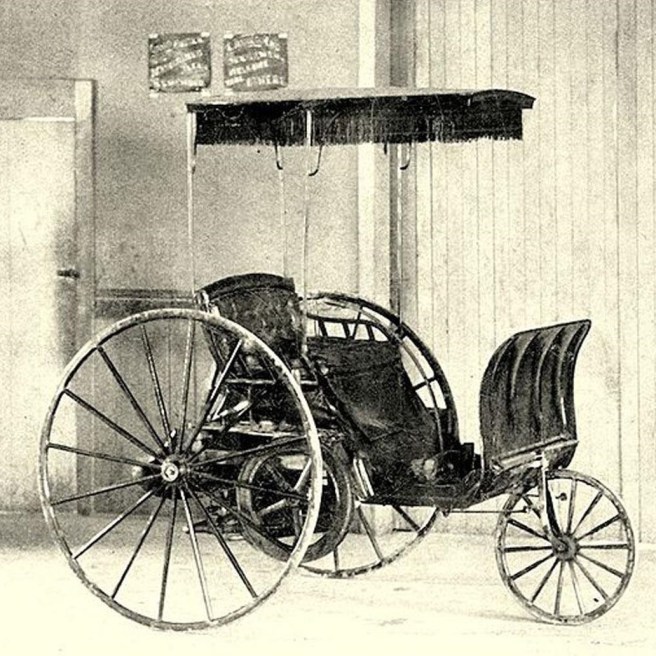
- He invented the first practical American internal combustion gasoline automobile in 1890 in Ohio City in Van Wert County, Ohio, where he tested it on the village streets early the next year. It was the Buckeye gasoline buggy, a surrey-topped three-wheel runabout with one seat. It had a three-cylinder, four-stroke engine.
- In 1891, that horseless carriage became the first automobile offered for sale in the United States. Priced at $550, it attracted no buyers.
- Undaunted by the buggy’s reception, he turned his attention in 1892 to making stationary gasoline engines for farm and industrial factory use.
- Lambert’s base of operations was the Buckeye Manufacturing Company, which he had founded in 1884 as a farm implement manufacturer and moved in 1892 to Anderson, Indiana.
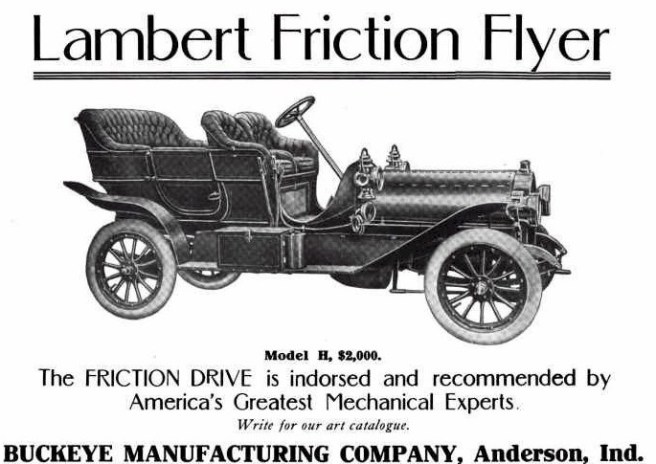
- His experiments with drive-train technology led to the Lambert friction gearing disk drive transmission. The gradual, or gearless, transmission became a signature feature on all of his future cars.
- His next attempt at an auto line came in 1895 with a model called the Buckeye. It was a four-wheel modification of the buggy but failed to find buyers.
- His first marketing success was the Union, released in 1902. About 300 of the tiller-steered cars were sold.
- In 1906 he introduced his first Lambert, establishing himself as one of the more successful automakers of the time. Production peaked from 1907 to 1910 with 2,000 cars a year.
- Buckeye Manufacturing, which built the cars, had moved by 1905 to Anderson, Indiana. The Lambert Automobile Company was one of its subsidiaries. Touting its Lambert Friction-Drive Automobiles and Trucks, the Buckeye factory mass-produced Lambert’s cars, gasoline engines, and auto components as well as fire engines, railroad inspection vehicles, and steel-hoof tractors before closing in 1917. At its height, the company had more than a thousand employees.
- Lambert held more than 600 patents and died in 1952, age 92, in Anderson.
How relative is time, anyway?
Let’s consider fourth place, as far as length in time. That is, realizing that I’ve been dwelling in Eastport four years now strikes me as a bit of a shock. I’m finding it difficult to make sense of the fact, at least in light of earlier landings.
Quite simply, I’m still settling in here, even if it’s in my so-called sunset years. And, yes, I’m still feeling this is it, a very suitable end of my road, even if I am being greeted by name by people I don’t recall knowing, this is in sharp contrast to earlier locales.
For perspective, those shorter spans were in my early adulthood: Bloomington, Indiana (four years in two parts); Binghamton, New York (1½ years, in two parts and three addresses); the Poconos of Pennsylvania (1½ years); the town in northwest Ohio I call Prairie Depot (1½ years); Yakima, Washington (four years); a Mississippi River landing in Iowa (six months); Rust Belt in the northeast corner of Ohio (3½ years); and Baltimore, my big-city turn and turning point (three years). You’ve likely met many of them in my novels and poems.
Looking back, each of those addresses was filled with challenging turmoil and discovery, soul-searching yearning as well as glimmers of something more concrete and fulfilling just ahead.
In contrast, my longest period of living anywhere was Dover, New Hampshire (21 years), my native Dayton, Ohio (20 years), and Manchester, New Hampshire (13 years).
Important people linked to the Gem City
In this case, they weren’t necessary born in Dayton, but the city did play a role in their success.
- Wright Brothers, inventors of the airplane
- Charles F. Kettering, prolific inventor
- John Henry Patterson, founder of the National Cash Register Company
- Thomas Watson Jr., of IBM fame after being fired – twice – by Patterson
- James Cox, Democratic presidential nominee and newspaper publisher
- Paul Lawrence Dunbar, Black poet
- Scotty Reston, editor of the New York Times
- Frank Stanton, head of Columbia Broadcasting Company (CBS)
- Milton Caniff, master cartoonist
- Mike Peters, freewheeling cartoonist
I should also mention Larry Flint, pornographer, who established Hustler magazine, named after his bar.
 Jnana's Red Barn