Downtown, scrawled on the side of a public trashcan or light pole, in quite flashy strokes:
MR. E?
I read it again, and realized: it was a mystery.
Now I wonder how it was intended.

You never know what we'll churn up in cleaning a stall
Downtown, scrawled on the side of a public trashcan or light pole, in quite flashy strokes:
MR. E?
I read it again, and realized: it was a mystery.
Now I wonder how it was intended.
Cutting through our neighborhood park and playground on a Saturday afternoon, I noticed it was filled with dads and their kids. Not even a mom in sight.
Usually (meaning other days of the week), it’s the other way around.
As I said at the time: Golly, I hadn’t thought in terms of “lower middle class” in ages, though that’s where I’ve been most of my adult life – even as management. According to government statistics, at least, and thanks to my union card, we made it up to median income, although in reality, considering the cost of housing in New England, we were never quite there. Before the housing market decline (our property had more than doubled in price in a half-dozen years), my wife saw the assessment and cried out, “I never thought I’d live in a quarter-million dollar house – and it’s still a dump!” Yup.
What is amazing is what can be accomplished when we focus our resources and set priorities. The secret is that you can’t have it all. My wife would love to travel, but then we managed for her to not have to be employed, which in turn allowed her to return to college and to chair the local charter high school (a full-time, unpaid job) while taking care of both her mother and the girls. Maybe we’ll get around to travel, but for now, there are too many other demands – on our time, especially. I was able to carve out blocks to draft/revise large sections of work, although in doing so, I wasn’t submitting much anywhere – that would come later, probably in retirement. So I hoped.
One of our favorite writers, Wendell Barry, points out that a divorced family is, on paper, far more economically viable because it has to pay for two households, hold down two jobs, maintain two cars, and so on, each point adding to the cash flow, which can be measured. Of course, that fails to calculate a lot of other, more meaningful values. Keeping my mother-in-law in her own little apartment in the barn, for instance, allows her some independence while still getting some family care – none of it showing up in the gross national product, or whatever we call that calculation these days.

While Dover Friends (Quakers) proclaim that we worship in our third meetinghouse, erected in 1768, our history of the previous two structures becomes a bit foggy. Even so, ours is the oldest house of worship in use in the city.
In his authoritative New England Quaker Meetinghouses (Friends United Press, 2001), Silas Weeks mentions that our first house of worship was built about 1680 on Dover Neck, just south of the present St. Thomas Aquinas High School. Correcting an earlier version of the relocation of the structure to Maine, he writes that in 1769 “the 1680 house from Dover Neck was taken apart and re-erected in Eliot at the corner of what are now State and River Roads. There is a bronze plaque marking the site …” (Alas, there goes the tale of its being skidded by oxen across a frozen Piscataqua River. Taken apart and put on a boat now seems more likely.)
Apparently, when our current house was built, we had no need for the smaller structure. I suspect that until our current meetinghouse was available, Dover Friends met for worship in the two smaller structures and gathered together for business sessions.
The disposition of the second house, though, had eluded his investigation. It had stood at what Silas “believed to be the present corner of Locust and Silver Streets,” but there was no indication it had been incorporated in later buildings on the site.
A publication from the Dover Chamber of Commerce, however, may have the answer. Dover’s Heritage Trails, a guide to historic walking tours through the city, notes this at 3-5 Spring Street: “This old dwelling was Dover’s second Quaker Meeting House, built originally at the corner of Silver and Locust Streets and moved to this location in 1728, before Spring Street existed.”
Silas reported “The second was erected in 1712 on land belonging to Ebenezer Varney. The deed, transferred to Friends in 1735, described the site …” in ways that support the Silver and Locust location. My guess is that the structure was moved in 1828, since the Chamber pamphlet mentions that neighboring houses were built in 1810 and 1811.
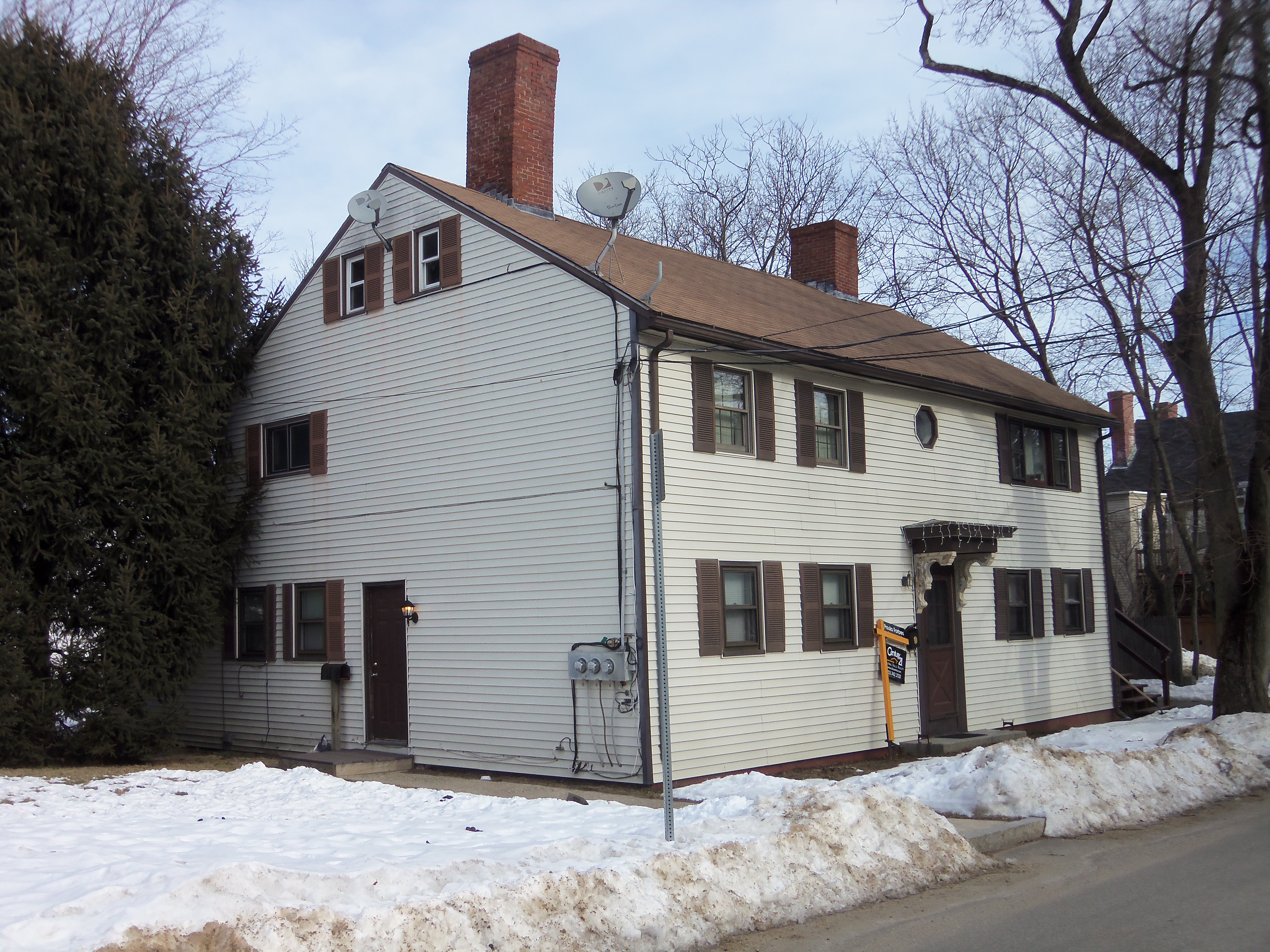
As they say, the plot thickens. And to think, the answer to our search may wind up just a bit more than a block up the street from where we gather.

This year’s Patriots’ Day comes next Monday, a holiday in Massachusetts and several other states to commemorate the April 9, 1775, Battles of Lexington and Concord that inaugurated the American Revolutionary War. These days it’s also the occasion of the 117th annual running of the Boston Marathon as well as a late-morning Red Sox game at Fenway.
New Hampshire, on the other hand, traditionally marked the event obliquely, with its own Fast Day the following week, ostensibly originating in 1680 and officially abolished in 1991. We got Fast Day as a holiday free from the office, but the only way we knew when it would fall in a particular year was by paying attention to the Marathon — and we’d get the following Monday off.
While Patriots’ Day marks the historic “Shot Heard Around the World,” the actual first armed skirmish happened months earlier at Fort William and Mary along the Piscataqua River in New Hampshire. On the evening of December 13, 1774, Paul Revere rode north from Boston with reports of the latest British actions, especially in Rhode Island. The news sufficiently angered 400 Sons of Liberty led by John Langdon to march on the fort, one of several protecting the mouth of Portsmouth Harbor, and raid it, carting off 98 barrels of gunpowder, roughly five tons. The next night, a small party headed by John Sullivan carried off 16 pieces of small cannon and military stores.
These supplies were then distributed to hiding spots, including the cellars of Boston churches and at least one New Hampshire home, before being used in the Battle of Bunker Hill on June 17 the next year.

I’ve learned to listen whenever we get heavy rain. Check to see that the jerry-rigged sump pump is still upright and its line’s not clogged.
Yes, indeed: too much rain, and the sump pump kicks in. Or else the cellar floods, along with the furnace.
It’s all a matter of perspective.
Where I live, you’ll often hear about the “New Hampshire Advantage,” which argues that the state’s economic growth is a consequence of its lack of income and sales taxes. Don’t get me wrong, I enjoy not paying extra at the store. But I also know that the sharp difference in my rent in Manchester, when I arrived, and what I was paying in Baltimore was caused by the property taxes here. When I added my Baltimore and Maryland income taxes to my rent there, it equaled what I was paying here. Voila! You’ll pay one way or another. The question is where and who bears the brunt of the cost.
The real New Hampshire Advantage is its proximity to Greater Boston and the economic powerhouses connected with the Harvard Business School and the Massachusetts Institute of Technology. Nearly half of the New Hampshire population that has a job commutes south each morning to workplaces across the border. The better-paying jobs, in fact. It’s largely a one-way flow, too. If lower taxes were a real stimulus, the entire Granite State would be booming, which is hardly the case in our economically depressed North Country or the Connecticut River’s Upper Valley. Just take a look around Berlin or Claremont and all their devastation.
Still, public services cost money, and the dynamic is that anything requiring labor is going to cost increasingly more. In economics, it’s called the Baumol effect, after a study of performing arts institutions.
New Hampshire is no exception. The real question is just where the additional state revenue will come from, and that always returns us to ill-fated proposals for an income or sales tax.
But complicating any income-tax discussion in the Granite State is the matter of reciprocity: normally, you pay a state income tax where you work rather than where you live. And normally, there are roughly equal numbers of workers commuting between two states to balance the equation. But that’s not the case in New Hampshire. So an income tax to lower property tax bills, as it’s usually framed, would mean either that the cross-border commuters would have to pay twice, both at the workplace and then at home, or that those folks who both live and work within the Granite State would have to subsidize the break given to the others.
It’s a genuine conundrum. Advantage? Beggar-thy-neighbor works only so long.
Our antique fish weather vane has long been something of a puzzle. It’s a rather attractive piece of copper, but these things don’t come with instructions, and the parts didn’t quite seem to come together. So it’s sat around in a corner of the barn just waiting for the day it could swim in the air again — or maybe simply on an indoor wall as an ornament. Still, finally getting the roofs over the barn and kitchen re-shingled this fall before the weather turned bad provided a stimulus for action.
The first challenge was trying to figure out how to connect the rod to the roof. As I inquired at one hardware store after another, I kept getting the same response. “I don’t know, it seems like there should be a simple way to do it. But we don’t have anything like that.” A few clerks suggested places that turned out to be dead ends. And as I looked at all the cupolas under many of the vanes around town, I realized that even with a cupola, you’d still have to have some way of attaching the vertical rod.
Finally, after a bit of online surfing, I came across an answer — a store, in fact, we’d passed many times in the coastal town of Wells. Weathervanes of Maine turned out to have a nifty little adjustable roof mount for $30 that fit our needs quite nicely. The store, by the way, has row after row of shiny new weather vanes — roosters, horses, eagles, moose and bear, ships, dragons, pigs (yes, flying pigs), and many more. If you’re ever driving along U.S. 1 there, stop in — it’s quite the destination.
Still, the connection to the fish itself still didn’t seem right. And again, nobody could give me a satisfactory answer. So it was back to Wells, where a fancy soldering job did the trick. Our fish could now face the wind. And, as you can see, more.
Where we live in New England, vanes are useful predictors of weather. While our prevalent wind is from the west, wind from the east or the south comes in over the ocean, where it loads up with moisture we encounter as rain or snow. From the north, of course, means colder than normal — a pleasant touch in summer but a nasty bite this time of year.
I’m quite happy to have the fish provide a modest and useful crowning touch to the barn. Or, as I sometimes announce, “The fish has turned.”
 Jnana's Red Barn