FROM BISHOP SPONG TO LIGHTHOUSES

Continuing this month’s survey of Books Read, here are a few more entries:

  • John Shelby Spong: Liberating the Gospels: Reading the Bible with Jewish Eyes. Or, as the paperback cover also proclaims, “Freeing Jesus from 2,000 years of misunderstanding.” Here the then-Episcopal Bishop of Newark, New Jersey, advances scholarship that argues the Synoptic gospels and Book of Acts were intended to be read aloud in the synagogue and early church as parallel texts to the day’s Pentateuch (Torah) portion. Rather than being accurate biography or history, then, he contends that they were essentially a midrash voicing something of the intensity of the early “followers of the Way,” theologically but not factually true. Crucial to his rational is an awareness of the major Hebrew holidays of the time, and placing the Christian teachings within them – that is, also within a lunar calendar. Thus, instead of a chronological history of Jesus’ working with the disciples over a three-year period, or more, the Synoptic texts compress their presentation into a one-year framework. In the final sections of the book he deconstructs the Nativity and the Resurrection, as well as many of the teachings attributed to Jesus, yet leaves a strong case that what was being demanded was an experience of the Spirit/Holy Spirit, rather than Jesus.
  • Patricia Lynn Reilly: A God Who Looks Like Me: Discovering a Woman-Affirming Spirituality. Essentially a self-help workbook for women to work through, either individually or in “circles of support,” this 1995 publication is now a generation old and no doubt surpassed by more comprehensive volumes. It does included reference to El Shaddai as “breast” even though it’s often translated in its other meaning, “high places.” She also includes a list of alternative images to use in place of masculine terms, including Womb of Compassion, Nurturer, Seeker of the Lost, Source of All Life, Faithful Mother, Shekhinah, Healer, Sophia, Queen of Heaven, Gathering Mother Hen, and so on. She makes a strong case for the negative outlook on female functions, including birth, as unclean, and curiously the lack of an infant rite equal to circumcision. She also makes a claim for the decreased value of woman as they age. I like her suggestion to record reactions to her exercises using one’s non-dominant hand, and wonder if this might help me get deeper into my own repressed layers.
  • Harold Loukes: Friends and Their Children. This 1958 British publication comes from another era as it attempts to steer a third way between those parents who would insist on a dogmatic training for their children and those who would offer them none. He does follow the cycle through infancy, the first years at school, adolescence, and so on. I wonder if any of it would have helped, back when.
  • Eugene Ehrlich and David H. Scott: Mene, Mene, Tekel: A lively lexicon of words and phrases from the Bible. Despite William Safire’s praises in the New York Times, I find little reason to continue keeping it on my bookshelves, not when I have Strong’s concordance.
  • Jessamyn West: Except for Me and Thee. A charming novel of a Midwestern Quaker couple and their family roughly covering the years 1810-1875. Some of it I would question against the cultural history, but for the most part, I think she gets it right. In some ways, it dovetails in nicely with MFK Fisher’s outsider look at small-town California Friends only decades later.
  • Sarah C. Gleason: Kindly Lights: A History of the Lighthouses of Southern New England. While my focus is on the lighthouses of New Hampshire, Maine, and Cape Cod, this volume goes far beyond its Southern New England catalog. Gleason provides a detailed history of the origins of the American lighthouse system, including a timeless examination of the true costs of a bureaucracy that for too long concentrated on a lowest-bidder mentality.
  • Jared Diamond: Why Is Sex Fun? The Evolution of Human Sexuality. Despite the title, this is a rather pedestrian dynamic based on the need for childcare within the tribe.

100_6842

FROM GOD TO CINCINNATI

Continuing this month’s survey of Books Read, here are a few more entries:

  • Karen Armstrong: A History of God: The 4,000-Year Quest of Judaism, Christianity, and Islam. A stunning a provocative overview. One I will be returning to repeatedly. Its examination of early Islam, especially, opens entirely unexpected perspectives to my awareness. The distinction between the Trinity of Western Christianity and of Orthodoxy is quite helpful in my emerging argument of Logos/Light.
  • G.I. Gurdjieff: Meetings With Remarkable Men; P.D. Ouspensky: The Fourth Way: A Lucid Explanation of the Practical Side of G.I. Gurdjieff’s Teachings. Two that will be leaving my collection. The meetings aren’t all that remarkable – for the most part, mostly travel journeys, actually, or an autobiography – in quite meandering, wordy prose. I could easily come up with nine more remarkable individuals from my own sojourns – and not exclusively male, like his. The Ouspensky turns out to be equally convoluted Q&A accounts of speculation. The wordiness (and vast ego) leave me unmoved.
  • David Meltzer: Hero/Lil and Six. After Armstrong’s explanation of Kabbalah and its growth, I returned to these two poetry collections and find them quite rich and energizing. Hero, however, comes across as more of a villain (and a deadly trickster, at his best) than does Lilith. Some great leaping within the individual works, including (to my surprise) the prose-poems in Six that actually work for me.
  • Robert Lawrence Smith: A Quaker Book of Wisdom: Life Lessons in Simplicity, Service, and Common Sense. A former headmaster of Sidwell Friends School reflects on the lessons he learned growing up in Philadelphia Quaker culture and the ways it played out over the ensuing years.
  • Stephen Mitchell: Parables and Portraits. An enjoyable read of original poems and prose poems based in large part on Biblical figures and their stories as well as others ranging from Manjushri and Huang-po to Vermeer and Freud.
  • Three poetry chapbook competition winners – Carolyn Page, Barn Flight; Linda Lee Harper, Buckeye; and Gary Myers, Lifetime Possessions. Page, a native of Rochester, presents some disturbingly violent insights into Swamp Yankee and then redneck (in North Carolina) life; the poems are essentially flat, prosaic, a single read tells you everything. Harper, with her stories of a childhood in Cincinnati, has a little more edge; still, I’m left wondering how rare my upbringing was, since I’ve found no hints of childhood sexual abuse. The last four poems in Myers’ volume break free from the pack and enter into a dreamlike state – the first pieces, in fact, that have stirred my admiration (how I wish he’d been able to sustain this for the entire book!).

100_6857

DISCOVERING JONATHAN LETHEM AND NICHOLSON BAKER

Looking back, I was surprised to find that somewhere along the line, I’d stopped making entries in my Books Read list. Curiously, this was a period in which I discovered two writers who leaped to the top of my favorite living novelists esteem, Jonathan Lethem and Nicholson Baker, two incredibly versatile writers who (fortunately) cannot be pigeonholed. Since this span of reading includes about a dozen of their volumes (half of them from the public library), I won’t try to summarize the works – they deserve long entries on their own – but I will note that The Everlasting Story of Nory opens with something I’d long argued for fiction: for the first 50 pages, there is seemingly no conflict at play, which somehow heightens the tension all the more. And I love the way Baker can handle a sentence of 250 to 300 words, a rarity in our era. Lethem, meanwhile, can construct a fat novel – and how – with insight, imagination, and flair.

These encounters – joined with Andre Dubus and Russell Banks – came as a relief after a stretch in which I wasn’t finding anybody in the current scene who was moving me the way, say, Kerouac, Kesey, or Vonnegut had back when I was in college. (Or even Brautigan, right after.) What a relief! And maybe, as I would hope, my standards have risen.

This period also includes discovering my most detested contemporary novelist, who will go unnamed. Tossing a string of senselessly murdered bodies in our direction does nothing to raise my sense of humanity. Quite the opposite. And with his professions of religious faith, I find no excuse for such nihilism. Nory, by contrast, delivers on all counts.

I also read Ernest Hebert’s Live Free or Die and Spoonwood, with their requisite New Hampshire perspectives. (His work is anchored in the distinctive Monadnock region of the Granite State.)

Edmund Gosse’s Father and Son, with its portrayals of the Plymouth Brethren in England, also led to the father’s marvelous illustrations of tide pool life, something I’m now pursuing every summer.

Kay Davis Coltrane’s Centre Friends: The Legacy of the Meeting on the Hill is a fat, thoroughly illustrated history of the Quaker congregation my Hodgson ancestors helped settle in North Carolina in the 1750s. Wonderful work.

Also, I reread Julian Barnes’ Proust’s Parrot and Proust’s Madame Bovary, and Tuesday’s With Morey.

100_6820

FROM THE BEGINNING OF THE OBAMA ERA TO ETHICS

Continuing this month’s survey of Books Read, here are a few more entries:

  • Vanity Fair, March 2009. The annual Hollywood issue is supplemented with “The Obama Era Begins” – and “Historic Portraits of Washington’s New Establishment” by Annie Leibowitz.
  • Money, Special Report: Rescue Your Retirement. Too little, too late. They’re talking about people who make hundreds of thousands a year – and can put like sums aside.
  • Terry Eagleton: After Theory. I’m not quite sure what to make of this one, an office freebie. I was expecting something related to literary theory, rather than an attack on “cultural theory” and “postmodernism.” Still, working from a Marxist perspective, he crosses over into theological and philosophical issues, so it fits into that stream of thought in this mini-sabbatical.
  • Jonathan B. Tucker: Scourge: The Once and Future Threat of Smallpox. Jonathan, of course, stayed with us for a week of the Obama primary campaign. Very well written, especially considering its technical nature.
  • Carlos Baker: Emerson Among the Eccentrics: A Group Portrait. Jessica’s copy, at her insistence. A good follow to Ives’ admiration. Am especially intrigued by what might have developed had Emerson linked his sense of overarching Reason with Logos and then Christ, rather than simply a universal goodness that instead evolved (the Unitarian evolution).

Curious bits with local twists for me: Father Samuel Moody, Emerson’s great-great-grandfather, famous preacher of Mount Agamenticus, Maine.

The Wesleyan Academy at Newmarket NH.

Indian name for Mount Washington was Agiocochook, as used by Thoreau.

“The God who made New Hampshire / Taunted the lofty land with little men” – Thoreau, “Ode Inscribed to W.H. Channing.”

The Old Man, the Great Stone Face, “that grave old Sphinx” (Thoreau).

Emerson: “I acknowledge (with surprise that I could never forget) the debt of myself and my brothers to that old religion which in those years, still dwelt like a Sabbath peace in the country population of New England, which taught privation, self-denial, and sorrow.” (on the death of Dr. Ezra Ripley)

Passenger rail service to Concord, Mass., began June 17, 1844.

Emerson was irritated by Shaker “dunce-dance,” “with buildings ostentatiously neat,” as if entering a “hospital ward of invalids afflicted with priapism.”

“… our Concord River which is narrow and slow and shallow.”

Emerson had always shown a fondness for Maine, even including the snowbank near Berwick into which his sleigh-stage had inadvertently dumped its passengers back in 1842.

Department of Interior Secretary James Harlan, “a grim Iowa Methodist” according to Walt Whitman. (Harlans originally a Quaker family connected to my own ancestors.)

In 1852, John Albee, a 19-year-old senior at Phillips Andover Academy, came to Concord to interview Emerson and met a man whose name sounded like Thorough or Thurro. (Note the accented syllable, being the first.)

  • Samuel Butler: Erewhon. A satire of the assumptions of civilized society – especially Victorian England and its established church – as well as those of Utopian enterprises, this slow-moving narrative was an amusing read. Consider its Musical Bank (echoing both the Church of England and the chambers of high finance) or the College of Unreason as two examples. (Another of my college-era collection, this time passed on to Jessica.)
  •  G.E. Moore: Principia Ethica. “What is GOOD?” is the premise for this work from my college-assignment collection. We never discussed it, though, and I never took the ethics course. Perhaps inadvertently, the definition of the Highest Good works best in theological terms.

January3 027

FROM MATING AND DATING TO THE GREAT NORTH WOODS

Continuing this month’s survey of Books Read, here are a few more entries from my scroll as I kept it:

  • Andrea Orr: Meeting, Mating (and Cheating) Sex, Love, and the New World of Online Dating. One journalist’s argument that matchmaking is what kept Internet companies afloat during the dot-com bust. Also interesting vignettes of the changing nature of courtship in America.
  • Nathan Graziano: Frostbite. Fine short stories in a Bukowski vein, set mostly north of Concord. Pessimistic, young adult outlook. Is title a pun on Robert Frost, for a Granite State writer?
  • Ray Blackston: A Delirious Summer. Frothy romantic comedy set in South Carolina. But ultimately sexless enough for Southern Baptist readership.
  • W.D. Wetherell, ed: This American River Five Centuries of Writing About the Connecticut. Good way to begin thinking more pointedly about living in northern New England, where I’ve now been nearly two decades. (Compare what I’ve done here so far to my reading about the Pacific Northwest back in the 70s and my Olympic Peninsula longpoem.) From where I live and work, the Connecticut seems to be the backdoor of the house, with my orientation toward Boston and Maine. Yet it also leads up to the crown of New Hampshire, which I need to explore sometime.
  • W.D. Wetherell: North of Now. Some personal thoughts about living in Lyme and the changing character of rural New Hampshire.
  • Simon Ortiz: Out There Somewhere. Poems and journal entries by a major Native American writer. Found the paperback in Kettering, Ohio, and shared portions on the Northwest Airlines flight from Detroit to Manchester with a lovely Sioux across the aisle. Still, the collection comes as something of a disappointment: I expect work of the level of the piece Rachel had for class discussion.
  • Iris Moulton: A Thin Time. First volume by a young Utah poet who seems to be instrumental in a revival in Salt Lake City.
  • Stephen Gorman: Northeastern Wilds. Full-color photos with essays exploring the Great North Woods sweeping from the Adirondacks eastward across Maine. Suspect I’ve seen many of these in Sierra Club calendars, and the writing often seems pitched to glossy magazines, with three or four not quite continuous sections pieced together to create a single chapter. Annoying, saved mostly by some decent reference material. An Appalachian Mountain Club volume.

100_6768

TOURISM SLOGAN

This is New Hampshire, after all. So the tourism officials like to tout it as a place “to be free” to do this or that.

If they were really honest, they’d admit our skinflint ways and caution: “Don’t spend liberally.”

But we really do exist at the expense of our neighbors. This is New Hampshire, after all. For now, we’re all hoping for great skiing weather “up north,” with all of the economic consequences.

JUST FOR ADDED KICKS

Admittedly, we live in an area that gives meteorologists headaches. It’s one of those where several major weather systems collide. Not quite as bad as where I once lived in Upstate New York and we sometimes wound up with four completely different forecasts for the day’s four editions of the paper as the day wore on. But here, one winter, when one of the local websites had its own retired Air Force meteorologist providing early morning reports, he did note an ongoing line running from Concord, New Hampshire, to Portland, Maine, and remarked that if it shifted slightly north or south, so would the weather, depending which side you were on. That line held on most of the winter.

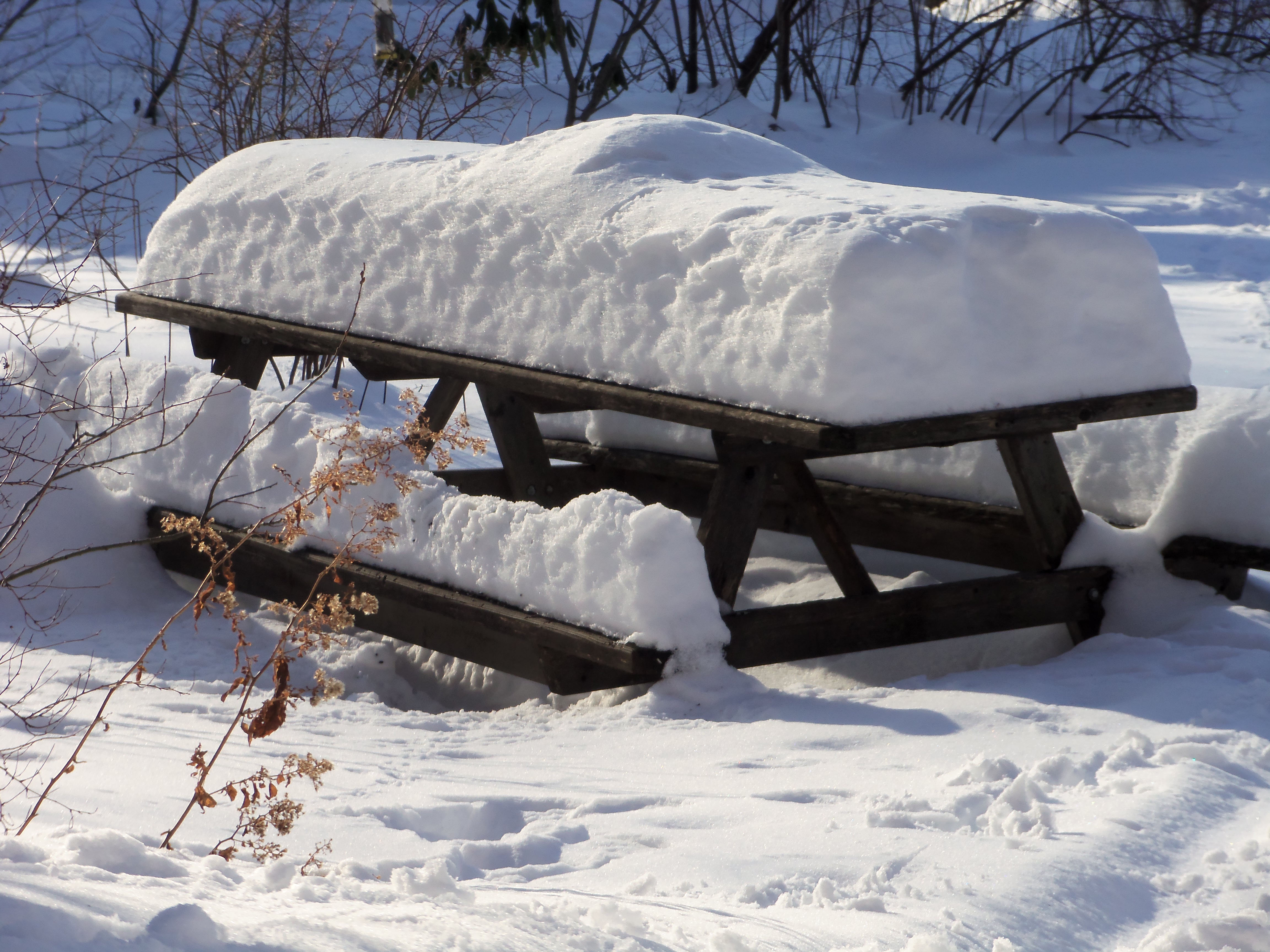
In the past week, we’ve just come through two “weather events” that provide some amusement in the iffiness of science department, even if it has meant more than 20 inches of snowfall to dig out. In the last one, the projected amounts of snowfall kept changing, sometimes with hourly revisions, or so it seemed, going from one to two inches and settling on two to four, at one service, to three to six at NOAA. We wound up with over eight. So they missed, one of them (the one that’s usually somewhat hysterical in its warnings) off 75 to 88 percent.

In the storm before that, I’m glad I decided to back out of plans to head to Boston for a working session with Friends. The heavier-than-expected snowfall was a mess, and I never would have made it there in time.

Now we’re looking at another weekend, one with a gathering halfway across the state tomorrow night, and the other Sunday morning, the one we rescheduled in Boston. And I have no way of knowing what to expect, other than it might be messy.

Without getting into the percent chances of precipitation but sticking only to the forecast, here are the options:

  • Saturday overcast, Sunday ice pellets, Monday rain.
  • Tomorrow wintry mix, tomorrow night and Saturday rain/snow, Saturday night and Sunday freezing rain continuing Sunday night, Monday rain/snow.
  • Tomorrow a few afternoon showers, Saturday cloudy, Sunday rain, Monday cloudy.

So Sunday’s the only day they agree on, and even that could be simple rain or really messy?

I guess if I had to choose one, it would be the third option, especially since Sunday has only the warmer rain. Or maybe, if I look around more, I might even find a fourth choice I like better.

Or should I just check my horoscope for a clearer idea, instead?