SWEPT OUT TO SEA

The stupidity of some people never fails to impress. You hear of those who refuse to leave the path of disaster or see pictures of families standing by an ocean churned by an approaching hurricane. You know, the foolish ones who then expect emergency personnel to come to their rescue (at personal risk and public expense).

I’ve learned to respect the moodiness of the ocean and its quick changes – the summer thunderstorms that come out of nowhere, for starters. If the Coast Guard or lifeguards say “Get out of the water,” just do it rather than ask questions. If the captain of the boat says “Get down under,” just do it.

Even before the hail or power outages.

How quickly it all passes, too, and everything looks perfectly serene again, with no hint of what just happened.

My wife and I once watched a deluge approach, strike, and return to normal all in the course of a seaside lunch. Fortunately, we were indoors, our table beside the window.

One of my first lessons came a few months after the 1991 Halloween nor’easter now known as the Perfect Storm. In New England, a nor’easter is akin to a cold-weather, slow-moving hurricane. One moonlit night three or four months after this one, I was driving along Cape Ann in Massachusetts and was awed by the depth of sand still piled along the roadway – like plowed snow, in fact – up on ridges out of view of the ocean. Such was the impact of the Perfect Storm.

But this was a calm night and coming to an overlook, I pulled over, got out of the car, and walked out on a ledge a good 20 or 30 feet above the water. I was still back from the edge when a large wave crashed up behind me and swirled off just to my side. I realized the current could have knocked me off my feet and into the brine below. I’m a good swimmer, but fully clothed in icy water driving into rocks would be a fatal combination.  

Yes, I’ve learned to respect the ocean and be wary.

SHOOTING THE SAME SPOT AGAIN

We could be considering writing or painting and drawing as much as the photography that prompts today’s line of thinking. Specifically, I’m reflecting on the tension between trying to capture everything I see everywhere versus the reality that one needs limits.

For starters, I reach a point in shooting where I begin to weary. Push hard enough and everyone hits a wall. When it comes to photography, I just stop seeing images of interest. When I’m writing, my words go flat. Folks in other endeavors can relate their own versions.

A second fact of life comes in trying to arrange and manage what I already have. Accumulate too much and I’ll never find anything when I want or need it.

I find a similar tension in a writing project, where I can hope for a tightly focused, crystalline work even as it begins to expand into a complex baroque construction. Or the other way around.

As I’ve been shooting over the course of the Red Barn, I’ve found myself increasingly resisting an urge to range more widely from my base in Dover. I’m sticking more and more to what’s at hand here and in a few other familiar places like Sandwich, to the north, and Fort Foster in Kittery Point, Maine. We’ll see how that evolves in the future.

For now, what fascinates is seeing how much new keeps appearing to me in our yard or while I’m walking to meeting for worship on Sunday. Perhaps that’s why working on pieces in a series hold so much appeal as more and more keeps surfacing from the depths.

The other aspect of the series is the desire that somewhere in there is the one iconic piece that rises above the rest, can stand on its own, deserves its own place.

Oh, what would Monet say to all this? Or Matisse? Or any of a host of others!

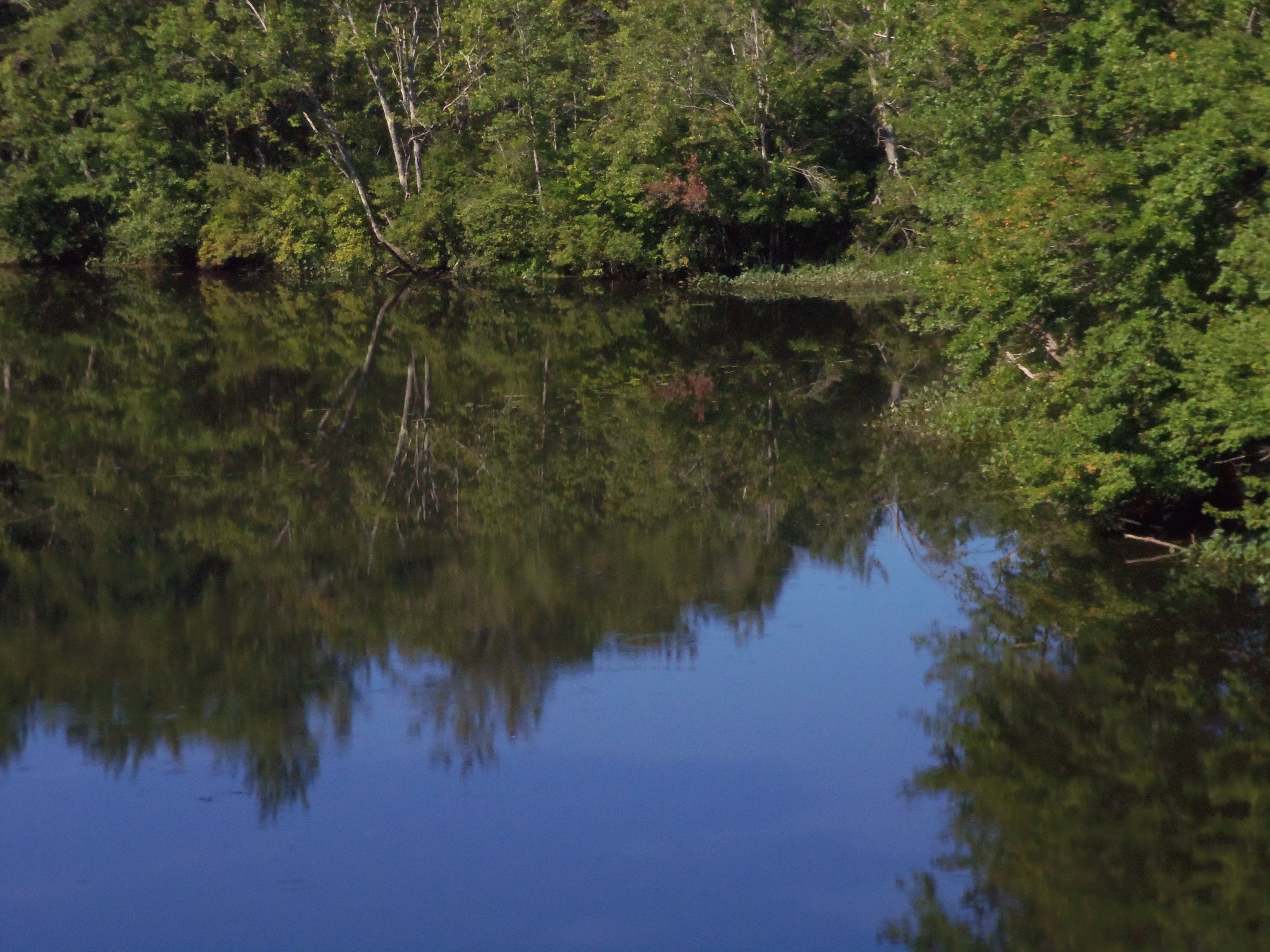
The Cocheco River viewed from the footbridge on the community trail has become a favorite spot for my camera. Here's part of the scene as I was walking to meeting for worship on Sunday morning.
The Cocheco River viewed from the footbridge on the community trail has become a favorite spot for my camera. Here’s part of the scene as I was walking to meeting for worship one Sunday morning.

CORKING THE STATE LIQUOR COMMISSION

For all of it reputation as the “tax-free state” and “live free or die,” New Hampshire has some pretty convoluted ways of making ends meet. True, we have no sales tax and no income tax, but that simply means finding a lot of nickel-and-dime ways of raising public revenues, starting with a hefty property tax rate. (Renters, of course, get no break on their federal taxes there, either – as I said, convoluted.) And if you dine out, even for breakfast, there’s another big hit, eight percent or so, one of many others. Eventually, it all adds up.

New Hampshire also has a reputation as the go-to state for cheaper liquor, compared to the rest of the Northeast. For all of the official conservative rhetoric of free enterprise, the state clutches its monopoly on the sale of hard liquor, unlike, say, neighboring Massachusetts, with its liberal tradition of neighborhood mom-and-pop “package” stores.

The conflict I see comes in the fact the state is both the regulator of alcoholic beverage sales, ranging from bars to groceries and wine stores and home consumption, and also the distributor. That is, the same agency, the State Liquor Commission, is both the policeman and an active dealer in what it is policing. It’s a situation rife with the potential for favors, favoritism, and outright bribery or corruption. As the Founding Fathers were well aware, whoever polices the police should not be the police. You separate them – the classic separation of powers, each keeping jealous watch over the other.

Not so here in New Hampshire. When it comes to alcohol, the only line of defense might be the Legislature or the Governor and Executive Council as the counterbalance, but that’s not the way it should be, especially when we factor in the possibilities of hefty campaign donations. The enforcer and distributor should be under separate agencies – then, if conflict arises, they appeal to higher authority. As it is, they’re likely to squelch any complainer … or else.

In addition, when it comes to wine, all the supermarkets, grocers, and independent wine shops face a double whammy. They’re required to buy their wine from the state (through the one and only licensed warehouse dealer), even though the state also sells directly against them. In fact, it’s the same agency they must apply to for their very permit to do business in this field. And then the agency adds its own percentage to the product, even if it’s from a winery the state wouldn’t otherwise stock except for the retailers’ order. As I said, convoluted and rife for abuse.

I first noticed this when I found a certain label for sale much cheaper in Massachusetts. Seems the Bay State has one less layer of middleman in the process. So much for the “Taxachusetts” tag we Granite Staters so often brush on our southern neighbor. Tain’t always so.

More recently, I found an example of the state’s monopoly bully at work when a local supermarket was out of several of its more popular varieties. Could it be someone had said something that miffed somebody in the state agency that was supposed to deliver the product, which now was just sitting in the warehouse? Who do you complain to, after all? You can’t switch to a different supplier, either. Where’s the free market free enterprise in this case? The official line may have been that the state was in the midst of shifting from one licensed warehouse operator, which had held the contract for decades, to a new one. But, as the old contractor miffed, the situation “is just the latest example of many where the the commission has cut a special deal” with the new licensee.

For years, I received the weekly release of which bars, restaurants, and convenience stores or supermarkets had their liquor licenses suspended by the State Liquor Commission, usually for underage sales of beverages. Not once did I see a State Liquor Store in that list. Not that they weren’t as prone to violations. As I said, who polices the police?

Yes, New Hampshire gets the revenue. As long as I’m not forced to go to Maine or Massachusetts to get the wine I want, where it’s available, maybe even more cheaply.

Any future MBAs interested in doing a case study? This one could be a doozy.
EVERYONE’S FROM SOMEWHERE

In the aftermath of major disasters, the wire services run a list of victims, something I used to think was to inform the editors of local newspapers of potential links to their own circulation area. But then my boss told me to run them.

“Why?” I asked. “We don’t have that much space for wire news.” Meaning national and international stories.

“Everybody’s from somewhere,” he answered. And I soon learned how true that was.

In fact, here in New Hampshire, we’ve come to expect a Granite State angle in almost every breaking story.

Small world, indeed.

COUNTING TO SEVEN

Dover, where I live, is proclaimed as the oldest permanent settlement in New Hampshire and the seventh oldest in the United States.

Counting gets tricky, because there were earlier settlements that were abandoned. As best as I can determine, then, here’s the list the counts to seven:

  1. St. Augustine, Florida, 1565
  2. Santa Fe, New Mexico, 1607
  3. Newport News as Hopewell or Elizabeth Cittie, Virginia, 1613
  4. Albany, New York, 1614
  5. Jersey City, New Jersey, as Pavonia, New Netherlands, 1617
  6. Plymouth, Massachusetts, 1620
  7. Dover, New Hampshire, 1623

While I found Weymouth, Massachusetts, as Wessagussett, 1622, the town itself notes 1630 as its settlement. And Taos, New Mexico, 1615, was abandoned by its Spanish missionaries in 1640. As I said, counting gets tricky.

GREAT TASTES FROM NEARBY SOURCES

There are some things we’ve decided not to grow. Sweet corn, for example, requires more space than we’re willing to allocate.

Part of our decision reflects the reality that we have some fine farm markets nearby, and we welcome the exchange of a local economy. The same-day butter-and-sugar or all white ears are unbeatable, especially when accompanied by our own tomatoes. Who says a feast has to be expensive?

A pick-your-own orchard presents another example. We have fond memories of family journeys to Butternut Farm in Meaderboro for peaches and apples. For me, of course, the visit reminds me of living in the orchard in Washington state’s Yakima Valley, so many years ago, now, though I welcome its many varieties other than Delicious. A Gala, anyone?

The annual trek to a Christmas tree farm here in the city feels related – first, to pick out our choice, and then, a few days before Christmas Eve, to harvest it and somehow fit it into the car. We still treasure the bird nests we’ve found in ours some years.

PUBLIC MAGAZINE SWAP

One of the most popular services at our local library is a small cart in the hallway where patrons leave magazines they subscribe to. The periodicals become free for the taking.

Considering the cutbacks in the library’s own subscriptions (accompanying the cuts in the hours the building’s staffed and open), it’s a major service.

We feel good leaving our now-read copies, and feel grateful when we pick up others for perusal.

It’s quite an impressive array still coming in the mail. Hip, hip, hooray!

A PROSPEROUS TURN

Demand for wool in the first three decades of the 19th century shaped the boom years of agriculture in New Hampshire, at least until the invention of the cotton gin allowed for a cheaper clothing alternative – a condition that was accompanied by a changing American workplace and economy.

The brief but prosperous boom financed many of the Granite State’s landmark large farmhouses and barns as well as the nearly ubiquitous stone fences that are still visible, some in the most unexpected remote forests.

Pay attention while driving along country roads, and you’ll often notice stretches where each house seems to be an evolution among the others. I suspect that what happened was they were all built by one craftsman carpenter and his crew – perhaps itinerants who would stay for a season of erecting a house before returning home – who were invited back in another year to build another, each one to customized specifications. The chimneys, for instance, reveal a progression away from the massive central fireplace of the Colonial era to the use of multiple chimneys after the Revolutionary War – something that has me thinking of how much firewood these houses must have consumed through a winter.

Kodak10 080

It’s possible, of course, that the carpenters and masons and others came to live in the neighborhood as well. But one thing I feel certain: the resident commercial farmers, faced with the demands of their flocks and fields, did not have the time or perhaps even skills to build houses like these.

Kodak10 084

Kodak10 073

Kodak10 075

Kodak10 079

Kodak10 087

Here are some of the fine examples found in a village along a ridge in the town of Deerfield, a neighborhood known as South Deerfield. There are more, I should mention, than I could capture in this outing. Meanwhile, I’d like to know more about the site of the popular Mack Tavern, with its fiddler’s throne to protect the player from the wild dancers.