ESTABLISHING A RHYTHM

greens

plant and weed     beside the kitchen     and
the forerunner of a fern bed     behind lilacs

on the swampy side     ignore omens     asking

the real question

if you’ll ever cry      Where are we going?
“it’s a big mistake”     Going     where?

my earth sinks / would always sink     if

it weren’t for stones     floating to the surface

each winter

land bridge jeopardy

cruel ground

stone soup     rather than potato     I intended
to tame     with compost, yes      and worming

so it was     holes in dirt     with next year’s
garden already planned out     she’s ready
to hear    I’ve never been fond of mowing
a lawn     but take to composting anyway

digging in

royally singing     in praise of red wigglers

like a man

so truly      the Cadillac

on my daily
commute

extending the scale      new construction
along all his options     have me wondering
how the routes would be     by the time
I retire

what will be planted     where forest was

Poem copyright 2016 by Jnana Hodson
For more,
click here.
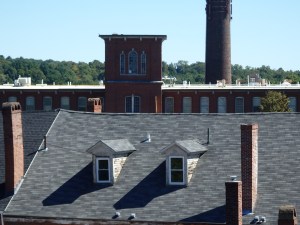
OVERLOOKING THE REMAINING MILLS

In the heart of downtown ...
In the heart of downtown …
The Cocheco Millworks stretch through downtown Dover.
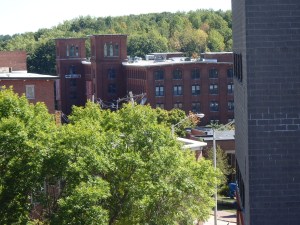
The Washington Mill complex picks up on the other side of the Cocheco River.

Hard as it is to imagine, Dover once had twice as many mills along the river, plus tanneries and other supporting enterprises.

My fondness for old mills, by the way, did prompt a novel, Big Inca.

IN THE GREENING

in the end, we miss the freezing rain
that becomes fog in treetops on my commute
over melting snow

still achy from gardening
so what do I know?
a touch of lime oil in my morning coffee

green swags
my windows

watch my back and sides
spasms
all that digging

a full month of April showers compresses
into thirty-six hours Monday and Tuesday
welcome relief, but

uproot a hundred stealth maples
and a squirrel
every day
this time of year

the garden looks great, so luxurious to have cut flowers indoors
a second sprig of laurel in my lair
against the deep velvet of Siberian iris
now we’re sinking to detail …

a bucket of strawberries, to the office

too much rain and the sump pump kicks in
a downpour leading to rare July flood warnings across the state

our Lady of Pink Flamingoes keeps taunting
“Have you been flocked?”

such a strange summer
cold, wet July days
rain and thunderstorms forecast
into next week, without break

my Lady of Coriander had the stove going three days

by Bastille Day, still no time in the 90s
and only a few in the upper 80s

where’s it going, our summer of plastic flamingos?

or the alternative, of very humid, stale air –
80 Fahrenheit, 80 percent humidity –
can’t move much
despite intentions

some sun, some rain
including brief downpours

the continuing decay

I mow the lawn, saturate a T-shirt in sweat
of course, it’s extreme high tide at the beach

1 a.m., bedroom windows open

thinking of the past
I smell a skunk
crossing the darkness
below me

into a lazy day, mostly on the deck

frozen daquiris, relief from 90-plus heat/humidity

the first time in five years

profusion of glorious mock orange
in and over the kitchen garden hedge
just because I watch the stars
doesn’t mean I trust them

Poem copyright 2016 by Jnana Hodson
For more,
click here.

TAKING HOLD, AS A VENTURE

I’m not that young, even to be this foolish
and this time, a month of rainfall starts
with fireworks, of course, viewed from our second-floor deck
before consulting a plumber about a bathroom
and heating for the barn
or a boiler replacement in our cellar, connecting
natural-gas appliances and restoring the downstairs toilet
and shower to use in a house

before drafting radical views of both the Garden of Eden
and Gethsemane and then the doctrine of Inward Light
alas, by year’s end, both would flower to book length
or, should I say, all? this time around, getting serious
as connecting the dots in a seedbed

Poem copyright 2016 by Jnana Hodson
For more,
click here.
REGARDING WHAT NEEDS TO BE DONE

despite a full plate of crumbling renovations on hold
Squirrel adopts the Yankee attitude on old-house syndrome and its endless repairs
that is (lots of laughs) wait until something actually falls off
if you can survive doing so
until the savings recover
or there’s thawing

* * *

by late May, the soil firms enough
to get about removing an extensive box elder
for light to expand a space
for a 25-by-4-foot raised bed
of asparagus

in late September, with 20 raised beds of various sizes
boldly placed
the child moans she hates wood chip pathways
and would rather have a soccer field on a hillside

still Squirrel wonders who’s kicking next in their recipe
invoking a snaking rainbow, and is grateful

Poem copyright 2016 by Jnana Hodson
To see the full set of Home Maintenance poems,
click here.

ANOTHER OF THOSE OLD WATERTOWN FAMILIES

Lately, I’ve been running into references to Saltonstalls. It’s an old prominent New England family, admittedly, but I had never really connected the dots.

One is an imposing Colonial saltbox house in Haverhill, Massachusetts, with 1712 emblazed on the central chimney. It sits at One Saltonstall Square.

Another dot to the family came in a reference to two (Robert and Sir Richard) as purchasers in the charter for provincial New Hampshire, perhaps buying out the first settlers of Dover. “Probably in 1633,” as the account goes.

Then there’s the principled judge (Nathaniel) who resigned in 1692 in disgust from the direction the Salem witch trials were taking.

That stirred memories of hearing of a U.S. senator from Massachusetts (Leverett II) or a family that owned a small daily newspaper north of Boston.

Now I see I’d taken photos of the statue of Sir Richard Saltonstall, a founder of Watertown in 1630. (Since Watertown is where my choir rehearses weekly, it’s on my radar.)

While Sir Richard returned to London two years later, two of his sons remained and established what became a Boston Brahmin family, one that produced at least one graduate of Harvard in every generation, plus governors of Massachusetts and Connecticut. Before leaving the New World, Sir Richard was among those granted a patent of Connecticut – and back in Europe he had his portrait painted by Rembrandt.

I suppose that’s enough for now. The full story could run on for volumes.

But it’s not the kind of world I grew up in, not out in the Midwest.

I’m left wondering if old establishment families like this functioned as close-knit networks or even as tribes and how much individual deviation was permitted. Who were the chiefs and elders, especially? What was the role of religion or political affiliation?

Maybe that would be an entirely different kind of history than we’re accustomed to seeing. What are your thoughts?

MOVING, AS IN SEEKING ROOT

we move. like the water, like the wind
– across rock, across soil –
until people speaking of common activities
and customs will completely baffle

sometimes the growing season’s quite short
compared to our place of origin
even so, she wants tropics
where everything in the closet
will mildew before sunrise
and there’s no worry of frost

we’ve gone underground, ourselves
after trusting too much in human love
emerged not on rock or air wholly
but collected from scattered places
and pieced back, as best anyone can
with blueberry-stained hands

so what’s the name of your divinity?
your desires? your natures?
the apple of your eye?

even the forest seeks climax
she’ll say, quartering a winesap
its burgundy ringing

Poem copyright 2016 by Jnana Hodson
For more,
click here.

IN PLANNING FOR THE YEAR

Just what more do we need
in addition to the beginnings of two panels of ferns
behind the lilacs – my woodland mirror

or a blooming tepee with gourds and climbing beans
surrounded by zinnias for my Lady of Sunday Comics
in the heart of the exposed swamp

and the race to implant the kitchen-door garden  …

Poem copyright 2016 by Jnana Hodson
For more,
click here.

SO MUCH FOR THAT PICTURESQUE IMPRESSION

Looking at all of the old red-brick mills remaining along the waterways of New England, you’re likely to see them as strong, serious, silent enterprises in their day. Something like a library, perchance.

The reality is something quite different. They were beehives, for one thing, where workers were subject to wide fluctuations in hot and cold (no heat, which could spark fires, along with some brutal summers) – in addition to cotton lung, like the black lung suffered by miners.

As for the quiet? Forget it. These factories were powered by leather belts that ran in relays from the groaning, splashing waterwheel to squeaky overhead rollers on each floor which in turn led to all kinds of clacking machinery. The whole building shook.

Not all of them wove cotton, either, but the mechanics were the same.

The leather belts, by the way, would wear out and break. They alone led to a unique art of construction and maintenance. The city where I live had tanneries to supply the mills, unlike the next city downstream, which was involved largely in shipping.

As the ditty went:

“Portsmouth by the sea,
Dover by the smell.”

As I was saying about that initial impression? These were the nitty-gritty realities.

GARDEN DIMENSIONS

“They already were like gods
made in Yahweh’s own image
and didn’t even know it.”

“I could see the Woman would be easier
to convince. She appreciated color and
the bouquet, where the Man noticed
only the fruit’s heft and taste.”

Every snake has its own hole.
Sometimes a snake is just as snake,
Doctor Freud.

And the Serpent went on to make a fortune
developing shopping malls lined with retailers
promising to cover everyone’s nakedness.

* * *

God creates a Helper for the Man
and she helps him, all right:
helps him get into trouble,

helps him to the forbidden fruit,
helps him get ejected from Paradise.
Not only that, but I’d venture

she believed she was doing something
beneficial for him all along,
something for his own good.
(And it was very good)

* * *

Where has Eden gone? Maybe
it’s now ahead of us, down
the road, rather than behind
with its gates shut tight.

As for Original Sin,
life’s not fair.
Some parents gamble
away the mortgage,
their children’s
college tuition.
Others get to be boss
through the injustice
of genetic roulette.
But that’s not really
part of this story.

* * *

Where do the other people come from?
Maybe the question becomes, for us,
where do other people COME FROM?
You! My neighbors! My antagonist,
my friend, my spouse, my children?

Perhaps they come from that other couple
God created, in the first creation story,
just before Eden. Perhaps they, too,
are ejected from their own Eden.

Perhaps there were other gardens
that were also released –
the ones whose stories we’ve forgotten.

Poem copyright 2016 by Jnana Hodson
For more,
click here.