More twists on the Portsmouth-Dover rivalry

The two small cities that emerged on the New Hampshire side of the Piscataqua River ultimately found themselves rivals.

While Dover, hidden upstream, developed earlier and had much of early Maine on its side, Portsmouth took on its own character.

Portsmouth had a harbor, for one thing, and as waters upstream became polluted with sawdust from the mills, along with the clearing of forests miles inland from the banks, Dover’s wharves and landings faded in importance. Its goods were relegated to small local vessels called gundalows, which could maneuver the shallow waters, and then repacked into larger ocean-going vessels rather than continuing directly.

All of that then had Portsmouth emerging as the focus for trade, connecting it to towns up and down the Eastern Seaboard and beyond rather than anything much inland.

The center of Dover, meanwhile, kept creeping upstream from its waterfront origins at Hilton Point. Its outlook turned increasingly up-country, powered by the waterfalls along the Cochecho River and the mills, along with farming and timbering.

It was a common pattern in New England, so I’m told. The merchant class of the harbor settlements kept informed on activities along the coastline and destinations overseas but knew little to nothing of what was happening just five miles inland. The inland points, for their part, had little interest in distant locales.

By the time of the American Revolution, Portsmouth boasted of some impressive Georgian houses owned by wealthy seagoing merchants, some of them signers of the Declaration of Independence. (The squalid, roughnecked, red-light neighborhoods that went with all that seagoing were left more unspoken.) Dover was far more modest, about 50 years away from emerging as a major textile manufacturing center, with the red-brick mills.

George Washington visited Portsmouth but not Dover. You get the picture.

The character of the two communities continued to diverge after that, and they still do. Today, Portsmouth is driven in large part by tourism, both as a destination and as a stopping off point for almost all of the motor traffic in and out of Maine. In contrast, Dover sits quietly to the north, though the new bridge at Dover Point makes the place more accessible.

~*~

The other two towns of New Hampshire’s first century also had different personalities.

While Hampton sat on the Atlantic coastline, it lacked a harbor. Nor was it inland enough to have the waterfalls to power manufacturing. Its base remained agriculture.

Exeter, further inland, did have the falls but somehow also took on a more cultured tone. It’s a story I anticipate hearing of more.

~*~

I was often puzzled that so few folks in Portsmouth knew anything about Dover, just a dozen or so miles away. Not so for Dover residents when it came to Portsmouth, the smaller of the two.

That just may be changing, however, with the downtown renaissance in Dover and the increasing commercialization and crowding of Portsmouth from the funky, artsy edge we so enjoyed just 30 years ago.

The one thing that hasn’t changed from the late-Colonial era is that Portsmouth remains more monied. Some of that, at last, just may be migrating northward, toward family-friendly Dover.

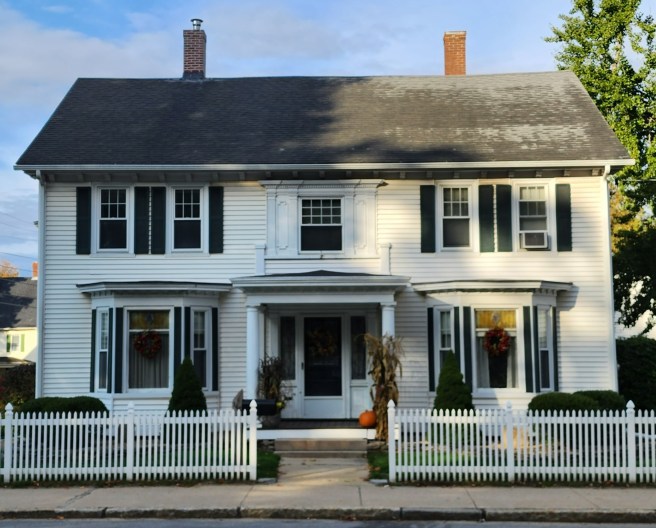
Next door to the Dover Quaker meetinghouse

When I first became active in Dover Friends Meeting in the late 1980s, a group of members and attenders seriously explored the possibilities of creating a  cohousing project. Their minutes filed in the meetinghouse could provide the foundation for a fascinating master’s degree exposition, but the wide range of differences in the participants’ needs and dreams proved to be too diverse to accommodate into joint action. Perhaps economic resource differences also came into play. On my end, I was single but had to consider what might happen if I met the ultimate partner and she had six kids. Ahem.

As it was, when I finally met and wed the almost perfect woman, she came with two marvelous daughters and a German mother-in-law, plus she needed or at least dreamed of and deeply desired space for a large garden. My ultimate party obviously would have required much more than a single bedroom with kitchen privileges.

Still, when I looked at what was then the Stringfellow house next to the Dover Quaker meetinghouse, I mused about how it might have evolved as the Friends shared housing project.

Maybe, as I’ve later learned, I wasn’t that far off target.

Better known as the Osborne-Cartland house, this was built by one prominent Dover Quaker and later owned by others with Friends’ connections.

In fact, it’s one more place the celebrated poet John Greenleaf Whittier likely stayed in his many visits to Dover, thanks to his Cartland cousins.

And it had carved off a slice of the original meetinghouse property.

Yes, it plays into my new book, Quaking Dover.

By the way, I should note that it suggests a Quaker neighborhood around the meetinghouse.

Between it and the Isaac Wendell home I recently posted about across Central Avenue was the Stephen Hanson house where Saint Joseph Roman Catholic edifice now stands. Hanson was somehow prominent in introducing manufacturing to Dover and built the house with his wife, Lydia Brown, after razing two smaller dwellings.

Wish I could show you what they, too, built.

An awakening awareness from a Native perspective

The realm of religion can certainly express our highest aspirations as well as manifest some of our darkest fears, as I feel I’ve examined in my new book Quaking Dover.

In my research of early New England, for instance, I see too clearly how often the differences between the Calvinist Protestants known as Puritans led to violent clashes with the French Roman Catholics to the north, as well as the other way around. (Not that I’d expect it to have differed if the Anglicans/Episcopalians had been in charge rather than the Puritans.)

Through their mindsets, the English, in their negotiations with the Indigenous tribes, crudely failed to acknowledge intricacies of decorum or ceremony that included food and dancing. Not so the French, whose missionaries to the Natives established bridges between the Native and Christian faiths. The priests even lived in tribal villages.

More critically, the English failed to impose the moral standards of their faith in their transactions with the Natives. Fair trade rather than widespread cheating would have been a start.

~*~

Where I’m now living, reciting the rosary is an important ritual among the local Passamaquoddy, especially at wakes and funerals. One late tribal leader was also a deacon and has left notes of his efforts to his blend Native religion and his Roman Catholic teachings. I’m hoping that some of this will find publication.

What’s the hold?

Are there comforting commonalities of rosary with chanting or even drumming? Or, from my end, might something connect to the long-lost art of Quakers who preached in “tones,” otherwise called sing-song?

Considering a young cousin’s ability to mimic one minister’s exhorting preaching style I encountered among Ohio’s remaining Wilburite Friends, I’m left wondering how much of the Quaker’s messages was formulaic and how much original, either way an emotional outburst not found in academic sermons and homilies delivered from a pulpit.

I suspect there’s a lot to be learned through what Quaker Douglas Steere called “mutual irradiation” when we do what’s sometimes called “listening in tongues” here.

It doesn’t always have to be about religion, either, though it may underpin much of the historical thinking.

One fascinating new voice from the Indigenous view is Lisa Brooks, author of The Common Pot: The Recovery of Native Space in the Northeast. Her websites – lbrooks.people(dot)amherst.edu/thecommonpot/ and ourbelovedkin(dot)com/awikhigan/index – continue her presentation.

I believe we can all be enriched by participating in such sharing.


Where were the schoolhouse and horse sheds?

Or maybe a large outhouse, as one map indicates.

I keep wondering if the Pine Hill school, at the fringe of the city cemetery, was originally one of Dover Friends early schoolhouses.

The Meeting apparently had a second one in Maine.

But horse sheds were also common around Quaker meetinghouses.

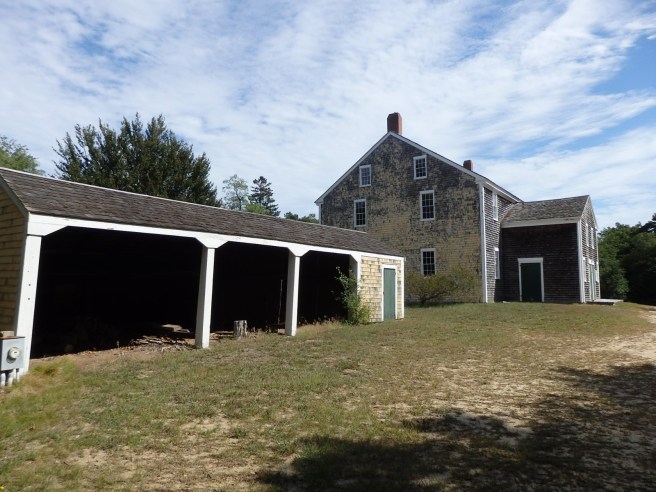
East Sandwich on Cape Cod, which has a lot more

Not that I’ve found any evidence of these now.


I’m rather glad I waited to read the First Parish history

As a parent, you really try to keep your kids from a lot of painful encounters but they never listen to your advice, as far as you can tell, which seems to be futile no matter how hard you try, and then the next thing you hear is crying.

Maybe that’s a good thing, if from their experience they learn more than you knew.

There are several books that fall into that model. Had I read them before completing Quaker Dover, I might have overlooked some fresh insights. But now that my book’s out, I really appreciate what else I’m finding.

Donald R. Bryant’s History of the First Parish Church is one of them. The 160-page volume, first published in 1970 and enlarged in 2002, offers another side of my argument of the Quaker invasion in town, for one thing, while relating other parts of the early years with, well, perhaps more discretion. And, my, I do admire his resources and tenacity.

One of my favorite sections is the profile of John Williams that Bryant works into the narrative. Williams, a member of the parish, was, as he says “a visionary, a leader in bringing textile manufacturing to America,” and a cofounder of what became the big millworks in today’s downtown.

But he also became part of the faction of 26 male members who announced in 1828 they were leaving the church to join the Unitarian Society in establishing a new congregation. The split among the heirs of the Puritans into Unitarian or Trinitarian Congregational at the time paralleled a similar one among American Quakers into Orthodox and Hicksite. New England somehow remained Orthodox, as far as Friends went.

The plot within First Parish further thickens over the kind of minister it needed along with the construction of a new, and present, house of worship. What follows in the parish history is a turmoil that includes the changing economics of the town I haven’t yet found in the Quaker Meeting.

Bryant’s history then turns largely to the successive ministers rather than the congregation’s members and their influence in the community.

Still, I appreciate the comments by David Slater at the end of the book. He was First Parish pastor when I first came to Dover and quite engaging. He offered a checklist on how church life was changing that remains relevant, though nothing hit me more than this:

“Christianity is becoming more and more counter-cultural.”

That takes me back to the Quaker invasion into Dover, back in the mid-1600s.

As for the city’s other congregations? I’m anxious to hear more.

Gratitude to the public library

Dover’s public library has been quite proactive in developing an online presentation of the city’s historical profiles and images. I’ve found those resources to be very useful for fast checks when drafting these posts and related material, for certain.

Its dark-hued historical room upstairs is a treasure chest of local lore, as I discovered decades ago chancing upon Dover’s Quaker family records serialized in the fat volumes of the New Hampshire Genealogical Record, 1903-1909. They’ve since been keyboarded and made available online, if you Google, though I’m still relying on my photocopies.

In time, as a library cardholder, I even had online access to U.S. Census records from home in the wee hours. What a privilege!

If it weren’t for the Covid restrictions and my relocation to far eastern Maine, I’d like still be digging around on the top floor there. I certainly encourage others to do so.


Opa!

In relocating from Dover, I do miss its annual Labor Day weekend Greek festival – the food, conversations, dancing with live music, and overall happy vibe. What they call kefi.

For Greek Orthodox congregations across North America, these events have become a traditional way of celebrating their culture, welcoming the surrounding community to sample it, reenforcing the bonds of their membership, and conducting some needed fundraising, sometimes for local charities as well as the church itself. The deep commitment of the volunteers and the overall organizational skill always amaze me, and it has been fun to be part of the food-serving line some years.

Earlier in the summer, neighboring Portsmouth usually has its own, similar but also with differences, and both weekends draw big crowds, jammed parking, and partisan comparisons. Dover’s has free admission, unlike Portsmouth, which has more dance addicts.

The festivals closet to Sunrise County are in Portland and Lewiston, downstate five or so hours away. Or, for variety, Halifax, Nova Scotia, which has a four-day schedule but is a six-hour drive away – or seven if you take the shortcut ferry ride across Fundy Bay.

~*~

For the Labor Day weekend, Eastport has a much more low-key observance, the Salmon and Seafood Festival.

Things get wilder the following weekend, then the pirates invade for what’s our blowout to the summer tourist season.

What are you doing special for the holiday weekend?

As for Underground Railroad connections?

While Quakers were active in the Underground Railroad for fugitive slaves, the practice wasn’t universally embraced within the Society of Friends. In fact, much of the illegal action across the North was undertaken by evangelical Protestants who even created the altar call at revivals to enlist fellow workers.

Yes, it’s one more story in the American experience that needs to be better known, in all of its gritty reality.

As I describe in Quaking Dover, the Cartland family farm in Lee is believed to have been a stop on one of those lines to freedom. While documentation of such participation is rare, escaped slaved turned abolitionist Frederick Douglass was a frequent visitor to the farm, and like also its small Quaker meetinghouse and school.

The bigger question would be how did the fugitives get that far and where did the route head from there? Not everyone along the way was sympathetic, after all. Newburyport, Massachusetts, for one, was downright hostile and thus an unlikely place to jump ship. As for Portsmouth or Dover?

Establishing reliable yet invisible connections every ten or 20 miles would have been quite an accomplishment. What prompted households to risk everything to the moral cause? They were, after all, a threat to a vast economic system and its wealth.

It’s one more another interesting twist to develop in future research through New Hampshire.

Of note across the street from Dover’s Quaker meetinghouse

The home Isaac Wendell built by 1827 sits across Central Avenue from the Quaker meetinghouse.

I often parked next to it on the side street and admired the bird boxes and woodworking details on the ample barn and house additions.

He’s most noted as the cofounder with John Williams of the Dover Cotton Factory, the forerunner of the big mills downtown, but of interest to my story, he had married Anna Whittier, a close cousin of the celebrated poet John Greenleaf Whittier.

We can assume Greenleaf was a welcome guest there on his many visits to Dover.

Let me add, the relatively humane working conditions in the mills deteriorated drastically after Williams and Wendell lost control to new investors, leading to the first labor strike by women in America in 1828.

Wendell also shows up in the founding of the Sawyer Mills, which I discussed a week ago, as well as a foundry.

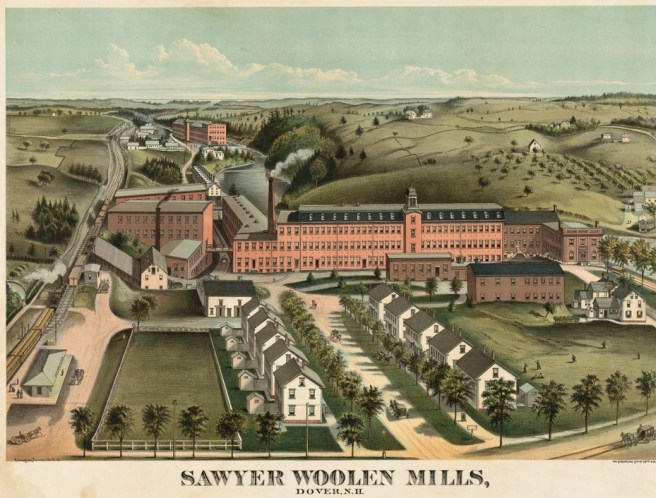
Sawyer Mills usually get overlooked

The town’s textile mills don’t get a lot of attention in my book Quaking Dover, in part because I haven’t found a lot of interaction between the emerging industry and the town’s Friends. Indeed, the Quaker Meeting was seriously aging about the same time the thriving mills transformed the town into an industrial power.

Dover’s conventional histories, on the other hand, have good reason to focus on the big brick mills along the Cochecho River, world famous for the quality of their calico and their stunning print designs and execution.

You might be surprised to learn, though, that they were in operation much earlier than the legendary cotton mills at Lowell, Lawrence, and Manchester on the mighty Merrimac River.

Largely overlooked, as one Friend reminds me, are the woolen mills on the Bellamy River south of Dover’s downtown and only a few blocks from the Quaker meetinghouse. These operated from 1824 to 1899 and were often innovative, employing up to 600 workers before being sold and continuing till 1954.

They were renowned especially for their flannel and were, at stretch, the largest woolen mills in the Granite State.

Today the mills and their historic housing have emerged as a charming residential district.

While there were some Sawyers in the Meeting, I’ve not yet found any connection to those owning the mills.

Based on the naming of some of their children, those were apparently Methodist.