The changing face of downtown Dover

The Robbins Block storefronts are now gone and a five-story Orpheum is rising in their place. The hardware store, lower right, is still there. From the top left are the library, community center, and district court.

When I moved to New Hampshire 32 years ago, downtown Dover – like many other city centers across northern New England – had definitely seen better days. The old textile mill dominating the heart of the city was largely boarded up, and the retail stores that remained did so out of faith and loyalty and family tradition. How could they hold out against the big-box stores at the mall?

And then along came some visionary developers like the late Joseph Sawtelle and David Bamford, as a turnaround slowly took hold. Sawtelle restored the mill as it welcomed offices and incubated entrepreneurial businesses, while Bamford rebuilt mixed-use retail and housing on Central Avenue – some of it tastefully looking more natively New England than what it replaced.

Now that I’ve been a Dover resident the past 19 years, let me say it’s wonderful living within walking distance of a living downtown, one with a small-town feel. As I tell my wife, when we venture out for a weekday brunch, many people drive halfway across the continent for this.

Big change is in the air, though. That center is shifting from being primarily a financial, retail, and office center to more of a residential destination, presumably for young adults, child-free couples, singles, and retirees – people looking for an urban setting close to the ocean and mountains.

Part of the shift has already happened with the top floors of the two biggest mills being converted to apartments, a reflection of soaring residential demand in our part of the state. But now it’s getting serious.

For a city of 30,000, having four significant and mostly residential buildings going up in the central business district is exciting, even before we get to the waterfront development about to unfold across the Washington Street bridge. (Admittedly, some of us do miss the quaint covered bridge for children and other pedestrians that was there when I moved to town 19 years ago, but I’ll go with the tradeoff – landing the children’s museum was a definite coup.)

This doesn’t just happen by accident. A lot of incremental steps over the past two decades have made this a more desirable place to live. And now it’s kicking in big time.

The former Strafford Bank building sits at the corner of Lower Square. The Barley Pub is gone, replaced by the Thirsty Moose.

Be the church

These T-shirts worn by members of Durham Community Church (UCC) at a Jericho Walk around the federal building in Manchester uphold the perspective of the church as the body of believers rather than the house of worship or the organizational structure. This was at a vigil opposing the deportation of refugees.

CELEBRATING 50 YEARS ON A SINGLE PODIUM

Okay, I know churches don’t have podiums for their music directors, but Rick Gremlitz at First Parish Church (UCC) in our town does conduct with a short white baton. What’s amazing is that he’s been doing this, in that venue, for a half century.

Among other things, the house of worship – serving the oldest congregation in the state – has its Belknap concert series where world-renowned organists perform on a remarkable hybrid organ. Parts of it are historic, as it Hastings and Hutchins, and part are state-of-the-art electronics, probably installed during Rick’s tenure. Any doubts in my mind about the sound itself vanished when bete-noir Cameron Carpenter did one unforgettable, amazing workout on the machine one afternoon a few years ago. It survived. The audience was left in a swoon.

Look, I’m a purist and lean toward the E. Power Biggs line of thinking that contrasts sharply with the Virgil Fox excesses that Rick adores. He addresses the man as the great Virgil Fox. I forgive him. We all have our icons.

So be it.

In his ministry, Rick’s led a number of Handel Messiah performances in the sanctuary. Last year it became an open sing with prepared soloists and two guest conductors. Seated between two seasoned voices, I discovered that the choruses are easier than they sound, not that I was anywhere near perfect. It was a most exhilarating event.

Today, though, Rick’s acclaimed friend Hector Olivera returns to the console, with a twist.

An ecumenical community choir, including yours truly, has been rehearsing to join in the performance.

We’ll be performing the world premiere of an anthem composed by Kevin Siegfried for the occasion, and we’ve been rehearsing weekly since mid-September at the Methodist church. How can you possibly keep something like this a surprise?

We’ll see. It’s still a special occasion. And, I might add, one of the joys of living in a relatively small community.

I’m hoping it comes off well. Especially if I don’t miss a cue while we’re singing.

COMMEMORATING 250 YEARS IN THE QUAKER MEETINGHOUSE

Dover Friends Meeting where I worship is the fifth oldest congregation in the state – and the first that was not part of the governmentally sponsored parishes that are now affiliated with today’s United Church of Christ.

Our meetinghouse – the third we’ve had, in fact – is the oldest house of worship in the city, and this year marks the 250th anniversary of its construction.

It went up on a single day in 1768, much like an Amish barn raising in our own time. There were likely 150 men and boys at work on the construction itself, plus an equal number of women and girls preparing food and the like.

To commemorate the occasion, we’re holding an open house at 2 p.m. There will be tours, a reading of John Greenleaf Whittier’s “How the Quaker Women Came to Dover” (his parents were married in the meetinghouse), presentations of activities we’re involved in, light refreshments and conversation, and a closing concert by musically talented members and the audience.

All are welcome.

ONE WAY TO NAME A CHARACTER

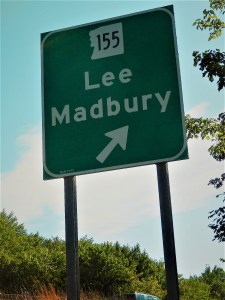
Those highway signs can often take on whimsical readings.

One poetry journal, for instance, took its name from an exit marker of the Interstate crossing from Pennsylvania into Maryland: Northwest Rising Sun. It was for two different towns. Everybody knows the sun rises in the east, not the west. Still, a great name. It pays to be alert.

Likewise, orchestral conductor David Zinman was recording with humorist P.D.Q. Bach (in real life, Peter Schickele) but found his contract with another label prohibited him from using his own name on this project. What could he use instead? Inspiration struck when he was driving on Route 128 outside Boston. That exit sign read Newton Wayland.

More recently, while updating and seriously revising my previously published novels, I set about renaming many of the characters for a better fit.

I’ve passed this sign hundreds of times and often thought it sounded great as a possible character, if only I had the right situation. And then, as I reworked the volume that now stands as Daffodil Uprising, I had the perfect guy to go by the name: LEE MADBURY.

The sign along U.S. Route 4.


TAKE A SELFIE WITH WILLIAM PENN

If the weather is fair, Dover’s annual Apple Harvest Day today will attract a crowd twice the size of the city’s population to the downtown.

Since there are no commercial orchards within the city limits, I’ve always been baffled by the festival’s name, but it does come a week ahead of the Columbus Day holiday, when most of the other communities in the state host end-of-the-season blowouts. It’s nice to beat the competition.

For several years now, Dover Friends Meeting has been among the nonprofit organizations that have participated. Our canopied booth offers a meet-and-greet opportunity to let people know that Quakers do indeed still exist and to invite folks to join us in reflective worship on Sunday mornings.

We’ve heard that as a nonprofit, we need to make 17 positive impressions, on average, before anyone responds, so we’re not discouraged if people don’t show up in our meetinghouse later.

It’s a two-way street, frankly. Answering questions can be a big way of getting a clearer view of the way others see us.

I was startled, for example, when one woman asked if you have to be a protester to be a Quaker. (Answer: No!)

And when some confuse us with the celibate Shakers, we now respond, “Shakers made beautiful furniture. Quakers make trouble.”

And last year, many folks told us how much they appreciate our “Love Thy Neighbor, No Exceptions” banner across the front of our building.

This year we’re setting out to have fun. Period.

You know, take a selfie of yourself standing with William Penn. Well, someone dressed as a not-too-accurate impersonator. Or you can make your own real Quaker rolled oats using one grain, a hammer, and an anvil. (Watch your thumb, please!)

Or here, have an oatmeal cookie or take a recipe for granola.

That sort of thing.

We’ll still have a bowl of water out for passing dogs and, as a new touch, a small changing station for parents or grandparents with infants.

It’s still a work in progress. Will probably always be, I hope.

TEN MORE THINGS ABOUT DOVER

  1. Hardworking leaders. We’ve been blessed by people who want to get things done. The town’s made a huge turnaround in the past 20 years, from a time when the mill windows were boarded up to the vital business incubator it is today.
  2. In general, we tend to vote more to the left, in a working-class streak. In a small state like ours, you’ve probably met the governor and at least one of your U.S. senators. And our city counselor lives across the street.
  3. Family friendly. We actually have four high schools – the city’s (which is moving into a new building), St. Thomas Aquinas, Portsmouth Christian Academy, and the state-chartered Cocheco Academy of the Arts. The Rotary and Kiwanis clubs have been active influences in shaping this direction.
  4. The Greek Orthodox church, one of the oldest in North America. Outwardly, they’re at the opposite end of the Christian spectrum from my Quaker plainness – something I find challenging and refreshing. But they’re welcoming and wonderful and have provided great grounding for my upcoming novel. And, as I’m finding, they’re everywhere in this town. The interior of their house of worship, by the way, is visually gorgeous.
  5. Public transportation to Boston. C&J buses run hourly to Logan airport and South Station. They’re clean and quite comfortable. And Amtrak’s Downeaster heads to North Station five times a day – what a delight! – as well as the other way to Portland, Maine, or a little beyond.
  6. Yes, we neighbor Maine.
  7. Fresh food. Farmstands are just minutes from downtown, as well as two farmers markets. Sweet corn’s no problem. Pick-your-own strawberries, blueberries, peaches, and apples as well. And then there’s the seafood – not just lobster, either.
  8. Market Basket. Well, technically it’s across the line in Somersworth, but this legendary supermarket chain is significantly cheaper than its competition while being highly responsive to its local customers. (It has the best tofu around. The Asian restaurants all get theirs there.)
  9. Police and fire and rescue services. They respond instantly, as we found out back when we had a phone button on autodial. (And they were very friendly about it.) Just as telling, women aren’t afraid to walk home late at night downtown. And, from what we hear from immigrant communities, they’re sensitive and supporting.
  10. Garrison Hill observation tower. The walk from our house starts through our neighbors’ yard, twists up some side streets and then through the woods to the top of the hill and then up the flights of stairs to the crown of the tower where the panorama spreads out over the village -like setting of downtown or, the other way, clear to one flank of Mount Washington. And then it’s the reverse. Great for quick exercise or a jaunt with our guests. See where we live?

~*~

What don’t you like about the place you live?

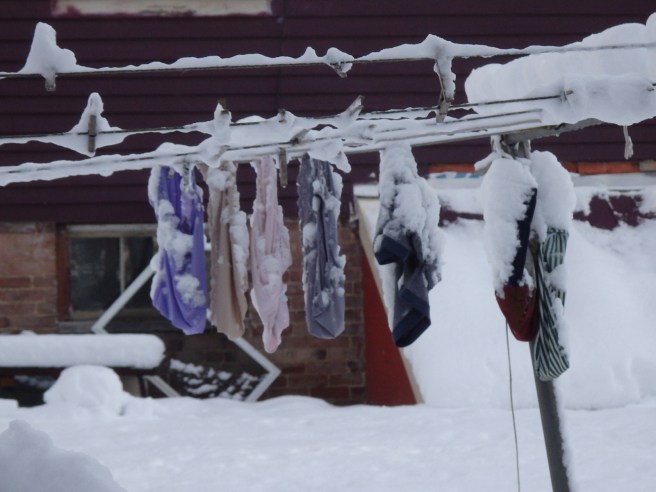
Laundry on the line.


TEN FINE THINGS ABOUT DOVER

For the past 18 years I’ve lived in a small city. One of 30,000 men, women, and children in addition to dogs and seagulls. And it’s felt right. Way back in my past, many folks expected I’d wind up in New York City, and while I do hold a certificate in urban studies from my university, my career took me in another direction.

Well, here are 10 reasons I like where I am:

  1. Quaker Meeting. It’s my core community, my circle of kindred spirits, and we’re the fifth oldest congregation in the entire state. The four before us were all state-supported Colonial Puritan institutions. We were the renegades.
  2. Walking distance to whatever is usually essential. What a civilized way to live! We’re a mile from downtown, in one direction, and the hospital, in the other. (Oh, yes, we can stop somewhere nice for a drink and not worry about having to drive home.) It’s pedestrian-friendly place, really. Cars have to stop or, well, I’ve seen them halted by cops on big horses.
  3. I really like our mounted patrol. As do most of the kids.
  4. The Community Trail. As long as we’re walking, we have the option of a former railroad line that’s become a narrow woodsy park heading out from the train station (I often take that route to Meeting on Sunday morning) or a riverside meander heading upstream. Sometimes I think I’m much further north, in the mountains, especially when I’m on cross-country skis in deep winter.
  5. Centrally located. Within an hour’s drive we have Atlantic beaches one way, forested mountains in another, and the Hub of the Universe in a third. OK, Boston depends on the traffic, but I do rehearse weekly in a choir there.
  6. Waterfalls in the heart of downtown. The river falls to the tide and runs through an arch in the big brick mill. It used to power the mill, too. The scene’s quite charming and sometimes dramatic. And salmon are returning to the fish ladder.
  7. The city’s indoor pool. I swim a half-mile four or five times a week. Nice bunch of fellow swimmers and lifeguards. Not bad for a Christmas present!
  8. Our neighbors. They’re a story in their own right.
  9. Architectural diversity, as you might expect in the seventh oldest settlement in the continental U.S. We’re always seeing something unexpected when we stroll.
  10. We’ve become the downtown for the state university one town over. A third of its students live in apartments here, so we have a bit of that college town flavor. But not so much that we lose our blue-collar edge.

~*~

What do you like about the place you live?

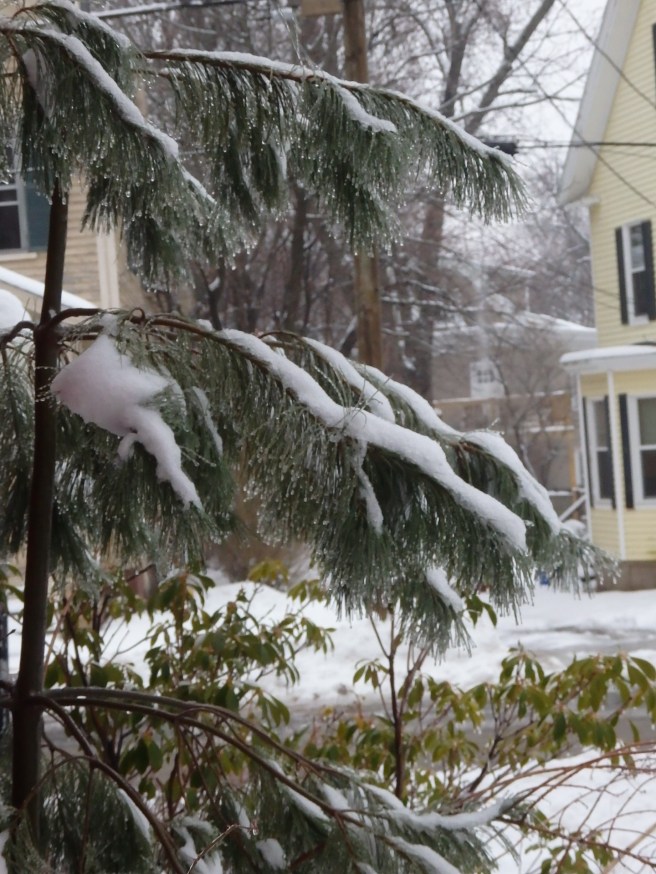
And for a little sobering perspective. It’s wet and cold on the bough.


LOOKING OUT

picnic table with a block of snow 2-feet deep atop it
and a hole at the center

extraordinary deep purple in the Siberian irises

Quaker ladies abloom on the meeting burial ground –
even on the Friends graves in Pine Hill Cemetery

the ox-eye daisies I lifted from rock and sand
to transplant here – my wife’s beloved June flower,
the blossom smaller and more delicate than the Shasta

old woman across the street with her phlox

sunflower, yes
forest sunflower
jungle sunflower
and the jingle, from the neighbor’s
wind chime

Poem copyright 2016 by Jnana Hodson
For more,
click here.

CLEARING, FROM SNOW

after the blizzard, a raven
lands over our suet and cracked corn bird feeders

and then, while digging out
the driveway
the front steps for the mail carrier
and the barn steps for the grandmother
a pathway to the compost bins, on one side
and the stacked firewood, on the other

I’m at the heart of my universe

while my wife tends the fires
in our kitchen

Poem copyright 2016 by Jnana Hodson
To see the full set of Home Maintenance poems,
click here.