Indonesian pride

You never know what we'll churn up in cleaning a stall

The Port City is hemmed in by water on three sides, and it’s running out of room to grow.
While the waterfront and beaches are part of the city’s tourism and residential appeal, the demand on downtown real estate has been going up steeply. Literally.
Not all that long ago, Portsmouth was a sleepy little New Hampshire city with a hippie edge and a lot of historic Colonial houses. Unfortunately, the city fathers had jumped on the urban renewal boom in the early ’60s, nearly demolishing one old neighborhood that was instead miraculously transformed into the Strawbery Banke living history museum. Visit it, if you can.
The side opposite the downtown wasn’t so lucky. Much of it, an Italian neighborhood of large Victorian houses with impressive interiors, was razed to make room for a small mall that never took off. It instead became a forbidding asphalt graveyard for private parking surrounding some kind of small bunker.
At least that vacuous mistake and eyesore is finally gone.
I’m not so sure about the replacement, though.
In what seems like one fell swoop, a monolithic set of five-story buildings has popped up to form a forbidding wall along the north side of the downtown.


It has none of the variety and charm of Congress and State streets that run parallel to it just a few blocks away. It’s largely not pedestrian friendly, preferring instead to maximize every square inch of rentable space, and despite its visual unity has a cookie-cutter quality that bears no kinship to the rest of the district other than brick. Where are the quirky touches that abound so close at hand in the earlier eras?
There is one exception.

Downtown Dover, ten miles to the north, is undergoing growth of its own and seems to be avoiding this kind of monolithic development, even while going to five stories. Whether we can avoid something similar on the riverfront project on the other side of the Cocheco is another question.
In both cities, these are once-in-a-lifetime opportunities for defining the larger community. What does this say about Portsmouth?
I know where I’m getting the candy rocks and gummy fish to decorate my gingerbread lighthouse this Christmas. And it’s also a great place for guys to find great little gifts for the significant other in their life, something that usually confounds us. It’s even a fun place to take her on a stroll around town. (Think cheap date.) You can sit in air-conditioned comfort while savoring the yummy ice cream. Or even keep a bunch of kids happy.
We’re hoping Lickees & Chewies Candies & Creamery catches on. It seems to have its act together, blending several types of economically marginal stores into one.
Key to everything is its location, across from the Children’s Museum of New Hampshire and above Noggin’s toys on the ground floor of the historic Cocheco Millworks downtown. The one drawback is that the entry is on the other side of the building, away from those two kid magnets.
But once you’re inside, you’ve entered a whole different world. It smells richly mysterious, largely from the chocolate bakery. There are maps with pushpins where customers indicate where they’ve visited from, and there are metal rings on strings you can swing toward hooks in the wall if you’re feeling playful.
There are more classic games in the sitting area, which includes a large round table suitable for a birthday party, actually. Or just resting or looking at the views out the window.
So one part of the operation is the ice cream counter, with an emphasis on creamery. But remember, this place is loaded with candy, as in toppings.
Then there’s the old-fashioned candy store itself, with about every brand you can imagine. The entrepreneurs don’t proclaim their organization or knowledge of the field, but it’s there – Southern candies in this part, German in that – even before you get to the saltwater taffies. Many of the smaller wrapped bits haven’t been a penny apiece for sometime, but that’s its groove anyway. After all, the idea is to fill your own bag.
Yet another part is the fine chocolatier. This is where to find a gift to impress, maybe even a new client. And there’s plenty of room to grow to the side.
They make the most of the historic textile mill space. The ceilings are tall, with bare wood posts. The lighting is warm, tasteful, with some German Black Forest kinds of surprises befitting a fairy-tale atmosphere in the evening.
It’s been here a year already, but I’ve just discovered it. I’m definitely anticipating getting back before Christmas.


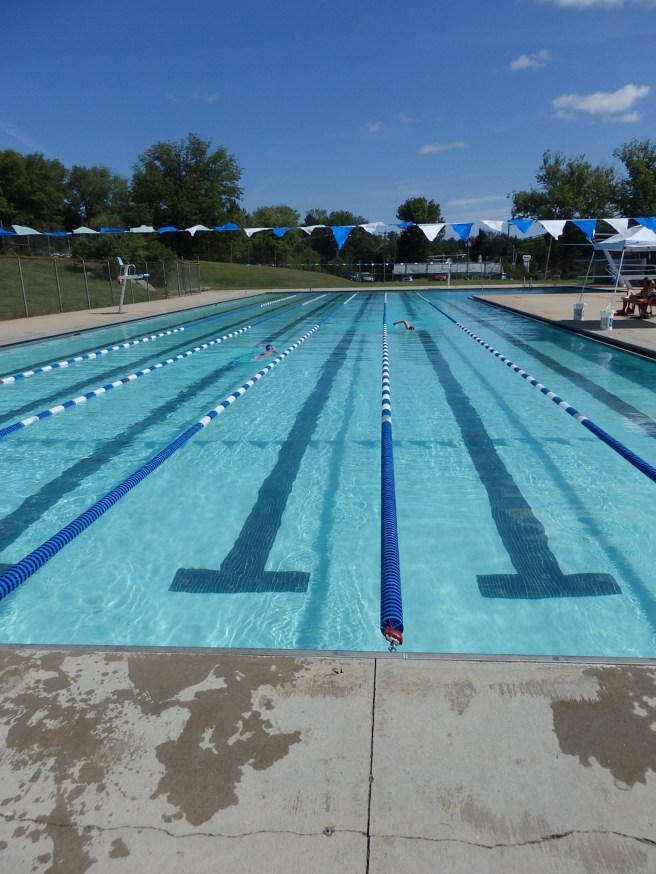
Since my indoor pool pass is good year-’round, I don’t spring for an extra pass to use the city’s outdoor pool each summer. Instead, I get to go there for free during the final two weeks of the season, when the indoor pool is closed for annual maintenance and upgrades.
The outdoor pool, though, can be a glorious experience. Here are ten points to consider.

Downtown Dover grew around the falls on the Cocheco River, where the mills could channel the current to produce world-famous calico and much more.
Below the falls and the dam atop them, tides from the Atlantic Ocean downstream rise and fall eight to ten feet every six hours or so. Boats from the ocean made their way the 14 miles upstream to pick up or deliver goods.
As pollution in the river has been cleaned up and the city itself become more of a center of the Seacoast Region, planners have been looking to develop an open stretch of unpaved parking lot and weeds across the water from downtown.
For years, the site was the public works yard – not the best use of potentially valuable real estate. That has since been relocated elsewhere. I’m guessing it was tannery and warehouses before that.
A proposal to build anew there fell through in the real estate collapse of the great recession at the end of the George W. Bush administration but now, a decade later, it’s emerging in new form.
Key to the design is the extension of Henry Law park along the river as a walkway with added attractions such as kayak and canoe landings. A hillside has already been carved back to allow moving an existing street away from the river to open the space for more pleasant picnicking or the strolling public.
Further on there will be room for new housing and small stores or offices. Done right, it should be quite welcoming and attractive.
Just as important, in my eyes, is the way this will open up access to an existing city park at the top of the hill. Rather than running into a dead end as it does now, Washington Street will rise up the slope to become the entrance to Maglaras Park. It will be an easy walk from downtown, rather than the convoluted route it’s replacing. Even for drivers, it’s a huge improvement.
Continue reading “Dover’s new riverfront appearance and hilltop park access”
My small city is the seventh oldest settlement in the continental United States, not that there’s a lot left from its first century, when the place was largely on the sometimes troubled frontier of English dominion.
As a working-class mill town, it developed more modestly than more prosperous harbor towns like Portsmouth to the south or Portland to the northeast or Newburyport to the southwest.
Our downtown is catching up, though. A small but significant building boom is under way.
Not all of the development around our downtown is aimed at luxury housing.
Back in the sixties and seventies, apartments for subsidized renters were erected along the river and a steep slope on Central Avenue. A few years ago, the Woodbury Mills transformed a boarded-up warehouse into a lovely affordable housing apartment a few blocks from where I live, and a mill along the Bellamy River also underwent similar rebirth.
More recently, the three Roman Catholic churches in town were merged into one parish headed by a single priest, and one of the houses of worship, St. Charles, was facing serious structural water damage. It was sold and demolished, making room for the newest entry, Bradley Commons, about six blocks from the waterfalls downtown.


With the release of Subway Visions, I’ve been returning to considerations of urban affairs. It’s not all New York City, either, even though the novel takes place there.
For me, the big city these days is Boston. I live an hour to the north – or northeast, more technically. I can even take the train in, as well as the hourly bus, which is quite comfortable and also links us to the airport. (You’d be surprised at the number of pilots and other airline personnel who are boarding from here.)
So we can go in for concerts or museums or dim sum on weekday mornings. We’re not exactly stuck in the sticks.
On the other hand, I live in a city of nearly 30,000 – the largest of a cluster of small cities that together form a larger population base to sustain our varied interests.
Portsmouth, 15 minutes to our south, is wealthier and more fashionable. It has probably as many restaurants per capita as Manhattan as well as several theater companies, the Music Hall, and art galleries.
The state university is ten minutes to our west, and about a third of its students rent apartments in our city. The school runs its own buses to serve them and anyone else who wants to pay to ride. Its library, of course, is a marvelous resource for independent writers and scholars.
In other words, I have no reason to feel deprived. Well, sometimes I wish the Harvard Book Store were closer or Symphony Hall. But I still have my choir in Watertown.
Looking at this has me recalling my mentor in political science, Vincent Ostrom, who coined the concept of “polycentric” to describe the overlapping jurisdictions that govern American polity. A city typically falls within a county, for instance, as well as a state and then the nation. Nowadays there may also be special districts to address things like water, pollution, or transportation needs.
As mayor of Baltimore, William Donald Schaefer took the concept in another direction by enhancing neighborhood identity and decision-making to revitalize a big city. Adjustments could be made in neighborhood settings even while having a central tax base, police and fire services, water and sewer system, and so on.
So my city has a much different identity and feel from Portsmouth or Durham or Rochester or Somersworth or the Berwicks over the state line in Maine. And yet we’re all conscious, even proud, of our identity as the Seacoast Region.
Do you see how these many circles begin to overlap, each adding to the richness we enjoy?
As the hippie phrase used to go, “Small is beautiful.” But, in this universe I’m describing, it doesn’t have to be confining or impoverishing, either.
For now, I do feel I have the best of both worlds.
When I say “we” here, I’m acknowledging a widespread sense of loss voiced by friends and neighbors. Some of these places I know by reputation only, though I still see signs where they were. And others are places I valued.
When I first came to New Hampshire more than 30 years ago, Portsmouth still had a funky feel through much of its downtown. But real estate prices have been soaring, and that’s taken a toll. Ouch!
~*~
What do you miss in a place you’ve frequented?
~*~


The Seacoast region of New Hampshire is dominated by a large estuary, collectively referred to as Great Bay. The waters include Little Bay and eight municipalities all pouring into the Piscataqua River with a continual strong tidal current. If you could harness that energy, you’d be a billionaire.
The bay essentially creates a peninsula with Portsmouth on the ocean side and Dover closer to the mainland. Population growth and the thriving Pease Industrial Tradeport have made the bridge linking the two sides quite congested at peak hours, especially when ski traffic or vacationers are added. One Friday afternoon in February, we got stuck in what’s too often normal these days. It took us an hour to go five miles. Look, we’re not big city. That chokes real life.
The bridge, which carries the Spaulding Turnpike and U.S. 4 before they split just beyond the northern end, is being doubled from four lanes to eight. The approaches are also being raised up to six feet as a precaution against climatic instability. Yes, storms are getting more turbulent, no matter the naysayers occupying the White House.
The bridge will make Dover more accessible to Interstate 95 in peak hours, and thus more attractive to people who hold jobs at Pease or in Portsmouth or in Massachusetts just to our south. In other words, it’s a factor in the city’s booming downtown construction to address a pressing housing demand.
Transportation, after all, is a major element in community existence.