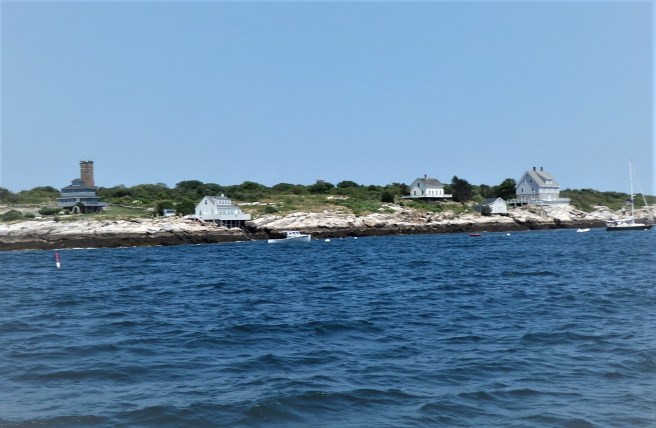
At Fort William and Mary

The small New Castle lighthouse is one of two along the Piscataqua River as it links Portsmouth Harbor to the Atlantic.

This fortification guarding the mouth of the Piscataqua River in New Castle, New Hampshire, has a unique place in American history. It was raided twice by Patriots in 1774, and the gunpowder and cannons captured from the British were later deployed at the Battle of Bunker Hill in Boston. Its small lighthouse is one of two along Portsmouth Harbor.

The panorama view shows the lighthouse in context with fortifications originally built before 1632 and renamed Fort William and Mary around 1692.

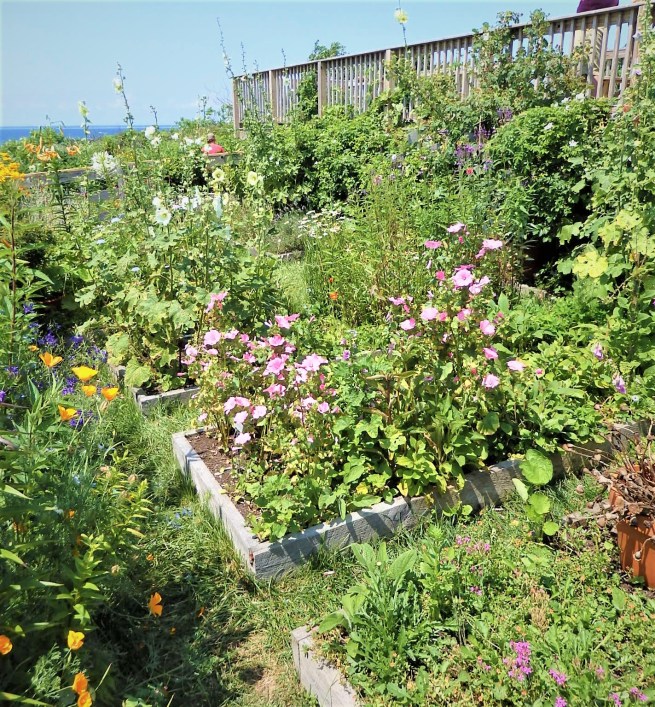
Celia’s garden and grave out on Appledore Island

The garden today tries to be faithful to the original. The railing is where the cottage porch once stood.

Celia Thaxter (1835-1894) is an intriguing character in New England history. An important figure in New England poetry, she was also a pioneering hotelier, flower gardener, and catalyst in the fine arts.
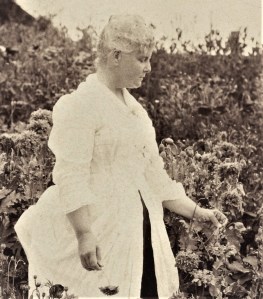
Celia in her garden, 1899

While turning her family’s hotel on Appledore Island in the Atlantic into what was probably the leading summer resort in the Northeast, she also created a famed artists’ colony with salon events featuring a who’s who of America’s leading artists, poets, novelists, and painters. There were likely more, including actors and dancers.

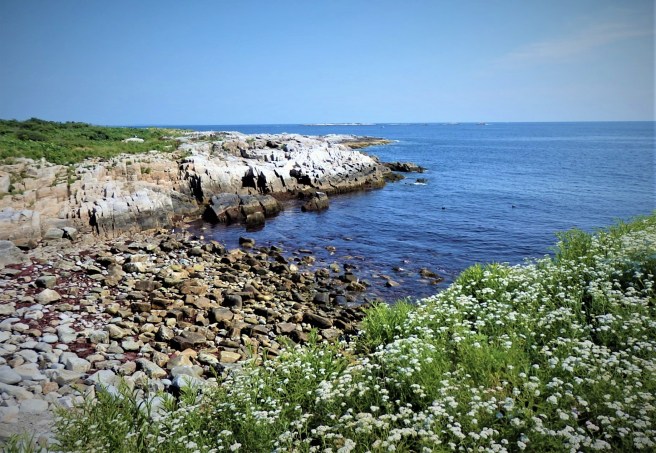
With its 95 acres, Appledore is the largest of the nine islands that comprise the Isles of Shoals about nine miles off the coast of Maine and New Hampshire. It was known as Hog Island until Celia’s family decided to build the hotel and turned to an earlier name for the shoals, one drawn from the Old English word for apple tree. How romantic.

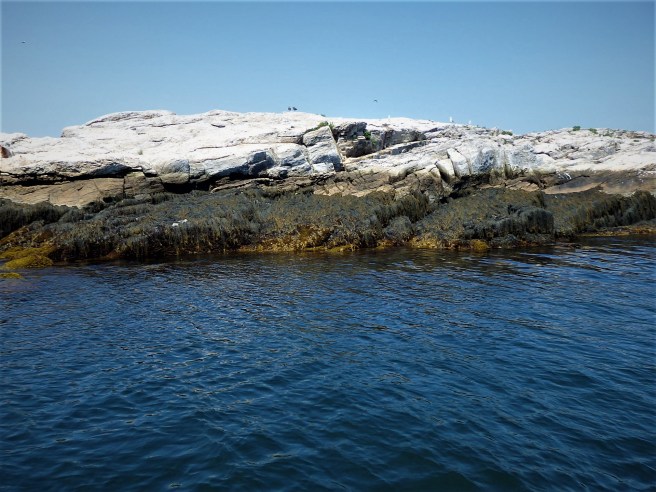
The shoals also include tidal ledges.

Celia’s flower garden in front of her cottage became legendary, celebrated in her lovely book An Island Garden, with glorious illustrations by Impressionist master Childe Hassam. I treasure my reproduction copy. She’s the one who convinced Hassam to use his middle name rather than Frederick as an artist.

The hotel itself burned in 1914, and today the island is privately owned, much of it by the Shoals Marine Laboratory run by the University of New Hampshire and Cornell University. Visits are strictly controlled.
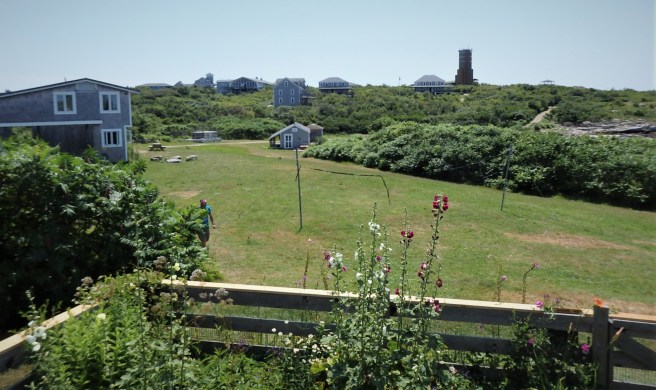
Today Appledore Island is the home of the Shoals Marine Laboratory. The tower was a bunker used to watch for German submarines approaching Portsmouth Harbor during World War II. The hotel sat in the open space from 1847 to 1914. A corner of her resurrected garden is at the lower left.

Last summer, my wife and elder daughter and I indulged in a tour of the island. Among its highlights was walking through the grounds of the long-gone hotel and a replication of Celia’s garden, which is much smaller than we’d expected and less carefully tended. The fact that it needed such constant care is a lesson in humility for those of us who expect similar results on much larger tracts.

And, for those of you who have read the garden book, I’m told that garden slugs are no longer a problem.

Nearby is her grave.

Celia is buried with her parents and siblings on the island.


Ten reasons I enjoy living in Dover

I’ve lived here for 20 years now, and worshiped here for another dozen.

Dover is the seventh oldest permanent settlement in the U.S. – and the oldest in New Hampshire. We’re preparing for its 400th anniversary in 2023. Did I mention I love history? We’re surrounded by it.

We’re also close to the ocean in one direction and mountains in the other.

Here are ten more things I appreciate.

~*~

  1. Right size. With 30,000 population, it has a small-town feel. We can stroll to a viable downtown from our house, have a drink or dinner if we wish, or just up the block to the bank or around the corner to the drugstore. That sort of thing. Even walk to Meeting on Sunday.
  2. Speaking of walking. The Community Trail, tucked in behind backyards and sometimes along the river, is a gem.
  3. Quaker Meeting. We’re the fifth oldest church in the state, and the first that wasn’t part of the government-backed Congregational denomination. First Parish, meanwhile, was the first congregation in the entire colony. It has an incredible organ.
  4. Greek-Orthodox. Its members have been an important part of the community for more than a century now, as I’ve been learning. The annual festival every Labor Day weekend is a blast.
  5. Ecumenical engagement. The twice-a-week soup kitchen the local churches provide is only part of the action. Immigrant sanctuary movement support has been extraordinary.
  6. The indoor swimming pool. For a senior like me, it’s a bargain. The locker room is tucked in under the children’s museum, which Dover lured away from Portsmouth, itself a reason to be proud to live in town. Oh, yes, let’s include the 50-meter outdoor pool at this point.
  7. Our hospital. It’s now a subsidiary of esteemed Mass. General, rather than being taken over by a for-profit corporation. Again, as a senior, top-flight medical access is a prime consideration. It’s within walking distance, too.
  8. The waterfall in the heart of downtown. It’s a pleasure to watch, along with the tide level below. There was nothing like this in the part of Ohio where I grew up.
  9. Proximity to the state university. Many of its students rent apartments here, and the school runs a regular public bus service through the region. Concerts, lectures, sports events, and the library are a plus. You should know hockey is hot here.
  10. Access to Boston. A comfy bus service to Logan airport and South Station runs hourly, and Amtrak’s Downeaster links to North Station with five trains each way daily. Apart from a small spur to the shipyard through Portsmouth, all of the railroad traffic to and from Maine passes within a block of our house. You can take the Downeaster in the other direction to Old Orchard Beach or Portland or even Freeport, home of L.L. Bean, if you wish. Riding the train’s fun.

~*~

What do you treasure about the place where you live?