
You never know what we'll churn up in cleaning a stall
For 149 years, a New Hampshire vacation tradition has been the big cruise boat that plies scenic Lake Winnipesauke in the mountains in the middle of the state.
Here’s the dope.


OK, I lied. Even to myself, as honesty is so central to my values.
Yes, I lied. In fact, as my wife recalls, when we jumped into our little city farm 21 years ago, I quipped that my next move would be in a pine box. Last I checked, I’m still breathing and my heart readings are falling within an acceptable range. Whew!
Oh, yes, back then my new stepdaughters informed me I’d better be nice to them because they’d be choosing my next home.
Skip ahead to now and the plot definitely changed. I’m not yet in a nursing home or eating those institutional meals, either. In fact, I’m enjoying relearning to cook, spoiled as I’ve been.
There were a couple of truck-rental actions where I helped our younger daughter (note the change of degree) and then our future son-in-law as well as a few younger members of Quaker Meeting, but that’s hardly the same of facing all of your own stuff. And I mean ALL.
And in our recent move, like my earlier ones, once more, we didn’t call the movers in but determined to do-it-ourselves.
Not that professional movers could have handled this one.
We were way behind in our sorting, for starters. Or, from another perspective, the move came upon us much earlier than we really expected. So much for the drama queen.
There was no way all of it could possibly fit into our new address in Eastport, even once we get some serious renovations done, so that meant a lot of redirection. (As I once remarked, after settling into Dover, I couldn’t imagine how people could live without a barn – yes, this Red Barn. But here I am.) Some of the mass has gone into our elder daughter’s Antique House and adjoining barn down in York, Maine, but there’s only so much space available there, and I can affirm that it’s jammed pretty solid. That led to renting and quickly packing two storage units, where I sense we’re buying time as much as anything else. Some intense triage will be done there. And the remainder has come up to Eastport with me, including one run with a small U-Haul truck itself. Along with more triage. And the dump, or “transfer station,” is nearly an hour away.
This move – my fifteenth address and ninth state since graduating from college a tad over five decades ago – has differed from the earlier ones, even if I had forgotten how heavy those boxes of books are, as well as the LPs, or vinyl, as cognoscenti like to say. Just noting that makes my lower back ache.
For one thing, this move’s been sequential, rather than a single burst. Each of my dozen trips between the two homes has allowed more goods to come east. In many of the earlier leaps, I hadn’t even seen the town until my job interview, and at least once I filled a truck, drove across many miles, got in town, and started looking for a place to live only afterward. (OK, a few times it was only my car, back when I had really focused.) Sure seems foolish to me now, but funds were limited. I’m grateful things worked out in the end, and it did provide some interesting fodder for my novels. And, oh yes, I was VERY single.
For another thing, my wife and I were moving from only the second home either of us had ever owned, and having a Realtor definitely helped, even in a hot real-estate market. Our new destination, meanwhile, connected to dreams I thought I had abandoned in leaving the Pacific Northwest, as well as some other activities I’ve added in New England. My wife, for her part, had come close to living on an island, and technically, she’s finally achieving that dream after a heartbreaking disappointment.
Emotionally, leaving a location you Barn readers know I truly loved was eased by being already socially distanced, thanks to Covid. Hey, I’m still getting together with those folks via Zoom, and I know I’ll be with many of them through New England Yearly Meeting of Friends even before considering the release of my next book, which is all about Dover’s unique roots. (Please stay tuned, as they used to say on TV.)
I’m also grateful for my goddaughter’s reaction to seeing our old place on Zillow and proclaiming, “Sheesh, the house certainly does clean up well! And that kitchen is truly a dream. I always loved feeling the warmth, whimsy and charm of that house, though I am sure your new place will have all of those qualities and more once you’re through.” We can hope.
She has her own connections to our relocation to Downeast Maine that I’ll skip for now.
So that’s where things stand. Maybe, as a result of all this, my survivors will have less to deal with when I “pass over,” in the old Quaker phrase.
What have your adventures in moving entailed?
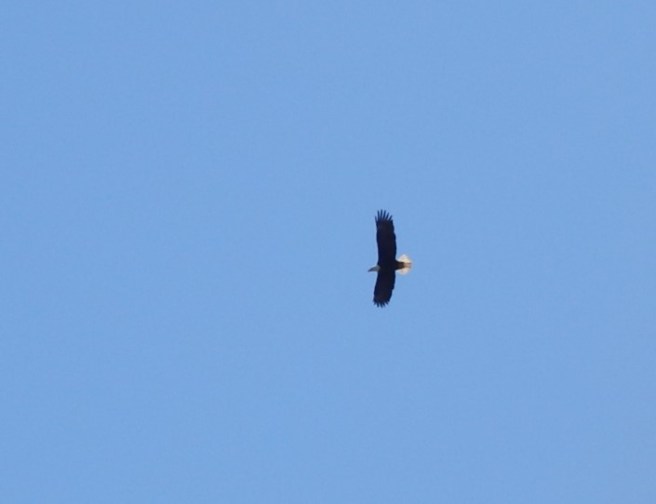
American bald eagles are majestic birds, among the largest in the air. From the first one I saw, back in the early months of 1977, I’ve found the sight of them to be exciting and inspiring. I was, in fact, one of a handful of folks who saw that first eagle to return to the Yakima Valley of Washington state, an event that prompts one scene in my novel, “Nearly Canaan.”
Since then, I’ve seen hundreds, from the North Cascades and Olympic Peninsula to the upper Mississippi River and the Great Falls of the Potomac, and then New Hampshire and Maine, especially. I loved looking up while working in the yard or swimming backstrokes in the city’s Jenny Thompson pool and seeing an eagle or two overhead.
Since landing the Eastport house in December and all the drives back to Dover, though, I seem to be seeing them everywhere. One Friday, on my way to Dover, I counted a dozen along the way, followed the next day by another just a block away from the Red Barn. It helps, of course, to know what you’re looking for.
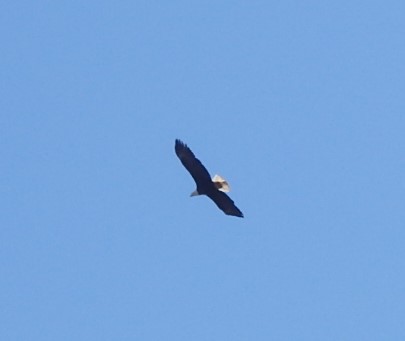
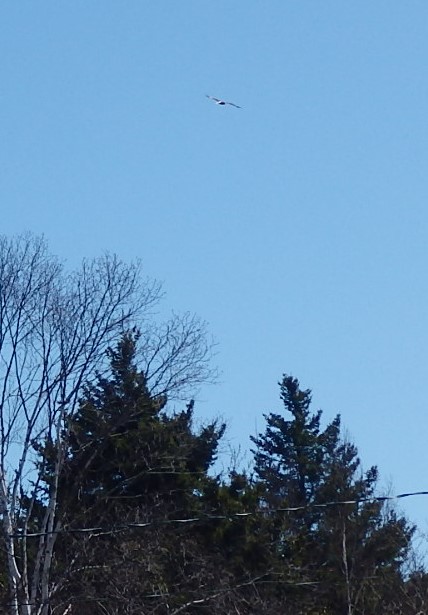
Now, I’ve finally been able to photograph one. I’m hoping for more.
Apart from a short spur to the Portsmouth Naval Shipyard, all of the railroad traffic to and from Maine and the rest of the United States runs through Dover. (I’m not sure how much, if any, goes through Canada.)
When we first moved into the house, our younger one started complaining about all the train noises in the night as sand and gravel moved to Boston’s Big Dig construction.
More recently, one my my regrets about the Covid shutdown has been that a number of Amtrak trips I’d hoped to take – to museums and the Boston Symphony’s Friday matinee concerts, especially – instead got scrubbed. And since the Amtrak station was in walking distance of our house, I loved joking about walking to Boston. Ha-ha.
On the other hand, it can be annoying when you get stuck at a railroad crossing downtown while a long freight train passes. I usually lose count somewhere around 120 cars.
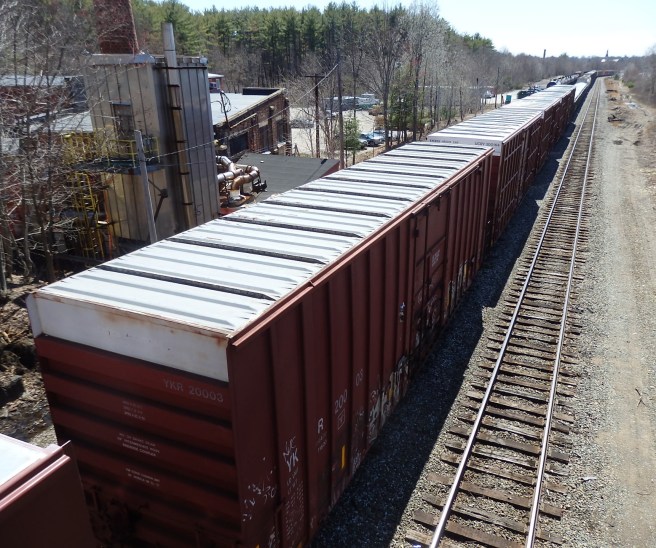
Here’s one I managed to shoot from the Oak Street bridge as it waited for the all-clear to continue rolling. Rail traffic, I’ve heard, doesn’t go north-south but rather east-west. Well, Portland’s north of us and Boston’s south. Make of it what you will.
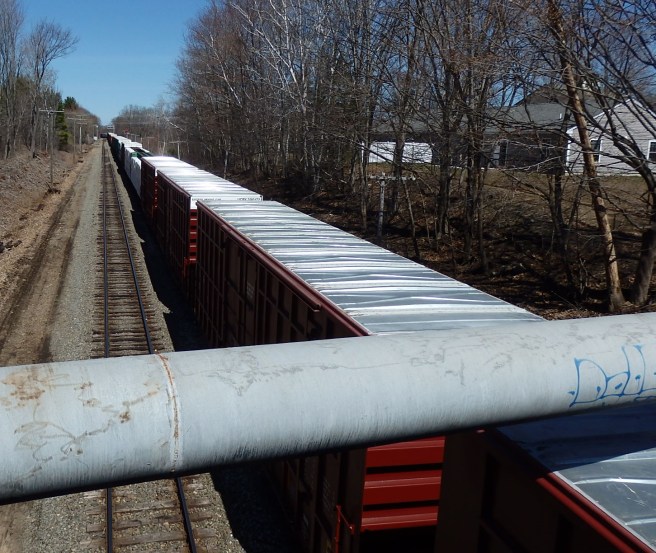
Can’t see the engines up front, can you?
 Jnana's Red Barn