Finally, I turned the camera on the newsroom

My novel about small-market journalism originated as an experiment on my first PC, an off-brand back in the days before hard drives or the Internet. In this case, I decided to build a book as a series of variations on a theme relying on a template chapter that I then copied and pasted for development. Set in a newsroom, each day was the next day’s edition but sampled months down the road. Some of you may think of the movie Groundhog Day, but that was still seven years in the future. The key to the book’s development was a set of seemingly random search-and-replace possibilities I then ran through the manuscript – on both of the 5.25-inch floppy disks that were required for the full book. Other variations required physical input, one by one. Either way, think of Mad Libs with seemingly random repetitions popping up like loose threads through the entire tale.

The basis, of course, was a composite of several of the newspapers where I had worked. By extension, it could also represent offices anywhere, but I found myself thinking about how little we usually know about our coworkers. Often, it doesn’t go much deeper than a phrase they repeat all the time or a piece of their favorite clothing or some annoying habit they have. It was enough to sketch each of them through the rounds of the book.

And then I put it aside to season before tackling it again.

When I returned afresh, I had to admit that the variations were insufficient. The loops were, uh, loopy. By then, the revision was turning into a kind of paint-by-numbers to flesh out the bones.

The tale still needed more work. So much for my pioneering experiment with A.I.

~*~

Hometown News did take my fiction in a fresh direction. It wasn’t exactly countercultural, for one thing. And it took place largely within a workplace, with day-to-day drudgery many people might identify with or at least recognize.

While Kenzie in my hippie novels labored as a photographer on his campus newspaper and then on a small-town daily chronicle, he did move on to higher pursuits once he married. In contrast, when my savings ran out, I was back in the newsroom.

Another surprise as I look back. This manuscript was also in the works before my Baltimore sabbatical big writing spree opened.

I have memories of jotting down notes while driving Interstate 95 between sales calls in Connecticut. My time on the road and in motels left me plenty of opportunity for uninterrupted thinking.

Even with TV shows like Lou Grant and Mary Tyler Moore, the public had little idea of what really happens in a newsroom. At the time, the job carried some prestige, if not outright fear.
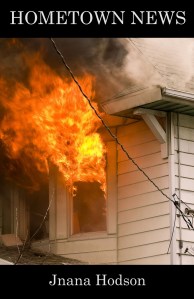
There was an adage that every newsman had a novel waiting to be born, and there was the cliché of the crusading reporter battling corruption and crime. Even Clark Kent and Lois Lane of Daily Planet renown. Mine wouldn’t be anything like those. The villains weren’t politicians or mobsters but, in the ultimate view, capitalism itself. And here I was, cheering for small, local enterprise.

For me, what emerged is the most problematic of my published novels, yet one of the most fertile. It certainly has the darkest humor and a large dose of dystopia.

I do recall one newspaper editor who candidly admitted to having taken a popular genre novel and essentially written over it to launch his own successful line of commercially published successes. Should I note that the owners of his newspaper also had one of the top book publishing houses in the world? Connections? Don’t discount them. Just don’t think of them as literary success, which I was aspiring to.

Rather than having the high drama of big bad guys somewhere outside of the newspaper company, mine were more insidious. In my experience, though, a more pervasive conflict smoldered behind the scenes within the business itself between the journalists, on one side, and the bean counters and their bottom line of obscenely rich profits, on the other. As the saying went at the time, many newspapers were a means of printing money for their owners. Not that much of it ever got down to the workers.

Let’s just say, too, that some papers were more competitive and innovative than others.

In my job of calling on editors across the Northeast, I heard personal stories that added to my own insights from working within two dailies that had undergone major transformations under inspired leadership, as well as lessons from leading a small paper in the town I call Prairie Depot and some stints elsewhere. Let’s skip the rest of the resume and get on with the book.

It was a world all its own. Or so I thought. And yes, it was set vaguely somewhere in the American Midwest.

Check it out at my Jnana Hodson author page at Smashwords.com.

Two years on the road came as a welcome respite

The ‘80s hit me with a couple of hard setbacks. First, Mount St. Helens blew up, as did my job in what I had seen as my Promised Land. I went bouncing back east, first to a stint along the upper Mississippi in Iowa and then three years in the Rust Belt of Ohio, where my shirt-sleeve management position ate up 60 hours or more of my life every week. Shortly after my first marriage fell apart there, my job was eliminated. At least I had a hot love going, with an engagement to be announced once I could relocate to Baltimore, where she had moved for her studies.

Somehow, I landed a field representative job with the Chicago Tribune’s newspaper features syndication service, one that allowed me to move anywhere I wanted within the 14 northeastern states I would be covering. Baltimore was perfect.

Except, once I ensconced in the top floor of an 1840s rowhouse in a gentile in-town neighborhood, my beloved wasn’t. If only I could get a straight answer from her.

Complicating matters was that I was out on the road three weeks out of four, home only to unpack and repack on the weekends. The job introduced me to a world many American men know: frequent flyer lounges, taxis and limos, hotels and motels, expense and mileage reports, quarterly sales meetings, three-piece suits custom made at Joseph Banks, a company car, bonuses. Newspaper management, especially on the smaller papers that I had known, were nothing like that. You might get a nice note from your boss or someone up the ladder thanking you for a particular job well done.

Getting from one sales call to the next gave me a lot of time for thinking as I drove or even reading, if I was flying. The time allowed me to decompress from a decade that had included 11 addresses in seven states. I could journey at ease or read or revise earlier manuscripts at night in my room, whatever its number.

My personal life included some of the loneliest nights ever but also led to my best friendship ever, a Plain Quaker who worked as a supermarket meatcutter when he wasn’t working as a nurse. I also had a circle of Mennonites who introduced me to four-part a cappella part-singing, a step that would lead me to the excellent choirs I would join in Boston and Eastport. I also visited among Friends, aka Quakers, and sometimes managed a few hours for genealogical libraries and archives or walking through cemeteries where my ancestors are buried. I even revisited the ashram and my old stomping grounds in upstate New York.

None of this apart from the newspaper world has entered my fiction directly. I thought she would be a fine character to build on, except in retrospect it turned out all too banal. What these experiences did feed was my poetry later.

Thanks to my best friend from my junior high and high school years, who was now living an hour south – unlike the previous decade, where we kept landing on opposite ends of the country – I obtained my first PC, something some of his buddies were building. It had 5¼-inch floppy disks, which would be ancient history to so many tech-savvy youths today.

In my travels, I saw much industrial wasteland. Not just Pittsburgh and western Pennsylvania or Sparrows Point outside Baltimore, but also around Philadelphia, across upstate New York, in Worcester and Buzzards Bay and the Merrimac/Merrimack River in Massachusetts and New Hampshire.

The newspaper industry was also taking hard hits. As manufacturing jobs disappeared, so did readership for afternoon papers, which were read by people taking the bus home or waiting for dinner. That greatly reduced the opportunity to place new features in their pages. As I was told, only a few years earlier, I would have had no difficulty selling to editors. Now, the challenge was keeping them happy with what they were already buying. I also saw great turnover at the helm of papers. I would curry an editor and have promises for a sale once the new annual budget was approved, only to find that he was no longer there in a year. The position I had aspired to and been groomed for was now revealed to be something less than desirable.

What became clear to the five of us out on the road was that the business was in trouble. One or more of us would be cut. I was the one. Besides, I really never was much of a salesman.

My observations of visiting other papers did augment my actual newsroom experiences that would emerge as the novel Hometown News.

Attention, please!

Are you a fellow blogger? Or did something else grab your notice here?

Let me confess that in playing creating titles for posts at the Red Barn, I’ve undergone a shift from the strict rules of writing newspaper headlines back when I was a professional journalist. For the record, I wrote hundreds of thousands of those, even while fixing the texts that followed or placing stories on the many pages I designed, all under a ticking clock and backlog.

One of the things I’ve discovered in blogging is that the title can stand on its own without having to quote from the text that follows. Instead, it can be a tease or even the first sentence of what then follows rather than a summary.

For another, it can be as long as I want. Not just up to ten counts or so of lettering on each of three lines, for example, which might turn out to be three to five words. Haiku looks easy in comparison. In blogging, the title might even be longer than the text that follows. Could you even summarize your post in a handful of words and still seduce readers? That was the newspaper challenge.

What we’re doing here seems all rather liberating or even lazy.

Not that it’s any less difficult.

Now, what grabs you next?

Were they or weren’t they friends?

Back in my undergrad days, I was hired by a retired jazz musician or some such insider to gleam through microfilm copies of the Indiana Daily Student and other sources as research for a bio or history book he was writing in New York.

The project opened my eyes to a wide range of 1920s’ history revolving around Bloomington, especially the legendary cornet player Bix Biederbecke and the Hoosier native Hoagy Carmichael. Yes, the place was a jazz hothouse, hard as that might be to believe.

I wish I still had carbon copies of my correspondence on that effort, but I do remember learning of a hitchhiking trip to a Harvard-Indiana University football game that Carmichael shared with Ernie Pyle, editor-in-chief of the Indiana Daily Student.

Seems it took them three weeks or maybe six to get back to campus from Massachusetts.

It’s a great story, no question, kind of pre-hippie, in this case two future celebrities back before they became famous.

The only problem, I’m not finding any corroboration online. Worse yet, I’m not sure how much Pyle and Carmichael’s timelines overlap. Besides, they were members of different fraternities, lessening the likelihood of a joint spree.

The game happened in October 1927, the same time Carmichael was making the premiere recording “Star Dust” in Richmond, Indiana. Pyle, meanwhile, was likely employed by either the New York Post or Evening World and had married. Some of his details get fuzzy.

I don’t remember who the writer was or whether his book ever came out.

By the way, IU lost, in a 26-6 rout.

Mortality and the passage of time

Realizing I really did need to get some regular physical exercise last winter, I finally caved in and ventured into the senior center for fitness class twice a week. It took three friends to nudge me into it, and it’s embarrassing to have to admit what 50 years of neglect have done to my body. I’m a long way from my yoga glory. Well, I’m also the only male in the circle, not that it inhibits the lively, enlightening, and laughter-riddled banter that occurs while we’re plodding through the routine. Their hour-plus dialogue could fill a hit sit-com or bestseller novel, if only I could find a plot. Well, much of the running commentary there is also about ailments afflicting folks in the community, sometimes leading to offering rides to their specialists or food deliveries – what I’ll call “good gossip.” And, oh yes, I much prefer to refer to the place as the Old Firehouse, skirting around the stigma of “senior center.”

That has me recalling an aside years ago when our managing editor told of a phone call he’d received from a reader complaining about being referred to as elderly.

“How old are you,” my boss asked and was told 78. “I see,” was the best he could respond with.

After that, I always struck “elderly” from news copy, along with “little” from child or kid.

Getting older is a multistage passage, most notably with the skin and stiffening joints, but the physical changes are only part of the experience.

One part is an awareness of being on borrowed time. Even when I was editing obituaries, I noted how many of the deceased were younger than me, and that was a little more than ten years ago.

Moving around the country has lessened some of the impact of aging, since I haven’t had to watch us grow older together. My high school classmates, for instance, will always never be more than 18 in my mind. Ditto for others left behind, they’re all frozen in time, even the few who are still in correspondence.

So another part is hearing that more of these colleagues of my generation are passing – a situation akin to personally knowing more people who have had been diagnosed with Covid and the recognition that it’s not just multiplying “out there” somewhere – that is, knowing only the abstract – but close at hand.

I recently posted two memorial minutes of Friends I worked with clerking Dover Meeting and have been reflecting on others in my Quaker circles.

Now I get word of the passing of an esteemed reporter who was six years younger than me, and somehow it hits more than those from the workplace who died earlier. To my surprise, it has nothing to do with how close we were in our daily interactions. (He and I weren’t, apart from a comment or two in passing. I should note that he produced “clean copy,” requiring little editing, and that meant little interpersonal friction.)

In his case, I think the blow comes as a sense of an end of an era. He carried institutional weight in covering the New Hampshire’s political scene and soared nationally during the first-in-the-nation presidential primary. With the decline of newspapers in general, his replacement at the statewide Union Leader will never achieve such prominence or influence.

I might as well get out of bed

Once again, another disturbing dream pushed me out of a restful sleep. It kept returning, with new twists.

It’s been nearly a decade since I last designed and paginated a newspaper page or faced its deadline pressure or even dealt with kinks in the paper’s latest computer system, but the game keeps popping up in my slumber – a game I’m also always on the verge of losing.

Why that and not, say, invading armies or insects or storms when it comes to anything verging on nightmares?

What are your repeated dreams?

WELL, IT REALLY WAS NEWS TO ME

This morning’s newspaper had a headline that sent an “Oh, gee, I haven’t seen that before” running through my head. As I mentioned the other day (Why Woodpecker Can’t Keep Up, June 14), so much of the news can be same-old, same-old variations on a theme. But this one really was new:

Motorcyclist Hits Bear.

As I also mentioned (Harley Heaven on Lake Winnipesaukee, June 16), we just had the nine-day Laconia Motorcycle Week, which attracts swarms of bikers to the Granite State, and racing along mountainous roads is one of their joys. Every year the event is accompanied by accidents and usually a few fatalities, but I don’t ever remember seeing one involving a bear. This one happened in the afternoon. Broad daylight on a perfect day.

Unlike moose, which are slow and dumb, convinced they can continue ignoring oncoming traffic, bears can be fast-moving, when necessary, and alert. Moose-car accidents are, in fact, commonplace throughout northern New England, while bear-car encounters are also a standard news item, though less frequent. I suppose I’ve seen a few moose-motorcyclist crash stories over the years, or at least should have.

This time I found myself recalling a report I’d edited and written the headline for back on my first news desk position right after college. We were Upstate New York, which has its own mountainous terrain. That time, a motorcyclist ran into a porcupine on a dark highway, and the results were fatal. As a city-boy, porcupines were still a curiosity, rather than a critter I often acknowledge in my journeys.

In this morning’s dispatch, the driver was airlifted to a hospital and reported to be in critical condition.

~*~

Another item making the rounds also seems to slip over from one of the routine categories — in this case, political survey results — into the I’ve-never-seen-that-before status. In the race for the White House, a Democrat, and a woman at that, is polling evenly with Donald Trump in the overwhelming Republican state of Utah.

~*~

This reminds me of another reaction I often have as a novelist: “This wouldn’t work in fiction.” Accompanied by “You couldn’t invent this if you tried.” Life really does take some bizarre turns if you look.

Really.

WHY WOODPECKER CAN’T KEEP UP

Many days in the newsroom I had the feeling of same-old, same-old. I’d seen it all before. Another election, just different names and tallies. Another car crash or house fire. A store opening or a restaurant closing. Graduations or obituaries. It’s a long list. And then something refreshing would come along, something that prompted the exclamation, “I’ve never seen that before!” Contrary to the doom-and-gloom image of the business, many of us at the newspaper loved having something uplifting to present.

These days, though, it’s more likely to be along the lines of this couldn’t be happening, could it?

The American presidential campaign is just the most obvious. The Woodpecker Reports appearing at the Red Barn are supposed to be a reminder of the underlying currents we thought would be shaping this election season – the history and power-brokers moving behind the scenes, especially. Things we’d seen before, round after round, including the same players or their disciples. Woodpecker can hammer away in the infected trees, as he’s been, but when the forest catches fire, he’ll take flight. I know this: things are spinning too fast to keep up. And that’s before we get to the climate instability that’s more glibly called global warming.

~*~

I’m still aghast at the reports of Sen. David Perdue’s “joking” when he encouraged participants at a religious conference to pray that President Obama’s “days be few,” a reference to Psalm 109. The audience apparently picked up on the calamities to be inflicted not just on the transgressor but on his spouse and children, too – evil thoughts, without question. In the text, however, King David is pouring out his soul in response to political persecution, a situation the Georgia Republican blithely ignores. King David’s lines certainly fit as a cry for help from Obama: “Wicked and deceiving words are being said about me, false accusations are being cast in my teeth,” as verse 2 reads in the New Jerusalem translation. “In return for my friendship they denounce me. … They repay my kindness with evil, and friendship with evil” (verses 4-5) match the good intentions Obama had for reasoning with a Republican Congress. As for the evil man oppressing the king, “He had no thought of being loyal, but hounded the poor and needy and the broken hearted to their death. He had a taste for cursing; let it recoil on him!” (verses 16-17).

Taken in its fullness, the Psalm – perhaps even the Holy One – could point to Perdue and laugh, “The joke’s on you.”

Except that this is serious, deadly serious. Prayer is never a joke, not for the faithful. And the Fourth Commandment (Exodus 20:7) warns: “You shall not misuse the name of Yahweh your God, for Yahweh will not leave unpunished anyone who misuses his name.” (The New Jerusalem here gives quite a different insight than the more traditional take of “taking the Lord’s name in vain,” usually seen as colloquial cursing or words not uttered in polite company.)

In a broader context, we can remember that King David could be both passionate and brash, qualities that got him in deep doo-doo more than once, and thanks to Abigail, he even had to recant one of the curses he was about to impose on her husband and all the males in her extended household (I Samuel 25).

While we’re at it, we can also leap ahead to Jesus commanding his followers, “Love your enemies,” and to look for the plank in their own eyes when faulting the splinter in another’s.

Nowhere do I accept an argument that it can be OK to pray for evil.

~*~

Only hours later came the massacre at the Pulse nightclub in Orlando, Florida, the worst mass slaying by a solitary gunman in the nation’s history.

As I read a few headlines quoting people who were suggesting the sinfulness of the lifestyle was the reason for the tragedy, I once again found myself aghast. (When I reread the reports more carefully, this was not their argument; rather it turned against Islam and its followers. Still, I have no doubt the original line of anti-LGBT argument is circulating through many circles.)

What angered me in my reaction was the notion we see all too often of blaming the victims. If their lifestyle were to blame, how then do we align that with shootings in churches, schools, even movie theaters, as we’re seeing? You’re going to blame Amish children or their parents? Come on, now! Or is something else the cause? At the moment, the United States has more guns per capita than at any previous time in its history; firearms were relatively scarce, even on the frontier, as you’ll discover reading wills from the period.

Let me suggest another calculus:

The more guns, the more murders. Period.

~*~

I just wish that mass shootings weren’t becoming same-old, same-old news in America, with only the numbers and frequency rising. Or that the anger weren’t fueling hatred.

Maybe I need to head out to the garden to see what’s new there. Even picking weeds might be uplifting.

CAN ONE CANDIDATE REALLY DICTATE THE NEWS?

As we’ve noted, Donald Trump has a very thin skin. Add to that his obsession with, well, himself as he imagines himself, brooking no dissension. It’s said he dictates the position of television cameras at public events to enhance the likelihood of only flattering images.

And now that the New Hampshire Union Leader has endorsed Chris Christie in the Republican presidential primary, Trump is taking credit for getting the state’s largest newspaper dumped from participating in an upcoming debate in its home city. The ABC network, it appears, simply caved in to the candidate’s demands. (For the record, it’s not the first. Let’s hope, though, it’s the last.)

Perhaps as part of his shallow understanding of the workings of the public sphere, Trump apparently cannot separate the news gathering and reporting side of journalism from the opinions expressed in its editorial columns. Now, it seems, neither can ABC News, which puts its own credibility in question. More to the point, where does the network separate news from entertainment? Is it as soft and spineless as Trump just accused the American public of being?

Where’s the truth in all of Trump’s image-building? Who’s to separate the reality before us from an increasingly weird fiction? Is it going to be left to the legions of National Football League fans he’s just insulted? Or is the court jester really in line for his own coronation?

One way to take down a bully, as we recall, is for everyone to pile on together. So who will take the first move – and who will be second? After that, you can imagine what happens. Right?