Join me virtually at Cape Cod

I’d love for you to join me on Cape Cod on Sunday, July 9, for a Zoom examination of ways a faith community can sustain a unique witness in the face of strong resistance. I do expect some lively discussion, based on my book, Quaking Dover, but you don’t need to be a Quaker to participate.

Do note that preregistration for the free event is required  (https://bit.ly/QuakingDover).

Hey, it’s a great place to be on a day in July!


As for another taste of scandal?

Dover’s second minister, the Rev. George Burdet, made a quick exit from town amid scandals, quickly followed by more in York, Maine. He had even briefly been “governor,” or the agent in charge of the New Hampshire province, making him in charge of both its religion and politics. Or, as historian George Wadleigh quipped, a wannabe pope.

Beyond that, as I observed in Quaking Dover, Burdet “was obviously on a downward spiral, as Thomas Gorges wrote to John Winthrop in 1641, noting that Burdet was at Pemaquid and ‘is grown to that height of sin that it is to [be] feared he is given over. His time he spends in drinking, dancing, singing scurrilous songs, and for his companions he selects the wretchedest people of the country. At the spring I hear he is for England.’ Later that year, the younger Gorges added of Burdet, ‘the dishonor of his profession and monster of nature, is now gone for England by way of Spain.’ That description of drinking, dancing, and singing rather seals the Robert Dover connection for me, even if Merrymount’s Thomas Morton, the more obvious reveling partner, wouldn’t return to Maine for another year or two.”

I do have to wonder where the wild tavern sat in the early Maine settlement here.

So here’s where he spent that wild binge – 110 miles or so from Dover, or a two-hour drive away today.

Recent research has come up with a site for the jail. I do have to wonder if the Rev. Burdet ever served time therein.

As for Robert Dover, who gave Burdet the inspiration for naming the New Hampshire settlement? He was an anti-Puritan wit and attorney. That, in contrast to the South English port famed for its white cliffs.

Reports of the cleric’s subsequent movements vary, possibly ending in Ireland, “where he was named chancellor and dean of a diocese. He died in Ireland in 1671, ‘after founding a much respected county family.’ Had he reunited with the wife and children he’d left behind?” As I say in my book, “Or was he, in fact, a bigamist? Also, there’s no mention of prison.”

Turn to Quaking Dover for the details.

What my Pemaquid visit made me realize is how little history of early Maine I had encountered in drafting my book, and how tenuous so much of it I’ve found since remains. Yes, the early settlements, including Pemaquid, were obliterated and abandoned during the decades of warfare with the French and their Native allies, but there had been significant settlement before that, something that kept getting swept away.


The 1630s was a most remarkable decade in New England

A comment from a professional historian after one of my Quaking Dover presentations has me realizing how much more needs to be seen in fresh light.

New England history, he said, is told through Harvard. And then, to smaller degrees, Yale and Williams College. A more accurate verb might be “filtered” or “focused,” but the implication was clear. The tale is party-line. Even Greater Boston-based.

When I delved into the roots of tiny Dover to the north, from the perspective of its Quaker Meeting, I had no idea how unconventional my stance would be.

The traditional history, I will argue, is Puritan-based and largely pushes aside the earlier settlers and the cultural differences or influence they had.

The well-organized Puritan invasion began full-force in 1630 with Massachusetts Bay and then the Connecticut colonies. Their utopian vision was far more fragile in practice than we’re led to believe. In that first decade, Roger Williams, Ann Hutchinson, and Samuel Gorton were banished, leading to the establishment of Rhode Island and quickly afterward, in reaction, Harvard College. Their own charter was under threat of revocation from the king, and they placed cannon on Boston Harbor to fire on Royal Navy ships, if needed. Think about that. And its Pequot War enslaved Natives who were exchanged for Africans, spurring the lucrative slave-trade.

That’s a lot in a small space in a short time.

Settlement to the north was not immune.

In New Hampshire, two of the four colonial towns were established by religious dissidents fleeing Massachusetts. Dover’s Edward Hilton conveyed his charter (exactly how or for how much remains unclear) to the Lords Saye and Brook for their own management … or mismanagement. As my book details, the New Hampshire province and neighboring Maine quickly became a hotbed of dissidents and misfits – a story that is largely overlooked in the traditional accounts. Let me just say it was a ripe time.

What I’ve also been seeing is that the story of dissent has focused on Rhode Island and largely ignored the north, including Salem, Massachusetts.

Should one of my upcoming presentations redress that?

The shipwreck of Angel Gabriel had a Dover angle

A monument at Colonial Pemaquid acknowledging to the 1635 tragic sinking of a ship caught me up short. I had forgotten the vessel’s impact on Dover.

As background, the ship had been commissioned for Sir Walter Raleigh’s last expedition to America in 1617 and in several subsequent incarnations been involved in some high seas adventures, staving off repeated boarding by pirates and beating off three Spanish ships. Not that I knew that in my initial research.

As the monument at the Maine historical site proclaims, the Angel Gabriel was a 250-ton galleon carrying settlers to new lives in New England in August 1635 when it anchored at the village of Pemaquid. Most of the passengers and crew got off the ship before nightfall to rest on land as guests of the villagers. That night, August 14-15, a storm later known as “The Great Colonial Hurricane” struck the area and the Angel Gabriel was torn from her anchors and destroyed.

Or maybe it had happened earlier and the ship had limped into harbor. Still, I’m quoting there, from an account that continues: “In the mid 1970s, efforts were made to locate the wreck in Pemaquid Harbor with divers and a magnatometer and sideccan sonar but no artifacts form the ship were ever located.”

For context, “The Angel Gabriel was very similar to the Mayflower but 18 feet longer and bearing four more gun ports per side.”

I am now curious to see whether the small museum displays a trunk that went down with the ship and was found floating the next day. It belonged to a passenger named John Cogswell and his descendant of the same name agreed to lend the trunk for display.

This marker, though, stirred up some memories of a section that got cut from the final version of my book Quaking Dover.

Here’s what I had:

Three Dover Combination signers shared a tragic introduction to the New World when their ship, the Angel Gabriel, broke up in the August 14 “Great Colonial Hurricane of 1635,” either in the harbor at Pemaquid, Maine, or at the Isles of Shoals.

[Note the clarification in the site of the disaster in the bronze monument.]

Twenty-one-year-old William Furber settled next to his brother-in-law, John Bickford, at Oyster River and later relocated to Bloody Point, opposite Hilton Point on Great Bay. He married Elizabeth Clarke, daughter of William Clarke and Elizabeth Quick, in 1642 in Dover.

(The Bickford family, meanwhile, has John landing at Dover in 1623 and marrying Temperance Furber in 1624 in New Hampshire. If these dates and locations can be supported, they would significantly change the early history of the Piscataqua settlement. Their son, John, though, was born in 1625 in Devon, England.)

Samuel Haines was an indentured servant or apprentice to John Cogswell, who was also aboard and survived. They were bound for Ipswich  [Massachusetts], where Haines finished his obligations the following year and may have moved at that time to Northam, as Dover was also called.

He did, however, return to England in 1638 and married Ellenor Neate within a few weeks after his arrival, suggesting they were engaged before his coming to America.

After a year-and-a-half, they set sail and established their home in Northam/Dover, where he had ten acres of land near the meetinghouse. Later, he had twenty acres on the Back River, where his neighbors were fellow Angel Gabriel survivors William Furber and John Tuttle.

He was taxed in Dover in 1648 and 1649.

In 1650 he leased Captain Francis Champernown’s Green Land farm for two years, and then secured ninety-one acres adjoining it, where he built a permanent home, and another ten acres where he eventually owned a mill. In 1653 he was one of the petitioners successfully asking the Massachusetts General Court to change the town name from Strawbery Banke to Portsmouth. That year he began the first of ten successive years as a town selectman. In 1666 he helped run the town line between Portsmouth and Hampton.

He was also the first deacon at the formal organization of the first church in Portsmouth in 1671.

At much of this time, the population of what now constitutes New Castle, Portsmouth, Greenland, and Newington was only fifty to sixty families.

Much less is known about survivor John Tuttle, who was about seventeen years old at the time of the disaster. After their rescue, he arrived in Chebasco (in Essex or Ispwich, Massachusetts). His age and destination suggest his situation may have been similar to Haines’. By 1638 Tuttle settled in Dover, where he was known as Shipwreck John and had a farm on today’s Bellamy River – one that grew into what was long known as America’s oldest family-owned and operated enterprise. (Never mind that Thomas Roberts’ heirs nearby would have a longer claim.) Tuttle’s son Thomas was killed by a falling tree while still a young teenager, leaving John Jr. to continue the family name.

~*~

Successive Tuttles became prominent Quakers. And, as I inserted, the monument is more specific about the scene of the disaster than I’d previously found.
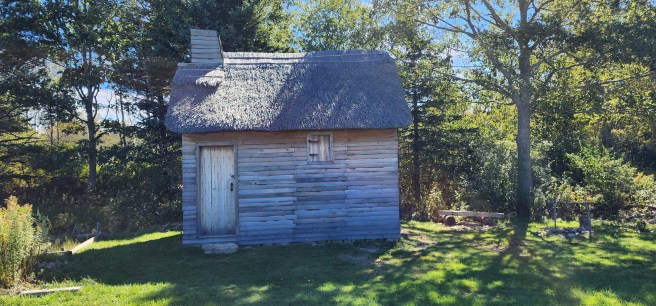
So this is how Dover’s early houses looked?

Some historical accounts contend that the first housing in Dover was log cabins, as opposed to the thatched roof houses of Plimoth Plantation we can visit down in Massachusetts on our way down south of Boston to Cape Cod. (Go there, if you get the opportunity, by the way. It’s truly enlightening. And you won’t have to eat turkey or cranberry, not that I would object. Anyway, did those Pilgrims have mashed potatoes or sweet potatoes on that big event menu?)

Let me emphasize, log-style construction is often claimed for both the Hiltons’ settlement at Dover Point and the growing settlement’s first meetinghouse, which sat on what’s now roughly under a toll plaza on the Spaulding Turnpike.

Alas, both Dover sites represent lost opportunities for historical research.

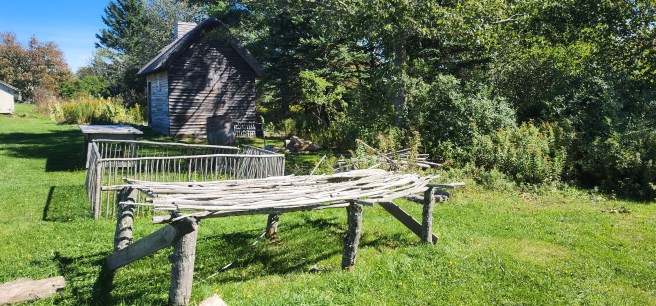
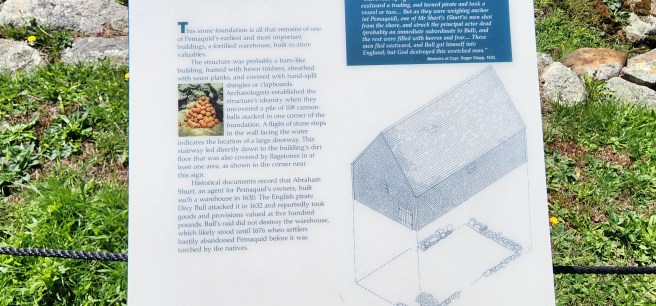
In contrast, Colonial Pemaquid, Maine, from the same era, has been subject to extensive archeological work. This reproduction is a typical West Country fisherman’s family structure for the period, based on those findings.

Yes, that’s right. A whole family would fit in one.

Notably, the earliest residents there and in Dover were from the West Country of England – especially Devonshire. And from nearby Bristol, a name that’s been applied to both.

An extended conversation with one of the dedicated volunteer caretakers convinced me on this style, unlike log cabins, which were apparently brought to America by Scandinavians to Delaware a few years later.

Fish-drying racks would have been important.

In a related conversation, close to where I now live, I was surprised to hear that the French settlers on St. Croix Island in 1604 arrived with pre-fab housing and set it up, rather than constructing their village and fortifications from scratch. When the survivors abandoned the site in the spring of 1605, they readily dismantled these and took them to their new site, Port-Royal, Nova Scotia.

That had me wondering how all of that would fit into a ship, but then I started thinking of it as the cargo coming in one direction, replaced with fish, fresh timber, and pelts on the return. Maybe it was bigger than a bunch of U-Hauls. You’d be surprised how much we’ve shoved into a few of those.

So might something similar gone on when the English sailed up the Piscataqua? It would make a plausible alternative to the log cabin assumption.

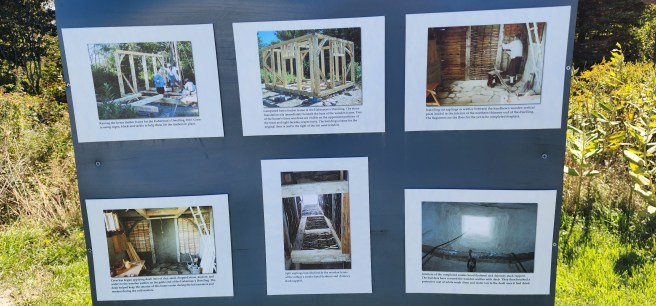
The Maine historical site adds details to the reasoning behind their reconstruction.

By the way, the Borderlands region of England had a structure known as a cowpen (sounds like cabin), reflecting the reality of a somewhat temporary house that would be destroyed by fighting within 50 years. Or maybe even a wild party.

I’ve never been quite comfortable with the traditional log cabin description of Hilton Point’s early settlement. Point made?

Pemaquid, out beyond the Piscataqua frontier

Call it a serendipitous trip.

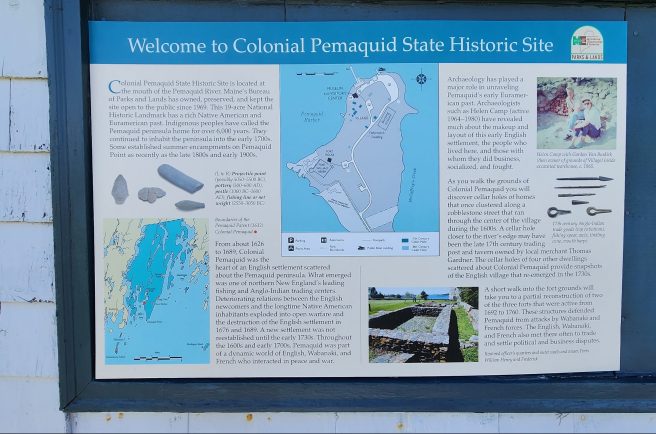
My stopping off at the Colonial Pemaquid historical site in Maine during a weekend at the Common Ground Country Fair last year was an impromptu decision. I’d made a side trip to visit the iconic lighthouse down on Pemaquid Point in midcoast Maine and saw a roadside sign and thought, what the heck, on my drive back.

After all, the settlement had some connections to early Dover, as I note in my new book, but simply setting foot there gave me a more substantial sense of the place than as a footnote vaguely out there somewhere up the coastline.

At first, the state-managed site appears rather modest. Its small museum and nearby seafood restaurant were both closed, this being the shoulder season. But nosing around revealed much, much more, as I’ll explain here and in some upcoming posts.

It was settled by West Country fishermen, like those who were pivotal in early Dover, shortly after Edward Hilton and Thomas Roberts set up shop along the Piscataqua, so they would have shared a common culture. Notably, both sites were established before the great Puritan migration into Massachusetts Bay, bringing a much different English culture into New England.

Unlike Dover, the Pemaquid village was destroyed repeatedly in attacks from the French and their Native allies in the decades from King Phillip’s war on.

In short, English settlement was erased from Maine all the way down to Wells and York, close to Dover. I have to admit that caused me to give lesser attention to settlement much to the east of the Piscataqua River.

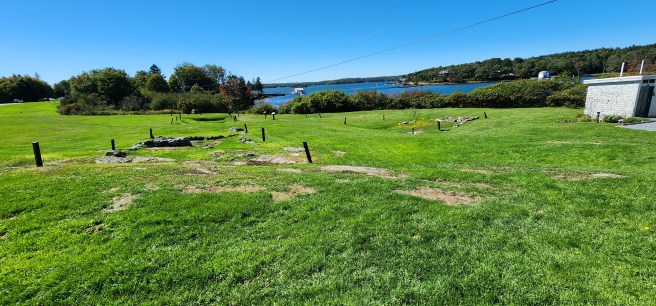
Still, the Pemaquid site, now in the town of Bristol, was left relatively undisturbed after the late 1700s. In the 1990s, though, extensive archeological excavations determined the shape of the village and a gave a clearer understanding of its economy and lifestyle. Today, the stone foundations and interpretative signage present some of their findings.

In those, as I’m excited to see, I got a clearer sense of how early Dover may have also emerged along High Street – today’s Dover Point Road.

I’d love to hear more about the settlers’ culture

What did they eat, for instance. Or, more accurately, how did they prefer it to be cooked?

And did children really smoke tobacco and drink beer, as seemed to be common among the Puritans.

My book, Quaking Dover, mentions a number of things that may have come down through the West Country culture of Devonshire. As one historian details, they were part of the Cavaliers’ lifestyle in Virginia, but for now I have no evidence of the degree they influenced the settlers in the Piscataqua watershed.

Still, I believe they were one of the reasons the Quaker message so readily took root and flourished there.

Not that Quakers or Puritans got very far in Virginia.

There’s a good reason Dover Friends didn’t have a meetinghouse before 1680

Or keep minutes, that we know of.

The Quaker Meetings in Salem, Hampton, and Dover were all in Puritan-governed colonies, and thus officially illegal at the time. Religious toleration around 1680 came with a change New England governance and a royal governorship in Massachusetts.

With it, Salem has claimed to have the first Friends meetinghouse in America, though it was built about the same time as the one on Dover Neck, just south of today’s St. Thomas Aquinas high school. And Third Haven on Maryland’s Eastern Shore may be a tad older than either one.

Now, if we only had documentation, we might find the honor of being first in New England belongs instead to Dover.

Perhaps one of your family lines runs through Dover Friends Meeting

We get the occasional inquiry from someone researching a family genealogy and wondering if they were part of Dover Friends Meeting.

Records for early Dover are pretty scanty, including both First Parish and the Quakers.

Family registers in New England Quaker Meeting minutes have never been indexed, unlike William Wade Hinshaw’s ambitious volumes for Pennsylvania, New York, Virginia, the Carolinas, and Ohio or the subsequent multivolume project for Indiana.

Well, Dover’s births, marriages, and deaths compiled for publication in the early 1900s can now be found online, for those so interested.

Also, I should point out that the Puritans never called themselves such and did evolve into today’s Congregational and Unitarian-Universalist denominations. First Parish is heir to that stream.

On the Quaker side, connecting the dots from the Dover Combination signers as an early census, the court convictions for non-attendance at public worship, and the Friends Meeting’s records from 1701 and 1703 on hinted at the foundation of Quaker membership in the early years. A survey of online family genealogies helped immensely in filling in the general body, though I take many of those details with a grain of salt.

So here’s the core of the historic Friends community around the Piscataqua watershed:

Ring any bells?