
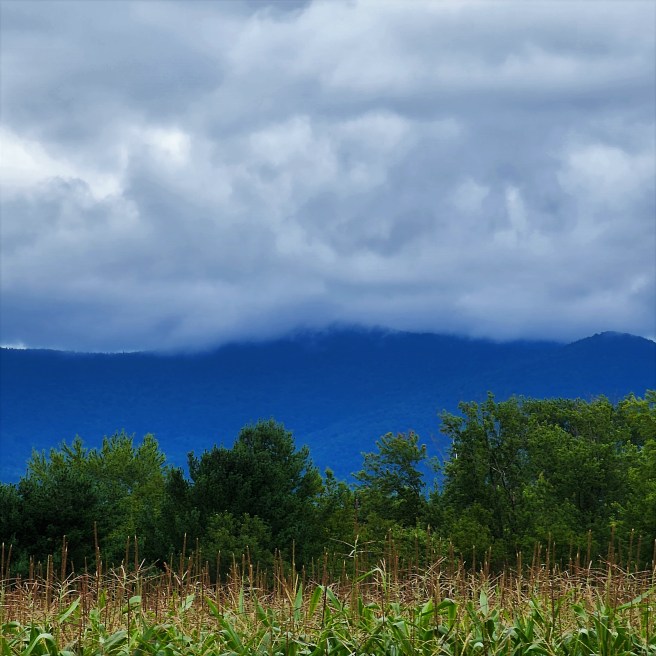
In New Hampshire’s White Mountains Presidential Range as seen from the Vermont state line.
You never know what we'll churn up in cleaning a stall

In New Hampshire’s White Mountains Presidential Range as seen from the Vermont state line.
I haven’t written a real poem
in at last a decade
prose, especially fiction, has taken the fore
plus relocating to a remote Maine island
do I even consider the photography
How else do you think
other than by talking to yourself even silently
or through the fingers or feet
I’ve long preferred instrumental music, abstract
or airs in languages I don’t understand
and usually forget the lyrics and lines in scores
I’ve sung in concert
So I was swimming a half-mile a day
before the pandemic but haven’t been back
in deep water, fresh or surf, indoor or out till today,
my first venture in a little-known river pooling
too rocky for laps but perfect for extending myself
in the familiar chill under a cloud-strewn afternoon sky
yes, it’s glorious and refreshing
in a way I discovered my first year after college
in hippie abandon or the New England coast
and Dover’s Olympic pool later
it’s the sunlight and breeze
stretching above, around
a call to attend to my rooting as well
in meditation, prayer, Scripture, favored poets
all as seemingly impractical
It would be an ambitious project, and I’m not sure quite how one would structure it, spanning six states and many subjects as it would from early colonial times to today.
Dover Friend Silas Weeks’ book of meetinghouses and burial grounds remains my go-to volume, but it’s mostly about buildings rather than people.
I’m still surprised to hear Rhode Island Yearly Meeting as the body’s early name, rather than New England Yearly Meeting. When did it change officially?
Well, I have seen some genealogies that get impossible to follow after, say, the third generation.
I even feel something like that in Dover, once the textile mills take over.
Still, the conventional histories of Quakers in America focus on Philadelphia, overlooking or slighting the unique challenges and characters of New England, North Carolina, Ohio, and more.
For now, my Quaking Dover is a microcosm of the bigger picture. I’m hoping it will prompt more.
From the start of our travel season, things here have felt slow. I haven’t seen as many cars as I have in the past or as many states represented in their license plates, for one thing. While there are people on the streets, they’re not crowds.
Even down on Cape Cod, summer homes are available rather than reserved long in advance.
Somehow, we’re hearing that retail sales have been holding up, but we’re also seeing more vacancies in the Airbnb options, too. (The latter hits us as good news, considering how the investment buyers have been skewering the home market away from working families we desperately need.)
Still, visitors are the key to retail businesses in our part of Maine – our version of Black Friday has already passed or soon will, unlike the day after Thanksgiving push elsewhere. Maybe the visits by cruise ships in the foliage season will provide a much needed boost.
Could much of this reflect the reality that inflation is finally pinching family budgets?
Dover’s third minister, Hanserd Knollys, no doubt laid a foundation for the Quaker message two decades after his brief tenure in the town pulpit. He was beset by controversy and even a physical skirmish or two, but he organized the church as a Congregational society even as his own theology was evolving into Particular Baptist.
Some of New Hampshire’s early Baptists did relocate to New Jersey, where they named a town Piscataway, in honor of Dover’s Piscataqua River. And Knollys himself became the pastor of London’s first Baptist church, once he had fled New Hampshire and the New World.
By the way, the number of colonists who returned to England from America still amazes me. How could they even afford it, much less the time involved?
Some of his challenges to conventional Christianity, like rejecting the baptism of infants, opened the way for Quakers to build on, once they arrived.
Still, I couldn’t get a clear picture of the existence of the Baptists as New England’s other dissident denomination in the colonial era. Was it all down in Rhode Island, where they contended with the Quakers over the governance of the colony?
My own book, Quaking Dover, concentrates on Dover Friends Meeting and its families, once they’re established, but the Baptists seem to be largely invisible until the Revolutionary War or so.
Carla Gardina Pestana’s Quakers and Baptists in Colonial Massachusetts now provides an understanding of the faith north of Rhode Island. Essentially, it was long comprised of one church in Boston, and its members were scattered across the region, rather like a network of solitary souls. The church underwent an evolution over the years, from lay ministry to ordained pastors, and ultimately presented less of a threat to the Puritans/Congregationalists than did the Friends.
Still, their insistence on a separation of church and state and their view of a church being comprised of fellow adult believers rather than a place one had to attend regardless of one’s heart and thinking were liberal and revolutionary.
Pestana’s description of the impact of the Great Awakening on the Baptist movement gives me a clearer understanding of why so many of its churches appeared in and around Dover – and the rest of New England – in the early 1800s.
In New Hampshire, Hampton is often touted as Happy Hampton, at least in summer, reflecting its long, broad, honky-tonk ocean beach and the rock concerts at the casino. Let me warn you it can be pretty crowded this time of year. Inland a bit, it’s also known for the Hampton Tolls on Interstate 95, which can be a major travel delay.
In the colonial era, Hampton was renowned for its saltmarsh hay and related agriculture.
It was also the center of the colony’s other Quaker Meeting, one at least as old as Dover’s, as far as I can tell.
As I was researching my book, Quaking Dover, I kept wondering what happened to the Hampton Friends over time. And then I discovered that, like Dover, Hampton had small, neighborhood worship groups, or “preparative meetings,” that came together once a month to address their joint affairs and personal conduct. The monthly sessions rotated among the meetinghouses under the Monthly Meeting’s care, in Hampton’s case including Amesbury, Massachusetts, which became home to the celebrated poet John Greenleaf Whittier.
Amesbury continues, while Hampton fell away long ago.
Since the boundary line between New Hampshire and Massachusetts kept shifting in the colonial era, sometimes reaching down to the Merrimack River – or Merrimac, as Massachusetts insisted – I feel safe in saying New Hampshire had two Monthly Meetings, while the Bay colony had only one, at Salem.
Either way, it could be a rich story in the telling.
Do you read ebooks? If so, here’s an offer you really can’t pass up.
For the month of July, the digital version of my history Quaking Dover is being offered for free at Smashword.com’s annual summer sale.

The paperback edition has been selling very nicely, thank you, but I do want to share the excitement during the city’s 400th anniversary and, well, here’s one more opportunity to get in on the story. Yes, little Dover is older than Boston, New York, or, well, any other city along the northeast coast other than Plymouth and Weymouth, Massachusetts. (Bet you didn’t know that!)
For details on obtaining this limited-time offer, go to the Jnana Hodson page at Smashwords.com.
It really is quite a tale.
In the conventional telling of the early Quaker movement in New England, the focus soon centers on Rhode Island and Cape Cod. One was an independent colony; the other, in Plymouth, slightly less harsh than Massachusetts Bay to their north.
In contrast, the three northern Meetings – Salem, Hampton, and Dover – are largely overlooked or dismissed as agricultural and poor.
Well, a historian goes where the records are, and those three northern Meetings were largely underground before 1680, when religious toleration came to Massachusetts-governed districts.
Arthur J. Worrell’s Quakers in the Colonial Northeast is slim pickings when it comes to those three Meetings, and Carla Gardina Pestana’s Quakers and Baptists in Colonial Massachusetts helps rectify that with her concentration on Salem, but her references to Hampton and Dover are few and often cryptically sketched as “New Hampshire and Maine.”
Well, Dover served both sides of the New Hampshire-Maine line, and for decades, it was the only Quaker presence in Maine.
As I keep calling out: Hello!
New England history is all through Harvard. And then Yale and Williams College.
Except, of course, a few mavericks like me. (Even though, humbly confessed, I’m not a historian.)
Well, you do have another opportunity to see why he said that if you register promptly for my free Zoom presentation from Cape Cod at 12:30 Sunday afternoon ( https://bit.ly/QuakingDover ).
Here’s hoping to hear from you there!
Quite simply, Britain betrayed the settlers in her colonies, from Ireland onward. The American plaint, “Taxation without representation,” reflected that all too succinctly. Where were the colonies’ representatives in Parliament or the House of Lords? What voice did they have?
The colonists identified as English but must have seen they were definitely second-class citizens. Or maybe third.
As I note in my book Quaking Dover, the Massachusetts Bay colony’s Calvinist intransigence had been at odds with the Crown from its inception. The first shot heard ‘round the world could have erupted at any point.
My pivotal question is just what turned the Loyalists in Virginia so far as to reject the monarchy as well and then join in taking up arms in the revolutionary cause by 1776?
The other colonies moved somewhere in between.
Not that all of this falls much within the scope of my little 400-year history volume as I try to keep a focus.