Gratitude to the public library

Dover’s public library has been quite proactive in developing an online presentation of the city’s historical profiles and images. I’ve found those resources to be very useful for fast checks when drafting these posts and related material, for certain.

Its dark-hued historical room upstairs is a treasure chest of local lore, as I discovered decades ago chancing upon Dover’s Quaker family records serialized in the fat volumes of the New Hampshire Genealogical Record, 1903-1909. They’ve since been keyboarded and made available online, if you Google, though I’m still relying on my photocopies.

In time, as a library cardholder, I even had online access to U.S. Census records from home in the wee hours. What a privilege!

If it weren’t for the Covid restrictions and my relocation to far eastern Maine, I’d like still be digging around on the top floor there. I certainly encourage others to do so.

 

As for Underground Railroad connections?

While Quakers were active in the Underground Railroad for fugitive slaves, the practice wasn’t universally embraced within the Society of Friends. In fact, much of the illegal action across the North was undertaken by evangelical Protestants who even created the altar call at revivals to enlist fellow workers.

Yes, it’s one more story in the American experience that needs to be better known, in all of its gritty reality.

As I describe in Quaking Dover, the Cartland family farm in Lee is believed to have been a stop on one of those lines to freedom. While documentation of such participation is rare, escaped slaved turned abolitionist Frederick Douglass was a frequent visitor to the farm, and like also its small Quaker meetinghouse and school.

The bigger question would be how did the fugitives get that far and where did the route head from there? Not everyone along the way was sympathetic, after all. Newburyport, Massachusetts, for one, was downright hostile and thus an unlikely place to jump ship. As for Portsmouth or Dover?

Establishing reliable yet invisible connections every ten or 20 miles would have been quite an accomplishment. What prompted households to risk everything to the moral cause? They were, after all, a threat to a vast economic system and its wealth.

It’s one more another interesting twist to develop in future research through New Hampshire.

Of note across the street from Dover’s Quaker meetinghouse

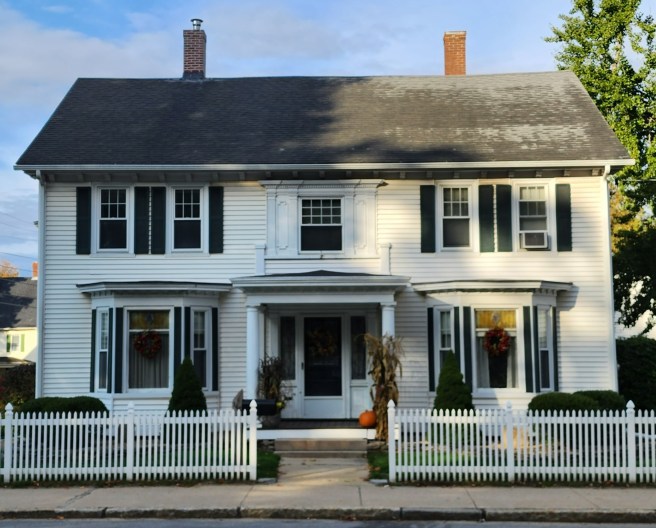
The home Isaac Wendell built by 1827 sits across Central Avenue from the Quaker meetinghouse.

I often parked next to it on the side street and admired the bird boxes and woodworking details on the ample barn and house additions.

He’s most noted as the cofounder with John Williams of the Dover Cotton Factory, the forerunner of the big mills downtown, but of interest to my story, he had married Anna Whittier, a close cousin of the celebrated poet John Greenleaf Whittier.

We can assume Greenleaf was a welcome guest there on his many visits to Dover.

Let me add, the relatively humane working conditions in the mills deteriorated drastically after Williams and Wendell lost control to new investors, leading to the first labor strike by women in America in 1828.

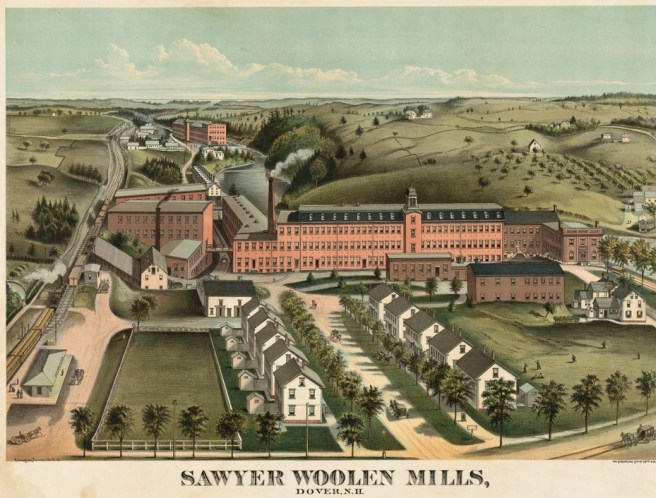
Wendell also shows up in the founding of the Sawyer Mills, which I discussed a week ago, as well as a foundry.

Did I hit a moose way back when?

It was dark and very cold that night, with snow piled high along the freeway.

Now that I’m getting familiar with deer, I realize that the critter I nicked with the right fender was much larger than any of the deer I see these days. They seem rather small, actually, apart from their appetites.

Still, that encounter could have been much worse. I have to consider myself quite lucky. A few feet one way or the other, the beast could have come crashing through my windshield.

Just one more fact of living where I do.

As a reminder from the dominant side

The ruling Puritans in New England had reasons for opposing the Quakers, something I need to remember in the midst of my Quaking Dover arguments, They don’t get much sympathy in their objections, at least from my audiences.

As Dover First Parish historian Donald R. Bryant put it, “The Quakers did not conform with the orderly practices of the Puritan churches. They would not join in fellowship, and met among themselves, propagating their own beliefs. Many of them did not do this quietly, but in a manner that was disturbing to regular church members. They were apt to interrupt a meeting or a preacher, or to even interfere with the proceedings of a court. They insulted church order and disturbed the peace. Their conduct was described as ‘indecent and provoking.’”

Some of these points still sting as I look at today’s political and social polarization.

Sawyer Mills usually get overlooked

The town’s textile mills don’t get a lot of attention in my book Quaking Dover, in part because I haven’t found a lot of interaction between the emerging industry and the town’s Friends. Indeed, the Quaker Meeting was seriously aging about the same time the thriving mills transformed the town into an industrial power.

Dover’s conventional histories, on the other hand, have good reason to focus on the big brick mills along the Cochecho River, world famous for the quality of their calico and their stunning print designs and execution.

You might be surprised to learn, though, that they were in operation much earlier than the legendary cotton mills at Lowell, Lawrence, and Manchester on the mighty Merrimac River.

Largely overlooked, as one Friend reminds me, are the woolen mills on the Bellamy River south of Dover’s downtown and only a few blocks from the Quaker meetinghouse. These operated from 1824 to 1899 and were often innovative, employing up to 600 workers before being sold and continuing till 1954.

They were renowned especially for their flannel and were, at stretch, the largest woolen mills in the Granite State.

Today the mills and their historic housing have emerged as a charming residential district.

While there were some Sawyers in the Meeting, I’ve not yet found any connection to those owning the mills.

Based on the naming of some of their children, those were apparently Methodist.

My range didn’t expand to the whole state

Statehood for New Hampshire was accompanied by growth in the Merrimac Valley and western side of the state, including Quaker Meetings.

Weare, especially, became a Friends center, with two large meetinghouses in town and another in neighboring Henniker. There was also the Clinton Grove academy.

Much of that growth, however, came from Massachusetts, not Dover, and so it fell outside the focus of my Quaking Dover story. They were even in a different Quarterly Meeting than the one encompassing the communities emanating from Dover.

Just in case anyone was wondering.

If you missed my latest Zoom presentation

You can catch up with my insights on “Quaker Meeting as a nest for social justness” via YouTube, thanks to West Falmouth Friends on Cape Cod.

The event, the latest of the special presentations based on my book, Quaking Dover and the New Hampshire city’s 400th anniversary, was recorded and is now available.

Many thanks to all involved.

To see what transpired during the hour, click here.