LOOK, WE KNOW WHAT WE MEAN BY A ‘NEW ENGLANDER’ STYLE HOUSE

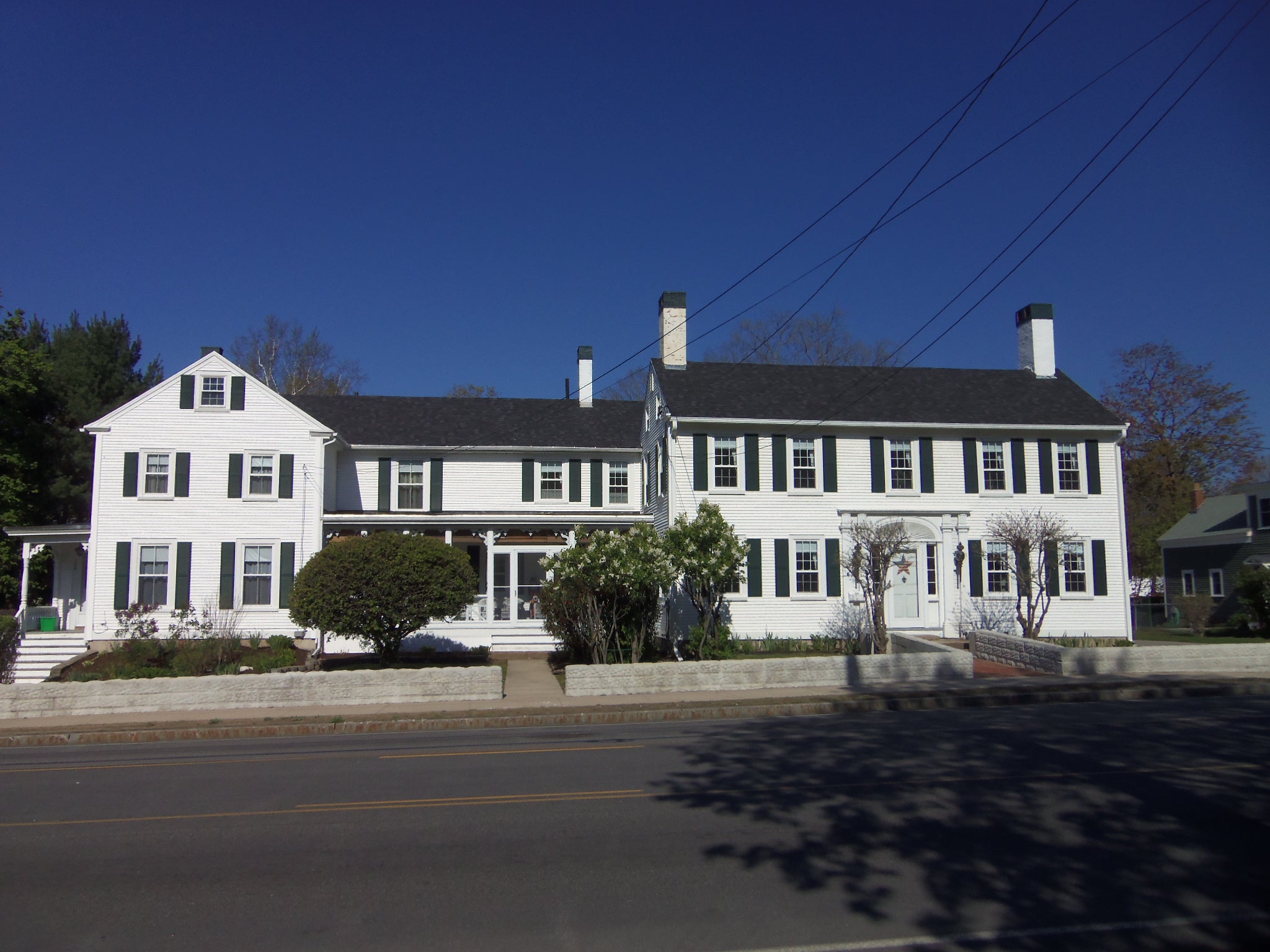
Around here, if you mention New Englander as a style of house, everybody knows what you mean. Gable end to the street, perhaps a bay window beside the front door, typically two full stories and a usable third floor. Not Greek Revival, except in a stripped-down way with some carpenter gothic touches, and definitely not Colonial Revival. Modest, middle-class – maybe even working class – sometimes even as a duplex.

But try looking it up and the best you can find is an accusation that it’s New Hampshire Realtor BS.

Well, that’s where we live. Ours seems to be from the 1890s.

~*~

My poems on the challenges of renovations, repairs, and relating as a husband are collected as Home Maintenance, a free ebook at Thistle/Flinch editions.

BEYOND THOSE GLOSSY ARCHITECTURAL MAGAZINE PHOTO SPREADS

More and more, when I look at a dream house, my reaction turns the other direction. Is that where I’d want to live? Who keeps it clean? How do you get truly comfortable? Make a mess? The kitchen, especially, looks like nobody’s used it for anything more than microwaving a frozen entree.

~*~

My poems on the challenges of renovations, repairs, and relating as a husband are collected as Home Maintenance, a free ebook at Thistle/Flinch editions.

JUST ONE MORE RENOVATION UNDER OUR BELT

These home renovation projects – I hate to call them remodeling, which points in some other direction – have established a pattern. The latest, the bathroom and utility room round, is one more in a sequence that began with saving the barn from collapse and then inserting a mother-in-law apartment 16 years ago, then redoing the kitchen five years later, followed by opening up the barn loft for easier access and three-season use just seven years ago. Looking back on photos taken before each of these always startles me. I could have kept living with that?

Each project begins with a vague sense of definition or direction. OK, I did make drawings for the mother-in-law apartment, and my wife had to order the kitchen cabinetry and plan for what would go where in that undertaking. But other than that, much more has happened – should we say been improvised? – along the way than I’d care to admit. Want to talk about lighting, for instance?

The pattern itself begins with ripping away obstacles. Even the first barn project had drywall to come down, windows and doors to trash, improper wiring to tear out.

That, in turn, leads to an urban archeology stage as we discover clues about earlier residents.

The barn, for example, had been inhabited by what we concluded had been an artsy set – the cable television line remains, no matter how outdated its specs – even though their arrangements were simply not allowed by zoning or building codes. Or so the inspector told us. A horse or a goat, we assume, had chewed away at some of the framing years earlier.

The kitchen, in a one-story el extending from the main house, had been added in 1928, as we concluded from Boston newspapers used as insulation next to the sheathing. As one of my favorite headlines optimistically proclaimed, automobile sales and production would just keep soaring through the coming years. So much for the Great Depression right around the corner. Our mudroom had been a pantry with a door where our stove had been, rather than the entry right around the corner. So the original kitchen had been somewhere in our current dining room or utility room?

Framing we find for former doorways often makes no sense now. Rooms have definitely been shuffled around. A hallway ran through two bedrooms, and then the bathroom was added – a small window there had been a full-size two-over-two. The closet to the front bedroom had apparently been just an opening atop the staircase, which would have let daylight in. Was there a second staircase in the back of the house? And were the stairs to the third floor moved from elsewhere? What we often see is how little had been done “right.”

We reflect on what we’ve heard about the previous owners and speculate on which ones made which decisions – many of which we’ve come to regret. Somewhere in the ’60s or ’70s, according to our calculations, two-inch-diameter holes were bored about a foot apart in a horizontal line along the exterior walls so that foam insulation could be pumped in along the framing. Great idea, except that in the subsequent years, the foam itself has dried out and turned to dust or useless puffballs. In reality, we have no insulation against New England winter. Still, I have to wonder about the asbestos siding, just when it was added – whether it was pried away for the foam project or added at the time.

As more and more debris comes down and goes out the door, the remaining exposed rough, dark wood leaves me feeling hemmed in. The windows grow small in response. It’s all part of the pattern.

In the next stage, though, I find myself staring at the open space. Think of an artist looking at a blank canvas or a writer, well, we used to have blank paper. This, though, is something else. For me, it’s Zen. The open framing, unfinished flooring, freedom from furniture – it’s all potential we will soon fill in. Unlike many who prefer lush surroundings, I love openness. The wiring and, if needed, plumbing need to go in, along with insulation and then drywall. We need to make decisions about lighting and color scheme. Toward the end comes the actual painting.

Add furniture. Then get used to the results.

As I said, it’s a pattern.

~*~

My poems on the challenges of renovations, repairs, and relating as a husband are collected as Home Maintenance, a free ebook at Thistle/Flinch editions.
WHAT CAN YOU DO WITH THE CONSTRUCTION DEBRIS?

We’ve not yet rented one of those green dumpsters that so often accompany a renovation project. To date, at least, that’s been one expense we’ve skipped. Yes, I’ve learned about the recycling center, as it’s called – in the old days, town dump was the term – except that now these things are hauled off somewhere else.

What it does mean is that we have temporary mounds of debris until I can borrow a pickup truck or find some new use for the waste.

With the bathroom and utility room projects, I kept pondering secondary uses for all the tile we ripped from the walls and floors. Any ideas? Can’t see using it as fill if there’s any possibility someone might want to dig there in the future. And yet?

As for the wood, I’d love to just have a big bonfire but know I’d never get a permit from the fire marshal. Alas.

Old piping, wiring, vents, fans, other mechanical parts, insulation, lathe … it all adds up.

The old drywall, at least, will disintegrate in the garden, and it’s a good source of lime to loosen up our clay soil. I’ll be using that stack on the new raised beds we’re planning for flowers.

As I blog about this, please remember I have no intention of speaking as an expert or saying this is how it is done, step by step. Far from it! Instead, these are simply the confessions of someone who’s fallen into the situation of being the owner of an old house – and whose abilities and interests fall far more into literary or theological realms than those of more pressing domestic matters. So much, it turns out, is a matter of muddling through. Or as one expert replied when asked where we were going with one problem: “We’ll know when we get there.”

OK, we did get that overbuilt monolith out from the doorsill we needed to repair and left it on the other side of the driveway. Six months later, I finally buried it – all 500 pounds – in a hole. We’re still thinking of building a gazebo above it. Now there’s one project I think I can handle!

~*~

My poems on the challenges of renovations, repairs, and relating as a husband are collected as Home Maintenance, a free ebook at Thistle/Flinch editions.

CARPE DIEM

Among the historic divisions among Friends, none were more traumatic than the Hicksite-Orthodox separations, 1826-27. While New England and North Carolina were spared, most other American yearly meetings were torn in two. The reasons were deep and complicated – often along socio-economic and geographic lines. Subsistence versus commercial farming, artistan-craftsmen versus industrialists, rural versus urban, traditional versus forward-looking, tensions between having the polity of Friends lodged within the monthly meeting or at the yearly meeting level, even language itself, one holding to old expressions versus those wanting to embrace a new evangelical ecumenism.

We were not alone. The Puritan legacy, for instance, splintered into Congregationalists and Unitarians about the same time we Quakers split, theirs ostensibly over naming the president to head, first, Dartmouth College and then Harvard. The Dunkers (or German Baptist Brethren), meanwhile, managed to hold together, although their tensions would finally reappear in the 1880s, leading to a five-way split, producing the Church of the Brethren – about the same time many Friends began turning to pastor-led programmed worship. Curiously, the Brethren, laboring under a single yearly meeting, faced major tensions between the Eastern, old-fashioned members and the “Western” (west of the Appalachian Mountains) progressives – the same lineup that Friends would see in the quietist versus pastoral worship styles, with our Western Yearly Meetings going programmed and the Eastern ones largely holding to tradition.

These tensions were fueled by and reflected in many larger societal issues. In politics, the Jacksonians reflected the emergence of westward expansion. In religion, the Great Awakening first blazed through New England (sometimes as the New Lights movement) before igniting in Kentucky and the newly settled regions. In the economy, the industrial revolution was well under way.

For Quakers, the divisions essentially shut down the itinerant ministry from traveling Friends, which had kept the central messages of the faith and practice intact. That loss no doubt played into the emergence of the pastoral system in places where Friends were settling, rather than long settled. Another loss was a breakdown in the sharing of epistles and other written material. We no longer had a common vision to express or unite behind.

I reflect on these not so much as history but as a recognition that our larger society is in one of those watershed transitions – as our presentations and discussions on envisioning the future have suggested. How do we parlay what’s been entrusted to us into the future? Will Friends, as a whole, respond with radically new worship, organization, expression? Will we be sufficiently open to be led where we are needed? Of course, Israel under Roman occupation turned out to be another of those watershed moments, spreading both Judaism and the newly emerging Christianity across the empire. But that’s a much larger and more complicated story, except for the fact that we’re Friends as a consequence.

Or, as old Quakers would say, “Christ is come and coming.” It’s more than “Season’s Greetings,” after all.

LET’S CHIP AWAY AT SOME GENDER STEREOTYPES

It’s supposed to be a guy thing, I know. At least in the widespread expectations. This matter of home repair – carpentry, electrical, plumbing, roofing, and the like. Any of us can do it – or so we think.

It also explains a lot of what we’ve uncovered whenever we engage a new project in this house. And the common response, from anyone on the job now: What were they thinking?

Even I can see a lot of shoddy workmanship. As one example, let me mention the wildly askew joists, previously hidden by ceiling, that had never been attached to the wall. Why hadn’t they blown away years ago? We’d been lucky.

Don’t tell me about the “good old days,” either, or how much better things were done back then. There are solid reasons we’ve enacted building codes and now license electricians and plumbers, among others. As for apprenticeships?

What I do admire in our home upgrade undertakings is the skills many of these individuals bring to the task. As one Friend once articulated during worship, as a carpenter he’s come to recognize that each project is different and requires original problem-solving – it’s what he enjoys. What he didn’t add was the range of skills he also brings to the matter at hand, the recognition that you can tackle it this way or that way, certain tools are better suited at this point, or even the accumulated experience that immediately notices something the rest of us overlook entirely.

~*~

By the way, we’re still wondering about that paper plate we found, face up, in the gap as we ripped up the bathroom flooring. It was pretty much under the sink, or where the sink  had been.

Who’d left it there and how long ago? Back in the ’80s or ’90s? Or was it in the ’60s, when so much of the house was redone?

I’m tempted to blame a squirrel or one of the kids growing up here. Or just a careless worker.

Oh, the mysteries we uncover in a project like this!

~*~

My poems on the challenges of renovations, repairs, and relating as a husband are collected as Home Maintenance, a free ebook at Thistle/Flinch editions.

AS THE CENTER OF ATTENTION IN OUR BATHROOM

In explaining our rotten floor worries, my wife would tell others she didn’t want to find our bathtub crashing down onto the dining room table below. Meaning our cast-iron bathtub, the one that came with the house.

The one that drained poorly, at best, and required plunging and rooting once a week or more and constant cleaning of the screen to catch hair at the drain.

It wasn’t even attractive in an antique sort of way. No claw-foot style, no insulating layer for deep baths, either. And then there were the cold drafts from above.

A bathtub, of course, is the centerpiece of a bathroom. You might substitute a shower alone, but ideally you want a bath-and-shower combination, which is where we were starting.

Determining where the floor moisture was originating and how much damage had occurred would necessitate moving the tub. Was it worth salvaging? No. So make that removing the tub altogether.

The project nearly died right there. Need we mention psychological depression? Despair?

Our carpenter informed us he couldn’t take it out – that would be up to the plumbers, who replied they thought that was his job. And then, with a good deal of swearing and sweat, they relented, busting up the tub with sledgehammers that shook the whole house and likely more.

The floor underneath had escaped moisture damage, but the related piping was another matter. We haven’t seen brass pipe like this in ages, the plumbers informed us, before adding: it could burst anytime, without warning. As for our drainage problem, the old-fashioned ball-drain trap – rather than the standard U? Ours had clogged to not quite a pencil width passage, so that a few stray hairs could create blockage. In other words, we were in for some major new pipes.

No turning back now. As tile and drywall, along with some plaster and lathe, came down and out, we had a clearer picture of what was at hand. A new tub would barely fit in the old spot, and that would take some finagling.

One thing we’d agreed on was our distaste for tile. Grout’s hard to keep clean, and it cracks. While we tried blaming the squirrels for the moisture leakage that led to the floor rotting, a better argument would point to tile failure, especially in the corner between the tub and toilet. Tile, too, is unrelentingly hard, should you drop something or, worse yet, slip.

After the plumbers told us they couldn’t install a one-piece tub-and-shower surround – they wouldn’t be able to get it up the stairs, much less through the doors – we accepted their advice to buy a tub with a matched shower-surround, a three-piece unit that would snap in place. Which was fine until we discovered that would mean losing the window in the room, the one that also provided most of the natural light to the hallway. Cutting into the surround would be difficult, at best. More likely, impossible if we wanted acceptable results. No thank you, there’s enough funky work here already.

Everybody kept suggesting we reconsider tile.

We wound up turning to a composite masonry that could be cut for the window opening. It cost about three times as much as the surround, before we added in the extra labor, and wouldn’t snap into the tub as neatly as the matched unit, either, but it wasn’t tile. But tile would not have created as much dust as cutting this stuff did, either.

Our original plan, to take the composite all the way to the ceiling, failed to calculate the angles of getting the panels into place. As we tried to maneuver the precisely cut units, reality sunk in. So it was back to the masonry saw … and all that much more dust. And that was before tackling the adhesive that would hold the units to the wall – for all eternity, we’d hope.

Well, the new tub’s deeper and drains like a dream. I love the broad stream from our new shower head. We still have our window.

But there are more funky fine points than I’ll care to admit. And the remodeled room is hardly showy – certainly not what you’d expect for the price, which I’ll keep private. I’d rather say we did the best we could under the circumstances. And please don’t tell me about that “old house charm.” You’ll have to understand if we scream.

~*~

My poems on the challenges of renovations, repairs, and relating as a husband are collected as Home Maintenance, a free ebook at Thistle/Flinch editions.