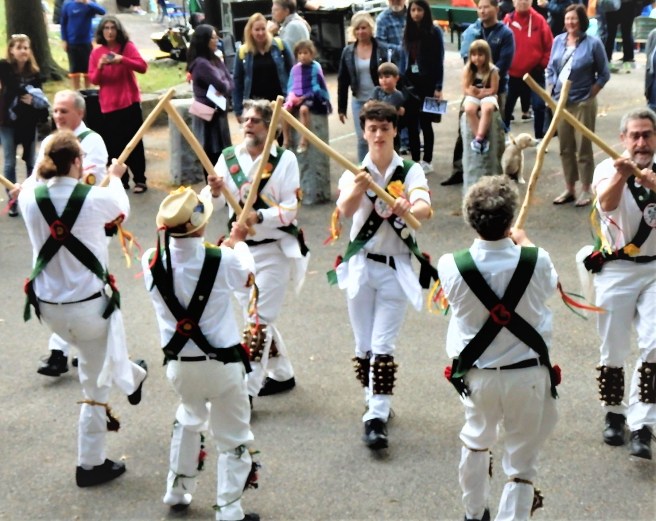
Morris men in a ring at the autumn equinox
You never know what we'll churn up in cleaning a stall
The Port City is hemmed in by water on three sides, and it’s running out of room to grow.
While the waterfront and beaches are part of the city’s tourism and residential appeal, the demand on downtown real estate has been going up steeply. Literally.
Not all that long ago, Portsmouth was a sleepy little New Hampshire city with a hippie edge and a lot of historic Colonial houses. Unfortunately, the city fathers had jumped on the urban renewal boom in the early ’60s, nearly demolishing one old neighborhood that was instead miraculously transformed into the Strawbery Banke living history museum. Visit it, if you can.
The side opposite the downtown wasn’t so lucky. Much of it, an Italian neighborhood of large Victorian houses with impressive interiors, was razed to make room for a small mall that never took off. It instead became a forbidding asphalt graveyard for private parking surrounding some kind of small bunker.
At least that vacuous mistake and eyesore is finally gone.
I’m not so sure about the replacement, though.
In what seems like one fell swoop, a monolithic set of five-story buildings has popped up to form a forbidding wall along the north side of the downtown.


It has none of the variety and charm of Congress and State streets that run parallel to it just a few blocks away. It’s largely not pedestrian friendly, preferring instead to maximize every square inch of rentable space, and despite its visual unity has a cookie-cutter quality that bears no kinship to the rest of the district other than brick. Where are the quirky touches that abound so close at hand in the earlier eras?
There is one exception.

Downtown Dover, ten miles to the north, is undergoing growth of its own and seems to be avoiding this kind of monolithic development, even while going to five stories. Whether we can avoid something similar on the riverfront project on the other side of the Cocheco is another question.
In both cities, these are once-in-a-lifetime opportunities for defining the larger community. What does this say about Portsmouth?




Not all of the development around our downtown is aimed at luxury housing.
Back in the sixties and seventies, apartments for subsidized renters were erected along the river and a steep slope on Central Avenue. A few years ago, the Woodbury Mills transformed a boarded-up warehouse into a lovely affordable housing apartment a few blocks from where I live, and a mill along the Bellamy River also underwent similar rebirth.
More recently, the three Roman Catholic churches in town were merged into one parish headed by a single priest, and one of the houses of worship, St. Charles, was facing serious structural water damage. It was sold and demolished, making room for the newest entry, Bradley Commons, about six blocks from the waterfalls downtown.



The Seacoast region of New Hampshire is dominated by a large estuary, collectively referred to as Great Bay. The waters include Little Bay and eight municipalities all pouring into the Piscataqua River with a continual strong tidal current. If you could harness that energy, you’d be a billionaire.
The bay essentially creates a peninsula with Portsmouth on the ocean side and Dover closer to the mainland. Population growth and the thriving Pease Industrial Tradeport have made the bridge linking the two sides quite congested at peak hours, especially when ski traffic or vacationers are added. One Friday afternoon in February, we got stuck in what’s too often normal these days. It took us an hour to go five miles. Look, we’re not big city. That chokes real life.
The bridge, which carries the Spaulding Turnpike and U.S. 4 before they split just beyond the northern end, is being doubled from four lanes to eight. The approaches are also being raised up to six feet as a precaution against climatic instability. Yes, storms are getting more turbulent, no matter the naysayers occupying the White House.
The bridge will make Dover more accessible to Interstate 95 in peak hours, and thus more attractive to people who hold jobs at Pease or in Portsmouth or in Massachusetts just to our south. In other words, it’s a factor in the city’s booming downtown construction to address a pressing housing demand.
Transportation, after all, is a major element in community existence.


 Jnana's Red Barn