Takin’ the ferry in New England

Washington state isn’t the only part of the country where ferry service is important. The Staten Island ferry makes appearances in my Subway Visions novel, strange as that sounds. Check it out.

A bit further to the northeast, here in New England the boat service can also be impressive. Most of my trips here, I should add, have been as a walk-on passenger.

Now for a look.

~*~

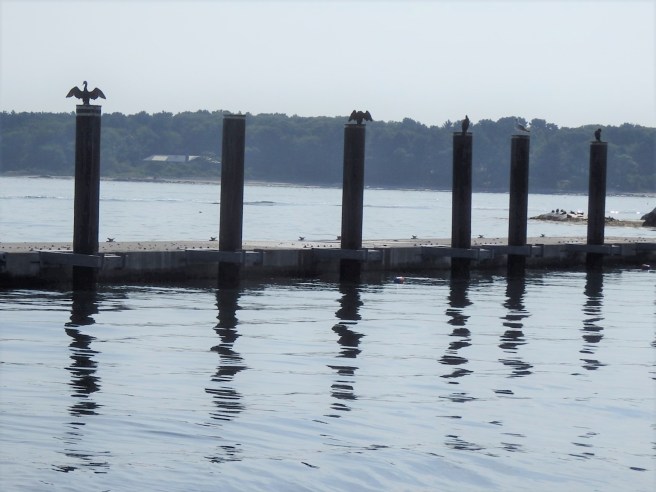
  1. Casco Bay. Portland (as in Maine, not Ory-gone) overlooks Casco Bay and some of its neighborhoods are on islands. A state-created ferry service makes daily stops on four islands within the city limits plus two in towns beyond. The little yellow-and-white boats are rather picturesque, truth be told, and the fares are quite reasonable. We’ve become quite fond of the mail run, which has six stops on five islands out and then back.
  2. Portland to Nova Scotia: Also out of Casco Bay is a catamaran ferry that zips to Nova Scotia in half the driving time. (Looks like there’s one stop en route, at Bar Harbor.) Back when it was a conventional boat, much of the appeal was in overnight gambling, once you were out in international waters.
  3. Nantucket. There are several routes, mostly from Cape Cod. The island likes to think of itself as a world all its own.
  4. Martha’s Vineyard. Like Nantucket, but maybe more exclusive.
  5. Boston to Provincetown. The catamaran zips from downtown Boston to the Cape in just 90 minutes, half of the time of driving in good conditions. I might mention some Boston Harbor commutes for shorter ventures.
  6. Block Island. Out from commercial fishing Port Judith in Rhode Island, it’s a fine daytrip. Rent a motor scooter when you land for a quick tour.
  7. Isles of Shoals. Just downstream from us, there are several services linking Portsmouth and the Isles of Shoals. The small islands split by the New Hampshire-Maine boundary include the Star Island summer retreat run by a Unitarian-Congregational church arrangement.
  8. Mohegan Island. Penobscot Bay in Maine has several ferry trip choices available. Mohegan Island is a prime destination served from several points onshore.
  9. Lake Champlain. Several crossings connect Vermont to New York State. Of the ferry trips on this list, these are the only ones on freshwater, not saline. One even follows a cable from one shore to the other.
  10. Campobello Island. OK, that’s in New Brunswick, Canada, but it’s once again served by a small ferry from Eastport, Maine. Sometimes the boat goes further, too, out on the world’s biggest tides.

~*~

Ever been on a ferry or whale watch? What’s your experience?

A Casco Bay ferry passes one of several historic harbor fortifications in Portland, Maine.

Made my own sashimi!

We’ve once more subscribed to the community fishery’s summer season weekly catch selection, which we pick up every Friday at our natural foods grocery. Often, what’s offered is a sustainable variety not often even sold at the supermarket, but this time, it was tuna. A beautiful, fresh, one-pound sirloin, which indeed looked like a steak.

Yes, sirloin is the term I found used in the recipes.

So far, I’ve never attempted homemade sushi, but looking at our tuna and then the recipes, I took the leap into sashimi, which I first encountered in a four-table Japanese restaurant in San Francisco back in the ’70s and maybe two times since. And yes, that first time remains memorable, even the plum wine accompaniment.

In a restaurant, it appears so daunting. As one recipe said, though, nothing could be further from the truth. Sashimi is a staple dish in Japanese homes.

I had no idea this would be so simple. Using a very sharp chef’s knife, you firmly cut long strips across the grain – no sawing. One swipe! And, by definition, no cooking. Sashimi is raw fish from the ocean, not fresh water.

It just happened that we’re growing daikon radishes for the first time, as an experiment, so I went out to the garden and pulled one, which turned out to be larger than we were expecting. No problem. Came in, sliced it, put those rounds into a ramiken, and covered them in rice vinegar as my side dish.

The dipping sauce was a ramiken of soy sauce mixed with the juice from half a lemon.

That was it. Easier than making a salad, actually.

Accompanied by a cup of sake (which we also chanced to have in the cabinet), this made for one of the most heavenly meals ever, at least from my hand. And this wasn’t even sushi-grade fish, which gets flown immediately to Japan for a much higher price. I can only imagine.

Still, this was fresh, and that’s much of the secret.

Great cuisine is about respecting the ingredients.

Sorry I didn’t take pictures.

Looking into the past

Apponegansett Friends meetinghouse in South Dartmouth, Massachusetts

Sometimes when I stop at old Quaker meetinghouses, I’ll try to take a photo of the interior through the windows. Reflections make it tricky, in this case casting an image of me and my camera back at  us. What remains is the rustic interior of the 1790 Apponegansett Friends meetinghouse in South Dartmouth, Massachusetts, viewed from the former women’s side of the house, with a set of cedar dividing shutters lifted out of sight in the middle. The gallery for ministers and elders is at the left, and seating for the general membership is at the right. Does it get any simpler than this?

Truly New England

Here I am, running errands around town, realize I’m driving with my car window rolled down, the temperature is 56 degrees, Fahrenheit, and it’s still February. Look, the reading was only 20 degrees this morning, and the frost was heavy. Still, having the window open feels natural, and the fresh air’s wonderful.

At the next stoplight, I look around and realize half of the other drivers also have their car windows open. Makes me think of the joke about how the drivers in Florida would all have their heat turned on if it was ten degrees warmer than here.

As I move on, I start wondering about the drivers who still have their windows rolled up. Is it because they have their air conditioning on?

We still have March and the potential for some heavy snowfall ahead.

Why presidential hopefuls brave the ice and snow

Its first-in-the-nation presidential primary has the Live-Free-or-Die state in the headlines these days. We want to meet and evaluate them all. It ain’t always easy.

The state’s presidential primary originated in Town Meeting Day, which is traditionally conducted on the second Tuesday in March each year. Since everybody had already come out for this unique form of grassroots democracy, it made sense to add one more item to the warrant, as the agenda is called, rather than make yet another trip to the town hall. (Besides, being winter, we’d have to heat it.) As other states have tried to jump into the spotlight, the presidential part has moved forward on the calendar. Theirs, though, don’t have organic roots like ours.

Contrary to what some candidates label their appearances, a real Town Meeting is not a political lecture or Q&A opportunity but rather a community session for debating and then voting on local government decisions for the year. Everyone can speak up and be heard. The town and school budgets are major considerations.

Now for some other perspectives on the Granite State:

  1. New Hampshire is bigger than it looks on the map. Rotate it 90 degrees and you’ll see it’s larger than Massachusetts, New Jersey, Hawaii, Connecticut, Delaware, and Rhode Island. It’s slightly smaller than Vermont. When water is included, Massachusetts and Hawaii jump ahead.
  2. Small-business owners comprise 96 percent of the employers in the state.
  3. An estimated 87,000 residents, mostly in the southern tier, commute to jobs in Massachusetts.
  4. It’s the only state where seatbelts are not required and one of only a handful where motorcycle helmets are not mandatory.
  5. The state has no income or sales tax. Property taxes make up much of the difference.
  6. The state ranks dead last in its support of secondary education.
  7. New Hampshire has the longest running state lottery in the continental U.S. Originally, the numbers were not drawn at random but based on results from the Rockingham racetrack.
  8. Dover, settled in 1623, is the nation’s seventh-oldest permanent community.
  9. The first potato crop in America was planted in 1719 by Scots-Irish immigrants in Nutfield (now part of Manchester).
  10. Although the state has only 18 miles of ocean frontage, the 6,000-acre Great Bay 10 miles inland is one of the largest estuaries along the Atlantic coast. It’s crucial for sustaining fish populations in the ocean.

~*~

Ever been to the Granite State? What can you add to the list?