Anybody else lucky enough to live in a place where you can buy unpasteurized apple cider?
So that you can buy two gallons at a time, as we sometimes do, and put one aside to start turning fizzy while we drink the other fresh? That second one stays sweet, unlike the pasteurized, which go sour, and is quite the treat. You know, with a little kick and fine bubbles.
Our usual source is a small roadside enterprise across the river in Eliot, Maine – King Tut’s, run by one line of the Tuttle clan, open weekends only from early autumn till Christmas or New Year’s, depending on the supply. They’ve been at it since 1903.
Other folks may be putting pumpkin in just about everything from beer to doughnuts as their autumn observance, but for us, cider’s the thing. Along with a few indulgences with pears, the ones that are properly ripened with no hint of graininess. (Poached makes for a very elegant breakfast or brunch.)
I think it was Confucius who insisted on no food out of season or place, which is fine in theory but impractical in regions like New England or the Upper Midwest. Still, it’s something I follow when I can, starting with the dandelion greens and asparagus in spring, glorying in nearly daily tomato sandwiches in August and September, and culminating in the brussels sprouts we harvest at Thanksgiving and Christmas.
Even though I grew up in a northern environment and its deciduous trees, autumn color was pretty much peripheral. We lived in town, after all, and I was essentially indoors at school or the like. Besides, much of the rural landscape around us was open farmland, with here and there a woodlot or riverbank.
My foliage awareness really took off a few months after graduating from college, when I lived in a small city surrounded by forested Appalachian foothills that turned ablaze at the end of September. Like Kenzie in my novel Pit-a-Pat High Jinks, I was working a job that allowed me to get out of the office at mid-afternoon, when my free daylight hours were soon devoted to exploring the visions along backroads in what became a daily epiphany.
From town, it appeared the hills caught fire at their summits and the flaming color then ate its way downslope. And, as I heard, the forests themselves were a blending of New England varieties and those of the South, so we had the best of both worlds for foliage.
In the years and wanderings since, that’s been my standard, though I should question if it was really quite as vivid as my memory would boast. Having lived in northern New England now for 33 years, I’ve often thought our fall foliage was more subdued than its legend, perhaps apart from some spectacular locales like Sugar Hill here in New Hampshire.
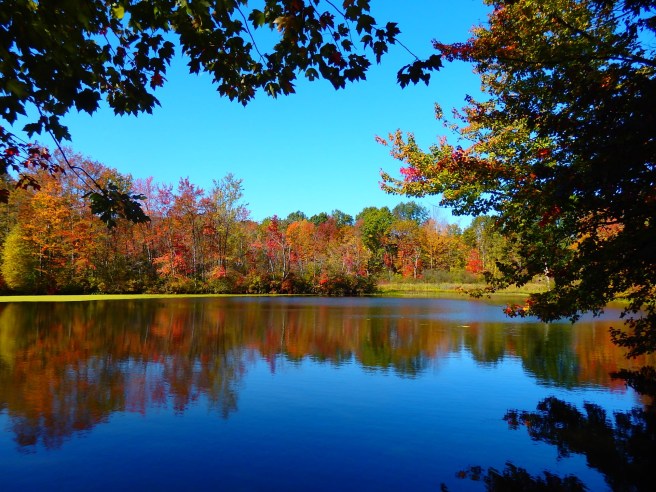
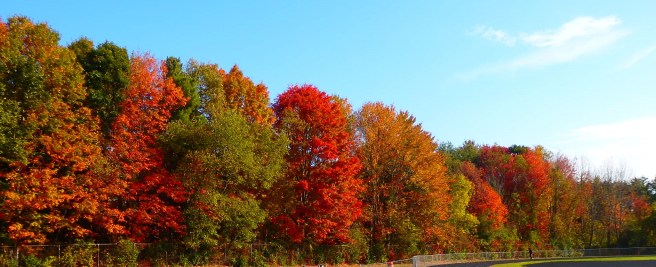
This past week, though, has changed my opinion. In driving about, I’ve come across large swaths in full color – not the usual mixed green and bare mixed in – and properly illuminated, even in an early morning mist and fog, not that my camera would capture that. It soon becomes almost too much, too rich, for one’s eyes to handle.
~*~
That first autumn Upstate, I didn’t have a camera, alas. Later, living in an orchard, I was disappointed that the apple, peach, and pear trees turned mostly dun. Finally, what I attempted, with film, my first years in New Hampshire came out so-so, partly a failing on my not knowing quite where to go, when. Only when I took up digital photography, about the time I launched this blog, did I start shooting earnestly, especially my first autumn after taking the buyout at the office and heading into the hills a little north of us.
As I’ve revisited those shots, I’m struck by how often utility lines mar the image – that, and other things our eyes overlook, though the camera is far less forgiving. Those lines stick out like the proverbial sore thumb. Thus, in the past month, as I’ve been shooting, there have been many fine examples of color I’ve out-and-out passed by for that reason.
Another difference this time is that I’m using my second camera, which has a “magic” auto-setting that intensifies the color. In alternating my shots with that and a more subdued tonality, I’m finding that the “hotter” one grabs more of what I’m feeling as I look, while the “cooler” option is closer to the reality … until the sun turns just the right way, which is what’s been happening the past week.
I am surprised our hundred-year drought hasn’t deeply limited the foliage. There was a walnut tree across the street that turned yellow one afternoon – maybe within an hour – but I postponed the shot. The next day was dull and wet, the light was just wrong. And the following day? The leaves had all fallen.
Well, it will all be gone soon. The phenomenon is a lesson in attentiveness and acceptance in the present.
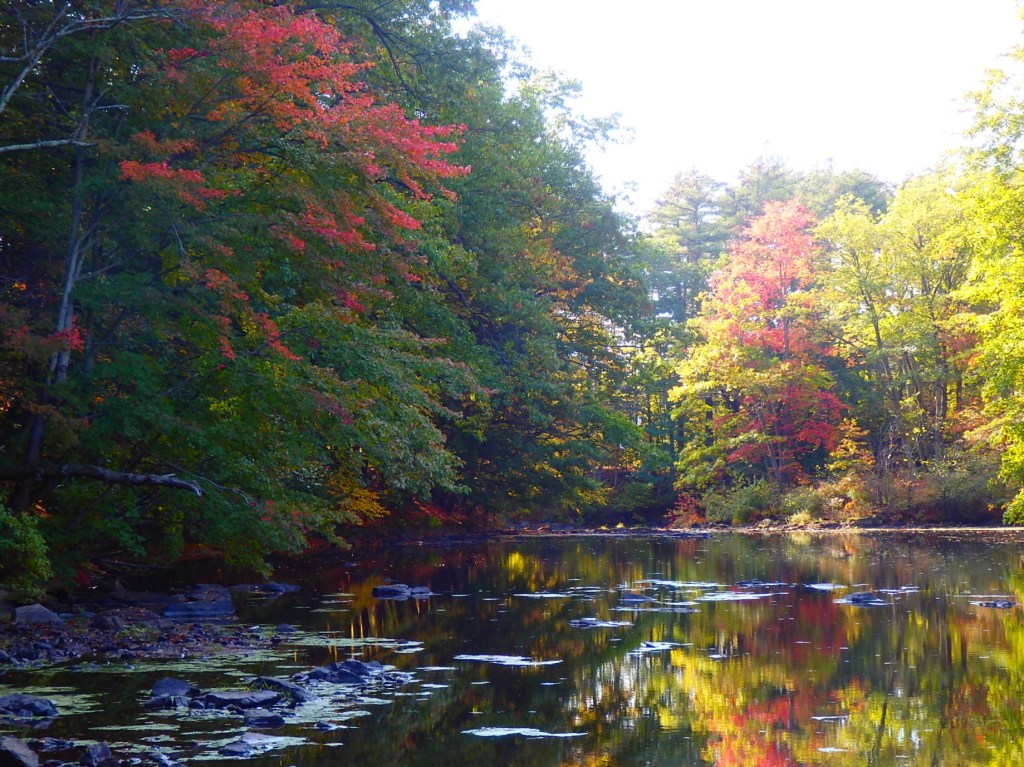
Colorful foliage reflects in a cove along the Cocheco River just a few blocks from downtown Dover. At one time, the site was used to cut blocks of ice each winter for sale to cities to the south each summer.The picture was taken from this former railroad bridge that’s now a highlight of the Community Trail.
Now, if we only had a place to put a canoe or kayak into the water.
Many know the Robert Frost poem, “The Road Not Taken,” but few know of its underlying Puritan foundation, expressed in Daniel Read’s 1785 shape-note hymn, Windham, based on lyrics by Isaac Watts. As the first stanza proclaims:
Broad is the way that leads to death
And thousands walk together there;
But wisdom shows a narrow path,
With here and there a traveler.
Frost, in contrast, has none of that grim Calvinist view, one that leads the next stanza to open, “Deny thyself and take thy cross,” and builds to a closing plea, “Create my heart entirely new, which hypocrites could ne’er obtain, which false apostates never knew.”
I can say that singing Windham in a choir is a rigorous experience. And, my, it feels incredible to bite on that final phrase, self-righteous though it can be.
Others can debate which piece better expresses New England terroir, but in contrast to Frost and his leisurely stroll in autumn foliage, I’d say the ideal embedded in the hymn remains the road less taken. Winter here is a much, much longer season than the fleeting falling of leaves..
The Columbus Day weekend is typically touted as “prime foliage” across much of New England, though we can quibble. In truth, the leaves of the deciduous trees change color in waves rather than all at once. Many are already bare, while many others are still green. And this year, severe drought has taken a toll, too.
Sometimes they seem aflame.
While Allen Ginsberg once quipped, “New England, famed for red leaves,” the reality is that few trees fulfill that vision. Far more are golden or buttery. Still, we keep looking.
By the end of the month, our landscape will emerge monotone – and likely remain that way well into March. Knowing what’s ahead, we savor what we can now.
The Cocheco River at Whittier Falls.
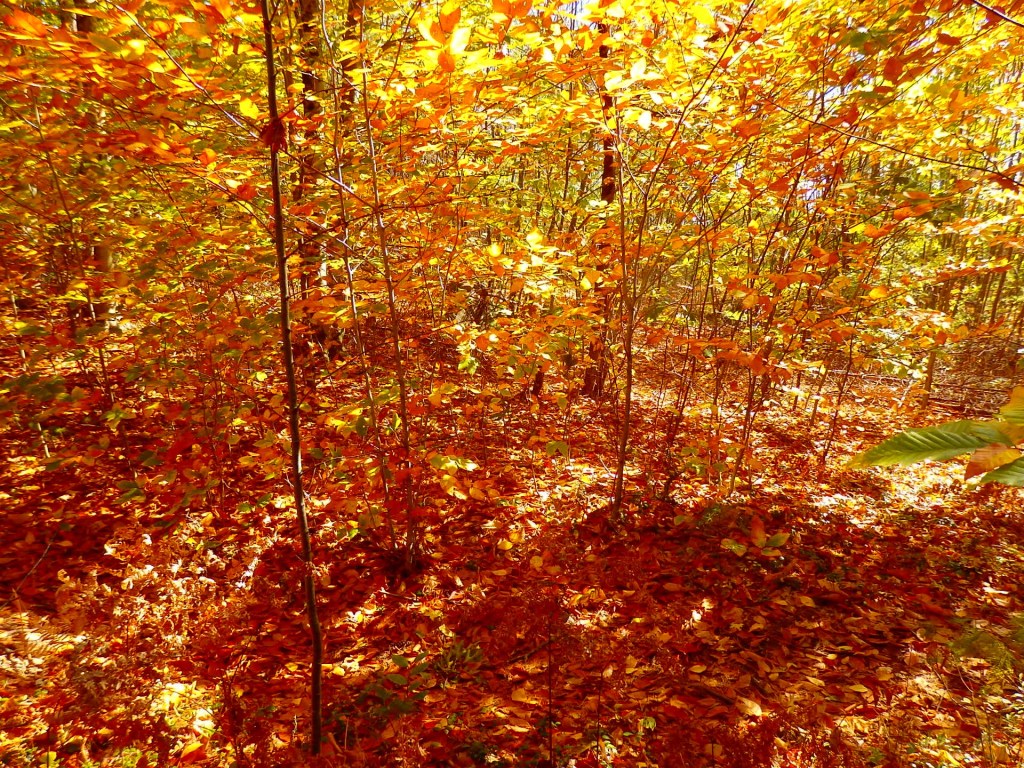
Don’t forget to look underfoot, too. And don’t overlook the impact of purple.
~*~
For my in-depth thoughts and photos reflecting New England’s fall folige, check out my posts from September and October 2013 at my Chicken Farmer I Still Love You blog.
Every December, the Boston Revels produces a new winter solstice celebration that now plays to 18 sold-out performances in Harvard’s historic Sanders Theatre. Or did, before the Covid-19 restrictions.
From their first round in 1970, the shows have grown into a unique hybrid of storytelling, theater, dance, concert, audience singalong and other participation. Each year focuses on a different corner of the world or a historical event.
Guest artists bring their traditions to the company, and the costuming and sets are always spectacular. Nobody could forget the big canoe that came flying out over the audience in a Canadian show a couple of decades back.
Well, this year’s production won’t be live in the flesh, but rather a streamed online retrospective. I don’t really know how to count it. Still, if you go to the revels.org website, you can attend a virtual show wherever you dwell. Admittedly, it won’t quite be the same.
Here are ten we’ve especially enjoyed.
~*~
Leonardo da Vinci. This was founder John Langstaff’s final appearance with the troupe, and it focused on three different cities in Renaissance Italy.
The road to Campostela. The culture of Spain’s Galatian region was featured in this homage to the pilgrimage known as The Way. Storyteller Jay O’Callahan was captivating, the flamenco was quite moving, and you wouldn’t forget those Spanish bagpipes.
Wales. There’s more to the British enclave than Dylan Thomas, though it did provide the timeframe for this production.
England’s Crystal Palace. How truly Victorian.
Venice in the 1500s. The music wasn’t all Italian and Latin, by the way. The Croatian, Sephardic, and Turkish pieces were all hits. And the story was a delightful comedy.
Acadia and Cajun. We followed the life and expulsion of this French-speaking people from Canada to New Orleans. The big tree at the back of the stage kept shifting color as needed, and the stream of immigrants into exile seemed to be endless, even though it was only the chorus of children and adults repeating their exodus toward the audience.
Nordic. Six languages, including English, big slices of the Kalevala myth, and a lot of polkas. The Scandinavian fiddles are distinctive.
Armenia and Georgia. I loved the economy of this one. The first act centered on a pilgrim in Armenia, where the Christian church took root at the foot of Mount Arrat, the landing place of Noah and his ark. From there, the second act followed him one locale over, to the Republic of Georgia. Though so close together, the traditions were also strikingly different. The Revels headquarters is in Watertown, a major center of Armenian population and culture, so finding a great cantor was no problem.
Scotland. Langstaff had a passion for Britain, and its folk culture is deeply engrained in the Revels DNA. We didn’t get to the acclaimed Irish show, but this one included reels we still dance in New England as well as songs familiar and rare.
American roots. Last year’s show started at a rural radio station somewhere in the South and covered a lot of ground by the end.
~*~
What live Christmas season events have become part of your tradition?
Fellow blogger Mark Bialczak’s recent posts about his romantic getaway from his home in Upstate New York to the Cape (as we New Englanders refer to Cape Cod) kinda guilted me into giving myself a day off and taking a few hours at a beach a bit over a half-hour’s drive from my little city farm.
Yeah, I know I’m retired (or was, before signing on as a Census enumerator … yesterday was a day off for me). Still, somehow, I get tied down at home. Haven’t swum in the ocean in the past three years, for that matter, not since getting the city pool pass. I always think there’s too much other stuff to tend to.
So yesterday, telling myself the season’s running out, I hopped in the car a tad before noon and simply took off. I thought about heading north to the mountains, but I’d already done a work-related drive in the direction earlier in the day, so I veered east into Maine and settled on Fort Foster, a Kittery town park situated at the mouth of the Piscataqua River.
Regular visitors here at the Red Barn have seen many images from this tranquil alternative to the more popular beaches just up the coast from it. For us, it’s closer than the beaches in New Hampshire, and always less crowded. During the summer, there’s an admission fee, which limits traffic, and for several seasons I opted for a season pass, sometimes spending an afternoon in the water before heading an hour inland for an evening shift in the newsroom. Even so, as I said, for the past several years, I’ve just been more of a homebody, with writing and revising as a top priority.
After Labor Day, the park gate is open only on weekends through September, but it is possible to park outside and walk in, which was the case yesterday. Despite the number of cars lined up along the road, I encountered few people in the park itself, most older couples or individuals walking a dog.
En route, I stopped at the Chauncey Creek Lobster Pier for raw oysters on the half shell, which is always a rare treat for me. It’s a lovely setting, a deck over the water in a narrow tidal passage off Pepperell Cove, and typically crowded. Some diners even arrive by boat. After Labor Day, though, the tourists thin out, making for a perfect time to enjoy our local attractions. Maybe it has to do with Covid somehow, but the oysters yesterday were smaller than usual, especially for this time of year, when they’ve fattened up for winter. No complaints, though, they were still tasty. If only I could learn to shuck them myself. It’s a skill, one that can lead to emergency-room stitches for an amateur.
‘Nuff background. Here’s a sampling of what I enjoyed a mile or two later.
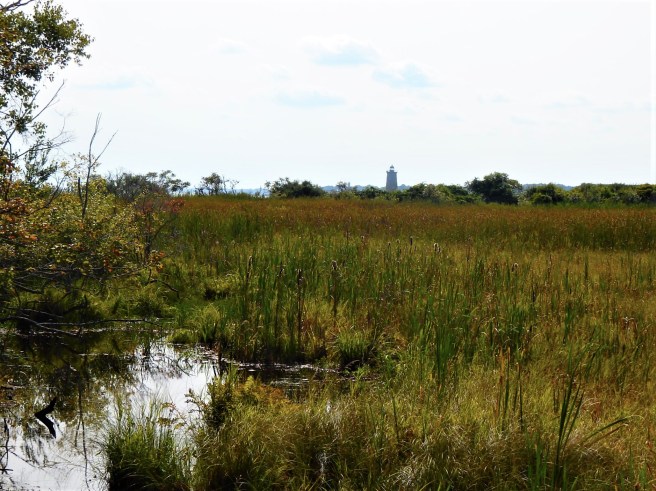
The road into the park splits, with one branch crossing a marsh filled with cattails. As I walked along it, I was struck by the way Whaleback lighthouse seems to pop from the trees, rather than its usual position surrounded by tides.
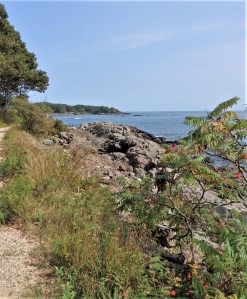
For the most part, I had the oceanside trail to myself. Autumn was definitely in the air.
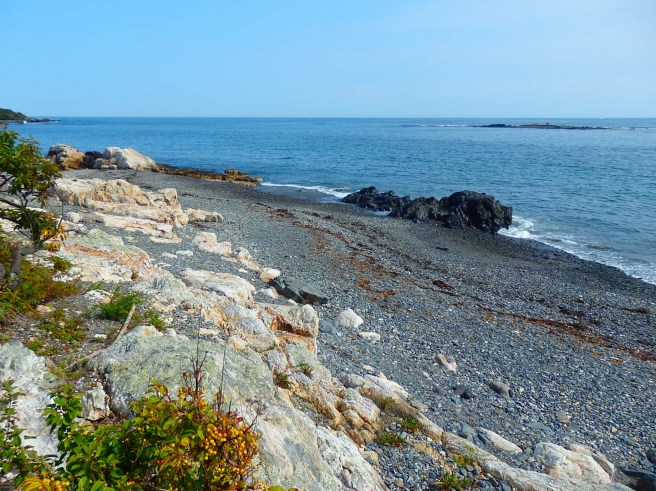
This pebble beach is my usual place to swim. It’s less buggy than the sandy stretches further on, and less crowded than the pocket beaches along the river. My fingers indicated the water was still warm enough for swimming, though I hadn’t brought a swimsuit. September can be some of the best times for swimming, but the cooler air can be a problem. The current also looked a bit rough, not that you see it in this photo.
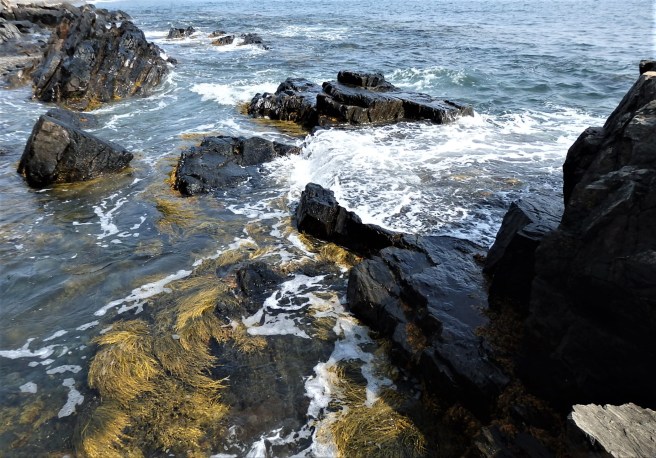
A wave pours into a tide pool. Had I come prepared, wearing old sneakers and a swimsuit, I would have been in the water, looking under rocks for starfish, urchins, anemone, and other colorful life.
No longer the cheap, plentiful seafood it once was in New England, lobster is still a specialty. We usually wait till later in the season, when prices fall and fresh corn on the cob is available, before feasting. (Photo by Rachel Williams)
Here I am with my buddy Harlan for a repast in our Smoking Garden. He had rubbed their heads in a way to hypnotize them and stand them on their heads before they went into the boiling pot. Said it’s an old Maine tradition. (Photo by Rachel Williams)
Washington state isn’t the only part of the country where ferry service is important. The Staten Island ferry makes appearances in my Subway Visions novel, strange as that sounds. Check it out.
A bit further to the northeast, here in New England the boat service can also be impressive. Most of my trips here, I should add, have been as a walk-on passenger.
Now for a look.
~*~
Casco Bay. Portland (as in Maine, not Ory-gone) overlooks Casco Bay and some of its neighborhoods are on islands. A state-created ferry service makes daily stops on four islands within the city limits plus two in towns beyond. The little yellow-and-white boats are rather picturesque, truth be told, and the fares are quite reasonable. We’ve become quite fond of the mail run, which has six stops on five islands out and then back.
Portland to Nova Scotia: Also out of Casco Bay is a catamaran ferry that zips to Nova Scotia in half the driving time. (Looks like there’s one stop en route, at Bar Harbor.) Back when it was a conventional boat, much of the appeal was in overnight gambling, once you were out in international waters.
Nantucket. There are several routes, mostly from Cape Cod. The island likes to think of itself as a world all its own.
Martha’s Vineyard. Like Nantucket, but maybe more exclusive.
Boston to Provincetown. The catamaran zips from downtown Boston to the Cape in just 90 minutes, half of the time of driving in good conditions. I might mention some Boston Harbor commutes for shorter ventures.
Block Island. Out from commercial fishing Port Judith in Rhode Island, it’s a fine daytrip. Rent a motor scooter when you land for a quick tour.
Isles of Shoals. Just downstream from us, there are several services linking Portsmouth and the Isles of Shoals. The small islands split by the New Hampshire-Maine boundary include the Star Island summer retreat run by a Unitarian-Congregational church arrangement.
Mohegan Island. Penobscot Bay in Maine has several ferry trip choices available. Mohegan Island is a prime destination served from several points onshore.
Lake Champlain. Several crossings connect Vermont to New York State. Of the ferry trips on this list, these are the only ones on freshwater, not saline. One even follows a cable from one shore to the other.
Campobello Island. OK, that’s in New Brunswick, Canada, but it’s once again served by a small ferry from Eastport, Maine. Sometimes the boat goes further, too, out on the world’s biggest tides.
~*~
Ever been on a ferry or whale watch? What’s your experience?
A Casco Bay ferry passes one of several historic harbor fortifications in Portland, Maine.