It’s hard for modern Americans to understand a basic reality of European colonies in the New World.
None of the players in the story own the land they’re dealing with.
Not the settlers, even though they’re clearing it and building on it.
Nor the proprietors or investors, either. They’re more like developers who offer leasing opportunities. Think of rental agents.
Nor the Indigenous tribes, surprisingly, even though many of the settlers also negotiate a payment to them for their land. The use of their land, more accurately. Admittedly, the payments are largely symbolic – a bushel of corn a year, for example.
No, quite simply, all land “belongs” to the king, and he allocates the privilege of using it as a means of leveraging his own prestige and power.
Under the feudal system, that would mean grants to barons and other lords in return for their fealty.
They, in turn, could dole some out to knights, who then become wealthy, as well.
Add to that the gentlemen farmers, living off the rents to their estates.
And then yeomen, who are still free on their own tenants, as their small holdings were called.
And husbandmen.
And, somewhere below that, the serfs who are bound to the land and its holder. Well, by this point in time, they’d been freed but were still at the bottom of the ladder.
King James I
~*~
THIS IS THE MODEL OF LANDHOLDING – not landownership – up through the American Revolution.
Its assumptions are quite different from those of modern Americans. What do you mean? I don’t own the ground under my house and barn?
No, you don’t. And you still have to pay rent on it.
~*~
AS A FURTHER COMPLICATION, charters could be revoked or rewritten.
Falling out of the king’s favor would have costly and dire consequences.
As my upcoming book describes, this land arrangement affected Dover and the rest of New England through a series of realignments and controversies and attempted evictions.
In fact, it almost leads to a rebellion in Boston Harbor against the king a century-and-a-half before Paul Revere’s midnight ride. Well, that’s one aside I don’t develop. There’s too much else going on along the Piscataqua.
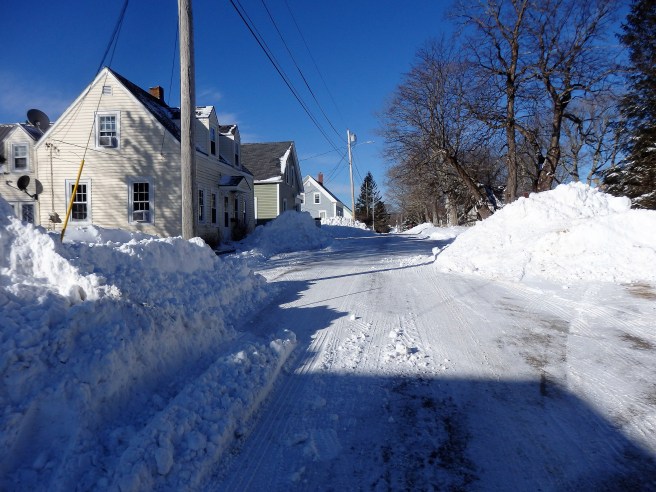
We had generally cleaned up from earlier snowfalls, with only a light covering left in town, before last weekend’s blizzard blew in. And, oh, my, did it!
Officially, we had 19 inches, though stiff wind and wicked gusts left some patches surprisingly bare, along with most roofs, but then piled the offset precipitation in the lee.
We were also hit with a widespread electrical outage, which fortunately was repaired in about only an hour or a bit more. I was braced for two or three before getting worried. Oh, I do miss having a wood-fired stove, though one is in our plans. And we do have a generator on order, one that would have been in by now if only we weren’t trying to relocate its proposed placement to allow for a tiny future full-sunlight garden, which is, in fact, now buried by the snow plow driver. Life gets complicated.
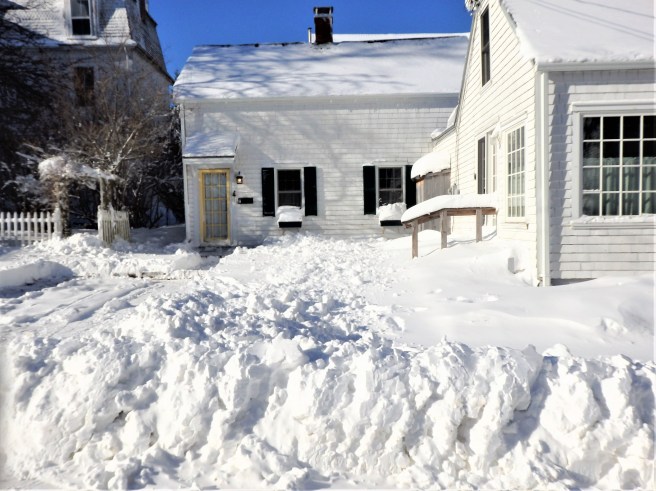
Shoveling out the front entry allowed for lighthearted conversations with passers-by, not all of them walking dogs. One woman even showed me a phone picture of her son or son-in-law’s back door, which was floor-to-ceiling snow when they opened it. Yes, I was deeply grateful ours wasn’t anything like that theirs.
So far, according to the weather service, we’ve had about 48 inches so far this season, but this last storm was the doozy, as you can see from our digging out. But, wait, there’s more, as the cliche goes. Tomorrow and the day after are expected to deliver another foot or so, the figures are still bouncing around. Dial up, scale back. Yeah, folks around here are skeptical of the forecasts, for good reason, but not stupid, either.
Reminds me of the guy behind me at the IGA checkout before the last blast. He had baby spinach and some related healthy ingredients followed by an impressive selection of wine. And you thought it was always milk, bread, and canned soup that got cleaned out?
Now, the big question is this:
If we get hit by this much snow in the days ahead, where we will put it?
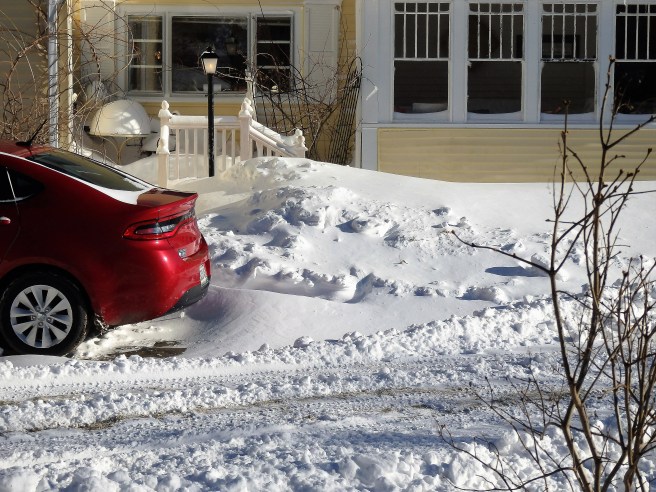
Note the raised porch.
Traditionally, February and March can bring the big whammies in New England and neighboring Upstate New York. This could get interesting. Or even tedious.
From the git-go, there’s been a rivalry between Portsmouth and Dover, though a closer look reveals it’s more nuanced than what we usually think.
The 1622 contract for developing the Piscataqua watershed allows for more than one vessel to arrive and more than one settlement to be planted along the river.
Scotsman David Thomson is the head of the operation. He sets forth in the Jonathan and establishes his fortified Pannaway plantation at the mouth of the river in today’s Rye – not Portsmouth, contrary to the Port City’s claims of founding. He’s highly placed politically, somehow having the ear of King James I. And specifically, he’s the only one named in the grant.
Pannaway faces the open Atlantic, with salt marsh to its back.
As the scene stands today. The landscape has changed but not the waterways.
~*~
IN CONTRAST, when the Providence arrives a month later, she apparently sails straight up the river to today’s Hilton Point aka Dover Point, where Edward Hilton and Thomas Roberts then set up operations. They disembark at Pomeroy Cove, which they name for Leonard Pomeroy, one of the three principal backers of the project. He’s also Lord Mayor of Plymouth, England, home of the company, and co-owner of the ship that’s brought them this far.
As I detail in my upcoming book, Hilton likely knew of the site even before setting sail. It was far enough inland to be sheltered from violent storms. Vast forests extended from the riverbanks, with timber for shipbuilding, piers, and barrels as well as homes and bridges and wild game for the taking. Best of all, the point was a confluence of rich tidal waters, with the Great Bay estuary on one side along with its tributary streams and, on the other side, the Piscataqua and its Cochecho and Salmon Falls rivers. Cod, salmon, sturgeon, eels, herring, oysters, clams, and lobsters are bountiful. Why go out to sea when the fish come right up to you?
While Pannaway is thoroughly documented, in part through its stream of visitors, its existence is short-lived, and the site’s abandoned by 1626, when Thomson relocates to an island in Boston Harbor and disappears soon after. His widow then promptly marries Samuel Maverick – yes, the source of that word. It’s a rough-and-tumble world.
~*~
OUT OF THE SPOTLIGHT of documentation, Hilton and Roberts continue on, in time joined by Edward’s brother William and their sister or possibly cousin Rebecca along with more family.
Either way, Roberts and Rebecca soon marry and start a farm about a mile from the point – they later move it another mile-and-half – but theirs will still be the oldest family-owned farm in the future United States well into the 20th century.
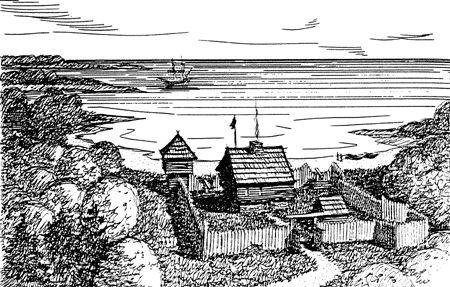
The Hilton Point settlement as it’s commonly been envisioned.
It must have been lonely through much of that first decade. The Hilton-Roberts clan was definitely on the frontier, and ongoing war in Europe cut off much ship traffic.
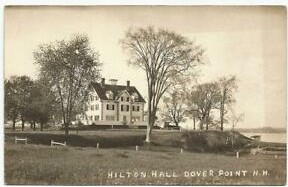
How much, if anything, did Hilton Hall originate in the early settlement at Dover Point? If the house was anywhere near this size, my perspective changes completely.
Edward Hilton is, however, definitively rewarded for his six years of habitation and hard labor by a charter giving him clear control at Dover Point. And they must be prospering, as seen in assessments placed on their province or his brief return to England for the legal document, perhaps a fish delivery, and definitely a marriage.
While Thomas and Rebecca Roberts remain in Dover for the rest of their lives, her brothers eventually move on – Edward to Exeter and William, by degrees along the Maine side of the Piscataqua. All of their lives take colorful turns along the way, which I relate in the book.
Even though Portsmouth baldly claims 1623 as its founding date, it had no European settlement until the Laconia Company chose to set up operations there in 1629 or 1630, calling their site Strawbery Banke. Yes, that was one more convolution of investors.
~*~
AND THAT’S THE BARE-BONES VERSION. There’s plenty in my upcoming book to flesh it out, some of it rather earthy – especially when we get to the contemporaneous and scandalous Merrymount plantation down on Plymouth Bay.
Fact: New Hampshire is the second-oldest state to be settled in New England. Older than Connecticut, Rhode Island, Maine, or Vermont.
Tourists may get a taste of a distinctive natural wonder in a particular landscape during their brief stay, usually in prime season, but it’s not the same as dwelling there through an entire year. A winter night or storm, for example, is a much different cosmos than a summer day.
I’ve been fortunate to have experienced some remarkable destinations through all their varying weather, thanks to my career moves, but never to the degree of living largely alone, as Henry David Thoreau did at Walden Pond or Henry Beston along the dunes on Cape Cod.
I’ve come to know both places firsthand over the rotating years, and so reading the two classic books that emerged from them evoked personal awareness of scenes that likely struck the general reader as exotic or even confounding. I never would have appreciated them the same way had I still been in the Midwest or Pacific Northwest, for certain. Quite simply, the encounters provided a stronger foundation for revelation of so much I had missed.
One of the fringe benefits of my second marriage was that my stepdaughters’ Grandpa Jim lived in Wellfleet on the Lower Cape, or what Beston more clearly calls the Outer Cape. (Understand that the Upper Cape is south of the Lower Cape, much the way Downeast Maine is really up the coast. Welcome to New England.) So we got to visit throughout the year, making me a big advocate of visiting popular travel sites in the shoulder season. There’s no way to describe walking several miles along the surf below the bluffs and having the expanse totally to myself – in perfect weather the week after the normally crowded Labor Day.
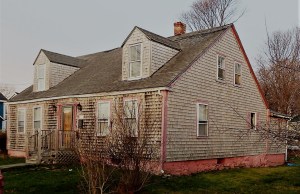
There’s a reason it’s called a Cape, or more technically, a full Cape. Here’s how ours in Eastport looks before the renovations begin. It was likely built more than a dozen years before Henry David Thoreau retreated to Walden Pond.
My wife used to gaze on the few remaining gray cabins atop the bluffs and voice a dream of living in one of them – the National Parks Service has been removing them piecemeal – noting that you wouldn’t want to have anything there you wouldn’t mind losing to a hurricane or nor’easter.
Beston’s 1928 The Outermost House tells of spending a year in just such a house only one town south of Grandpa Jim’s, and so I could envision and even smell much of what he describes.
At first, I was put off by the feathery, slightly Victorian language, as well as the affectatious British spellings rather than American, but once Beston presented some sharp, detailed observations of wave and wind motion and sound, I was captivated. His examination of waterfowl and other birds, especially, is admirable, but the range of shore and sea life he portrays is also encyclopedic.
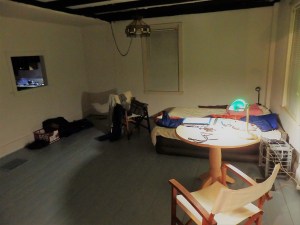
Here are my luxury accommodations the first months in town. I essentially lived in two rooms, spilling over into two more.
He writes from a time when the Cape still retained an older character that was being overlapped by newer ways that included telephones and flashlights, both unlike today’s suburban feel, and his book is credited with inspiring the creation of the Cape Cod National Seashore to protect the wildlife and geology he treasured – as many of us do today, thanks to the protections.
My reading came a few months after moving into my own equivalent of Beston’s cabin, albeit it much further up the coast and in a fishing village – still in view of the ocean.
You’ll be hearing a great deal about it through the coming year.
Are there books you’ve especially enjoyed because they’re rooted in places you know?
To understand why a third of Dover became Quaker in the mid-1600s, we need to go back to the very founding of the colony.
The whirlpool in Sir Ferdinando Gorges’ coat of arms eerily reflects his role in New England’s early settlement.
The common presentation of history has New England settlement being prompted by a quest for religious liberty – you know, the Pilgrims and then the Puritans – but close examination finds that’s not the full story.
For instance, the first permanent English habitation, Plymouth in southern Massachusetts, is only half Pilgrims – the other half is diverse individuals looking for economic opportunity. The colony is also heavily in debt to investors in London who dictate much of its operation. Religion isn’t on their radar.
There’s nothing altruistic in the investors’ role. They’re looking for quick returns on their money. Their eye is on gold and silver or at least a shortcut to the Far East and its lucrative spices. Trade for furs could also be lewdly profitable. And then there’s the possibility of creating landed estates in the New World, where they could live at ease as gentlemen farmers supported by the rents paid by their tenants once the time’s ripe.
All of that puts the investors at odds with settlers who are out to establish homes, livelihoods, and security.
~*~
AS A FURTHER COMPLICATION, the investors come in layers. One company holds rights to the development of all of New England and then enters agreements with others interested in specific tracts, sometimes within a specified timeframe.
Sir Ferdinando Gorges is the godfather of all this and plays a crucial role in the birth of Maine, which emerged largely on its border with Dover. Quite simply, the Maine side of the Piscataqua River is a big part of early Dover’s community.
Sir Ferdinando’s business associate, Captain John Mason, emerges more directly as the proprietor of New Hampshire itself.
Together, only two years after the Pilgrim venture, they negotiate with a band of Devonshire merchants to settle on the Piscataqua River, today’s border between New Hampshire and Maine.
~*~
THEIR AGREEMENT SPECIFIES seven settlers – and, as we will see, that implies their families, servants, and laborers – intent on commercial opportunity. Forget religion.
Captain John Mason may have owned the province of New Hampshire, but fate intervened before he could set foot in it.
The Puritans, pointedly, are nowhere to be found. They’re still seven or eight years off in the future. Their arrival to the south of New Hampshire will, however, spark a culture clash and ongoing power struggle that will include Maine. As you’ll see, the plot thickens.
In the meantime, the odds are greatly against the survival of the Piscataqua enterprise.
Other attempts in New England have failed, some without a trace, as would others. The Plymouth colony is faltering.
Remember, nobody finds gold or silver or that shortcut to China.
Even so, Gorges and Mason leave a deep imprint on the future Dover.
As do Edward Hilton, a member of the powerful fishmongers’ guild in London, and his apprentice, Thomas Roberts. Their outpost at Dover Point is the start of the seventh oldest permanent European settlement in the United States – and the third oldest in New England.
Edward has been recognized as the Father of New Hampshire.
Thomas, however, is generally neglected, even though he has a more central role in its continuing development. He even becomes Quaker, for all intents and purposes. And though an apprentice, he’s not a disadvantaged youth looking for a step upward. He comes from a privileged family, and his father, by some accounts, is about to become a baron.
~*~
ALL OF THAT’S PART of what we’ll be celebrating next year – 400 years after their arrival. And my new big book tackles some of the story.
Dover Friends have long relied on the story of the three Quaker missionaries who came to town in 1662 as the origin of Dover Friends Meeting. They were severely persecuted and whipped, the subject of a well-known John Greenleaf Whittier protest poem, yet they were promptly followed by more itinerant ministers and soon a third of the population was Quaker.
The Puritan authorities had enacted harsh anti-Quaker laws. Anyone who even listened to a Quaker for an hour or owned a Friends book or tract could be imprisoned, fined, have an ear loped off, or have the flesh mutilated with a red-glowing branding iron. By the time the three women – accompanied by two men – came to Dover, four Quakers had been hanged in Boston. Yet in some places, a few people listened and even hosted them.
Dover, obviously, was one – and, as I find, had welcomed Friends even earlier than we’d thought. In 1659, some residents were fined for neglecting public worship, meaning the Puritans’ services, and attending Quaker Meeting instead.
My central question keeps asking what made Dover, of all places, so responsive to the controversial Friends message? What made some residents so willing to defy the prohibitions and risk the consequences?
My upcoming book delves into the findings, but quite simply, the town had been rocked by divisions for much of its then-short existence. At one point there had even been an armed skirmish between rival ministers for the town’s tax-funded pulpit.
~*~
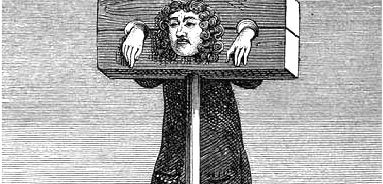
Merely listening to a Quaker could lead to this. Hours hanging in the town stocks.
Some grudges are harbored a long time, awaiting the right opportunity to flare up again.
Or, for repeated offenses, even being branded.
Another factor to consider is the ways that Dover’s settlers differed from the majority of the Puritans to the south. Dover’s came overwhelmingly from Devon, a large shire in South West England, while the Puritans were rooted in East Anglia, to the other side of London. Culturally, they differed strongly, from accents and cuisines to courting and marriage patterns to superstitions and social customs. It’s something Dover shared with two Quaker hotbeds nearby – Salem, in Massachusetts, and Hampton, down the coast of New Hampshire.
Frankly, I’ve been surprised by the degree to which Dover was a center of controversy and scandal in the mid-1630s and a bit on, all so early in New England’s history.
Much of the Atlantic coastline hadn’t yet been settled. What happened in Dover fuels a big part of my big book and definitely sets the stage for what follows.
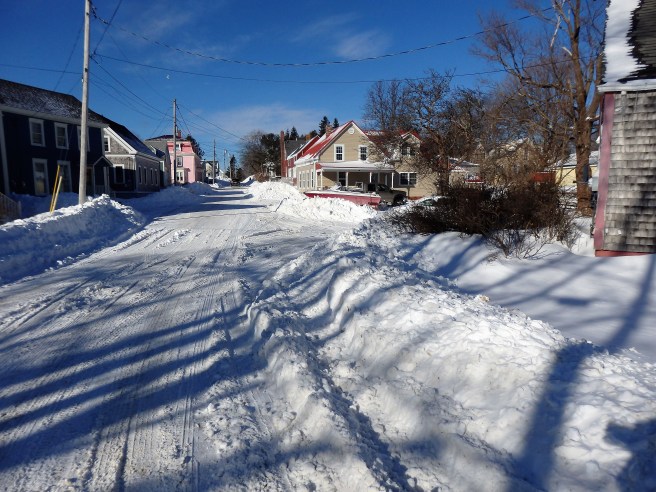
Weather Underground kept scaling back its anticipated snowfall here, cutting it to a tad over three inches. Instead, we woke up to this yesterday, about 9½ inches after a day of blizzard conditions. Seemed strange going from near whiteout one day to cloudless blue the next.
Gotta dig out to make room for more.Should I mention this was a break in our ongoing gale conditions?
We’re bracing for subzero temperatures in the coming nights, but a minus four is still ten degrees warmer than just up the road. And then another half-foot is on the horizon.
I know we’re hardly alone when it comes to scenes like this, and I’m grateful I no longer have to commute through hazardous storm conditions.
I thought we Dover Quakers – or more formally Friends – had our long history covered. I had even helped Silas Weeks, way back, in some of his research for his definitive volume on New England Quaker meetinghouses and burial grounds.
Frankly, after revising and republishing seven novels after the appearance of my eighth, I wanted a break.
A big break.
These are supposed to be my retirement years, OK? Admittedly, I had long imagined devoting myself to the writing as a big part of that dream, but really!
But then a casual request for an overview of Dover Friends history changed everything. It came indirectly, through someone in another denomination who was active in our Sanctuary movement. But then, going back through my filing drawers, I came up empty – couldn’t even find my folders of notes. What we did have was mostly about our three meetinghouses over the years – especially the structure where we’ve worshiped since 1768 – along with a few prominent events.
This left me unsettled.
Unlike many other denominations, the Society of Friends, or Quakers, is first and foremost about its members. Our definition of church is the body of believers – not the building or the polity and definitely not the ordained clergy. It’s why we call our building a meetinghouse and why we organize as Meetings, reflecting the times and ways our church-people come together. Church can happen whenever and wherever we are, even over dinner in our homes or chance encounters on the street or in the midst of social activism. And vitally it’s not just us – we’re meeting God, too.
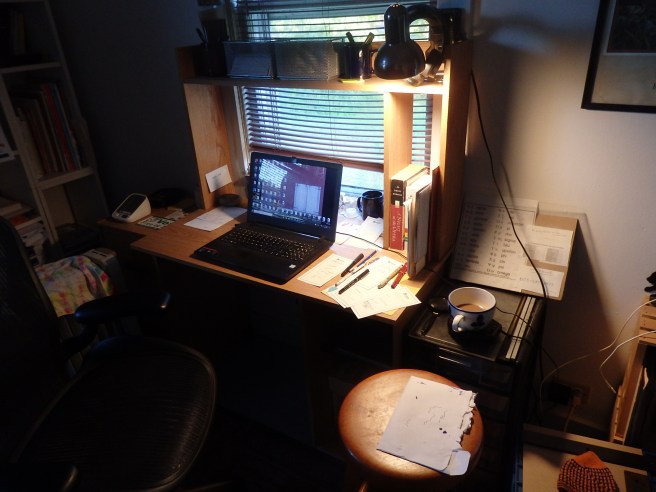
I spent a lot of time at my impromptu workstation in Eastport, Maine, last year working on a history of Quakers in Dover, New Hampshire. And I arrived with what I thought was a largely finished manuscript. I was mistaken.
~*~
WHAT NEEDED TO BE TOLD was the lives of the individuals and families who were the essence of one of the oldest Quaker Meetings in the world.
I resisted as long as I could but finally succumbed. Who were they? Why were they so willing to risk severe punishment and persecution imposed by the Puritan authorities? And in the face of that, how and why did a third of Dover’s population quickly become Quaker? And several generations later, start fading away?
With the 400th anniversary of the settling of Dover – and thus New Hampshire, too – coming up next year, the timing for our side of the history felt right.
Now that the book’s written and revised, I’ll be sharing some of my findings with you as well as news of publication itself as that nears.
~*~
WHAT EMERGED IS A PARTIAL HISTORY, as in partisan, with my focus on a radical religious subculture that thrived in a unique, out-of-the-way, locale. Partial, as well, to the independent streak of New Hampshire against more powerful Massachusetts authorities to the south. Partial even in being incomplete as well as lacking footnotes, and not even the work of a professionally trained historian.
The story is also partial in being biased toward a sequence of unusual, sometimes roughhewn, figures and their families – not all of them Quaker – and inclined especially toward the narrative they shape.
The roots, as you’ll see, arise in the very beginning of English settlement. Forget what you’ve assumed about New England before Paul Revere and Sam Adams and the American Revolution and Boston as the Hub of the Universe.
A lot had already happened before the first Puritans sailed into Boston Harbor. Let’s look instead to Dover, which lays claim to being the seventh-oldest continually inhabited European settlement in the United States.
In the standard telling of the founding of today’s city of Dover, New Hampshire, two brothers arrived from England in the spring of 1623 and settled at the mouth of Great Bay on the Piscataqua River, upstream from the Atlantic Ocean. The brothers were fishmongers, members of one of the oldest and wealthiest guilds, or great companies, of London.
Except, as it turns out, one of the brothers didn’t arrive until a few years later.
Instead, the cofounder of the new settlement was a fishmonger apprentice who would be an important figure in the early years of the colony.
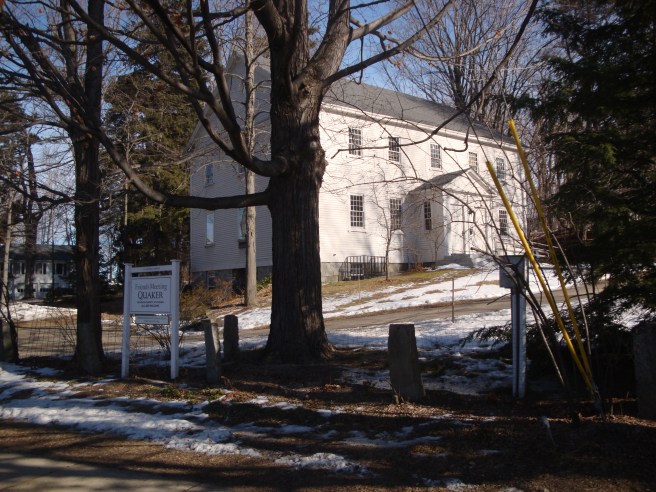
The meetinghouse, Dover Friends’ third, is home to the faith community today. It was erected in a single day in 1768.
~*~
YOU’LL PROBABLY BY AS SURPRISED by this alternative take on New England history as I’ve been. It’s not just Quakers. There’s much more to New England’s past than a Thanksgiving dinner and a riotous tea party followed by a midnight ride and the shot heard ’round the world or even the notorious witch trials.
Here at the Barn, you’ll definitely be hearing a lot more about this big project through the coming year. Believe me, some of the findings will be startling.
I like to think that natural beauty can be found anywhere, but I have to admit that too often, what’s happened is that brute ugliness has prevailed in far too many places, typically as a result of greed. There’s no excuse for much of that, either. A little extra expenditure could have added grace to any development, created visual intrigue, lessened the harshness. Urban or rural or what’s in-between, alas.
Whenever possible, I chose career moves that opened me to natural or artistic settings and inspiration – along with opportunities to shine professionally. It’s meant avoiding suburbs, for one thing. Sometimes, though, it’s also meant invoking a sliding scale of value – you know, finding pockets of serenity within otherwise harsh localities. And then there were some other postings that principally industrial, even when it was mostly farmland. So it’s been a mix.
Still, as I’ve said, I came to realize that had I remained in my native corner of Ohio, I wouldn’t have been able to write poetry, the vibe was simply wrong. Or, if I had, it would have been much different from what I’ve done.
On the other hand, the four years I lived two hours east of Mount Rainier, back in the late ’70s, gave me repeated access to one of America’s greatest national treasures, often from lesser-known perspectives. What memories! And that’s before I turn to much of the back country and wilderness that was closer to our home. I even came to love the beauty of the desert where I was living, a landscape that initially struck us as hideous.
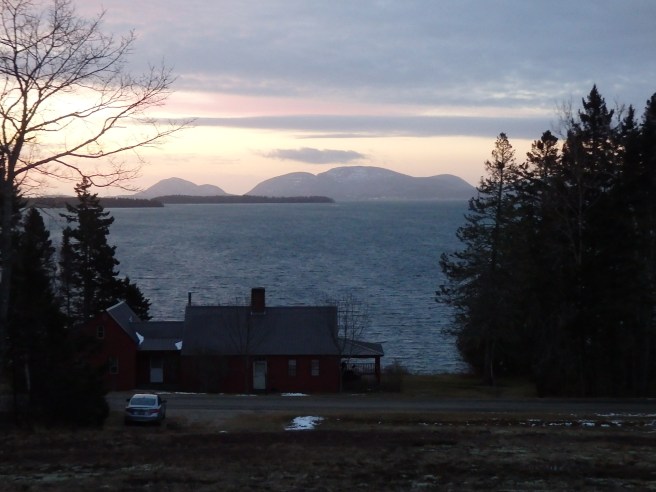
Mount Desert Island, home of Acadia National Park, glimpsed from the east.
Now I’m finding myself dwelling two hours east of an even more popular natural park, Acadia. Already, I have glimmers of many backwoods and remote rocky shores to explore in-between.
Technically, all of Downeast Maine is also Acadia, the French name of the region. For most folks, though, Acadia means the park.
The biggest land mammal out west was the elk, while here in northern New England, it’s the moose. Just as the celebrated shellfish here is lobster, rather than Dungeness crab.
The fact is, for many people, either place is about as close to paradise as you’d find on earth.
And, yes, I’m feeling lucky – or especially blessed – that way.
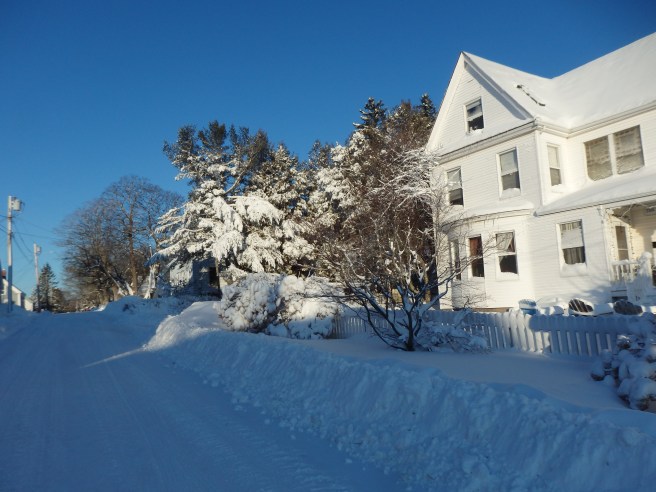
At the beginning of the week, we had a tease of the Christmas-card expectations of a white holiday. Whether it holds to the big day itself is always in question, and the forecast seems to shift hourly. Even so, enjoy the scene.
Classic. Look closely, and you’ll even see deer tracks.And this was just down the street.






 Jnana's Red Barn