Behind the first English ocean-going vessel built in the New World

Most Americans, dare I venture, have vast gaps in their knowledge of the history we inhabit. And inherit, as well.

Even though I had visited the site several decades before I wrote my book Quaking Dover, the impact of the attempted Popham settlement came back with a whammy in the developments that followed.

More recently, a post-concert conversation with Fred Gosbee of the folk-music duo Castlebay thickened the plot.

Here we go with ten points.
  1. As far as North America goes, the French had already failed with their St. Croix Island settlement, 1604-1605. I’ve posted on that previously, since it was only a few miles from where I now live. Quite simply, New England winters can be brutal. The English established a toehold in Virginia, at Jamestown, 1607, and were attempting a twin in today’s Maine, at Popham. Again, weather would be a factor.
  2. Sir Ferdinando Gorges, the godfather of New England, as I describe in my book, was the major mover behind the project. As I’ve argued, he’s largely overlooked in his impact on what would become New England. The Native honored today as Squanto actually lived for a few years in Gorges’ manor in England, where he learned English. (Alas, he had been kidnapped. Another story, no matter that Gorges was appalled.) The Puritans would arrive in New England only because they ran a successful end play around Gorges, and then had King Charles I, fatefully, fall prey. Not that I’m particularly pitying the king.
  3. Back to Popham, 1607, where the settlers at the mouth of the Kennebec River somehow managed to build a seafaring vessel during their dark winter. Try to picture them felling and shaping trees in the depth of winter, and then framing them into a ship. Where did they get the sails, nails, and other essential items? They were barely surviving as it was.
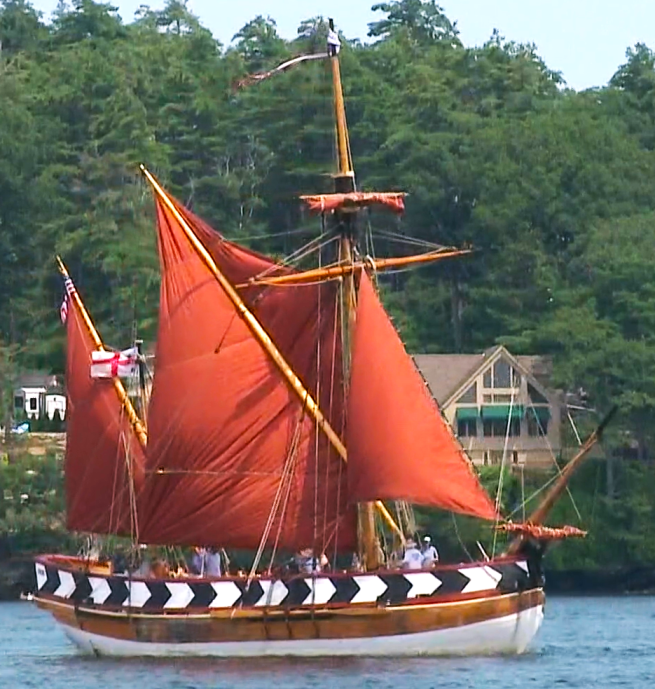
  4. The ship, which they named Virginia or Virginia of Sagadahoc, was a pinnace, a small tender. Even so, once a supply ship arrived in 1608, they were able to use it to abandon the new colony and sail back to England. The small ship not only made it but later returned to the New World.
  5. The second and third “local” pinnaces (Deliverance and Patience) were built soon afterwards in Bermuda following the loss of Sea Venture, another story altogether. Let’s just say that conditions in Jamestown were dire.
  6. One of the Popham colonists, a young boy named David Thomson, was intrigued enough to return in 1623 to the mouth of the Piscataqua River and briefly lead the settlement in what’s now New Hampshire. That plays into my Dover book, even though he vanished before he could claim any title. His colleague Edward Hilton, however, stayed on and earned due rewards.
  7. Gosbee also told me that one of the Popham leaders had also received a major inheritance during his New World sojourn. Hearing the news of his windfall, he joyfully headed a return to Merry Old England on the new ship.
  8. The site of their colony later served the bunkers at Fort Popham and Fort Baldwin on the opposite side of the river, defenses against intruding vessels. The beach, meanwhile, is a very popular state park with some of the best swimming along the Maine coast.
  9. The Jamestown colony, meanwhile, could be the basis of a big, juicy, scandalous streamed series. Folks who are opposed to “woke” would be truly rattled by the turns in Virginia’s origins.
  10. A replica of the Virginia now has naval scholars wondering about some of the rigging. She is a most unusual vessel, from today’s perspective.
A replica of the Virginia of Sagadahoc plies the waters of the Kennebec in Bath, Maine, upriver from the site of the ill-fated Popham Colony. Can you imagine crossing the Atlantic in such a small craft?

How relative is time, anyway?

Let’s consider fourth place, as far as length in time. That is, realizing that I’ve been dwelling in Eastport four years now strikes me as a bit of a shock. I’m finding it difficult to make sense of the fact, at least in light of earlier landings.

Quite simply, I’m still settling in here, even if it’s in my so-called sunset years. And, yes, I’m still feeling this is it, a very suitable end of my road, even if I am being greeted by name by people I don’t recall knowing, this is in sharp contrast to earlier locales.

For perspective, those shorter spans were in my early adulthood: Bloomington, Indiana (four years in two parts); Binghamton, New York (1½ years, in two parts and three addresses); the Poconos of Pennsylvania (1½ years); the town in northwest Ohio I call Prairie Depot (1½ years); Yakima, Washington (four years); a Mississippi River landing in Iowa (six months); Rust Belt in the northeast corner of Ohio (3½ years); and Baltimore, my big-city turn and turning point (three years). You’ve likely met many of them in my novels and poems.

Looking back, each of those addresses was filled with challenging turmoil and discovery, soul-searching yearning as well as glimmers of something more concrete and fulfilling just ahead.

In contrast, my longest period of living anywhere was Dover, New Hampshire (21 years), my native Dayton, Ohio (20 years), and Manchester, New Hampshire (13 years).
‘Big cities’ in my life

I’ve long been fascinated by major metropolises, or at least the concept of a downtown as a pulsing power center buzzing with fashionable activity. My hometown, while a thriving city at the time, never struck me as “big.” As for glitz? Forget it.

In the list I’ve assembled, each of the cities has at least one professional baseball team, and today also an NFL team, not that sports were a big factor for me. Great symphony orchestras and art museums, however, definitely were. And later, I came to see subway systems as another measure; the majority of the cities here have them.

All but one of these locations is somewhere I’ve been more than once, and we’re not even counting connecting flights at the airport. While I’ve resided inside only one of these hubs, I’ve lived within the gravitational orb of another seven.

That said, here goes, presented more or less in the order in which I experienced them.

  1. Cincinnati: I grew up about an hour away, and once I got my driver’s license, I got to know the place much better than just Crosley Field, riverboat rides, the zoo, or the observation deck atop the Carew Tower, destinations of family outings or school field trips. I’ll save the details for later.
  2. Chicago: The Loop, with its narrow canyons between skyscrapers, and the walkway along the Chicago River still embody the visceral excitement I identify as big city. An initial visit as a teen followed by visits to friends and lovers later culminated when I worked for the media syndicate of the Chicago Tribune and was whisked up high in its tower overlooking Lake Michigan.
  3. New York: I didn’t get to the Big Apple until the summer between my junior and senior year of college. I was living in a boarding house and working an internship about four hours Upstate, but after graduation I returned and had housemates and friends from The City. Visiting the place with them was delightful. Later, living in the ashram about two hours away or in Baltimore to the south, I got in for even more exposure.
  4. Seattle: During my four years in the desert of Washington state, an escape to “the wet side” of the Cascade mountains was a regular part of our existence. I’m not sure how much I’d recognize the place now, but we did have friends who’d put us up. Even then, people were worried the city would lose its charm, the way San Francisco had.
  5. San Francisco: In my one visit, there was still some charm left. Especially the affordable ethnic restaurants out in the neighborhood where we were staying, with our sleeping bags on the floor. The hippies had long gone to greener pastures, but City Lights bookstore was still packed.
  6. Cleveland: Living about two hours away, I got to know the city on Lake Erie mostly as University Circle, with its extraordinary art museum (free admission), famed concert hall, genealogical library, and Quaker Meeting. The downtown still hadn’t rebounded. I’ll also include the famed orchestra’s summer home south of town as part of the experience.
  7. Pittsburgh: Two hours in the other direction, we spent more time in Squirrel Hill and the university neighborhood than downtown. The steel mills were long gone, but major corporate headquarters still flavored the core, much more than they did Cleveland.
  8. Baltimore: Oh, how I loved the place. My first apartment was the top floor of a rowhouse within walking distance of symphony hall. The gentrified neighborhood was something like Boston’s Beacon Hill but pre-Civil War era rather than Colonial. Even when I relocated to a suburb, I spent a lot of time in Roland Park and a few other neighborhoods. The Inner Harbor was always a delight.
  9. Washington: Living about an hour to the north in my Baltimore sojourn meant I could head down easily, usually to visit friends in the Maryland suburbs. What surprises me on reflection is how little I made of the opportunity to do more. Yes, I did use the National Archive and Library of Congress a few times for genealogical research, and visited the imposing National Gallery and the Phillips more collegial collection, but I never got to the Smithsonian or White House tour or any of the monuments, really. Besides, there was nothing much of a downtown – charming Georgetown seemed to fill that function.
  10. Boston: It took me a while to warm up to Boston, but once I was living an hour to the north, my attitude changed. For more than 30 years, then, I turned to its museums, theaters, concert venues, bookstores, record stores, restaurants, and more, even contradancing two or so times a week, and that was before having a girlfriend or two in the suburbs or joining a suburb community choir just beyond Cambridge. In the end, though, I was still an outsider.

I realize how much the experience of most of these places is based on walking. Pedestrian-friendly was a key element separating them from others.

Honorable mentions: Worcester, Saint Louis, Toronto, Philadelphia, Montreal, Detroit, Providence.


Oh, there could be so much more

If you’ve wondered about the many unanswered questions in my book Quaking Dover, let me say I’m hoping they become a prompt for other history fans to follow up on.

Frankly, if I hadn’t given myself the deadline of Dover’s 400th anniversary, I’d still be in the research stage rather than having a published book in hand.

I would especially be interested in pursuing what happened to Friends who were disowned by Meeting, especially over matters of marriage. How many joined other congregations – and which ones? How many drifted away from religion altogether? How many Quaker values did they continue, as well as which ones did they reject?

There are also the things from our own time that we might answer, if asked, but that will fall through the cracks. Ours are truly fast-moving times, and I’ve often been startled when presenting my own poetry and fiction to find points I have to explain to younger ears in the room. Transistors, the forerunner to computer chips, was a prime example.

So here we are once again, looking ahead and looking back in our own lives.

As for Dover, as the big 400th anniversary wraps up?

Happy New Year, all!

In all of the holiday festivities

In the colonial era, neither the Congregationalists/Puritans at First Parish nor the Quakers/Friends observed Christmas.

So much for singing festive carols or decorating a tree.

The Friends didn’t sing at all, actually, unless it was somehow spontaneous.

At First Parish, meanwhile, a bass viol was introduced in the 1700s to accompany the hymns.

That gave way in 1829 to an organ built by Bostonian William M. Goodrich. In 1878, the instrument was rebuilt and repositioned by Hutchings-Plaisted of Boston, with alterations in subsequent years.

In 1995, a thoroughly revised instrument was unveiled, the work of Biddeford, Maine, Faucher Organ company. A hybrid of the original pipes and of newer electronic and computer elements, it’s a monster machine capable of rattling the house and shaking the bottoms of your feet.

I am glad we simple Quakers don’t have to pay for its routine maintenance, though I am grateful for those who do.

Not bad for holiday festivities, including accompanying a community-wide Messiah sing.

It’s not the only option in town, either. For some, those carols have to wait till the end of Advent, when the Twelve Days begin.

And, for the record, the Greek Orthodox start celebrating Christmas 12 days later.

As for some of Dover’s conventional histories

I’ve previously mentioned newspaper editor George Wadleigh as a fascinating source of Dover historical narrative.

The Rev. Jeremiah Belknap, a renowned historian, proved far less helpful when it came to the Quakers. They seemed largely invisible to him.

I largely ignored the Rev. Alonzo Hall Quint, another Congregational minister, whose historical notes had been read by Wadleigh, probably when they were originally serialized in the Dover Enquirer from 1850 on. One of my reasons was practical: the scanned ebook edition of the book is nearly unreadable. Besides, even in retirement, I have only so much time. One point worthy of revisiting in the original would be the use of “inner light” in 1855 – if accurate, that would be the first reference to the Quaker doctrine anywhere. Previously, it was Inward Light, with a much different focus. I’m assuming this was a “correction” by John Scales in editing the full book edition published in 1900. Scales himself authored an independent colonial history published in 1923.

One source for later research would be the journals of the Rev. Enoch Place, a pioneer of the Free Will Baptist movement. He visited Friends Meetings in his travels from Strafford, which would offer a fresh perspective, as well as presiding at thousands of burials, baptisms, and weddings from 1810 to 1865. His might balance the histories of the period that revolve around Dover’s downtown mills.