RIDGES AND RIVERS

Someday I’ll learn the identities of clouds. Buy the chart, memorize their qualities and forms, and then watch the flowing sky afresh. This is, after all, yet another strand of mapping.

From childhood, I’ve absorbed maps. Mind travel. Concepts augmented by photographs and writings, which have often furnished a sense a such familiarity that when I arrive in a new place, strangers stop me to ask directions, even on my inaugural visit. Foliage, waters, buildings, and people fill in the lines of his maps as they stretch toward some new border. But this move, with its desert, has been an exception. Nothing’s been predictable or particularly comforting. Besides, I experience a vague agitation when venturing to the edge of my known universe. If possible, when visiting new locale, I push out a few miles further, to determine what’s over the next ridge or river — or at least down the road — as if to anchor myself within some context, rather than remain at its periphery. Curiously, I feel more secure when placing that border at some shoreline or rise — countryside, at the least — rather than within seemingly endless tracts of housing, factories, stores, and pavement. Even a round earth has places where monsters may lurk. Gaps exist in any map. Consider the clouds. Everything is, after all, changing. Even that rock, where Kokopelli is sitting.

For more insights from the American Far West and Kokopelli, click here.

RELICS, IN TIME

1

along the edge
where river after river, cove and forking
confuse and disguise without end
each minaret has a name, often two

a badge
capped by a dome
a green-copper half-moon
above glass and the flash
or a triangular
arrowhead pointing to Heaven

the occasional towers standing in pairs
are to be read as eleven, rather than two
in the mathematics of waves

along Cape Cod, Cape Ann, Cape Elizabeth

2

token of peril
crag and sandbar

a warning
to welcome
a warning

acknowledging most shipwrecks
occurred within sight of shore

however deceptive the calm

3

a preference for lighthouses on craggy sites
to those on lawns or hillocks

still all stand

arrayed as white prayer flags along the coast
these relics, in time

all fall away

as we journey

Poem copyright 2016 by Jnana Hodson
To see the full set of seacoast poems,
click here.

IN THE DIMENSIONS OF DAILY EMPLOYMENT

Any workplace holds confidences you can never reveal. Not that you don’t want to expose company secrets. Then, considering the office computers, fax machines, and photocopiers, you realize they’re incapable of guilt. They simply do their job — and you might find that unsettling.

Whenever I do manage to tap genuine emotions regarding this employment, no one’s more shocked than myself. Take something as simple as a pane of glass between my desk and the trees outdoors. Even on my job in Appalachian mountains, I wanted a window. One the size of a book would suffice, although a picture view would be preferred. I’ve always appreciated a panorama, a sense of precisely where I fit into the weather of a particular day. Instead, I feel trapped underground, half-buried in regulations and routine. Only a band of natural light at the far end of the fluorescent-and-steel expanse hints of sun, moon, sky, or clouds — and even that aperture is tinted. Why are my hours on the job so cut off from the rest of life? “We may as well be coal miners in carbonized veins or muscular razorbacks sweltering in midnight foundries. Is it only the sun we miss? Examine the calendar. Check on the moon’s phase.”

I could just plot my escape. I am surrounded by desert. Trek there alone. Right to the heart.

He recall the words of another friend who spoke of the paradox of Zen Buddhist freedom: the very limitations the practice imposes also lead to an extraordinary freedom. An individual who’s free in the Spirit can be placed in prison and yet not be captive — persecuted and yet unbowed — denounced and still spotless.

The Dedicated Laborious Quest, as my Teacher taught, is a truly free way.

Free, yes, with the labor.

I pick up the phone and hear Kokopelli’s whistle. He wants us to get going. Then tells me of the dance where we’ll be playing.

For more insights from the American Far West and Kokopelli, click here.

PLAIN GRAY AND GRAYING

Within the range of distinctives
of nasty red, the Capitol black
the ethereal albino instead
he aligns with the eastern gray
and the western gray.

Yet who would be saint of the squirrel?

Not Lord Rama, who caresses one
as a pet. Nor the cultivating Hermes.

The Blackfoot know him as Old Man.
As he was becoming.

*   *   *

of course squirrels have faith
of a practical sort
in running the wire, in leaping from a branch
and landing a full eight feet between trees
with such airy jurisdiction

*   *   *

in a flash         such as music
or the tail        as a sail

just leap
and grab hold somewhere    

*   *   *

the question, at heart, what was in his blood?
as well as what was it becoming?
not the patriarch, then          free from bondage

*   *   *

overhead, the years overlap
underfoot, the roots tangle

to be light, then         lighter than pigeons
or laughter and tears

become gray pussy-willow                 at the end of winter

Poem copyright 2015 by Jnana Hodson
To read the full set of squirrelly poems,
click here.

ROUNDED WITH LIGHT

rounded stones of the shoreline
or a garden path glisten
many navy blue or nearly straw

others speckled with indecision
speckled, within and without
what grows hard as rock on a rock

nearly black stones exposing white ridges
to the light, blue veins, like mothers
slate-blue orb cleft with white quartz

some color of cooked lobster
glow of berries
in dull eddies

of clamshell or snout of rising seal
given an eye, the face of a cod or shark
approaching with its mouth closed

another burnt
and still burning
none yet look like washed potatoes

between them, broken mussels and sand
firm in clear brine
each retaining its shape, for now

Poem copyright 2016 by Jnana Hodson
To see the full set of seacoast poems,
click here.

NERVOUSLY, IMPULSIVELY, SCRATCHING

what happened to all the nuts
planted back there
acorns with their hearts ripped out
all his transports in this cosmic trap
in the breach             the yard could as easily be jammed
with half-buried books
waiting to be devoured

all the same, he darts into hidden pages,
spitefully                   aware his plot was unfolding
more than ever expected

Poem copyright 2015 by Jnana Hodson
To read the full set of squirrelly poems,
click here.

MOUNTAINS AS A RELATIVE MEASURE

As I listen, I realize the locals don’t consider the surrounding ridges to be mountains. Although these “foothills” or just plain “hills” are as tall as Pennsylvania’s Alleghenies, shorn of trees, to speak of “mountains” signifies that one must drive away into forest. The time comes to hike in unfamiliar high country.

I drive west, into a mountain pass, and park at the trail head.

Climbing through clouds on Sheep Lake Trail, I identify snow lilies, phlox, two whistling marmots I mistake for groundhogs, and a ptarmigan. In these topless mountains, snow and rocks glimmer atop jagged white threads that twist, plunge, and roar over miles. In this clarity I recount a friend’s determination to perceive the important task to perform each day — a focus she achieved in the sunset of her young death. Go on.

The next outing, I follow another friend’s favorite trail. My valley of orchards and meadows stretches behind in a twilight of small-city lights and barren blue ridges. In golden splay dusk, I learn to fear glaciers atop volcanic spines and in their grooved depths, too. So much depends on which way you turn. Clouds, one moment pink, shift into slate-blue. Think of a great-uncle’s farm in Ohio flatlands when green-wood ringed the fields and autos were novelties; and how, when the United Brethren in Christ build their new sanctuary, one tree furnishes enough lumber for all the pews. Such timber is long gone from most of the Midwest, and nearly gone here, as well.

Strangely, adjusting to such disorientation can allow one to see more than the landscape with fresh eyes. I begin reckoning my birthplace afresh, too. I perceive a native poetry now vanished: in flat terrain they coined Sweet Potato Ridge Road when they became sensitive to what had been called Nigger Pike, after work crews that came out from the workhouse jail in the city; Diamond Mill Road was made of limestone gravel flecked with quartz or mica, but named for the distillery beside the rails. What could be in those rural lanes I had sped along on the way to the farm to cause their ghosts to arise out here? I think, too, of the hayloft I had delighted climbing in, even though the old folks feared I’d fall through and be trampled by cattle; more ominously, some shed rafters I walked like a high-wire artist had hogs rummaging below, with razor snouts and teeth and a latent taste for blood. That farm acreage is scarcely like these Western orchards or open ranges, yet something echoes. It’s earth and air. Sunshine and clouds. My days in the mountains are airy conifers. I could be a pioneer, in spirit, at least. My ancestors settled those Ohio tracts. Another line, a bit earlier, settled North Carolina Piedmont. Here, I find unspoiled corners.

Perhaps bears do drink beer. Rocks, leap from mountaintops into oceans. Naked breasts, swell from snowmelt pool to sky.

Against this wall, between his desert and the frigid sea current, I declare my vast ignorance: left to myself, I’d likely starve, soon sicken of berries, and have never caught fish properly or gutted a rabbit. Somehow, I wait to be fed. Thus, one point of my Dedicated Laborious Quest involves learning to be wholly myself — embracing flaws as well as talents, as I search out my own boundaries.

Away from the office and encircled by an ever-renewing earth — even an apparently lifeless desert that restores his sanity and a brand of insanity, too — you may find that every trail you follow brings you closer to your own attainment, your emerging sense of place and mission within the universe. As for looniness — ah, loco! — you soon appreciate how all are in some way at least un poco, indeed.

For more insights from the American Far West and Kokopelli, click here.

UNDER THE SEA


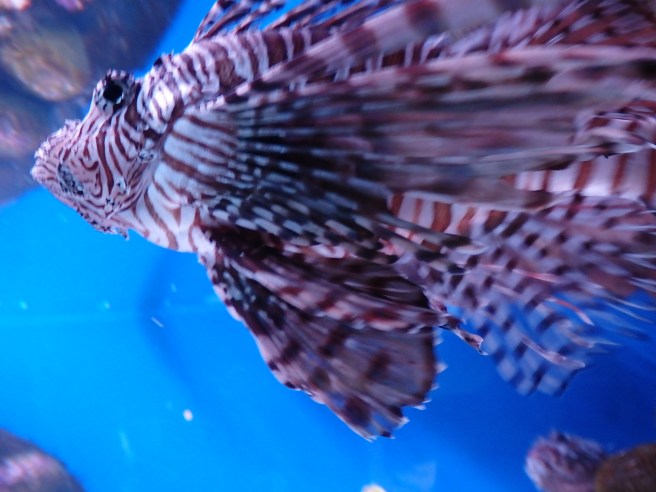
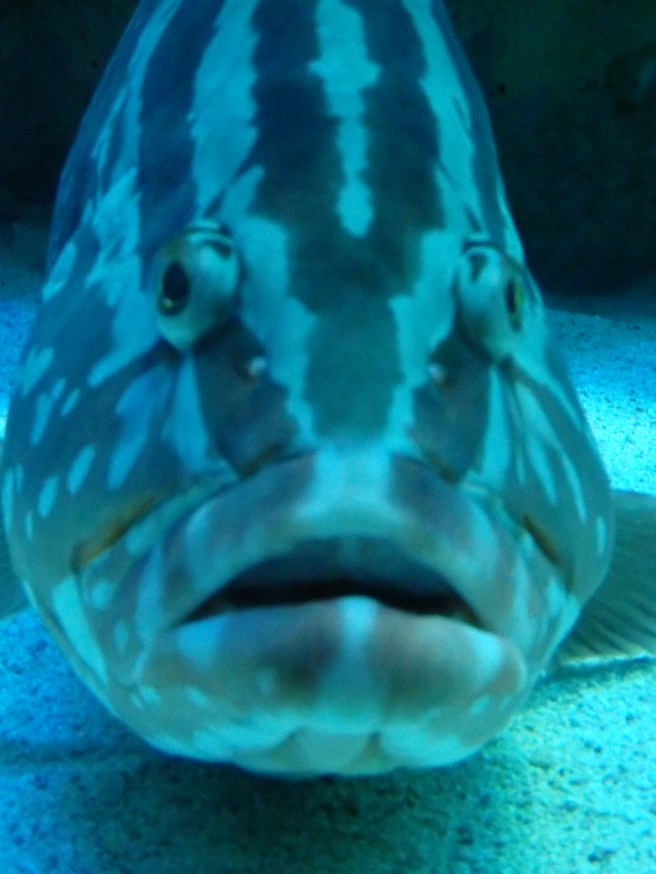
Looking at you, too ...
Looking at you, too …

The big tank at the New England Aquarium provides close-up views of oceanic stars.

Boston is a rich and varied destination – the Hub of New England, or the Universe, as they used to say. Living a little more than an hour to the north, we’re well within its orb.

Somehow, I'm reminded of a butterfly.
Somehow, I’m reminded of a butterfly.

LIBERTY

Few people move to desert out of any desire for its peculiar landscape. True, there are those who hope its dry air will alleviate some health problem, yet even they typically install green lawns and shrubs requiring frequent irrigation. There is the prospector expecting to strike riches to squander elsewhere, or the cowboy or shepherd accompanying the herd or the flock, or a refugee or smuggler moving across the opening as a place of the least likelihood of detection or the least resistance in the border. Admittedly, some come to a particular job or to retire. Some come for opportunities of outdoors recreation — proximity to forested mountains or snow-fed rivers rather than the tawny dry ground itself. Almost all, however, have taken flight from something back there — whatever their birthplace or last residence — more than any deep conviction that this horizon embraces their Promised Land. They arrive with boxes and garments, with reminders of conflict or distance. Moreover, they cling to the desert fringe — settling in oasis towns or cities where irrigation water rushes along cement ditches — rather than miles beyond their next neighbor, with only buff surroundings.

My wife and I are no exception.

At the office, I’m asked, Where were you born? What brought you here? Where are your parents? I calculate: few children live within a day’s drive of grandparents, aunts, or uncles. Compared to my birthplace, cemeteries are rare. Nobody admits fleeing family, which is a fact of life. The trout fishing, they say, is unsurpassed. There is salmon. If you have water, you can garden nearly anything to perfection. You can hunt elk in the mountains or various quail in the foothills. You can raft on the river. There’s no rain to speak of, and overcast days are infrequent, excepting the winter.

I explain my reasons were professional. I’m establishing a career and am something of a specialist whose last job was eliminated by sharp, painful budget cutbacks. Here, at least, I have opportunities to advance as a manager, working under a progressive-minded mentor. I accept this move as a shortcut before moving on, to bigger things beyond that horizon. Besides, I’ve promised my wife that somehow we’d relocate to this corner of the nation, a place she fondly remembers from four years of childhood. Following me in this move, she’s distraught to find desert where she anticipated rainforest. In short, both of us suffer dislocation.

Here, then, a rewiring begins. Some of it connects the person to the place. Some of it, the two people to each other. Some of it, the individuals to their dreams.

Horses preserve a way of desert life. Consider rodeo. Agriculture is spelled rancher, not farmer: Even fifteen acres becomes a ranch. There’s great distance nearly anywhere you’d want to go. Religion polarizes into New Age, on one hand, and fundamentalist, on the other, with little in between; this condition is as true within denominations as across the diverse range of religions themselves. There’s a different spectrum of ethnicity to contend with, too — Native-American, Hispanic, and Asian. More, too, than the Eurocentric nationalities and African consciousness he had seen Back East — to say nothing of rearranged economic strata. Within and without. The bum on the corner turns out to be a multi-millionaire who owns a thousand acres. Here cattle are not cows; it’s beef rather than dairy. Federal government agencies are omnipresent: the Bureau of Reclamation manages hydroelectric generation and irrigation; beyond, there are military bases, national forests, tribal reservations, high country meadows, famed parks, Corps of Engineers reservoirs, state-owned sporting grounds, horticultural boards, Extension Service projects. People apply to the Feds when they file for grazing rights or mineral mining stakes supposedly there for the taking. You’ll observe unspoken contradictions, beginning with the right-wing rhetoric common within these federally subsidized communities. As for the Bureau of Reclamation: how dare we say we’re reclaiming when we’re merely putting our human stamp on a piece of soil by diverting water and planting? Maybe we’re declaiming or proclaiming instead. The Bureau of Indian Affairs appeared even more unsettling. Chiefly …

I am learning. There’s good reason the rattlesnake-infested, corrugated humps encircling the orchard valley are pale brown: they receive none of the snowmelt impounded from late March into July in the high mountains. Agencies release and distribute that water through blazing summer into October. Green agriculture parallels the river and irrigation canals, defying the tough, roasted inclines above, where sagebrush and bunchgrass stroke tawny eternity. In this compass, wind rarely precedes rain. Beyond lucrative strips of orchards, the principal agriculture involves herds or hay; because of irrigation and unfettered sunlight, five mowings a year are common; bales are trucked to dairy cows and pleasure horses on the rainy side of the tall mountains. Desert has few chickens — and no pigs to speak of. Somewhere out there, Basque shepherds elude the heat. Forests begin at the top of high ridges observed fifty miles distant.

In the Far West, most men hunt and fish. Their goal is big game: deer and elk, especially. Big trout and salmon, too. Everything else remains “Back East” or target practice. Its vastness hammers the imagination.

On our journey westward, we notice that Custer National Forest flanks the barren holdings of the Crow and Northern Cheyenne reservations. Somehow that summarizes a Far West polity in what I thought would be a classless society.

For more insights from the American Far West and Kokopelli, click here.
BY DAY, BY NIGHT

1

I admire a lighthouse more than a ship
without masts, as a qualifier

anchored in some upstanding foundation

I, who have roved the continent
and no further
gaze from the shore

or out, from the water,
to peer at each obelisk
instructing the coastline

yet masts, in open sail
could make this a wash
or a wish-list

2

I look in vain for a painting or photograph
of ocean only
always some shoreline
or ships – naval battle
conflict or simply
what attempts to bridle wild space

the lighthouse, as a genre, especially
countering the fabled variations of blue

at last, O’Keeffe’s large canvas of clouds and sky
comes closest
even more than her cross by the sea

3

costly as a ship
to construct and to run

this marker
of commerce, progression, and change
made obsolete, still

a warning as welcome

faithfully alludes to danger
in homecoming

a way around obstacle
a passage through the mouth
to safe landing

as much as the other abode
sailors justly dread

4

in daylight, a solitary standing figure
a sentinel
upright numeral one

a spire, a prayer
shrine, stupa
gravestone

defiantly erect penis

by night, its repetition
insisting
“Here! I’m here!”
as much as “Beware!”
in a tally of shipwreck

once with its whale oil and great lenses
arrayed on a crystalline comb
investment in life

such magnification
casting its spark
so far

this rock, uttering its expletive
to death

pinprick of light

Poem copyright 2016 by Jnana Hodso
To see the full set of seacoast poems,
click here.