RETURN

1

slowly approaching a line
that grows from the edge of the sea
and then spreads at the harbor mouth

slowly, details emerge
and at last, some recognition
in what’s become familiar

home, or at least neighborhood
extending

attuned here, more than elsewhere

the awareness, something all your own
has happened with this place
but not knowing precisely when

in the tide
returning

2

introductions, by degrees
lapping and receding

even in six hours

Plum Island with Eric, Bill
and the baby, “Why don’t we leave our towels
down there?” rather than the crest of the dune

“you’ll see”
once the surf bubbled inches
from our possessions

or high tide covering the jetty
that shaded the sailboat venturing out

or entering a ferry on one deck
and exiting
on the return, from another

or weather

on a carefully selected
Sunday picnic, and air
optimal for swimming at the sandbar
only to have the Coast Guard
pull up in an inflatable raft with a bullhorn
“Out of the water! A storm’s coming!”
while the sky’s still cloudless but
before we reach shelter two hundred
feet away, the sun’s gone and a deluge opens

with or without hail

or the mid-afternoon ferry
through twenty-foot swells
and returning at sunset
on calm water

not that we’re friends
or have much of what you’d call
a relationship

3

miles inland, closer to the house
detecting high tide in marshes and rivers
or its absence

salt hay in cow milk

Poem copyright 2016 by Jnana Hodson
To see the full set of seacoast poems,
click here.

ANCIENT VIBRATIONS

Instead, I looked in another direction and discovered that the Yakama people once occupied 17,000 square miles and had three distinct language stocks. So, even back then one tongue was insufficient to articulate the vibrations of this place, even as an open desert. To try relating the qualities of a simple thing, a pane of hundred-year-old glass, perhaps; the interaction of clouds and sun, alkali and volcanic ash is far more complex. You start by learning the names of flora and fauna. Watch, listen, wait. I open a window and consider the current research, which places the first people here about 14,000 years before my arrival. These nomads made tools from bone and mineral. Hunted large and small game. Fished salmon. Collected river mussels. Gathered wild food plants. Given a guide and sufficient time, maybe I could learn to do these things. (Don’t look at me, Kokopelli shrugs. I’m not from around here.) Maybe I shouldn’t feel so strange about being here, either, even though such long perspective makes me feel incredibly insignificant. The Anglo civilization embodied here is only veneer concealing much deeper systems. The ancient climate was cooler and moister. The land was dotted by many lakes and small streams. Grasslands scattered with pine stands and willow flourished where there’s only sagebrush now. Food sources included bison, antelope, deer, foxes, muskrats, rabbits, ducks and geese (their eggs, too), and turtles.

I want to leap through time to join them, dressing the hides of their game, or making rattles and tools. These people used red and yellow pigments, and valued birds for their feathers as well as their flesh — cormorants, geese, condors, turkey vultures, and eagles all had clothing functions. Maybe I need some ceremonial garb. (Come, now! Kokopelli is hooting with laughter. He loves to taunt and mock me.) Tiny bone needles were used as far back as 10,000 years. I have enough trouble with steel needles today. So what do I make of their earliest burials, cremations that send the body back into spirit?

It’s obvious my own difficulties won’t end overnight.

This is a time of sparrows.

For more insights from the American Far West and Kokopelli, click here.

GRAY SEAL PARADISE

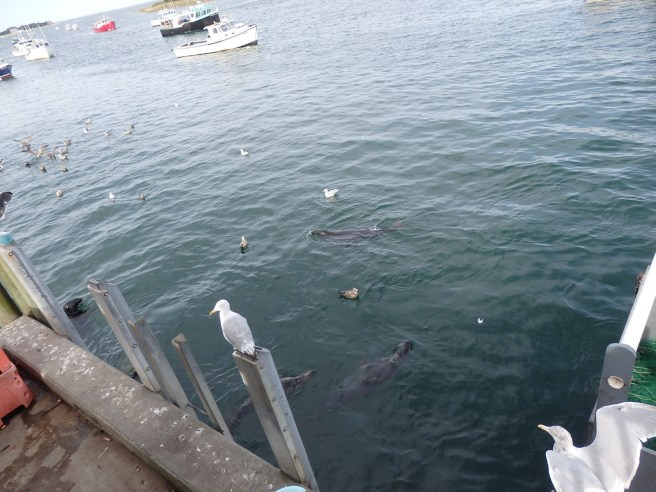
They seem to enjoy the backstroke. So do I.

The deck of the Chatham Fish Pier is ideal for viewing gray seals in motion.

The town at the elbow of Cape Cod also includes Monomoy Island, an 8-mile-long sand spit that is home to thousands of the seals, as well as great white sharks feeding on them in recent years.

Seeing four at once is common here. Another had just dived where the gulls now flock.


AS FOR WOLF

A wolf is powerful because it eats powerful food, Kokopelli warns me.

As for the girl-chasing man who’s always hungry, it’s “hair-pie,” he grins.

Although I’ve never hunted, I see points at which ancient traditions lurk within modern religious practices. Meditation, high among them, has roots in hunting and gathering. Then, too, there’s the role organized sportsmen have performed in restoring populations of wildlife, and you can learn much from hunters eminently adept at reading animals’ ways in the field. Keep an eye open.

Natures change slowly. The hunt on land and the water has barely begun.

There’s great game beyond food. Much of it, Kokopelli sings, runs through your brain.

For more insights from the American Far West and Kokopelli, click here.

ESTABLISHING DIRECTION

1

light in shimmering bronze
illuminates maritime charts and sails
unfurling with desires, an escape
in the apex of broad wakes

who you think you are
doesn’t matter
when the tide turns

a band from the North Star
turns toward harbor –
glints of affirmation or rebuke from a stranger –
ruffles bells and rigging

identities don’t matter
when the wind turns

off we go, then, and this time
this world or this way and then another

2

 five seals, headed north

their heads sparkling with stars
disappearing quickly

the austerity of beach swept clear

Poem copyright 2016 by Jnana Hodson
To see the full set of seacoast poems,
click here.

HUNTING IN THE OLD DAYS

True hunters in this country live on what they track, Kokopelli explains.

Articulating this precinct means drawing on three language stocks: Sahaptian, spoken by Klickitat, Yakama, Kittitas, Wanapam, Palus, Nez Pierce, Cayuse, and Umatilla; Salishan, by Wenatchi and Columbia; and Chinook, by Clackamas and Wishram.

Nine thousand years ago the climate resembled today’s. Around seven thousand years ago, Mount Mazama lost its head and Crater Lake emerged. Did the ash fall reduce the game? Kokopelli assumes so. About that time, Olivella shell beads show up in archeological sites, revealing coastal trade, in addition to a new kind of projectile point. About 6,500 years ago the roost became drier and warmer. Rivers ran significantly lower. Adz blades of nephrite and serpentine, about 4,500 years ago, permitted heavy woodworking and expose trade relations with what is now British Columbia. “That’s when I got this pipe,” Kokopelli says, allowing me to stroke the instrument. As winter temperatures became warmer, sizable winter villages gathered in river valleys for fuel, fresh drinking water, and greater protection from bitter winds. Such clustering required food storage capabilities and also permitted greater social and ceremonial activity, perhaps a result of more efficient food gathering. Most likely this involved salmon fishing, properly dried and preserved, caught in great numbers; fish traps and weirs were much more efficient than spears, lines, dip nets, or bows and arrows.

From this came pit houses, some of them earth-covered for insulation, others covered with mats and grass or brush. The mats swelled and froze in winter to keep wind and rain out; as spring temperatures rose, thawing provided ventilation. Such housing required well-drained soil, such as that of desert.

The tipi was introduced much later, from the Great Plains.

A-frame mat houses developed from the pit design. Their emergence especially reflected the introduction of horse culture, which added to trade possibilities and also brought saddles, bridles, quirts, dress, and ornamentation such as feathered headdresses, but above all else, ideas about tribal organization. Appaloosa were on the way. Whalebone clubs, as well as fishing nets and harpoons, were acquired through expanded trade networks.

Horses allowed more food to be brought back from summer sojourns in the mountains. Soon bowl-shaped mortars and elongated pestles were used to prepare food. “Let me tell you about real progress,” Kokopelli insists.

Each local group assumed stewardship over the economic resources of its locale. Leadership arose out of respect, not law. Ritual purification occurred in sweat houses. Three-day workouts weren’t uncommon. I wonder whether voters and candidates alike should do the same before Election Day. There is, after all, a kinship to hunting and fishing.

Kokopelli agrees.

The major run of king salmon and oil-rich sock-eye salmon comes in late May or early June, when most of the year’s food supply is caught. The best spot for dip netting is where rivers bear down through narrow channels or over low falls. Wooden platforms tied precariously to basaltic cliffs hang over whirlpools and eddies. Such stations are inherited and highly prized. Permission must be sought before fishing there.

Fish head pulverized in a mortar, then carefully packed in baskets and stored for winter, provides a highly concentrated protein food. Even a few ounces serves as a full meal.

Bears caught in a dead-fall were hunted mostly for claws and teeth — ceremonial ornaments.

Wapatoo was a type of wild potato, perhaps like camas.

Cooperative hunting and salmon harvests were common. Women’s berry picking parties, too, even though some tribes were basically river folk. Excepting the Wishram band, the Yakamas believed in individual rights. They differed from coastal tribes, which possessed slaves who might fall to a cannibal ceremony.

Much the way rabbit skins are cut in a spiral to produce long strips, I keep learning. Once you acknowledge the importance of certain foods in a given turf, you discern zone-specific energies. In ecologically aware feasting, hamburger and hot dogs are thoroughly inappropriate for many reasons. They have no authentic geographic home.

For more insights from the American Far West and Kokopelli, click here.

CURRENT, CURLING

1

 prevalent, from the west
clear and cooler, from the north
rain on the way, from the south
tempest, from the east

reading the wind

in a flag
in smoke
in running clouds
or water in a clear thistle tube

2

listen, a storm approaches
through leaves and hills
the same sound as falling water

surf repeats its snare drumming
along the shoreline

matching a far-off airplane

all voice great power
resounding

in a stream
in the tide
in air
even in a light bulb

what’s present, now
within some great
motion

around each wing
the flow of thought
keeps running

3

ring around the moon
as a warning

listen, rainfall
will warm the ocean

and swimming is best
just after high tide

Poem copyright 2016 by Jnana Hodson
To see the full set of seacoast poems,
click here.

GAME TIME

Late each autumn, hunters sip Wild Turkey. Stovepipes stick out through canvas walls. Cardboard surrounds their campfires. Nearly sullen, they hunker down in numbing wind. So much has been protected for their harvest. It’s crazy, this unreleased male desire to sing deep and loud. Call for your honey. Bellow again. With a measure of self-despair, the men admire the bulls they stalk.

In these parts, elk management thrives. Bureaucratic neckwear is a moth collection worn in a smoky room. With books resembling bear traps, Fish and Game as well as Forest Service authorities gather in what appears to be a poker party; it could as easily be city council or a gathering of the Committee of Economic Development, maybe even the Federal Reserve Board. Nobody speaks directly of the field or on behalf of its inhabitants. Each player represents a particular constituency, even though nobody represents the elk themselves. Everybody, it seems, wants a piece of action, connoting elk harvest.

Kokopelli’s prescription: Around the office, snort loudly. If there are windows, pop ’em, even when snow falls.

Better yet, leave the room. Go to the site, meet the subjects on their own ground. If they trek off too soon, it’s the regulations need adjustment.

Take note. In open country a snow-driven bull breaks trail to lead clusters of cows and calves single-file through winter range. Elsewhere a train of two hundred passes before I lose count. From these huffing creatures come vapor trails — some float parallel to a freeway that avalanche will soon block. Truck hoods and beds await them in hunting season. Through deep winter, though, elk come down to the canyon station. Feeding time’s 1 p.m.

I wonder which grandparents or great-great-grandparents witnessed the disappearance of elk across the continent, save for a few spots. I meet old-timers who recall the elks’ return in two boxcars sent from Montana, the ones that repopulated Washington State. That’s how close they skirted extinction.

Bulls, cows, and calves graze between conifer species. In any journey a name may encompass far more than anyone suspects.

Winning the state’s autumn lottery comes down to two hunters for every elk. Victors’ identities are repeated on the airwaves. Encampments arise between snowy boulders. Not every elk license winner succeeds in bagging his prey, though an elk tag will exempt him from jury duty. Any judge understands how a man on a ledge feels unexpectedly face-to-face with a stag. What thunder breaks heart and horns! Hallowed be tumbling water, on the homeward trek.

“You never forget the bull’s song,” Kokopelli says. “It curdles your blood.”

Men relate time-honored tricks of the trade. It’s the Fall of Cards. Cut the Deck. Deal Me In.

Imagine joining the Elks lodge. When buzzed in through the door, follow a red carpet hallway to the bar where barley-skinned salesmen compared their ex-wives. If a herd of real elk prances past, scouts the room, and bellies up to red vinyl barstools, take a dive. Wait for the blowhards to readjust themselves in front of the mirrored collection of liquor bottles resembling a carnival shooting gallery. Here and at Eagles and Moose dances, as well, there’s too much drunken groping for Beaver, as Kokopelli and I have observed. The game takes revenge. A shot’s a shot. Glasses and reflections shatter. Under glazed eyes, unfit individuals collapse. Their blood reaches out across the carpet. Red on red. Real animals unmask and sniff a fallen Jack of Diamonds. They paw an expiring Queen of Clubs.

When individuals participate in governing themselves, the whole business returns to the right track. All elk ask is a fair shake. Kokopelli knows many by name.

First, he says, ban all guns, motor transport, and steel traps. To be wild’s hardly enough. Before going afield, hunters must fast and enter a sacred sweat lodge. They must flake their own sharp tips and cross range on hoof.

Back at the bar, the ex-wives and widows gather. Who knows where their children are. When they understand the new rules, there’s NO BULL. The whole tribe and herd are in this together.

Simultaneously in Iowa, a man sheepishly hugs his rifle and emerges from woods with a gray pelt the size of a rat hanging at his waist. He could have been shooting beer bottles. A macho urge is not the same as hunting, my boss repeats after taking his adopted seven-year-old hunting the first time.

“Daddy, that man just said fuck.”

“That’s all right, son, that’s all right,” comes the reply. Their dove-hunting companion sips McNaughton’s; the son, a soda. The boy sticks close, raising the same questions they, too, asked as lads. The cycle repeats.

Later, the game soaks in onion before roasting in garlic or being sauteed in wine. This terrain demands many rituals.

Where desert and timberland interlace, foothills run braided above your hat brim. Tufts of grass punch through light snow. Like red mites on paper, elk advance through fog-wisps overhead. Standing beside half-iced rapids, I raise my binoculars and lose count again.

On the eve of the season’s premiere, cities of tents, camping trailers, and vans crowd into wild wood. In a state of sixty thousand elk and one hundred and twenty thousand licensed elk hunters, expect free-fire.

Opening day, an office pool bets on the quarter hour the first hunter will be hit. 9:15 it’s BINGO.

Look out. Glazed heads festoon truck prows. Multi-sail frigates careen through mountains with skinned carcasses stretched across their decks. Give the victors their trophy, even as a hood ornament.

“Many of these guys get so plastered, if anything moves, it’s open-fire,” Kokopelli says. “In the shootout, each heatedly claims the kill. Then the fun begins.”

That is, there are more intriguing animals than elk to hunt. Other armed hunters move in.

By evening, poker-faced herds pressed my rear-view mirror. They steer vans, pickups, and sedans. Slow down, and you discover their horns.

I vow never to dwell where I can’t see premonitions of seasons advancing clearly in dawn. “Watch the Milky Way turn through silence, you assume a point within millions of years of light,” as Kokopelli says. Even hunting can be timeless. Eventually, I see the Dedicated Laborious Quest as a specialized form of hunting.

In a slow drizzle across back roads in the valley, shacks and sheds occasionally relocate themselves to Wisconsin or Maryland. The green growth, scudded sky, lush shrubs, and running fields send memories tearfully home. Was I really, completely Out West?

For more insights from the American Far West and Kokopelli, click here.
SCROLL ON A SNAIL

From the stone tower atop Blue Hill
Boston’s skyscrapers resemble tombstones

“Daddy, did you build those?” A pause.
“Well, did somebody build them?”

Let us now delineate an array
of solar and lunar expectations
parenting the human condition

~*~

This sawtooth display
counters basic nature

spirals, branching, honeycomb
So which one are you coursing?

~*~

On my parking spot, Brianna’s
blue-and-purple chalk spells out

BELLE
BEAST

– perhaps she has the story straight
where beauty’s rainbow masks terror

Even a fruitcake granny can see
“He needs to get right with the Lord”

~*~

I’ve gone tracing
THE OLD SANTA FE SNAIL

Some rain. Some sun
The labor spreads before me

poem copyright by Jnana Hodson
(originally appeared in the journal Indigo)

THAT BIG BEE FUNNY MOTION

long enough we could see the flashes of ruby throat
a flash of flight in front of me
only one thing that could be, such fast motion

later, sitting in the crossbars of the feeder
before dropping to the sugar water

continue to see flits around the house
that big bee funny motion

a hummingbird at our feeder, size of a dragonfly

hummingbirds arrive late April or May
leave in August or early September
fly 600 miles across the Gulf of Mexico
bulk up in Georgia and Florida adding
an ounce of fat to their four-ounce bodies …

to wit, some most amazing creatures

Poem copyright 2016 by Jnana Hodson
For more,
click here.