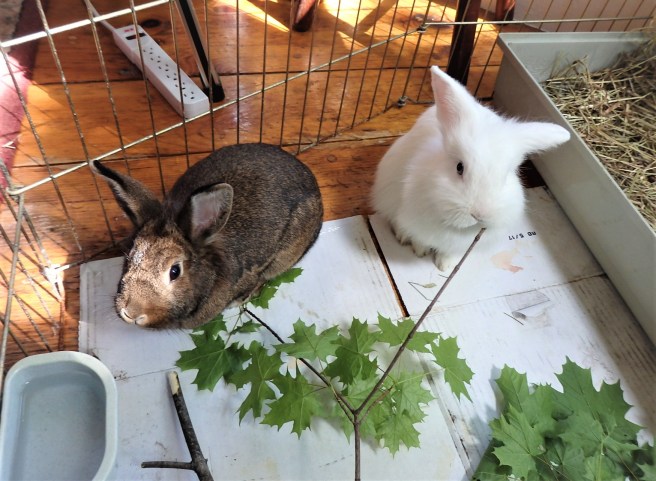
New to the family
You never know what we'll churn up in cleaning a stall
Blame my elder stepdaughter. Or give her all the credit. She took up the cause last year by setting up two beehives at her house. Her mother and I then witnessed much of the excitement and drama that followed. It was contagious.
Jump ahead to this spring. We were encouraged to get our own hive, starting with the boxes and frames from another couple at Quaker Meeting, and then, drawing on said daughter’s expertise and guidance, we launched into our own “greening” venture. I painted the brooder- and honey- “deeps” or “supers” and the landing board all a light green, and set up a concrete-block base to discourage dampness, ants, mice, and our local skunks from invading. Positioned the entry to catch the morning sun, per said daughter’s instructions. And then she taught us how to attach sheets of what are called foundations to each of the frames that go inside the boxes for the bees to build their honeycombs on. Oh, there is definitely a whole new vocabulary for us to ingest.
The buzz really kicked in when our colony and queen arrived from Georgia earlier this month. We gingerly poured them into the hive, like a big glop, and they do seem to be settling in perfectly. Watching the details is fascinating, from their purging of the drones shortly after the big move and then moving on to the guard bees who expel “robber” bees trying to invade from other colonies while the workers get their bearings, explore, and arrive home with their legs brightly loaded with pollen. Who would have thought there would be so much personality in an apiary? We haven’t even gotten to the queen bee yet,deep within the hive – we hope.
We’re not expecting to collect any honey this year – we’d rather have the hive be well supplied for its first winter – but the benefits to our garden and the surrounding environment give us justification enough.
Yes, we got bees – honeybees!

In a whimsical twist in my novel What’s Left, I placed the town along the Ohio River. Well, the navigable waterway is a defining element of southern Indiana.
The pileated woodpecker is one of the largest members ot the family, rather comical and awkward looking, at that. It’s also not commonly seen, so sightings are always exciting, at least if you have an eye for birds. (Pronounced PIE-lee-ay-tid or PILL-ee-ay-tid, by the way.)
I remember one of my first encounters was while having dinner with the Ostroms at their house perched atop a wooded ravine outside Bloomington, Indiana. One alighted just outside the window, to our shared surprise and wonder.
More recently, as I was driving with my elder daughter down a road in Maine, one was flying just ahead of us but veered off before she could look up.
A week later, on a different road, the same thing happened.
She accuses me of making those up.
So the other day, after a meeting at the Unitarian-Universalist Fellowship in Durham, I noticed two people in the parking lot who were staring at something in the trees just beyond. I caught the red head and then the full bird. Yup. Amazing, considering this was an urban neighborhood.
And then, on another trunk, I spotted on more red head and big body, which then swooped down to join the first.
The pileated ‘pecker is a large bird – 16 to 19 inches long with a wingspan up to 30 inches, as I’m reading, likely the largest of its family in North America – and they can do some serious damage to trees they decide to nest in. Think of a beaver with wings. Again, from some quick referencing online, I’d guess you can look for a nest based on the pile of wood chips below.
My companion, in her early 90s, apologized that she’s never been able to really see birds, not even as a child. “My eyesight’s always been poor,” she apologized. So much for a witness. At least she could attest that two others were also commenting on the birds before us.
As for said daughter? She insists I’m making this up, too.
For the record, I don’t think I ever seen more than one classic redheaded woodpecker in my life. Hairy woodpeckers and downeys and flickers, of course, are another matter. Old friends, I’d say.
Of course, the Woody Woodpecker cartoons don’t count, do they?

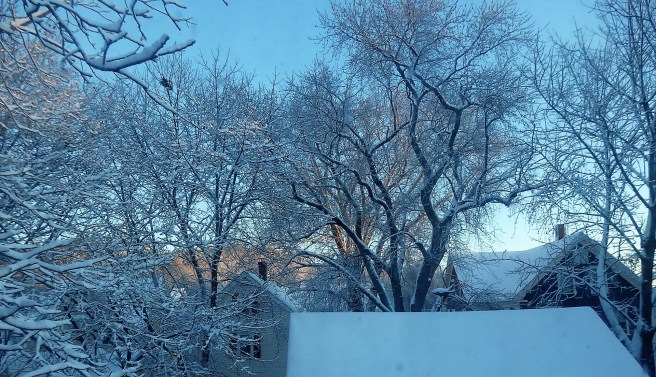
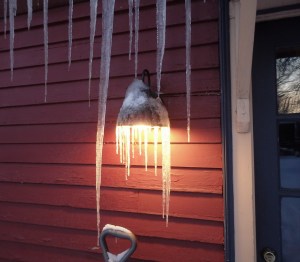
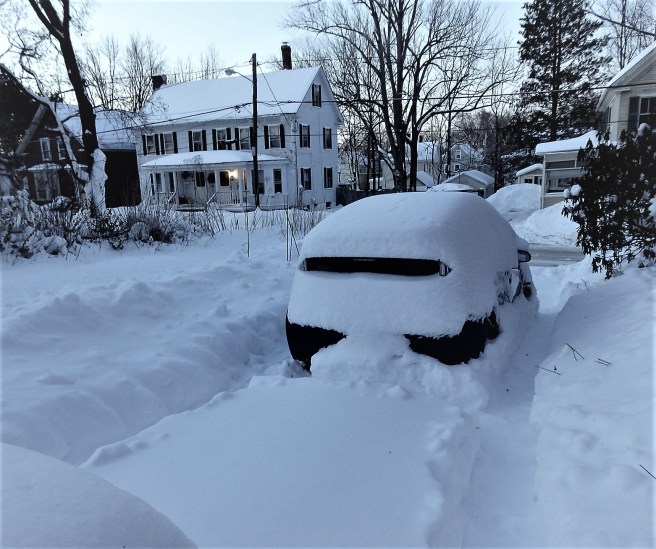
Even with a field guide, weeds can be hard to name. At least in polite terms. As a gardener, identifying them as weeds is easy enough, once they’re past a certain point of sprouting – they aren’t what you’re expecting and they’re growing faster than what you planted. Staying ahead of them is another matter, especially if you’re trying to be organic like us.
Here are 10 that have been especially problematic this year.
fingers stiff, numb
on ice-encased rigging
any fire in the hull
a hazard
tend the footing, Jack,
and stay dry, if you can
steering around the storm
* * *
hell comes without
flame
without smoke
under the prow
* * *
impressed
by chance misfortune
or the flight from somebody
gone astray
rolled together, creaking
skin to crab shell
all the same
lost, for the cold duration
Poem copyright 2016 by Jnana Hodson
To see the full set of seacoast poems, click here.
 Jnana's Red Barn