
Robin egg and nest
You never know what we'll churn up in cleaning a stall
I’ve been living in Eastport a full year now. Admittedly, during the initial four months, I was commuting the 300 miles back to Dover every weekend or so, mostly to help declutter the house and prepare it for sale. What amazed us, though, was how quickly my loyalties switched – Eastport was where I felt at home, not the house I’d lived in for the previous 21, the longest of anywhere else in my life.
As you know, I delighted in Dover. Some of my previous moves had left me homesick for a year or more – the colleagues I missed, the social and arts circles, the landscape and opportunities. Even in some of the less attractive places, there was something or someone I regretted leaving behind or unfinished.
This time, though, it felt more like dropping a fantastic perfect lover by being swept away by someone more exotic. You know, leaving a knight’s castle to go off to live on a shack on an island with a mermaid, even if she smelled like fish. (Remember, we’re talking about homes here, not actual people.)
Trying to sort out the reasons for the ease of my quick identity shift has been tricky.
I was at a point in my new creative project where extended solitude would be very helpful. And it was. You know, the writer’s retreat or arts colony.
Covid had also already distanced me. I was no longer swimming laps daily and seeing that crowd. Quaker worship and committee work was on Zoom. Choir in Boston was suspended. With museums and concerts canceled, there wasn’t even any point in taking the Amtrak down and back. And the research I was doing had enough resources online that I could finish the project. There are some questions that might be answered if I had a few weeks to spend in the reopened archives, but I’m content to leave off where I have for now.
Eastport has more of an active arts scene that Dover did, though there was plenty once you included a few neighboring towns. It’s just that the one here feels more organic, as you’ll likely be hearing. We have to be resourceful, since there’s nothing like Boston over the horizon, as there had been in Dover.
Getting back out in the wilderness has been especially invigorating, even if the years are taking a toll on my hiking abilities. Ditto for taking yoga classes on the waterfront here in town.
Did I mention meeting a series of fascinating people, all with rich stories and experiences?
Or the artists-in-residence or world-class chamber music performances by local pros?
Quite simply, I’ve declared this was my best summer ever. The prior highs had always had some big downsides – trouble at the office, upheavals in romance, unnecessary complications. Not so this one.
We had hoped to get the renovations under way, but all of the contractors have been booked out for a year – and even if we had one on the job, supplies have been hard to get, as is the case everywhere. The delay does give us a chance to plan more thoroughly for what we want to see done. And it did mean I didn’t have everything torn up for the workers. I’ll leave that for next summer.

One sight always catches our breath as we drive Route 9 across what sometimes feels like the fringe of civilization as we’ve known it. And, for the uninitiated, the state highway from Bangor to Calais can become pretty monotonous in its long uninhabited stretches. As they say, make sure you have a full tank of fuel before you tackle it.
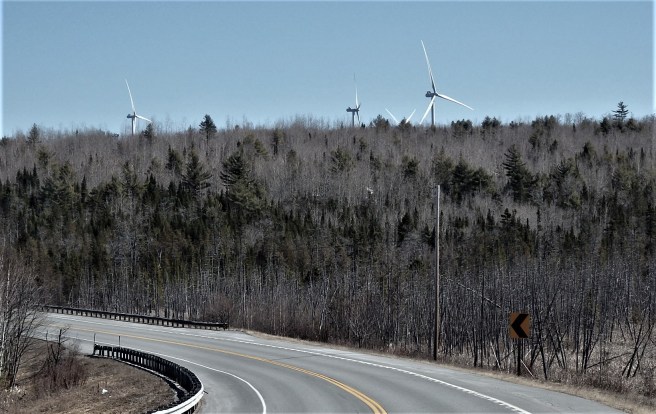
On a clear day, from a dozen miles away you might catch glimpses of a corner of the windfarms on Weaver Ridge and adjoining hills in Hancock County – I’ve counted at least 30 towers before the road dips away – but there are more tucked away in the high terrain. Still, nothing can prepare you for that first flash of the big blades turning gently in the air right in front of your face, or so it seems.
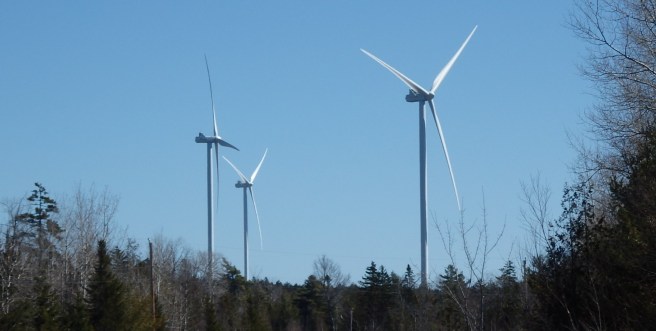
They dance gracefully – sometimes as a solo, then as a pair, or four. You spot them to your left but they suddenly show up on your right – the roadway twists along the slope. As those slip behind you, more giants rise above the hedge of forest. And all too soon, you’ve moved on.
The towers and their blades are bigger than you’d suspect. In fact, at the moment, they’re the tallest wind-powered electrical generators onshore in America, though much larger ones are projected for offshore installation.
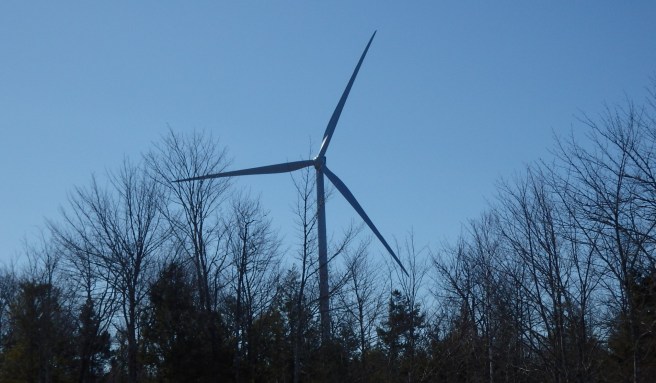
Wind generation accounts for nearly a third of the electrical production in Maine, though the state also imports a fourth of its electricity from Canada, largely Hydro Quebec.
I am baffled by the “not-in-my-backyard” opponents to similar windfarms. They still want energy for their computers and refrigerators and lighting, right?
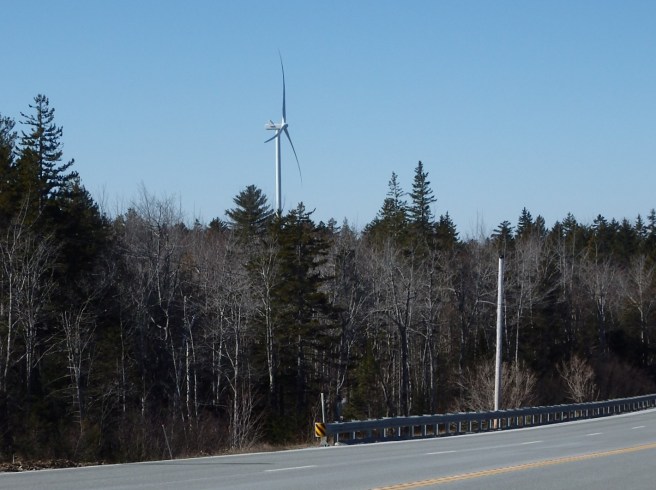
As if these “spoil the view”? I find them mesmerizing, even enhancing as a kind of sculpture and a reminder of the currents in the air itself. They definitely look better than a toxic oil refinery – and there’s no awful smell. For that matter, they strike me as much more attractive than a television transmitter or cell phone tower as a hilltop crown. And they do remind us of the charming Dutch windmills in a much smaller scale.
The latest installation, 22 Vesta towers and turbines, cost $150 million and went into full operation earlier this year.


A MURDER OF CROWS (collectively)
a hundred crows a minute
according to a professional counter
over Owings Mills
as I stood on my deck, transfixed
maybe a half-hour



 Jnana's Red Barn