You never know what we'll churn up in cleaning a stall
“I looked out in the yard and seen a magnificent eight-point buck eatin’ apples.”
Wild ones, fallen from the tree between us.
“And the velvet was gone from his antlers, right?”
“Yep.”
With only a flash a few days earlier, I had noticed something different in its bearing. Like being a kid no more but a handsome young prince. One with a shiny sword ever so proudly.
I’ve been part of a study group that’s been trying to envision a sustainable future for our small corner of the globe.
It’s been an exciting exercise, actually, looking for ways we can enhance what we have in conjunction with neighboring communities.
But it’s also terrifying, when we look more broadly.
Nine billion population, up from one billion when I was born. Can the globe really carry that load? I’m doubtful, but maybe.
Let’s start with increasing urbanization. I was blown away by the fact that 75 percent of Britain is considered urbanized today.
Add to that global warming. The regions where population is booming will be scrambling for food and water. Yes, water becomes essential. As well as ways to earn a livable income.
Now consider the automation of many jobs, something that points toward income readjustment, which is being largely ignored in public discussion.
Get political, and Republicans are in utter denial about all this, something I find deeply troubling. Engage, intelligently, will you? The future of humanity is at stake. Or are you really dinosaurs, just looking only for your next meal?
According to the projections, I’m in a good place to survive this – or at least my descendants are. Yeah, the ocean will be closer to our doorstep, even if we are higher than the downtown we adore. Still, the directions on the charts point to a lot of turbulence ahead, especially desperation and violence.
Here, in these workshops, we’ve been looking at the enhanced value of tourism, seeing our place as a pocket of natural wonder. As much as I love that projection, I doubt things will be that easy.
Will Florida actually be off the map by then, along with all of its reactionary politics? Or maybe those partisans will still be denying global warming would ever happen.
Where do you see the world in just 30 years?
Or even in just six, 2030?

Let me be honest and admit that the most amazing fall foliage I’ve seen was in 1970 in the Susquehanna Valley of New York and neighboring Pennsylvania. I’m not sure how it would stack up today, if I had a way of reviving the actual color, but the experience was unlike any before or since.
I was fresh out of college – free of being cooped up on campus and indoors. I had my own wheels and a job that had me free by midafternoon, when the angular sunlight was kicking in. And the local forests blended the species of New England with those of the middle Appalachians. What I had known before was Ohio and Indiana, without the big foothills that propped the forests up before my eyes like giant canvases or, from the crests, arrayed them below me like vast quilts punctuated with villages and farm fields and meadows.
I suspect another major factor was a killing frost by late September, which would intensify the color and make, officially, Indian summer. With global warming, that frost has been delaying until all of the leaves have fallen.
All the same, living in New England for nearly half of my life now, I recognize how profoundly the autumn change strikes the region. My in-depth reflections and accompanying photos from New Hampshire are found in the archives of my Chicken Farmer blog. Do go there, if you can. The posts and slideshows appear in the New England Spirit category from August through October 2013.
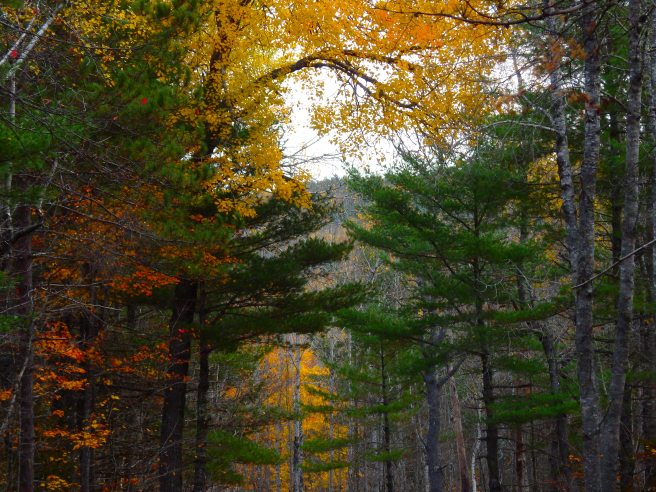
What I’m now encountering is Coastal Downeast Maine, with its own variations. The forest is largely evergreen, which of course stays green. But it does provide a solid background for the deciduous trees as they change.
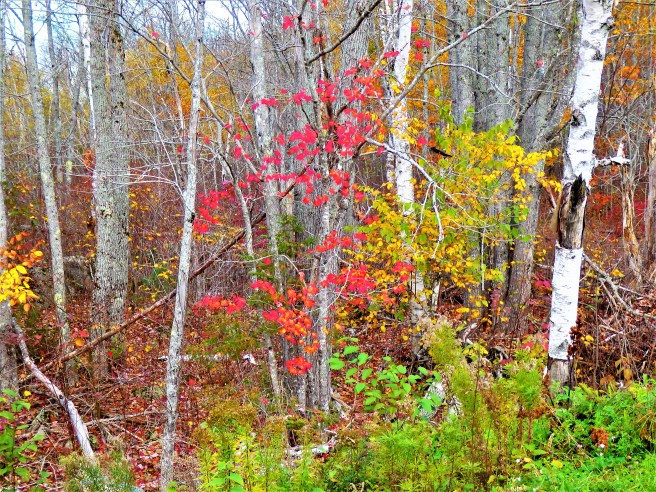
Having written that, I encounter an early morning drive across stretches where everything is perfect. The foliage is prime, a full range of the palette, nothing holding back. The temperature’s still chill, so maybe they’ve already had that hard frost up here. Better yet, the sunlight’s brilliant buttery and straight-on, rather than overhead, illuminating the leaves from the side facing me.
It reminds me of other “oh, wow!” epiphanies in northern New England that no doubt would equal or even surpass the year further south that set the standard.
So here’s a taste of how it happens around here.



Ripe orange descending
And then the sharp scythe new moon
With her consort, Venus
Orange-fruit globe ascending
Silvery lakes between fog-wisped forests
Many miles intervening
Same orange glop descending
And then the sharp scythe new moon
With her consort, Venus
It’s a common topic of conversation this time of year in New England.
How’s the foliage shaping up?
Are drought or wetness, heat or cold, or any number of other factors impacting it negatively?
Or is it going to be another banner month across the six-state region?
Vermont and New Hampshire tourism tries to capitalize the most from the colorful outburst, but they’re hardly alone in sometimes dazzling displays. New York and Pennsylvania can also be memorable.
So here we are, trying to make the most of the outdoors before winter cold sets in all too soon.
What’s it like where you are?
Some early wag exploring the channel that separates Eastport and Campobello Island thought a rock formation visible only at low tide resembled an old monk and dubbed it the Old Friar.

The headland behind it soon became known as Friar’s Head.
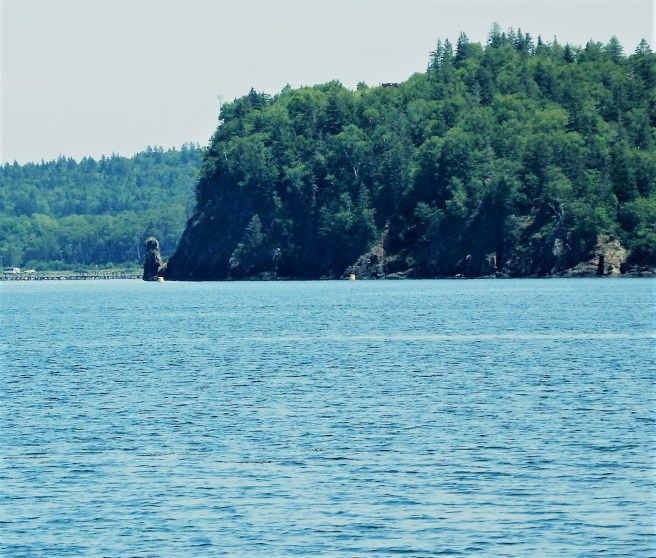
As for the channel? It’s Friar’s Roads, curving along the island to its end on the Bay of Fundy.
The Old Friar himself may have lost some features during the Civil War when cannoneers stationed on Treat Island used the monolith for target practice. Canada, apparently, never complained, sparing the U.S. an international incident.
The Passamaquoddy, meanwhile, referred to the pillar as the Stone Maiden. The legend told of a young brave who left on a long journey after instructing his lover to sit and await his return. The distraught young maiden sat on the beach and waited for months. Alas, when he finally returned, he found her turned to stone, forever to wait and watch.
Listen to me, like I’m an expert.
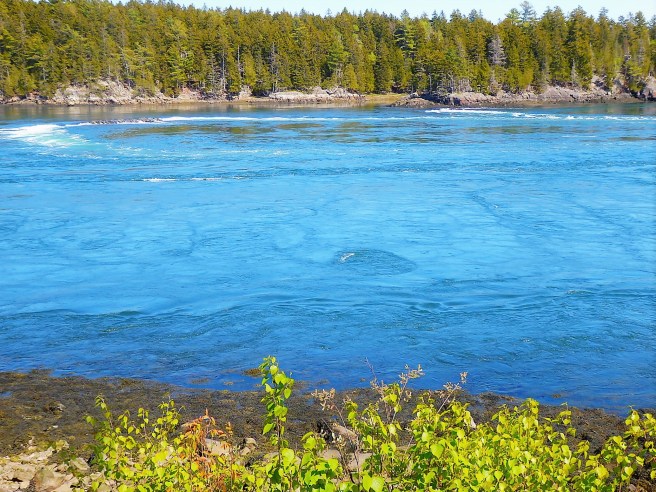
Still, the Old Sow can be seen about a mile away from Eastport if you time it right, about three hours before high tide on the biggest days of the month. The Western Hemisphere’s biggest whirlpool not only swirls but also shoots spouts into the air. As if I could capture that flash with my camera.
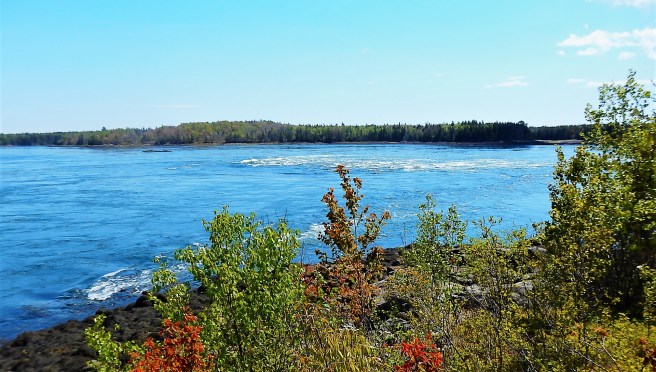
The current, though, often runs at seven knots, faster than an Olympic champion swimmer could manage in even a very short burst. It’s also treacherous for Scuba divers, waders, and sailors alike.
It’s by no means the only place to be mesmerized while watching the charge.
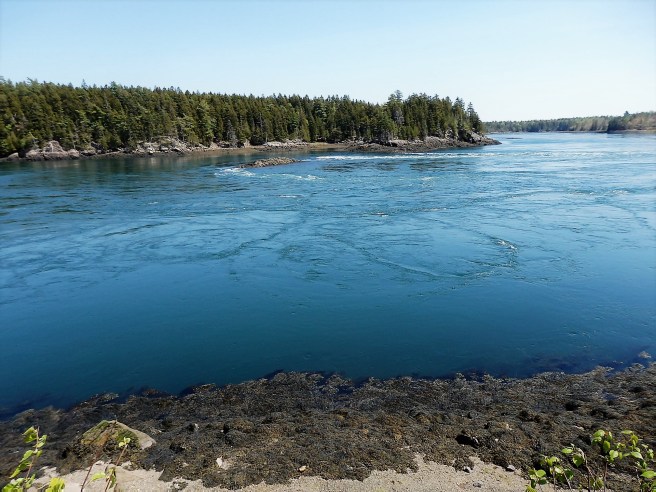
Another impressive sight is the Reversing Falls in Pembroke, though “rapids” would be a more accurate term. The sounds of the waters rushing from one bay to another are as mesmerizing as any waterfall, though.