A few prime strolls around here

Visitors on the street sometimes ask me about good places to hike around here, and looking at them, I don’t always want to recommend anything too strenuous. On my part, I do miss the old carriage road up Garrison Hill back in Dover, New Hampshire, but you can’t beat some of these.

  1. Quoddy Head State Park in Lubec. The parking lot is close to an iconic lighthouse, spectacular bluffs, and an Arctic peat bog. Not a bad combo as an introduction.
  2. Shackford State Park in Eastport. It almost became an oil refinery. The central trail leads to an incredible panorama of Cobscook Bay and a high probability of seeing bald eagles.
  3. Matthews Island. Also in Eastport, this Maine Coastal Heritage Trust site can be reached only at low tide. Getting there will give definitely give you a sense of mudflats. MCHT also has nearby Treat Island, which we intend to explore by renting a water taxi to get us there and back.
  4. MCHT includes other personal favorites, starting with Boot Cove in Lubec. If you like Acadia National Park, you’ll love these lesser known opportunities. Nose around in this Red Barn blog, you’ll find photographic evidence why.
  5. The Bold Coast public lands in Cutler. This is for the serious hiker, one willing to walk 1½ miles to get to the rugged ocean. From there, though, there’s a six-mile breathtaking clifftop trail along the restless ocean, and even primitive camping on a limited first-come, first-served basis at the end. The trailhead parking lot can be overflowing in prime season.
  6. Cobscook Shores. Thanks to a newer family trust, 15 small waterfront sites provide public opportunities for investigation. Most have outhouse or indoor plumbing facilities as well as picnicking, sometimes in screened-in pavilions around a single table. My favorite to date is Morang Cove.
  7. Moosehorn National Wildlife Refuge. So far, I’ve sampled trails at its Baring and Calais district but there is more in Edmunds township. Former roads, now used only for ranger access, make for broad, easy pathways through a variety of ecosystems. My big caveat for inland trails is to be prepared for black flies from late April into July. They can definitely spoil and outing.
  8. Downeast Sunrise Trail, atop an abandoned rail line. I see it primarily as ATV and snowmobiling in season, but it does offer insights in inland ecologies. Again, note the black fly warning.
  9. Mowry Beach in Lubec and Roque Bluffs State Park south of Machias. Sandy beaches in Downeast Maine are rare. Here are two wonderful exceptions for those who want to indulge in a long barefoot walk.
  10. Back in Eastport, the Hillside Cemetery is worth nosing about. It’s newer than many classic New England burial grounds, but the engraved stones add up to some fascinating stories.

With the Canadian border now reopened, I’m looking forward to some treks on Campobello Island, both at the Roosevelt international park and a few other sites.


This is a great place to enter the twilight zones

Here in Way Downeast Maine, many dawns would blow you away, at least if you’re awake in time.

It’s not just when our closest star comes into view but also the vast unobstructed sky over the bay and the ways neighboring Campobello Island interact with the growing light.

As I’ve been finding – and you’re seeing in some of the photos here at the Red Barn – much of the glory occurs in what’s officially the twilight zones, defined by how low the sun is below the horizon.

These zones are otherwise known as dawn and dusk, apart from Rod Serling’s once upon a time spooky black-and-white TV episodes.

And these are longer and more pronounced the further away from the equator they are.

I’m on the 45th parallel, halfway to the North Pole and its days of endless summer light or winter darkness. Meaning our twilights are much longer than what happens in most of the rest of the continental U.S.

Checking our local weather forecasts, I’ve noticed a few unfamiliar terms but not looked into them until recently.

The first is astronomical twilight, which I’ll skip over this round. It seems to apply mostly to the Arctic and Antarctic.

The second is nautical twilight, which apparently has its origins in the era when mariners used the stars to navigate the seas. In clear weather, most stars are still visible to the naked eye but also, finally, the horizon. You need artificial light to do much of anything outdoors.

Around here these days, it begins before 3:10  am Daylight time – or what would be 2:10 Standard. The wee hours, no matter how you slice it.

The next stage is civil twilight. It’s brighter, enough to mean artificial light may not be required for outdoor activities. Only the brightest celestial objects can be observed by the naked eye. These days for us, it’s around 4 o’clock. Yeah, 3 Standard time. Still really early for most folks.

And finally sunrise, about a more than quarter to 5.

That’s an hour and a half of magical natural light.

I think it’s why most people around here are up and about early. Even in winter, the roads are busier at 5:30 in the morning than 5:30 in the afternoon.

Of course, the reverse happens every evening.

The shifts also produce what’s called the Golden Hour, when sunlight turns warmer and softer. Or, in my thinking, buttery and magical. I place it mostly as the hour before sunset, especially when the light shoots in horizontally.

As well as the Blue Hour, when only a few stars or planets are visible. Painter Maxfield Parrish exploited it to the hilt.

During the day, much of our sunlight is reflected from the waters back into the sky, something many classic Italian painters explored as well as more modern artists here today.

So how’s the natural light where you are?

Let’s crack into shellfish

We’re too far north to harvest oysters, at least for now. Ours come mostly for midcoast Maine. But our Downeast waters are famed for their scallops and other shellfish.

Last year, a Tendrils focused on lobsters, and I’m thinking of a few others in that vein looking ahead.

So today, let’s look at shellfish more broadly. You know, things like the fact they’re spineless and have hard shells. Now, for a few specifics, working around the fact that scientifically, they’re classified in three groups.
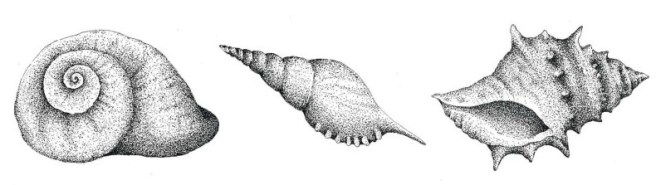
  1. Mollusks include snails, clams, mussels, scallops, oysters, octopus, cuttlefish, squid, slugs, and abalone. They form the second-largest phylum of invertebrates, making up 23 percent of the named marine organisms and also widespread in freshwater and terrestrial environments. The oceanic ones are usually very tiny.
  2. The expression of “happy as a clam” is more accurately understood in its fuller version, “happy as a clam at high water.” Or should that be “high tide”?
  3. The chemistry of creating their calcium-rich calcareous shells remains largely mysterious. Chalk, for one, is comprised of their deposits.
  4. But some of them, especially the larger species, have no bones at all. Can they even be considered shellfish?
  5. The second group, crustaceans, includes lobsters, crabs, shrimp, crawfish, krill, and barnacles. They come with a segmented body, two pairs of antennae, and a tough, semitransparent exoskeleton. That chitinous covering is something they have in common with butterflies, crickets, beetles, and caterpillars.
  6. A single shrimp can lay a million eggs. Of course, humans are far from alone in having a fondness for a shrimp dinner.
  7. Crabs communicate by thumping their claws and drumming in a kind of Morse code.
  8. And finally, echinoderms, which are found as adults on the sea bed at every depth. They include starfish, sand dollars, sea urchins, and sea cucumbers. They’re recognizable by their radial symmetry.
  9. In general, shellfish blood is blue, not red, because it relies on copper, rather than iron. And many shellfish rely on plankton for their diet.
  10. My favorite shellfish all seem to go well with melted butter and lemon.

We’re even part of the famed Bay of Fundy

Maybe you’ve heard of it, the place of the world’s most extreme tides, up to 53 feet every six or so hours, meaning about six feet hourly on average or up to 12-plus in certain time windows.

If you swim, you know that’s way over your head.

So here’s a little perspective.

  1. Most U.S. maps cut out nearby Canada, leaving little sense of how much lies east of Maine and not just north. That’s anything beyond Portland, essentially, yet not that far north of Boston.
  2. Typically excised from maps of Maine, the big island of Grand Manan is essentially as lengthy as Martha’s Vineyard but with much more substantial cliffs and an undeniably working fisherman economy. To get there, you need a ferry hop or two from Canada. And that’s saying nothing of its craggy inhabitants. It’s definitely on my bucket list.
  3. Technically, I dwell on one of the subsidiary waters. Fundy Bay itself is about 55 miles wide just south of here, pointing to another place renowned for its scallops. Or is that also east? In other words, Fundy’s big.
  4. The bay’s positions of Maine and New Brunswick, on one side, and Nova Scotia, on the other, act as a funnel that intensifies Atlantic currents in and out of the channel. It’s a long story but likely worthwhile for certain nerds, especially once you see how it shapes up on the dinner plate. The intensity of the record tides does have some techies well as others drooling.
  5. That leads to the possibilities of electrical generation. Mainers would definitely welcome a reduction in our electrical bill. Wind, solar, and tidal power generation are all rising as important sources.
  6. We are mused by one local craftsman who proclaims her studio the Clay of Fundy. She’s hardly alone. You’d be amused or quite critical of the range of wordplay prompted by the Fundy word.
  7. It has rivers that reverse their flow, a phenomenon known as tidal bore.
  8. The bay can report up to ten kinds of whales every summer.
  9. For water to get from the mouth of the bay to its crown can take up to 13 hours.
  10. Its ecosystem is said to rival the Amazon’s. Just ask scuba divers.