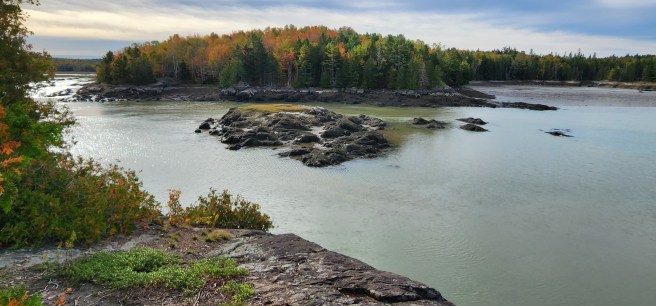
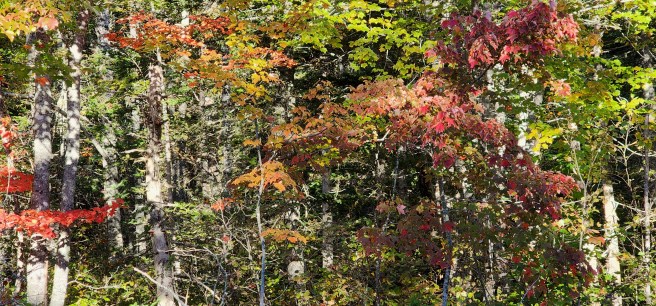
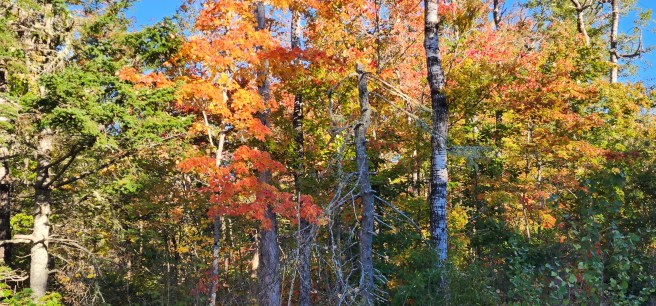

A good frost or two will really bring the color out. Just check the tall grasses or your windshield in the morning.
You never know what we'll churn up in cleaning a stall
A good frost or two will really bring the color out. Just check the tall grasses or your windshield in the morning.
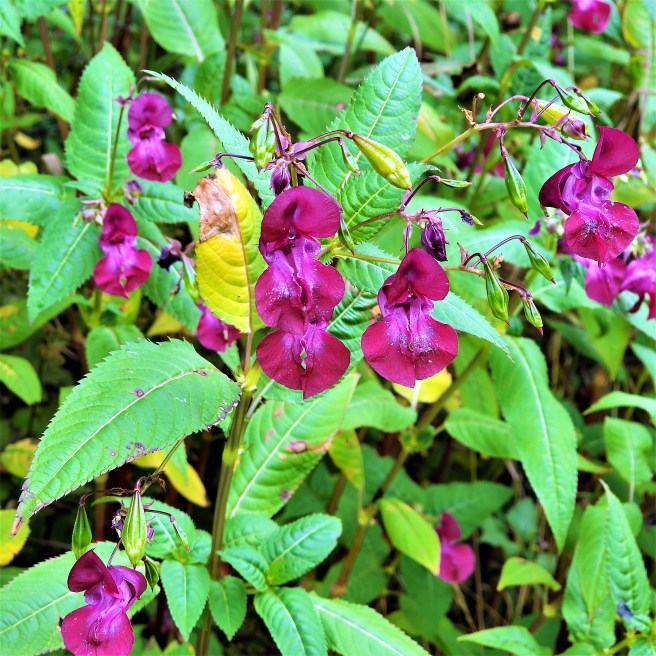
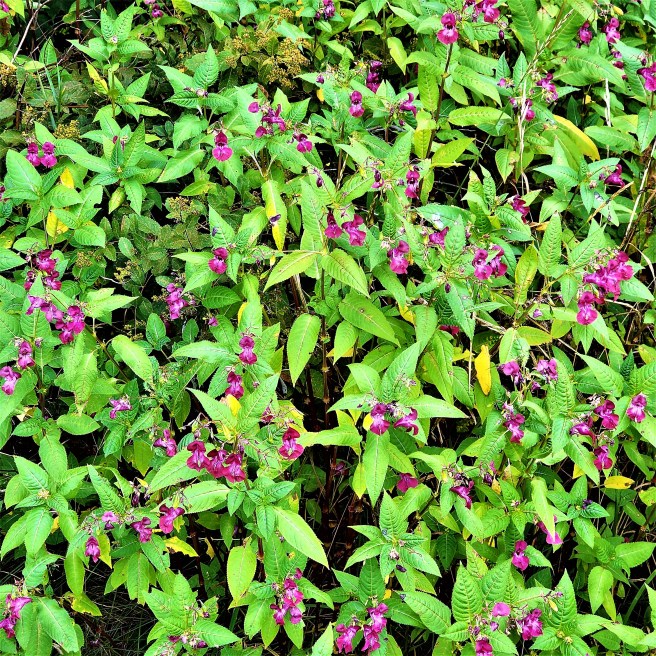

Others have pointed out that most of the places I’ve resided in have been rich in natural beauty. While I’ve dampened that with an argument that you can find beauty wherever you are, or at least visual stimulation, I do have to concede how rarely that’s the case.
Many places, in fact, are brutal on the eyeballs.
Part of the attraction to Eastport for me was, after all, its access to wilderness and a rugged shoreline. Good shots seem to be waiting everywhere.
It shouldn’t be surprising that I’m overwhelmed by the number of solid photos I’ve been taking. How on earth is one supposed to organize them, much less share them?
It’s not like the old days of light meters, F-stops, film, or even focus, either.
Digital makes it a snap. All you have to do is look and see something.
And, yes, sometimes the camera – or cell phone – sees something more.
Eastport is a pedestrian-friendly village with old houses and storefronts, meaning more variety and detail than you’d find in the average drive-by suburb. It’s surrounded by forests, shorelines, and streams that present more opportunities. No wonder we see people pointing their lenses everywhere, and not just for selfies.
Where are all of these images going to go, anyway?
They’re Calais, Eastport, Lubec, and Machias. Or the other way around, depending on how you’re driving or sailing.
Like pearls on a string, one that hugs the coastline of vast Washington County.
The image of four anchors arrayed along a map makes sense, each one with its own distinctive attraction.
Their combined population comes to barely eight thousand.
The terrain around here is much more real than Acadia, for sure, if you’re the least bit interested in the Real Maine.
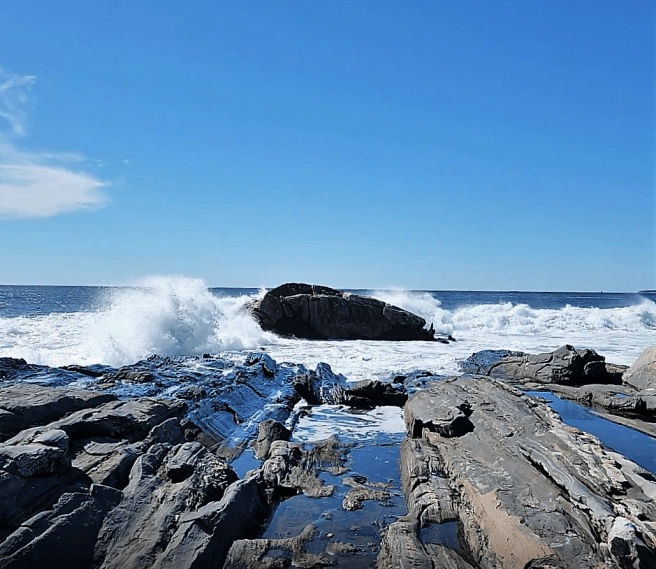
Nothing like a decaying hurricane somewhere out at sea to roil the water. This one was rough enough to cancel ferry service to neighboring Monhegan Island for days.
Sunrise County – more formally, Washington County, Maine – and neighboring Charlotte County, on the facing waters in New Brunswick, are the center of some serious salmon farming. Cooke Aquaculture, a pioneer in the field, is a major employer in both places.
Without getting into the surrounding controversies, millions of salmon are shipped to market from these farms and are one reason the protein-rich anti-oxidant species is no longer a luxury item for most people. It’s a surprisingly healthy option, if you’re so inclined to investigate.
The local enterprise has even spawned Eastport’s annual Salmon Festival over the Labor Day weekend, which includes narrated boat trips to farms in our coves, typically clusters of 16 pens, and explanations of their care. Some locals describe the event as drawing an NPR kind of crowd, in contrast to our Pirate Festival the following weekend, which may be seen as more of a NASCAR following or its biker equivalent. (Please stay tuned.)
What I’ve found fascinating this summer is the flock of working boats busy around two of the farms in our fair city. The pens have been vanishing!
The reason, I’ve been told, is that every few years, the pens and their nets need to cleaned and repaired. And then they also lay fallow for a season or two.
Don’t know about you, but I’m impressed. Each pen starts out with a million and a half baby salmon. Maybe more.
And the filets we get do make for some impressive sashimi – raw fish that are a favorite in Japan, expensive in restaurants, and surprisingly easy to make at home. If you’re interested, check out some recipes online. My between-the-lines improvised sauces remain delightful, at least as far as me and my sons-in-law are concerned. (Pardon the English there, I’m yielding to their generation. Those boys really can skin a fish, by the way.)
From here, we’re most curious to see about how Cooke’s efforts at oyster and mussel harvests from our waters are also progressing.
The advice to eat local remains a spiritual discipline, as far as I’m concerned, not that it’s always practical where I’ve lived.
Now, what’s on your plate tonight?
It was dark and very cold that night, with snow piled high along the freeway.
Now that I’m getting familiar with deer, I realize that the critter I nicked with the right fender was much larger than any of the deer I see these days. They seem rather small, actually, apart from their appetites.
Still, that encounter could have been much worse. I have to consider myself quite lucky. A few feet one way or the other, the beast could have come crashing through my windshield.
Just one more fact of living where I do.
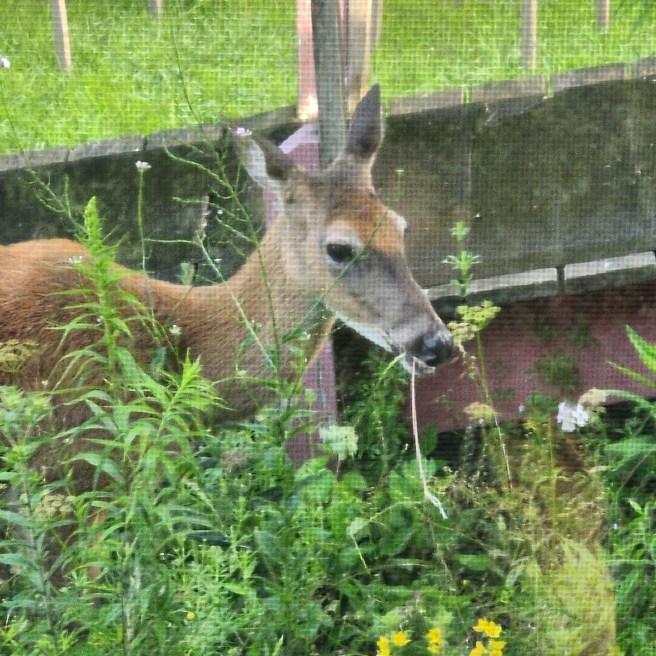
Eastport – centered on Moose Island – is one of many small cities being overrun by deer. You may have met some of the culprits here at the Red Barn.
Here are some random bits as a result.
Some Sunday mornings, my drive to and from the Quaker meetinghouse a half-hour from my home is a meditation in its own right.
Even in fog or snow, it can be refreshing.
Much of the road is through forest, plus stretches along Passamaquoddy and Cobscook bays and their tributaries. The route also passes through a tribal reservation and a national wildlife preserve, which does sound a bit exotic though I take it as routine.
Eagle sightings are common, and I have had to stop for deer or turkeys in the middle of U.S. 1. Once I even spotted a moose far ahead on the pavement.
A radio program of classical choral music on a CBC station that comes in quite clearly is often also an element, depending on my mood.
Do you remember the freedom you felt when you first learned to drive? Some mornings, especially when there’s no other traffic, that elation returns.
While I’m tempted to proclaim “What could be more glorious than this!” I will also note many of the scattered homes I pass resemble junkyards – poverty in Washington County is a constant – so there’s a reminder of that reality, too. I suspect there are more dead cars and trucks here than people.
As an added touch, there are no traffic lights, either.
 Jnana's Red Barn