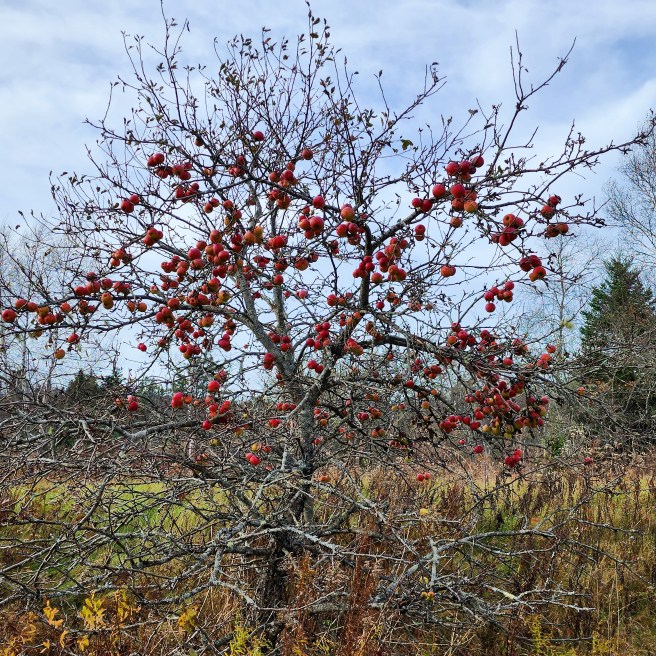

The trees are found everywhere around here. As are the deer that eat all the fruit they can reach.
You never know what we'll churn up in cleaning a stall
The trees are found everywhere around here. As are the deer that eat all the fruit they can reach.
Yes, the tiny one-inch ball with its moon Charon, at one-half inch, out on that branch.

We won’t get into the shock of the dwarf status revision within the lifetime of some of us, in part in consequence of the discovery of that moon.

As a further twist, the Aroostook system has two Plutos, one inside the Houlton tourism center, where it represents the orbs’ average distance from the sun (40 miles in the scaled version), and this one presenting its more current placement in its wildly elliptical orbit, a relative 33 miles from Presque Isle for the next 20 or so years.

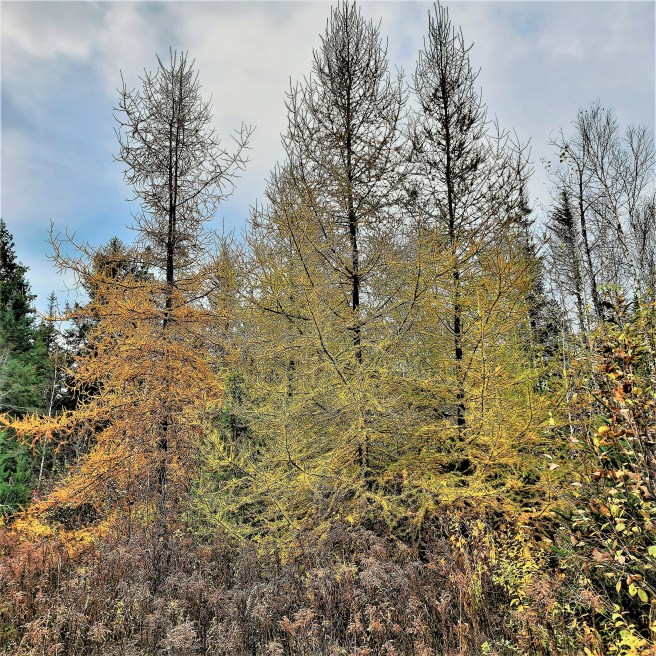
A boreal larch tree, also known as hackmatack, is a member of the pine family, it is one conifer that changes color every fall and loses its needles. The species grows in wet soil and withstands extremely low temperatures, reasons it’s found widely around here.

Its bright yellow autumn color is shared with birches, also found widely hereabouts.
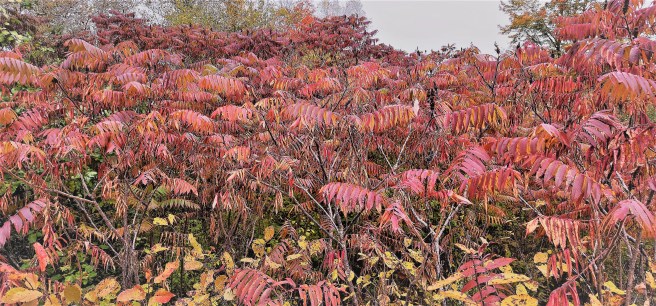
And let’s not overlook the red punch of sumac.
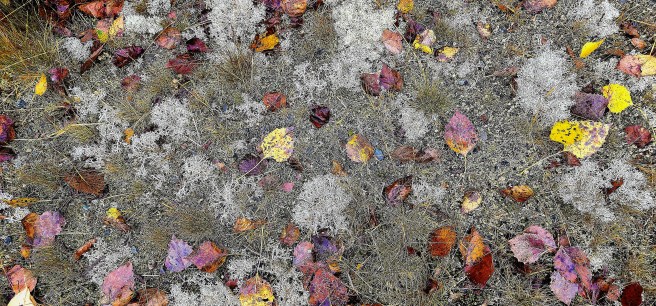
All too soon, it’s over.
With a 21.3-inch diameter and placed 31.7 miles from the sun in Presque Isle and having many moons too small to be presented at this scale, this stormy mystery orb also hints at the vast span of our solar system.
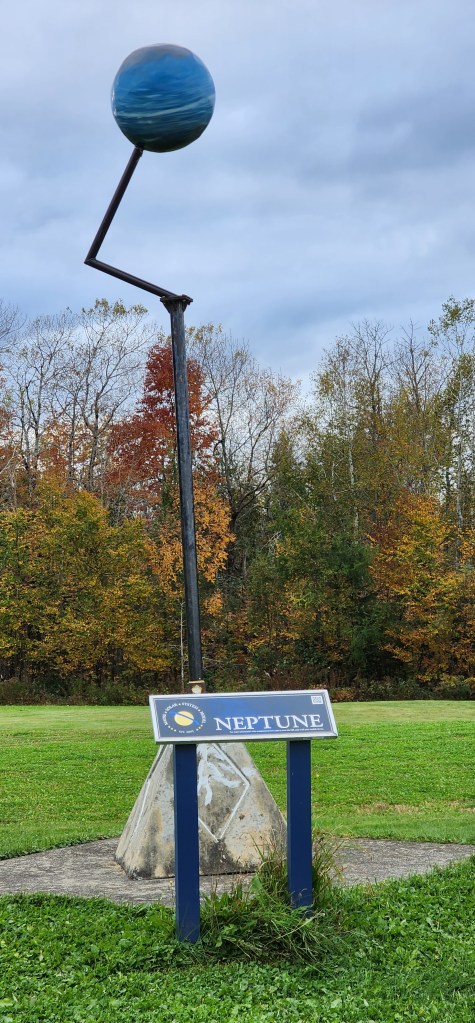
By this point in the drive, I’m really struck by the emptiness of the solar system and the space beyond. It’s essentially a vast, overwhelming nothingness. These are like pins in the proverbial haystack. And then, take heed of the incredible balance of forward motion and the sun’s gravity holding each one in place.
Science can attempt to answer the “How” in our ponderings, but as for the “Why,” if one even exists? That would mean facing questions of religion or theology. I’m not even touching on the mythological dimensions of these specks in the night sky.
Is it all an accident or some intentional mathematical outcome? Hmm, is there a neo-Calvinist turn in this thinking? We have miles to go yet.
In my previous visit to Aroostook County, I remember my amazement at passing this puzzling presentation only to encounter Saturn about 20 minutes later. Now I know it wasn’t one person’s quirky obsession.
Supposedly my Zodiac identity, and likely not yours, the model sits 20.7 miles from the sun model at the bigging of the display. Here its diameter is 22 inches.
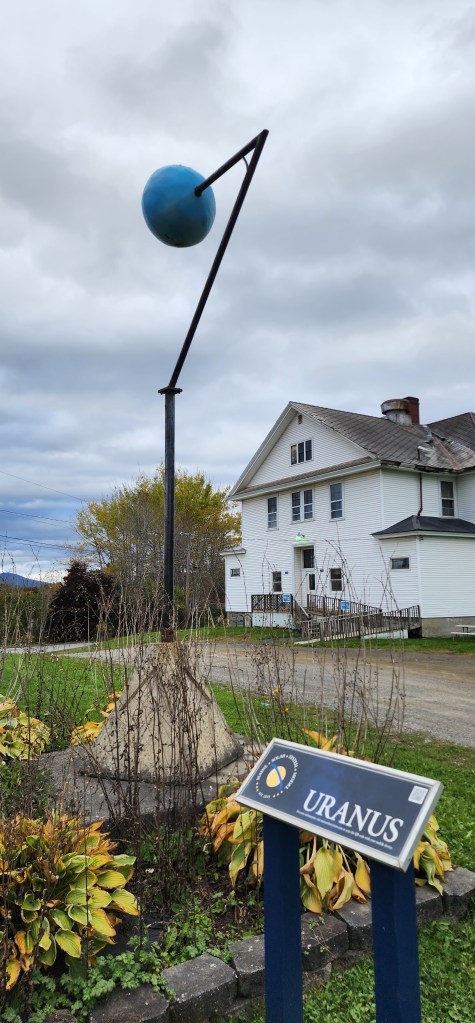
The reason for the angled arm that lifts the planet is to present the axis with its extreme tilt, pointing its North Pole permanently toward the sun.
And we think a midnight sun at the height of summer’s a big deal? How about the endless darkness at the South Pole?
When you stop to think about it, the labor and care supporting this solar system presentation is astonishing. Just whose flash of inspiration came up with the calculations of our central star and its orbiting bodies, starting by placing Earth a mile from the sun?
And then came all the craftsmanship not just with the heavenly bodies but also the concrete bases and metal arms plus landscaping and the willingness of landowners to make room for the displays on their properties and tourists poking around. In all, 700 volunteers were involved one way or another.
For a large county with a small population, it was a truly astronomical undertaking. And there’s more …
Getting further out on our solar system journey, we come to the dramatically ringed planet. Sitting 9.7 miles from Aroostook County’s model sun in Presque Isle, its diameter here is 51.9 inches but the outer ring extends the diameter to 117 inches – nearly 12 feet.

Of its many moons, only Titan is large enough to be displayed on this scale.

Back in New Hampshire, I was often engaged in a losing battle with squirrels. We had them for a while in the wall of the house and in the bay window, found they’d chewed into the attic through the flashing around the chimney, and were never able to eradicate them from the Red Barn, where they pretty much devoured a 20-foot strip of crown molding. They were always digging up bulbs or taking chunks out fruits and vegetables in our gardens.
At least we eventually got a birdfeeder that would send them falling off, an advance that left us endlessly amused, especially when we noticed the obsessed critter as a new kid on the block.
One good friend, an avid gardener, aptly dubbed them tree-climbing rats with big tails.
Here are a few related facts.
At least we don’t notice them around our current home on an island in Maine. Instead, we have deer.
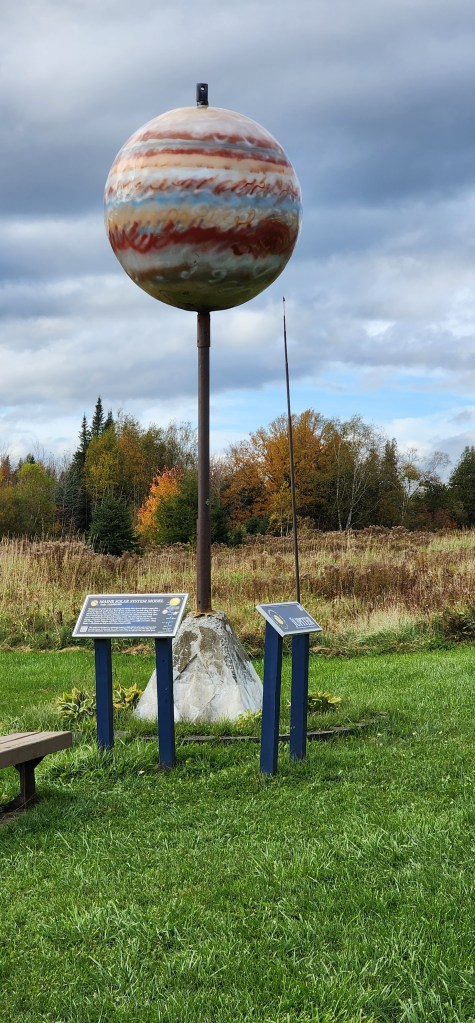
The largest planet in our solar system represents a gap between the cluster of planets closest to the sun and those beyond. At 5.2 miles from our model sun on our astro-scavenger hunt, we’re finally getting some size. This one’s a bit wider than a five-foot arm span – it’s 61.4 inches – like a really big beach ball. And its four largest moons are Io, 1.6 inches; Europa, 1.3; Ganymede, 2.3; and Callisto, 2.1.
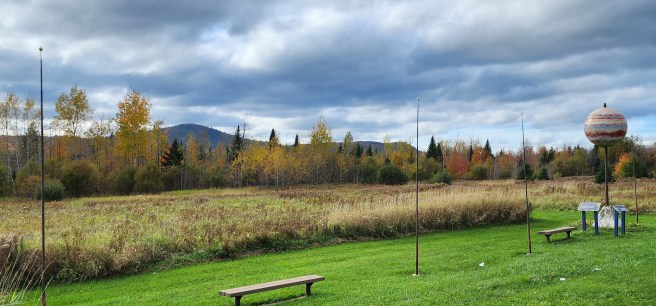
Remember, this is a scale of one to 93 million. As inconceivable as that seems.
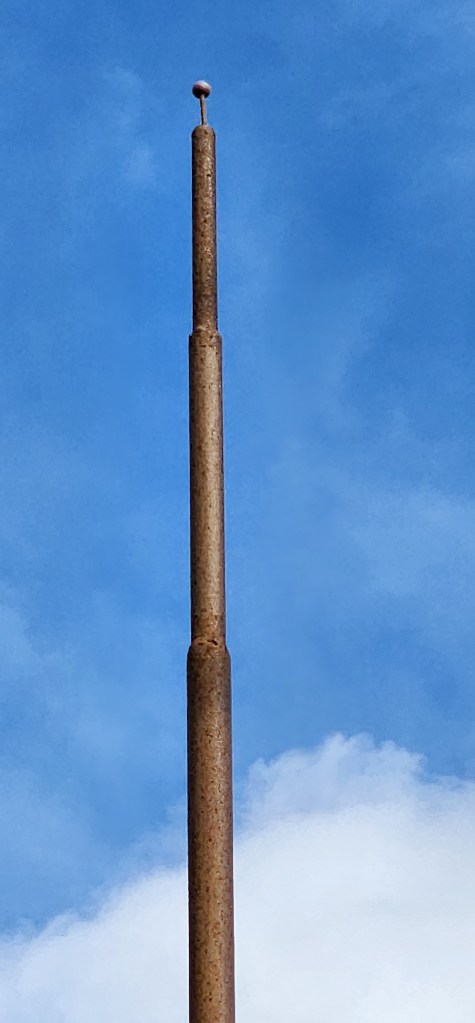
At 3/8 of an inch in the scaled solar system – that is, a steel ball bearing – this is the largest object in an asteroid belt between Mars and Jupiter.
The model was erected after the rest of the Aroostook system was in place.
Did you even know about this body? Hate to admit, but I didn’t.
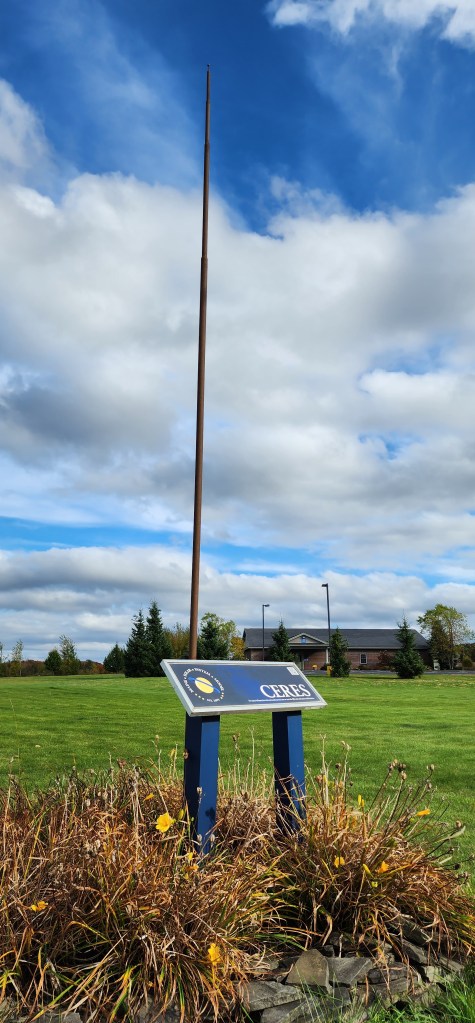
At 1.4 miles from the sun in our scale, Mars is about half the size of Earth and has two moons that are too small to be presented in this display.
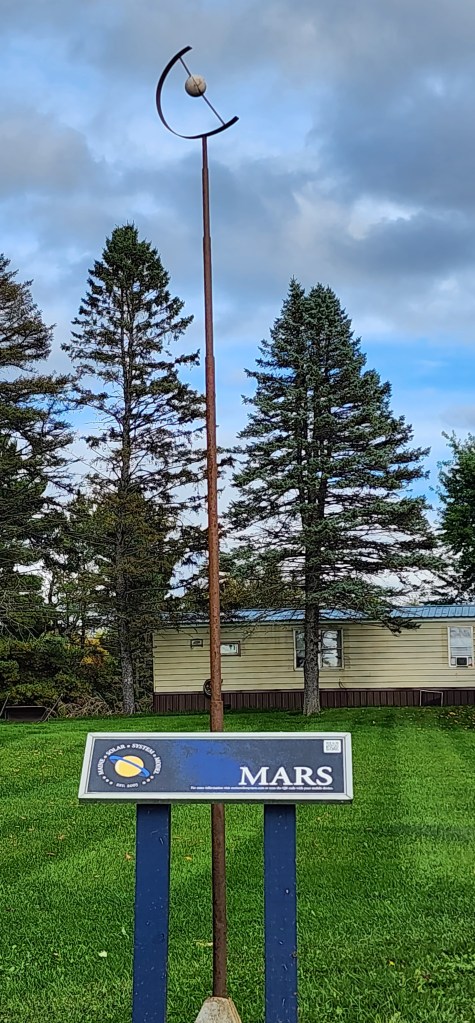
The angled post in the crescent, as we were learning, represents the planet’s tilt in its orbit, the major factor that gives us our seasons.
By this point in our drive, we were beginning to catch on to what we were looking before rather than passing by and having to circle about. The game now became who would spot the next stop first.
 Jnana's Red Barn