Get primed for a windjammer experience

It’s like camping, with the canvas over your head rather than a tent.

Peter tried to brace me for the, uh, unique quarters. And the pause when I mentioned taking a shower.

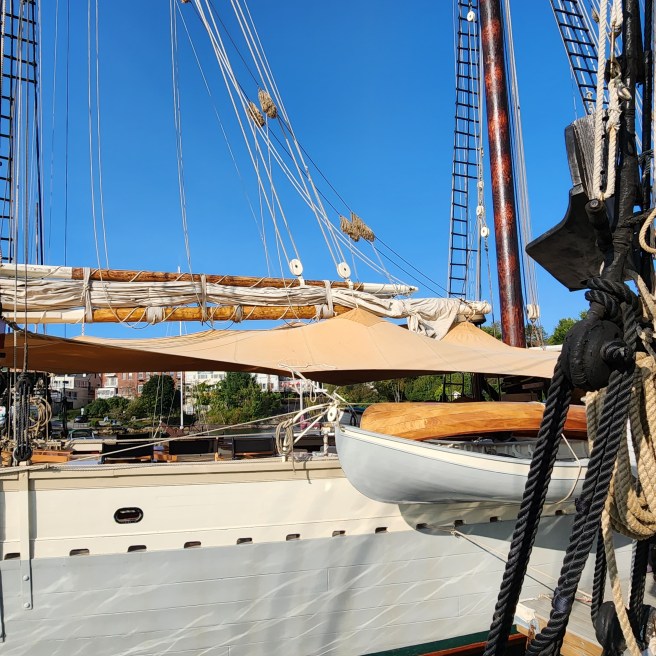
I had a snug berth, as you’ll see later. The only electricity on board came from some strong batteries and a small solar array.

Rather than a floating night club and hotel of a typical cruise ship, a Maine windjammer is small and laid-back. You even have to wash your own dishes.

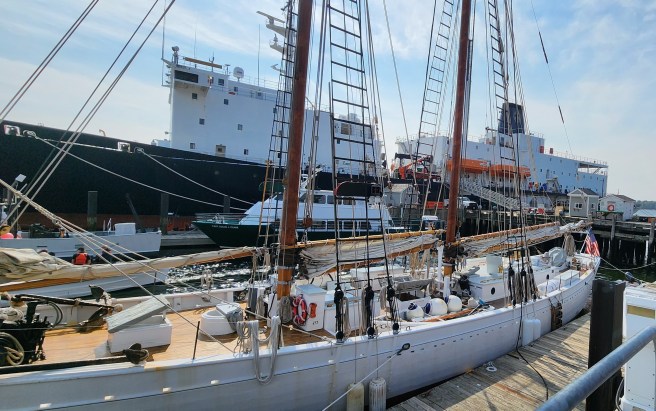
We were docked next to another schooner before departing.

As the windjammers’ association brochure says:

Unlike large cruise ships, windjammers have bunks and cozy cabins, not monster staterooms and 24-hour buffets. Windjammers are woody and compact below decks. Crew and guests live and work in close quarters. The ship’s galley and dining areas are like your kitchen at home – everybody mingles there.

The Maine experience dates from 1936, when Captain Frank Swift started offering adventurous passengers sailing opportunities formerly only available to private yacht owners.

Last summer I got to be one of them. It really was memorable.

Schooner or later

Ships come in all sizes and shapes, and people aware of the differences see vessels that float quite differently than the rest of the population. Well, it’s like looking at birds and then birders.

Living beside the ocean I had learned to differentiate a sloop from a schooner, or so I thought. Both have triangular sails, with sloops having just one mast and schooners, two or more.

Not to be confused with square-riggers, the kind of tall-mast ships most people envision from history. Or so I once did. You know, Old Ironsides, the USS Constitution, or even the Mayflower, however much smaller.

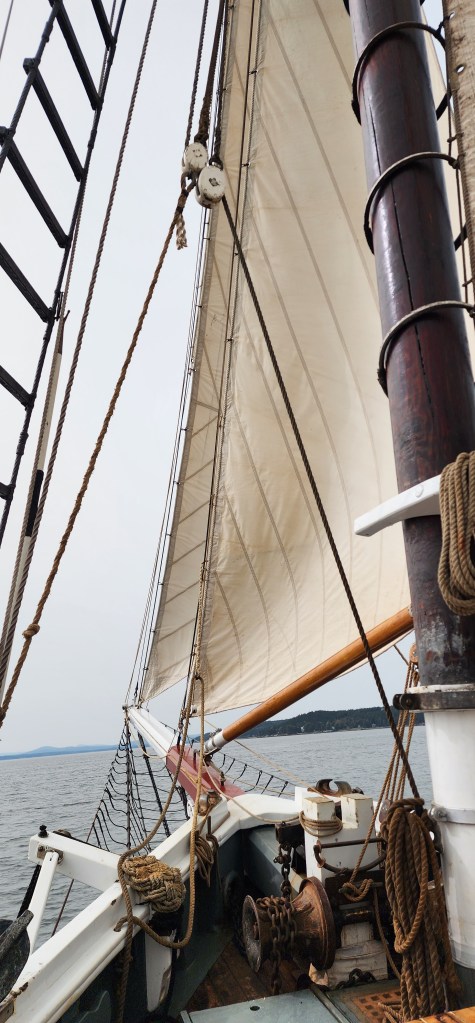
As for triangular sails, like those on sailboats. Not quite accurate when it comes to schooners. There’s something called a gaff … creating the hip-roof look of a schooner’s sails.

The Bowdoin of Arctic exploration fame.

My closeup introduction to a schooner came in a side trip earlier in the day I would step aboard one for my virgin voyage that will inform later posts. To kill time, so I thought, my buddy and I headed off to Castine, then a hole in my inner map of Maine, apart from references by friends.

And that’s where I was introduced to the Bowdoin, now named for the college of the same name but more importantly a historic vessel used by Donald Baxter MacMillan in his Arctic expeditions. Quite simply, she was designed to withstand incredible freezing – and did. I’m now wondering how the crew did, under those conditions.

That said, she was a schooner. I had seen one docked in Eastport, but this time I had a curator at hand to explain the distinctive parts.

Emphatically, it is not a square-rigger.

Schooner, as Dutch, it’s not SHOONER, after all, as my New Amsterdam Dutch-descendant Peter could easily point out, yet from deference, hasn’t. (Do I get points for noticing?)

Typically, a crew of 2½
two men and a boy
no cook?

an average life of 25 years

for a wooden ship
(owned in shares
spread the risk and profits)


There’s more to the Northern Lights than you see

Living as far north as I do, just a hair below the 45th parallel halfway between the north pole and the equator, I’m starting to keep an eye out for the Northern Lights on clear nights through winter. Moonlight, clouds, precipitation, and pollution all block viewing, but our remote location means that many of our nights can be visually crisp and rewarding for those who bundle up.

  1. More formally, the beautiful, dancing waves of light are known as the aurora borealis, named by the Italian astronomer Galileo Galilei in 1619 in honor of Aurora, the Roman goddess of dawn, and Boreas, the Greek god of the north wind. They most famously resemble giant colorful curtains blown by some cosmic wind, though that’s all a mesmerizing illusion. In fact, where I live, they’re more likely to be detected by time-exposure photography than by the naked eye.
  2. They’re best viewed between September and April, when the night sky is longest and darkest, especially in the “auroral zone,” a cap roughly within a 1,550-mile radius of the North Pole. Places like Fairbanks, Alaska; Tromso, Norway; Lapland, Finland; Orkney, Scotland; and Yellowknife, Canada, are key travel destinations for viewing, but rare sightings have been reported as far south as tropical Honolulu, Hawaii.
  3. While Northern Lights happen 24 hours a day, seven days a week, 365 days a year, they are most intense after a geomagnetic solar storm, which tosses energized particles into Earth’s upper atmosphere at speeds up to 45 million miles an hour. As the Earth’s magnetic field shields the surface by drawing the onslaught toward the poles, the energized particles collide with atmospheric gases, producing vibrant hues of blue, green, pink, violet, and even gold in surreal movement across the night sky.
  4. Solar storm emissions run in 11-year cycles. The last peak of extreme activity was in 2014, and the next is next year. We’re already in the higher-than-usual range.
  5. The strongest geomagnetic storms can disrupt GPS systems and radio signals. One temporarily knocked out electricity across the entire Canadian province of Quebec. The largest solar storm recorded, Carrington Event of 1859, sparked fires on telegraphs. I remember some occasions in 1970-’71 when they turned the overnight teletype news reports from the Associated Press, United Press International, and other wire services into unintelligible jumbles. (Some of my Sun Spot poems are drawn from that outpouring.)
  6. The storms even have the potential to wipe out the Internet for weeks or months unless the technology is “hardened,” , according to some warnings.
  7. The night lights also appear in the Southern Hemisphere as the aurora australis but are more elusive because there’s less land mass, and, thus, fewer suitable spots for viewing the spectacle.
  8. Earth’s not alone. Jupiter, with a magnetic field 20,000 times stronger than Earth’s, has far brighter blazes. Auroras have also been discovered on both Venus and Mars, despite their very weak magnetic fields.
  9. NOAA’s forecasts are available online at NOAA’s Aurora Viewline for Tonight and Tomorrow Night page, mapping the southern-most locations from which you may see the aurora on the northern horizon.
  10. The best time for viewing? One source says mostly just before sunrise or after sunset. Another says between 9 pm and 3 am.

Let’s fill in some more blanks

Some people sit down in the depth of winter to peruse seed catalogs and dream of harvests. We’ll be doing some of that in our household, and you’ll no doubt sample some of the results here.

Some find it a good time to revisit highlights from the previous year or further back. Yup, that too.

The snowy months also offer delightful travel opportunities, and not just to warmer climes. Even if you stay close to a wood fire or the equivalent, taking time to sift through brochures can stimulate plans for trips long or short later in the year. Consider my upcoming posts based on my week on the waters of Penobscot Bay at the beginning of autumn in that vein.

Quite simply, retirement and winters aren’t a blank stretch in my life.

~*~

One movie I viewed as a kid in the Dayton Art Institute’s tapestry-walled auditorium left a lasting impression on me. I think the film was scheduled to be shown outdoors but this was the rain site. What I do recall is its presentations of windjammers racing along under full sails. I was still far from any actual encounter with the ocean or sailing, but from that point on I did realize I had no interest in a traditional cruise, or what I’ve seen as a floating nightclub. No, if I went out on a cruise, it would be under sail. Not that the option quite came in front of me.

Instead, the closest over the years were jaunts on ferryboats in the Pacific Northwest and then the Northeast, along with whale watch daytrips and, especially, my boss’ 32-foot sailboat in the Gulf of Maine.

One impression I gleaned from those outings is how differently a geography fits together when it’s experienced from its waters rather than its land. That awareness certainly came into play in my history research for Quaking Dover.

Being on the water filled in some blanks.

~*~

As a lover of maps, from childhood on, I’ve also learned how the mere fact of being in a place transforms the charts. A location becomes real when I’ve walked around in it. Or, as I learned in my time on Penobscot Bay, if I’ve walked around in a boat just offshore.

Listening to new friends in Maine presented a series of towns I could place only vaguely – Castine, Stonington, Brooklin, Islesboro, Southwest Harbor – along with related locations like Vinalhaven, Isle au Haut, Blue Hill, Swan’s Island (not to be confused with Swan Island in the Kennebec River), or Little Cranberry. I could nod along with a blank look. My week on the water filled in more of that comprehension.

Now, let me fill in the name of the ship in question here – the Lewis R. French – and the fact she was a schooner, a very special distinction, as I would learn.

And as you’ll see.