I broke her heart, repeatedly
with my own shards
You never know what we'll churn up in cleaning a stall
I broke her heart, repeatedly
with my own shards
As a third book involving Jaya shaped up, I reflected on ways some people perceive things most folks don’t. The angels everywhere, as Hassidic contend, perhaps matching the dakinis of Tibetan Buddhist circles. Some of my fellow yogis saw auras around people, although I’ve seen just one, quite black, surrounding the Reverend Pat Robertson when he and his handlers walked through the newsroom for a conference with the editor-in-chief and the editorial writer.
Since moving Way Downeast, I know of the small rock people some of the Passamaquoddy observe.
You might add elves or gnomes or other creatures to the list.
The concept did give me a threat to unite the three novellas into one.
~*~
What was needed was a third novella, reflecting the place Jaya lived between Prairie Depot and the Pacific Northwest. It would have With a Passing Freight Train of 119 Cars and Twin Cabooses before it and Along With Kokopelli’s Hornpipe following. It would be like an adagio in a symphony or sonata or the middle panel in a painted triptych.
I decided to draw on a wooded alcove I loved to explore during my return to Bloomington. It was a largely unknown tract that had included a city water reservoir as well as several caves and springs that had fed two gristmills.
In the years since I moved on, the site has been cleaned up into a city park that even has a stairway down one of the steep slopes.
It had inspired a set of Leonard Springs poems you can find as a free chapbook at my Thistle Finch blog. As I revisited those pieces, I realized that the hollow’s scene and history just beyond the duplex my first wife and I rented on my return to Bloomington as a research associate would transport well to the Ozarks. Especially the part about grist mills at the foot of the sharp hillsides slopes where springs poured out from cave formations.
The story took off from there, especially when I chanced upon the woman miller. I must confess being especially fond of the result. Was this Cassia from What’s Left whispering in my ear once again?
Researching details for this story was a delight. Grist mills had run for a while in my ancestry; the Hodgson Mill in the Ozarks, for one, reflects one side of my family – they even spelled their surname for a while without the G, like mine. (They descend from one William while the other William, also a miller, was my umpteen greats-grandfather.)
Caves were another thing the Ozarks had in common with southern Indiana.
And, speaking of things some people see and hear that others don’t, we had the American Shakers whose spirit drawings and writings wandered outside of the normal artistic constraints. That gave me one more element to play with, especially when I turned to the artistic projects that Jaya had relied on to replenish her own soul in her spare time. I didn’t want her to be writing poetry, as I had, but to be creating some blend of art forms beyond that. Think of Joseph Cornell’s boxes or Emily Dickinson’s bits of paper constructions as possibilities. While I touch on Jaya’s legacy on that front toward the ending of Nearly Canaan, I felt freer to explore it here.
Just what was Jaya’s off-hours creative activity and spiritual practice leading to? Or what prompted them?
Miller at the Springs became an ideal forum for their consideration. Here it was, the final piece of writing in my range of fiction, and it was the most joyous to draft, the least ambitious in its art, and perhaps the most down-to-earth.
~*~
These three novellas presented a private Jaya much different from the one in the public eye. Titling the book the Secret Side of Jaya came naturally, along with the subtitle, Three surreal and fantastic encounters.
The book rounded out my Living Dharma series.
I was ready to kick back and relax, intending to enjoy the role of an author.
Maybe if I had a camera at the time, the trip would have wound up as photos rather than a poem. The weeklong camping trip was a turning point in my life, though, and the poem that emerged from the experience was initially accepted by a prestigious Northwest literary press but then declined – they’d lost a grant, they said.
Had it appeared at the time, my path as a poet would have advanced, definitely more securely than it did. But the effort definitely solidified my growth in the craft.
Poem? It’s my attempt at what William Carlos Williams advocated as a longpoem, where the challenge is “to find an image large enough to embody the whole knowable world about me.” About, in this case, having meanings as both the immediate world around the poet and his own autobiographical revelations. In his case, the image was the Paterson, New Jersey, the river city where he practiced medicine and lived.
For me, it became about the Olympic Peninsula of the Pacific Northwest, bugged, perhaps, by Basho’s wanderings in ancient Japan.
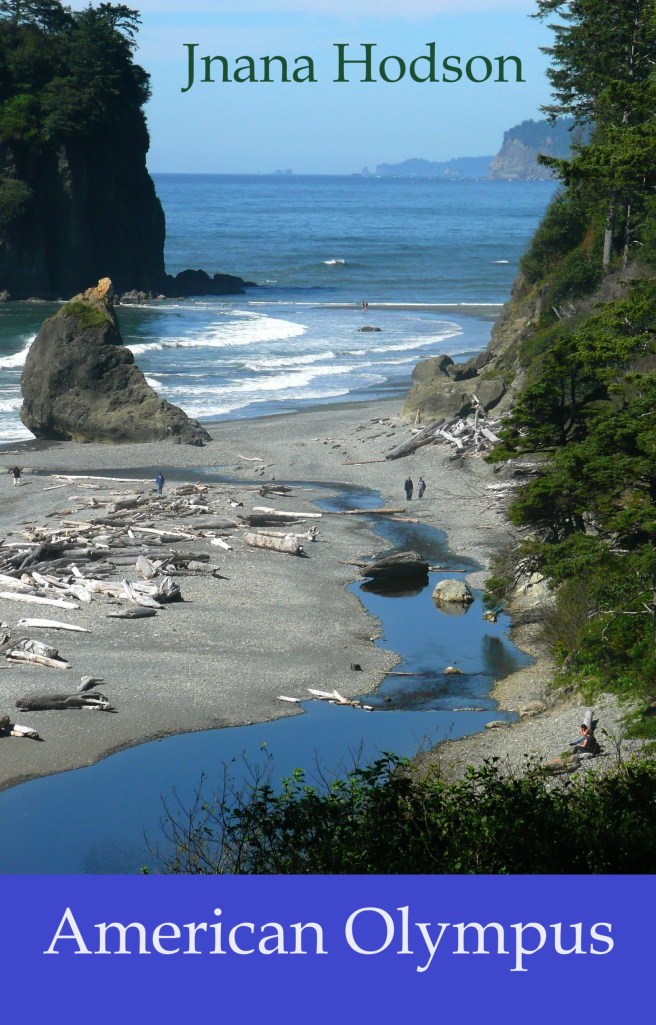
Having originally appeared in Thistle Finch editions, this collection is now available on your choice of ebook platforms at Smashwords.com and its affiliated digital retailers. Those outlets include the Apple Store, Barnes & Noble’s Nook, Scribd, and Sony’s Kobo. You may also request the ebook from your local public library.
Do take a look.
My encounter with Technicians of the Sacred: A range of poems from Africa, America, Asia, and Oceana came about the same time I was taking up yoga in the early ‘70s. This sampler of so-called primitive peoples had a freshness I found stunning. Many of the translations were fragmentary, giving the sense of having just been excavated from an archeological dig. Others reflected my sense of discovery arising from the practice of meditation. These were unlike any poems I had previously encountered, and they altered my writing direction.
Thus, I was immersed in what he called deep image and ethnopoetics before I’d ever heard the terms.
I know it’s not his only book in my library, and I am anticipating looking for the others when we move many of our goods out of storage.
there were no fish in the moat
of the slimy castle
as for crocodiles?
Great ideas remain the heart of a revolution. The kind that strike the core of one’s being and inspire action.
They must have a foundation in irrevocable reality if they’re to succeed in the long run.
Not lies, which are shifting sands. Or dreams, which float far from their anchors. Instead, some touchstone that resonates and holds fast, even on the great prairie.
And that’s it, for now.
Carry on.
Respectfully, I hope. Or else.
They cross boundaries and break rules but have strong intellects. You need them but also need to be wary of them, especially when it comes to your wife or daughter.
In mythology, they appear across cultures, and not always as an animal or immortal. And we’re not talking about trick-or-treat night.
Take a look, here are ten.
Somehow, this hunchbacked flute player has become the most widely recognized Native symbol around. Maybe because there’s something playful in his step. He even became a character in one of my novellas in The Secret Side of Jaya.
Here are some facts about him.
Living in the family I do, my TBR stack of books is well larded with Christmas and birthday presents – things others think I’ll like or should at least tackle, as well as volumes they’ve already enjoyed and wish to tempt me. I’m not complaining, mind you, though I can be perplexed by their choices, at least until I’m moved to open the cover and dig in.
Sometimes it takes me several years to get around to that, which was the case with The Fellowship: The Literary Lives of the Inklings, by Philip Zaleski and Carol Zaleski.
The tome surveys the Inklings, a literary circle established at Oxford University by the likes of J.R.R. Tolkien and C.S. Lewis, an affiliation that lasted their lifetimes and paralleled the more progressive Bloomsbury elite.
As I read of the budding authors’ early years and passions, my eyes were opened to how different their reading habits and expectations were from mine. They were steeped in a desire to recover a mythos of elves and other realms arising in ancient Britain but lost over time to the teachings from the Continent. There was also a fascination with invented alphabets and languages and secret communications. In contrast, apart from an early round of Tom Sawyer and English shipwrecks, my tastes ran to non-fiction – biographies, histories, and science, especially – and to visual arts and classical music. I still love to read maps, by the way. As for language, English still holds plenty of room for exploration, and Spanish and French are challenging enough.
Fiction returned to my lineup my senior year of high school via an essentially political route – Animal Farm, Brave New World, and 1984 on the leading edge. Besides, that was the time when I was finally getting serious about writing and editing, too.
In short, I read to learn things, and still do, for that matter. Rarely would I admit to reading for pleasure, as such.
But the first years after graduating brought a change, including The Lord of the Rings (which struck me as a rehashing of Wagner’s Ring Cycle material), Samuel Johnson, and Virginia Woolf before getting to Tom Wolfe, Vonnegut, and Kerouac and, after college, Brautigan.
My preference soon settled on contemporary and American, here and now, even if I have a fondness for baroque twists and long sentences.
I have to admit having little in common with the Inklings. Even our religious leanings veer in opposite directions – their thick Catholic and Anglican wrappings versus my Zen and Quaker ascetic.
~*~
At that point, while cleaning a very dusty bookshelf, I chanced upon Becky Gould Gibson’s Need-Fire, a poetry chapbook elaborating the life of Hild, a 7th century abbess who founded a monastery for men and women in Whitby, North Yorkshire but at the time Northumberland. It was a time when some women had more authority in the Catholic church than would be the case later. That, in turn, led me to learn more of the history of Britain in that period, including the reality that much of the land was openly pagan perhaps into the 9th century, much later than I’d assumed.
With another leap of thought, I realized that much of what I’ve found puzzling in the English folksongs, mummers’ plays, and the Abbots Bromley and Morris dances I’ve encountered through Boston Revels is thinly veiled pagan tradition living on, part of the deeper culture of the land and its earlier peoples.
Well, as we say, the plot thickens.
My next question returns to these shores and an awareness of what this land means to its inhabitants. For me, that’s a blending of science, economics in the broadest sense, spiritual awareness, and the arts.
So how would you define the grounding of your own reading habits and interests? Has it changed over time?
Despite of having read all of the Bible – and wrestled with many of its passages – I had never read it straight through until a few years ago. (Rather, it had been piecemeal. Seeing it in the larger structure presents some unique hurdles and troubling assumptions, as well as an evolving comprehension of the Holy One and faithfulness. )
Since the beginning of the year, I’ve been retracing that experience with a new post each week at my As Light Is Sown blog. My reflections, as you might expect, are quite unorthodox, and in the books of the Hebrew Bible (aka Old Testament), they’ve been augmented by heartfelt insights and confessions by some wonderful Jewish poets and novelists – not the stuff commonly encountered in Christian circles. You don’t have to be a believer to be engage with these stories. Think of them like Shakespearean or Greek drama, if you will, filled with human drama.
It’s a much different approach than reading it as law, one filled with more punishments than rewards. No, this is essentially about life itself.
I’d love for you to join in the series – and look forward, especially, to your reactions and comments.
 Jnana's Red Barn