SWIMMING WITH PISCES

Why wait for the dust to settle? Here are 10 bullets from my end.

~*~

  1. Would love to get back to another personal routine that’s somehow fallen by the wayside: sitting abed and “simmering” each morning with a cup of coffee to accompany some reading or just my own thoughts. Rather than popping right up and getting in gear. Theologian Howard Thurman was a big advocate of the practice and its reversal in the evening.
  2. Do have the indolent luxury of hiding out in our third-floor guest room (a.k.a. crafts room), opposite my studio, maybe even allowing a whole thick novel to wash over me as I read if I’m not napping there. It’s the room up there that gets direct sunlight, unlike my north-facing studio.
  3. Forsythia, which she insists are as hardy as weeds, are in danger of blooming too early. One more sign of disaster we’ve observed. We’re watching them, all the same, to bring a few sprigs in to force into flower sometime approaching Easter.
  4. Returning to the memory of hitchhiking – giving a lift to others when you can or extending their generosity, in some manner – suggests compiling a long annotated list of our experiences and what we learned, pro and con. Maybe as Letters to Youth from a retired hitchhiker or a way of finally gleaning some wisdom in reflecting on the era. Yes, it could be giddy but also risky. And I’m not the one to see it from the “hippie chick” perspective. Anyone else want to rise to the challenge?
  5. We’re well into sauna season, the little cabin at the edge of the pond. I’m still not breaking the ice for a dip. Let the younger, more foolhardy guys to that. No, there’s no reason for us geezers to tempt cardiac arrest.
  6. Curiously, I don’t seem to be getting any more done in my personal pursuits than when I was working fulltime. Or was I really neglecting a lot more then than I remember?
  7. February is such a short month, especially for those of us who have legal obligations to fulfill – car inspections and new tags, for instance. And then there are all those monthly payments coming due the equivalent of at least a weekend earlier.
  8. Quakers traditionally eschew a liturgical calendar, preferring instead that every day should be holy. Not that we commonly manage that. But that doesn’t preclude some of us from voluntarily taking up disciplines that would be mandatory in other denominations. For example, my wife and I customarily delve into Advent and Lenten readings and abstain from alcohol for those periods. (As a practice, it’s good to be able to say “No” and stick with it, especially when it comes to temptations like my martinis.) This past Advent we engaged Eastern Orthodox “fasting,” realizing a vegan diet would fit the rules if we eliminated oil on Mondays, Wednesdays, and Fridays, apart from the fish allowed on weekends. The avoidance of meat was no problem, but we really missed the cheese and eggs, which many vegetarians allow, and I nearly added milk to my coffee more than once. Almond milk, by the way, is a fine substitute, but I also gained an actual fondness for black coffee. So much for the sugar. Still, it’s surprising how many labels I began reading – cookies, chocolate – and found offending additives. With Orthodox Lent beginning February 27, we’re looking at even stricter rules. It’s what she describes as being a tea-totaling vegan with no olive oil. We really have to admire all those who take this in stride.
  9. And any day now we’ll be invaded by ants. They seldom wait for mid-May.
  10. We’ve seen too many who shout “law and order” turn out themselves to be lawless and disorderly.

~*~

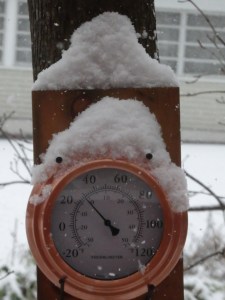
You know it's a cold morning when you look out the window and see this. Especially when all the other neighbors are in the same boat.
You know it’s a cold morning when you look out the window and see this. Especially when all the other neighbors are in the same boat.

WHATEVER THE NEXT STAGE

the Late Quartets
meaning, always, Beethoven
always attended most intensely
late at night
alone

something here liberated from audience
or sound itself
or even emotion or intellect, solely
some pure essence
released within four players’ labor

~*~

the labor has me thinking
of Stephen Foster, his two strands of work
the minstrel songs that provided
his income and reputation
but his parlor art songs from his depth

yes, I’m far more compartmentalized

journalism, poetry, fiction, religion, et al

~*~

imagining my own funeral
a performance of Schubert’s string quintet
or a hymn-sing
if not my Quaker silence with vocal
messages therein
whatever the next stage

Poem copyright 2016 by Jnana Hodson
To see the full set, click here.

A FEW MORE NOTES IN THE SCORE

The mind dances here and there, rarely in a linear fashion. So what’s on my mind these days? How about counting on these fingers?

~*~

  1. Even before she argues I’m regressing to adolescence, she has many reasons to ask: Am I still emotionally … 15? Maybe this time I’ll get it right. Or just FINALLY.
  2. How is it so many people see me as masked, restrained, even inhibited? All these years. Will the real me please stand up?
  3. Like a pack of cards, “shuffle the deck,” the way of the Red Barn – or my all too rambling life with all of its competing interests! Don’t we need a job or children as focus? Or God?
  4. A jazz guitarist asks me between sets, “Are you a musician? You listen like one.” I take it as a compliment. As for my choir?
  5. Too easily I find myself retreating for too much of the day (and night) in my attic studio, apart from the rest of the house. Call me a third-floor hermit. That’s where I think I write best.
  6. I’d dreamed of having Molly Ringwald join in a movie I’d scripted: 61 Candles. We’d all grown up. Or something like that. Even I was younger then.
  7. It’s a familiar goal in revising a piece of writing and, as I’m finding, in making music. Think of the visual arts, too, and any number of places in daily life. Gain lightness in what had been blocks of density.
  8. Inscribed on the tower: “Maybe he was the love of my life … but I wasn’t his.” (Which interpretation do you prefer?)
  9. How is it I got so old? Even within an old soul?
  10. My overcoat, still tinged with city grime, needs cleaning.

~*~

This is it, indeed.
This is it, indeed.

OR THAT?

Being mindful of what’s right in front of us can always be a challenge. Here are 10 new items from my end.

~*~

  1. I haven’t said anything about shoveling snow, have I?
  2. One tension in today’s world is a matter of staying in place in a restless world. Sinking roots, as it were. Going deep. Without getting stuck. How is this rooting balanced with personal growth and evolution? And, too, how is it I’ve stayed Quaker, amid all the other self-identities in play?
  3. Am continuing my practice of learning Spanish before breakfast – along with our Cuban-roast coffee.
  4. A friend shows us the mass of stonework in the cellar of his 1755 New England saltbox house, and we recognize it’s a thermal mass that holds heat in winter, keeps the place cooler in summer. Those old Yankees were way ahead of our times.
  5. So the day starts clear, then clouds over. Snow on the way? Gotta check our weather vane, see if the wind’s coming in off the ocean.
  6. Observing two side-by-side icicles hanging over our second-floor windows, I see one’s bumpy while the one next to it’s smooth. Then realized, yes, water drops freeze as bumps, and thus the smooth one becomes the question.
  7. As Boss would have told Bill in Big Inca: “I told you to report EVERYTHING.” Maybe there are limits.
  8. Listening to piano music by Louis Moreau Gottschalk, keep hearing a riff that sounds like “Skip to the Lou,” itself a puzzling phrase. Turns out it’s Scottish for “love,” and the tune accompanied a circle game. Also, Gottschalk was quoting a slightly different and more wistful tune from New Orleans, which explains the notes that move sidewise.
  9. The Libertarian Party really blew its big opportunity. Royally. Now where does it turn?
  10. Perhaps tomorrow will be a bathrobe day. Or at least sweats. No driving, just stay indoors at home. Plenty to do here, anyway.

~*~

Joe Pye in ice -- what had flowered does so once again in the heart of winter.
Joe Pye in ice — what had flowered does so once again in the heart of winter.


FINGERINGS

many classical musicians regard a score
more through their hands (as instrumentalists)
or the eye, according to the sheet (as composers)
or even the mouth (as singers)
than through the ear, much less the heart.

in that light, Beethoven’s mastery in deafness
should appear no miracle

unlike Charles Ives, off-limits
when the circle needed completion
– without the ripple of applause or engagement
or critical test of application –
only the stone-dead silence of scorn or indifference

let us touch, then, releasing these birds
from rows of ink on a page
as if this were another spring morning

Poem copyright 2016 by Jnana Hodson
To see the full set, click here.

THIS IS IT?

I’ve long been fond of collage as an art form. These Tendrils continue the stream.

~*~

  1. Ground Hog’s Day marks the end of solar winter, in contrast to the standard calendar’s use of the equinox on March 20. We have as much daylight now as we did around Halloween, back t the end of October. It’s another reason I view the year as eight seasons rather than four.
  2. I’ve previously posted about the ways observing Advent as the days leading up to Christmas Day – which then ushers in the Twelve Days of Christmas –greatly alters our way of experiencing the holidays. As a result, since we don’t put up our tree until Christmas Eve, we leave ours up much longer than our neighbors. Long after theirs have headed for the dump, ours is still casting magical light around our front parlor (the room we call the library) while the mass of tiny lighted bulbs outside the bay window are also still glowing. Deep winter’s much more tolerable this way.
  3. When the evergreen tree does go out of the house (meaning any day now), its place in the bay window is soon taken up by flats of seedlings we’ll transplant to the garden, likely in May. My task now is to retrieve the appropriate shelves and bars of lighting from the shed – out in the brittle cold. We always seem to be behind schedule there.
  4. How sad to see so many so-called conservatives turning barbarian, intent on destruction – pillaging civilization and culture.
  5. My last days at the office included erasing my tracks. A lot of stuffed folders went into the trash.
  6. I finally acknowledge my past lovers would have never made me a suitable spouse. How blessed I am now.
  7. Think of the books we keep returning to. Or simply journals. Which of them keep you on track?
  8. There’s a day, as the rabbi admits, for sex and delight, free from the usual intrusions. It’s called Sabbath. Seriously.
  9. Goose – all dark meat, a lot of good tasty fat – a spoonful is great for favoring other dishes while cooking.
  10. Someday has come.

~*~

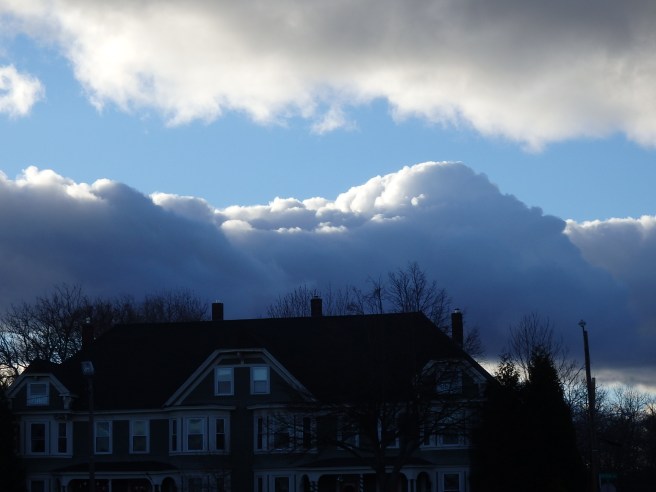
Afternoon winter sky over Dover.

MY CALL

for dancing, I want fiddles or flutes
more than saxophones or electric basses
for the measure

how true when they say accomplished waltz
extends either romance or seduction

moving either toward shelter or some dangerous
fascination, all the same

when we link together in a line or a circle
we will pivot and fly . take me away, then

with equipoise into the periphery

Poem copyright 2016 by Jnana Hodson
To see the full set, click here.

THE MYSTERY OF MOZART

In the annuals of genius, today marks a special observation, the birth of Wolfgang Amadeus Mozart in 1756.

The traditional biography reads something like an extended fairy tale, starting with the child prodigy who charms European royalty in the flowering of the Enlightenment. Yes, there are emotional conflicts with his taskmaster father, who nevertheless deserves much of the credit for those early successes as a performer, improviser, and composer. That doesn’t stop the son who dashes off masterpiece after masterpiece in lively company or en route on stagecoaches rather than in deep solitude with a keyboard. Later tales of poverty and domestic desperation, however, mask his inability to handle money or patrons. You could say he was a tad spoiled but, oh my, unbelievably talented. Besides, it turns out he was the second-highest paid musician in the world, after Franz Joseph Haydn, who lived in conditions offering much less freedom. You could also say that in his prime, nobody wrote with more spontaneity, perfection, or elegance. So much for the standard version.

The fact is that Mozart set a standard that, on its own terms, could not be matched. much less surpassed. In the world of opera, his are among the very best, even without considering how he lifted the genre to new heights. As an opera composer alone, he would have been among the top handful. He essentially created the piano concerto. And the symphonies, alongside Haydn’s, are models of an evolution leading to a final culmination rivaled only by Haydn’s two London series.

I must confess that my deep passion for classical music began in fifth grade, age 10 or 11, with an encounter with the 29th symphony, in A major. Its infectious, joyous outburst, order, and underlying idealism struck a deep chord in my young soul, spurring a hunger for much more, which I found in his work and those of other symphonic and, later, operatic masters.

The prolific legacy Mozart left at his death at age 35 is prodigious, even before we get to the chamber music, choral compositions, or instrumental offerings.

With him, sooner or later, we come face to face with the tragedy of a life cut short, in the fullest blooming of genius – like his fellow Aquarians and composers Schubert and Mendelssohn, especially. The question then turns on the what-if of whether he could have advanced in the artistic challenge of Beethoven and a torn-apart social order to ever greater heights or whether he would have failed to adapt and, thus, withered.

Which leads us to the biggest mystery regarding Mozart. What if he had lived a longer life, say one as long as Beethoven’s? There’s the inevitable comparison, Beethoven. Not Bach, curiously – maybe it’s the matter of those symphonies. Put another way, had Beethoven died at the age of Mozart, his reputation would have been as a second-tier composer, one resting largely on 23 piano sonatas, culminating in the “Appassionata,” plus three classical-style piano concertos and three symphonies – including what would have remained the enigmatic “Eroica,” one that would likely not make much historical sense without the Fifth, Seventh, and Ninth for perspective. There wouldn’t even be his tortured venture into opera. Oh yes, we’d also have the six string quartets, Opus 18, in their homage to Haydn. Had he died at 35, Beethoven would have not been regarded in the same league as Mozart or, for that matter, Bach. I was about to add Brahms and Dvorak, but hesitate since they were so beholden to Beethoven’s challenge and model.

Within the Mozart-Beethoven dichotomy is another deeply intriguing consideration. The conventional interpretation is that Mozart would not have adapted to the artistic and social revolutions ahead, that he had simply gone as far as anyone could in what we call the Classical period and its dimensions or that he would have been baffled and outmoded by the changes to come. More and more, though, what I hear in the last four symphonies and the unfinished requiem suggests something quite different. Mozart was yearning for wider horizons and expressive possibilities. Yes, we have a surfeit of his work as it is, how can we truly desire more when there’s so much already, but what may be lacking is that singular, definitive great gesture along the lines of Beethoven’s Missa Solemnis or late quartets or late piano sonatas or even the Choral Symphony’s final ecstatic outburst or perhaps Bach’s Chaconne from the Second Partita for solo violin.

Alas. Remind me of that when I’m immersed in one of Mozart’s extraordinary opera arias or a slow movement from a piano concerto.

I could recast the consideration, then, into a question of whether Mozart had moved to Prague, which adored him, rather than stay in Vienna, or even on to London, which had so embraced Handel and would later welcome Haydn. Suppose Mozart had lived another decade – or three or four – in fresh, more supportive surroundings? We’re back to genius and its nurture.

In the end, we have what we have, filled with delight and such promise. Let’s see what we choose to play today in that honor.

YES, AQUARIUS

Why wait for the dust to settle? Here are 10 bullets from my end.

~*~

  1. Since we don’t put up a Yule tree and decorate it until Christmas Eve, ours stays on display longer than any of our neighbors’. The lights make January a less forbidding stretch. Make it more festive and relaxing. So what do you do special this otherwise cold, dark month?
  2. She’s really at home in a grocery store. Knows all the comparative prices, what’s a bargain, what’s special. Not so in other retail settings. Still, you should see our pantry. Or the two big freezers in the barn.
  3. Swami had long ago said I didn’t need a job (I’m an old soul) because that’s not the work I should be offering. That was long, long ago.
  4. How often does it seem: Fashion = Money … along with the race for something better?
  5. Would I be satisfied with a single-line poem that said everything? Stake my reputation on it?
  6. Considering all the hours I put in on my “personal writing” over the years – the poetry and fiction, especially, or genealogy and Quaker fare – it would have added up to a lot of overtime pay. Even at 10 hours a week, though I suspect with vacations and holidays thrown in, the average would have been closer to 20. I’d really have to land a bestseller to come anywhere close to recouping that investment.
  7. The frustration of my twilight years in journalism, seeing us increasingly pander to stupidity, ignorance, and hatred rather than trying to lead and enlighten.
  8. As the funeral director told me, “We hate holidays. Holidays suck.”
  9. Fortune cookie: You will make many changes before settling satisfactorily.
  10. Can this really be happening to America? Or the world?

~*~


Looks like white-painted architectural touches to me.
Still looks like white-painted architectural touches to me.


HOW ABOUT A SUTRA?

As I revisit my copy of The Diamond Sutra and the Sutra of Hui Neng, the binding falls apart. How appropriate! The price, $2.95, says everything: this is a volume that has been carried from one end of the continent to the other and back, with a world of spiritual practice and discovery in between.

A sutra typically is a Hindu or Buddhist teacher’s discourse for aspirants.

The scarab, a symbol of ancient Egypt, originates as a beetle, By extension, it also becomes a symbol of transportation in the hippie era, leaping from there to the Hindu and Buddhist texts and back.

Break away from routine – job, home, neighborhood and friends, the commerce of community – just long enough to let the mind clear. Don’t fill the silences with radio, conversation, any music or dialogue but your own. From somewhere deep in the nervous system, atypical even random bits of memory and observation rise in unanticipated sequence. What ought to have been obvious all along suddenly asserts itself, perhaps with bold surrealism or jarring candor.

In a flash, the mind dances, as it will, with whatever engages it. Field notes, the words themselves, appear unadorned, without apology. Here something other than straight thinking presents its original mental hopscotch.

To a generation of Americans, the Volkswagen Bug represents cheap, easily repaired, carefree transport – often accompanied by adventurous first-time experiences and personal growth. In ways, the plain VW depicts a break between the routines of schooling and establishing families and careers to follow. A time, too, of spiritual exploration, with a flowering of Yoga and Zen, especially.

Here, then, the machine serves as a vessel into the Void, where the mind glimpses and tastes “all this fleeting world: a star at dawn; a flash of lightning in a summer cloud; a flickering lamp, a phantom, and a dream,” in the words the Diamond Sutra (Vajrachchedika).

Listen to this teaching. As Hui Neng insists, “Mirror-like Wisdom is pure by nature.” And persevere!

~*~

Ripples in a Bejeweled Prayer Flag

Well, these are all at play in my newest poetry collection, Ripples in a Bejeweled Prayer Flag. Take a look at Thistle/Flinch editions.