Some of my favorite dishes the leading lady in my life creates

As I’ve said, she’s one of the world’s great cooks. Middle-Eastern, Italian, Mexican, French, German, even Vietnamese, Thai, and Indian, she does them all and with flair. Me? Let’s look at some of the more regular things I’ve delighted in.

  1. Anything over charcoal – lamb, peppers, flatbreads, steaks and chops. It never really figured in my life before her. Usually, they were more like sacrificed offerings.
  2. Roast chicken any number of ways – thyme or rosemary lead my list, but Thai and even Indian now come close behind.
  3. Asparagus under a poached egg – ditto for spring dandelion.
  4. Strawberry or blueberry clafoutis. It’s just one of her many creamy desserts that wow me, often with our own berries.
  5. My annual birthday bash of prime rib and Yorkshire pudding, which she says is one of the easiest things ever.
  6. She’s quite fond of pork. One year we even had a whole half-pig to play with, cut up to her specifications. I think I’ve already told that story.
  7. Homemade yogurt. It’s almost like ice cream.
  8. Pho or banh. Vietnamese staples.
  9. Chowders. Sometimes using lobster stock from leftover shells.
  10. Souffles. They taste as heavenly as they look. Even after they deflate.

Now that I’m done bragging, what’s some of your favorite home cooking?
 

How different today’s downtown Eastport looks from even the 1950s

Stroll through Eastport’s downtown – rebuilt within a year or two of the disastrous 1886 fire and now in the National Register of Historic Places – and you’d think it was always like this, only with all of the storefronts bustling.

Not so, as I’ve been hearing, and that’s confirmed by a closer look at the undated aerial photograph on the cover of Joe Clabby’s two history books.

So as an idea of how things have changed.

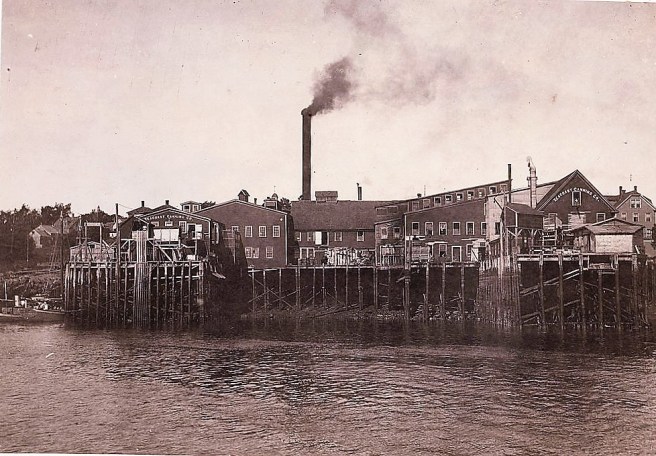
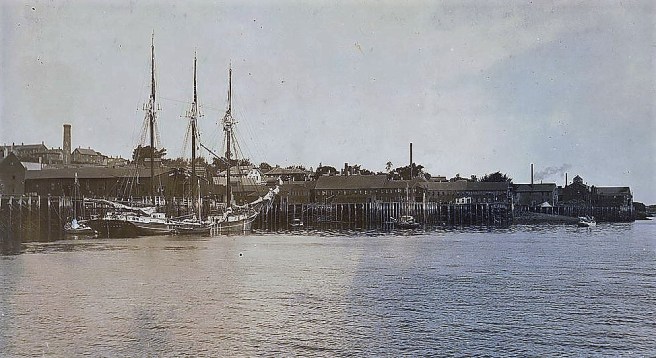
  1. The waterfront is still full of sardine canneries set out on wharfs just behind the storefronts downtown, but many of the operations are now abandoned. There had been 21 at the prime around the turn of the century, but only one is still operating after 1975 and that ceases in the early ‘80s. As one local told me, you could watch the town fall into the water. Only the shell of the American Can factory still stands today.
  2. In fact, you would have a hard time seeing the water. The Waterfront Redevelopment Project, launched in 1978 and completed in 1983, cleaned up much of the scene and installed the popular walkway.
  3. The railway station, successor to the steamboat pier sits, beside the American Can factory. There’s a large apron in front of it, possibly for parking.
  4. A big movie theater occupies the space where the parking lot and the fisherman statue are now. And another big building fills the now-open space of the amphitheater. Today both are big gaps in the row of storefronts but allow more sunlight into the district.
  5. No Breakwater pier. That won’t come until 1961, with extensions later. It’s the focal point today.
  6. And no Fish Pier, which further defines the harbor.
  7. A rail line still runs into town. Service will end in 1978 and the tracks, removed.
  8. The Hotel East sits where the Motel East now is – at a 90-degree angle to the original.
  9. A row of houses is perched at the water’s edge of Shackford Cove. Long gone.
  10. There’s no Coast Guard station.

Here’s how the waterfront looked even earlier, from two photographs taken by Lewis Wickes Hine in August 1911, now in the Library of Congress collection.

There’s nothing “quaint” about the place in these, is there?

Favorite names I haven’t used in a novel

I’m waiting to name a character Sorrell. And Hezekiah is what I would have loved to have named a son, not that I would have found support on that one. Maybe as a middle name?

In a story, I try to avoid using names of people I know, or at least know well. Ditto for close family. So they don’t count here. It certainly narrows the range. On top of everything, after multiple revisions, I don’t always remember what I’ve kept in the end.

Besides, a name should be suggestive.

Now for ten or so more.

  1. Lane. Or Blaine. Unisex, very useful.
  2. Perry. Unisex again.
  3. Majik. Was a fisherman around here but could be unisex.
  4. Dana. Well, since we’re on a roll.
  5. Marilyn. Evocative, yet all-American.
  6. Pierce. I see a cutting edge in his glance.
  7. Bonita. Could go by Bonnie, too. From the Spanish, makes an alternative for Linda, which I also haven’t used, or Melinda, even better.
  8. Trent. The family had aspirations and this was the golden boy.
  9. Berry. Back in unisex, along with alternative spellings.
  10. Lark. Even Clark. Or Clifford. Or Larkins.

For children, though, I’ve become very fond of handing down family names. Even using a maternal surname. Guess it’s the genealogist in me at work.

We haven’t even gotten to nicknames, which can really pop a character into focus. Think of “Willy” as one possibility.

How ‘bout some suggestions from you?

 Some things I miss about Dover

It may be a small city, but even so, it was home. And much larger than where I’m now living.

So some of what I miss?

  1. The over-the-fence or across-the-street conversations. Especially the guy stuff. Tim, Mark, Jack, Mayor Bob, that circle, especially.
  2. Recycling. I feel guilty putting it all in one bag. Unless the volunteers regroup after this Covid thing.
  3. The indoor pool. Not just the physical exercise of swimming, but the banter with other swimmers and the lifeguards.
  4. The Quaker Meeting and Greek circle, too. Not just older folks, but meeting the babies who have come along in the interim.
  5. Our garden, even though it was a lot of work. It was even visually pleasing.
  6. That leads to glutting out on fresh asparagus for nearly a month in late spring.
  7. And heirloom tomatoes, with tomato and mayo sandwiches for the better part of two months come high summer. (Downeast Maine is too cold at night for them to mature.)
  8. A range of dining options, not all of them in Dover. We weren’t far from neighboring communities. Not just ethnic, either. LaFesta Pizza would be a prime example of taking a specialty a step extra.
  9. The Amtrak as an escape to Boston or Portland. Not that I had used it that often, back before Covid, but I had plans.
  10. Dishwasher, clothes washer and dryer. Without the renovations on our new old house, it was a return to a primitive era for me. The two nearest laundromats were an hour away, in opposite directions.

When sardines were big

Eastport’s economic glory days were when the city was the Sardine Capital of the World.

They’re small herring and abounded in the waters around Eastport, where they were easily caught and delivered straight to the cannery atop the wharf.

Here are some related facts.

  1. Napoleon Bonaparte helped initiate the canning of sardines, the first fish to be so preserved.
  2. Packing in Maine took off from Eastport in the 1870s and peaked around 1900, with 75 plants, mostly along the Downeast coast. The first sardine cannery in Eastport started in 1865 but failed to reduce the moisture in the cans, leading to a sharp, unpleasant odor. Its owner returned to Portland and found success with baked beans. Others in Eastport improved the process.
  3. The workforce was largely women, with blurring hands and sharp knives or scissors expertly packing the small fish into cans – as crowded as sardines, as the popular expression went. Their hands were in cold seawater, year-‘round.
  4. Eastport also cranked out the cans and lithographed labels.
  5. The fish were packed in cottonseed oil, soy oil, or upper-end mustard sauce.
  6. The world’s biggest sardine cannery jutted 250 feet out from the shore at the entrance to Shackford Cove.
  7. Home refrigeration doomed the industry, making fresh cod, haddock, and other fish readily accessible.
  8. Sardine tins were part of soldiers’ rations during the world wars.
  9. The discarded fish parts were used to make fertilizer, while the scales were transformed into pearl essence, a shiny coloring used in many consumer products.
  10. Vintage sardine cans and labels are collectors’ items.
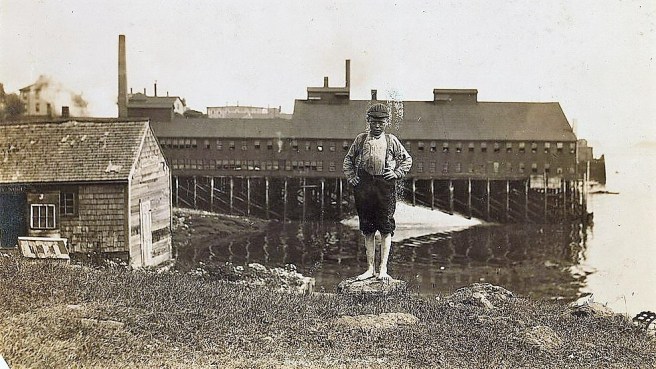
Eastport’s sardine canneries were also centers of child labor, as photographer Lewis Wickes Hine documented in August of 1911. Above, Fulsom McCutcheon, 11, was a worker at the covering machines. The world’s biggest sardine cannery extends behind him. It was about two blocks from my house. 
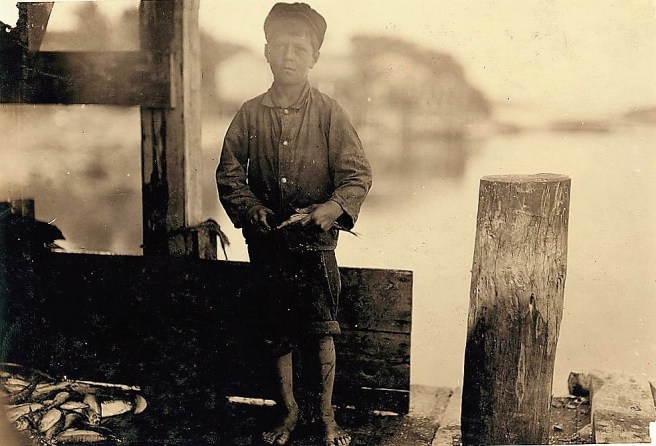
Hiram Pulk, 9, cuts sardines at the Seacoast Canning Company’s Factory No. 1 in Eastport. “I ain’t very fast – only about five boxes a day. They pay five cents a box,” he was quoted. Both photos from the Library of Congress collection.


A few things that peeve me royally

Look, don’t make me elaborate. Here are a few, in no particular order.

  1. Getting stuck in traffic
  2. Having my plans derailed
  3. Overly loud music or TV or movies or mufflers
  4. Not being able to make out the dialogue or lyrics. Along with people singing way out of tune
  5. People cutting in line or who who can’t count the limit in the express checkout
  6. Stupidity of all sorts, but willful stupidity most of all
  7. Arrogance
  8. Lateness or just not showing up, as promised
  9. Lying and cheating
  10. Abuse of authority slash power or gross injustice in general

Your turn!  Lay it on!

Reflecting on the upcoming Met broadcast season

Each fall, donors to the Support the Met Broadcasts campaign receive a handsome program guide to the upcoming opera season.

I’ve kept mine, going back to 2005, and find they make a fine reference collection regarding both the plots and performers.

My own listening experience goes back to Joan Sutherland’s first role there in late 1961 or ’62. It was exciting, even through all of the AM radio static of the day.

While much of the core repertoire remains the same, there are also new productions and new or rare works, and it’s interesting to see how these are lined up.

What struck me in the new booklet is how few of the singers’ names I recognized.

When I first started listening, the leading performers were celebrities, often household names and gossip column fodder.

It was a tight circle at the top, in this country and in Europe, enhanced by handsome multidisc LP albums.

Think Pavarotti or Callas.

Well, times have changed, as has the focus. The singers are often more musically informed, and they’re required to physically to act and project their roles in sometimes demanding stagecraft. As for the sets and costumes? This is the height of theater.

The amazing thing is how many fine performers there are now, and they’re active far beyond the confines of the Met and its elite sisters.

There’s a similar shift in the conductors. I recognized only six who will be in the pit. The biggest surprise was seeing the Pittsburgh Symphony’s maestro among them, and he’s considered solid but hardly superstar. (Consider that a compliment, by the way.)

What’s significant is that one-fifth of them are women, one leading two separate operas. The cadre is growing.

What’s missing, though, is American-born conductors. They are active on the symphonic scene globally.