Heads up!

Oh, my, so much has happened since the Common Ground Fair at the autumn equinox.

The week that followed, when I was out in the schooner, introduced so much, and two days after I returned, the big renovation project on our house finally began.

Many of those developments will be presented in weekly posts after the New Year. I do need time to digest the implications. Remember, I spent too much of my professional life as a journalist in the immediacy of daily chaos. I do value a longer view.

For now, there are other bits to catch up on as well.

Life is feeling very rich, indeed, if I don’t let it become overwhelming.
Doodling around with the origins of ‘Yankee’

The label does have a range of applications, from residents of the six-state New England region or Connecticut in particular to a Manhattan professional baseball team to anyone north of Dixie (often prefaced with “damn”) to anyone from the USA who lands in a foreign country.

Along with the shortened “Yank.” Or its many uses as an adjective.

The word’s origins, though, are contested.

  1. The earliest recorded use is credited to British General James Wolfe in 1758 when he complained about the Americans under his command. The British continued to use it in a derogatory fashion. The pompous fools.
  2. A largely dismissed theory had it arising in a French word for English-speaker that the Wyandot rendered into Y’an-gee.
  3. Another had it being adopted when New Englanders defeated a Native tribe who had identified themselves as Yankoos – meaning invincible. Problem there is the tribe must have been invisible all along.
  4. More likely is a derogatory Dutch-language origin in the early 1600s through New Amsterdam, beginning with the name Jan, for John, pronounced Yan. One theory has Jan being applied to any Dutch-speaking English colonist, a kind of winking acknowledgement that they could converse. How about having it originate among those Dutch-speaking Englishmen? I haven’t seen that suggestion before.
  5. Or it may have been imported from the Old World as Jan Kaas, “John Cheese,” a generic nickname the Flemish had for Dutch in the north.
  6. Or Jan might have been combined with another popular Dutch name, Kees, into Yankee, as English-speakers turned it against the New Netherlanders.
  7. And then those New Netherlanders soon slapped the word on English colonists in nearby Connecticut.
  8. By 1681 there may have even been a Dutch pirate, Captain Yanky or Yanke. The Dutch settlers, now subsumed into the English colony of New York, may have seen the Brits as pirates. Sounds awfully late in the timeline for me. I think it was definitely widespread slang before that.
  9. By the time of the Revolutionary War, the song “Yankee Doodle” was well established. Whatever its original intentions of mocking the Americans as simpletons, New Englanders took it as a badge of honor, macaroni and all.
  10. Somehow, after the Revolution, it became a synonym for Protestants descended from New England Puritans and their values. Take “Yankee ingenuity” as a prime example.

None of these quite convince me, but I feel Scottish, Swedish, and even Persian roots are even less likely.

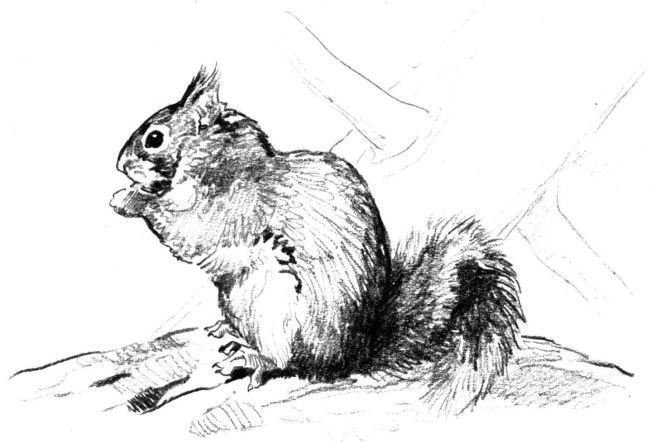
Sometimes I’m accused of acting squirrely

Back in New Hampshire, I was often engaged in a losing battle with squirrels. We had them for a while in the wall of the house and in the bay window, found they’d chewed into the attic through the flashing around the chimney, and were never able to eradicate them from the Red Barn, where they pretty much devoured a 20-foot strip of crown molding. They were always digging up bulbs or taking chunks out fruits and vegetables in our gardens.

At least we eventually got a birdfeeder that would send them falling off, an advance that left us endlessly amused, especially when we noticed the obsessed critter as a new kid on the block.

One good friend, an avid gardener, aptly dubbed them tree-climbing rats with big tails.

Here are a few related facts.

  1. They eat their own body weight every week, typically 1½ pounds.
  2. They can find food buried under a foot of snow or, for males, smell a female in heat a mile away.
  3. Their front teeth never stop growing, even when they eat right through wood.
  4. They can climb about anything. Yes, metal poles are no problem. Plus they can rotate their front feet 180 degrees.
  5. To elude predators, they run in sharp zigzags. They also have a way of moving to the side of a tree trunk opposite the side of a human, keeping themselves out of sight.
  6. They can leap ten times their body length. But not quite that much straight up, which I think is only five lengths.
  7. They can fall 30 meters without injury and run sprints at 20 miles an hour.
  8. They can travel as much as 100 miles in a day. So much for all those Havahart trap runs I took across the state line, just to add a river between us and the liberated rodent.
  9. By chewing electrical wiring in the walls and attic, they’re a major cause of house fires, perhaps 30,000 a year globally. They’re also responsible for an estimated 20 percent of electrical power outages, including knocking out entire transformers and leaving towns in the dark.
  10. Chipmunks are a kind of small squirrel with a prominent stripe rather than a big fluffy tail. They may be cute, but they may be the most destructive of all of their kin.

At least we don’t notice them around our current home on an island in Maine. Instead, we have deer.

Various lifestyles I’ve lived

Maybe it’s a good thing we didn’t have selfies through most of it. Most of those shots would have no doubt been embarrassing now.

So here’s how my life’s shaken out in terms of lifestyles.

  1. Straight ‘50s middle class: Growing up in the Midwest.
  2. Hippie: From college to Upstate New York and various moves thereafter, including my first marriage to an emerging visual artist. Well, this does fuel my novels Daffodil Uprising, Pit-a-Pat High Jinks, and Subway Visions.
  3. Monastic: The rogue yoga ashram in the Pocono mountains. See my novel Yoga Bootcamp.
  4. Ascetic: In many ways, this was still hippie as I lived in a loft in a small downtown in a place resembling what I’ve called Prairie Depot.
  5. And back-to-the earth: The next move was a return to my college, this time as a research associate position before leaping on to the interior Pacific Northwest, one with my personal life filled with growth as a published poet, a shift to Quaker spiritual practice, and immersion in backwoods and wilderness wonder. These inspire my novels Nearly Canaan and The Secret Side of Jaya.
  6. William Morris: Steel mill region in what one called the Near East, aka the Rust Belt. Included a divorce and rebound. Hometown News arises in that experience.
  7. Nearly Plain Quaker slash Muppie: The Mennonite Urban Professionals I was hanging out with in Baltimore were the less expensive version of Yuppies. Living in a federal-style brick rowhouse in the Bolton Hill neighborhood was the culmination of my big-city dreams. During the week, I was often on the road with a company car and expense account. This was a rich mix for me, a time of much personal growth, ending in a self-gifted sabbatical year hunkered down in a suburb in which I drafted early versions of much of my fiction.
  8. Yuppieville on the Hill: Relocating to New Hampshire, I wound up living in a complex where I rented a small townhouse. Back in the working ranks rather than management, I was freed from long unpaid overtime hours and the neckties and suits of my earlier professional situations. Contradancing, especially, steeped me in Boston, an hour to the south, while I immersed my personal writing in poetry circles. My love life had many ups and downs.
  9. City farmer: Remarriage prompted my move to the New Hampshire Seacoast, where we bought an old house within easy walking distance of downtown and the Quaker Meeting. That “farmer” label actually befits my spouse, the avid gardener. The property also had the small carriage house you know as my Red Barn. Retirement included serious choral singer and daily swimmer roles.
  10. Island author: We needed to downsize, which led to the remote fishing village with a lively arts scene you’ve been reading about here.

How many flights to Europe each night?

While watching a meteor shower last summer, probably two jets a minute overhead, I was surprised how big they still looked or the fact that we could hear them at all, considering they may well be five to seven miles above us, and then many miles away before disappearing.

How many passengers and how much freight a day? And then, how much coming the other way? And how many military?

Within the U.S. every day, there are 2.9 million passengers and 45,000 flights – not all of them commercial.

Think, too, of the number of diseases that could be carried from one continent to another or some other social upheaval.

It averages out to 46,500 passengers U.S. to Europe a day, or nearly 2,000 an hour. The United Kingdom and Germany are the leading destinations.

Surprisingly, U.S. to Central America flights predominate over the European traffic.

Altogether, 44 airports in the U.S. and Canada have nonstop flights to 41 European airports.

Each day has between 355 and 435 flights in one direction, up to 117,000 seats for sale – roughly 5,000 an hour.

So they’re rarely flying to compacity.


Pumpkins are no longer just a Halloween and Thanksgiving thing

At least in New England, pumpkins have become a ubiquitous autumn flavoring, from bread and doughnuts to muffins and classic cheesecakes and pies. I still balk at beer.

Here are some more facts to chew on:

  1. They’re actually fruits, though I’m glad they don’t grow on trees. And, yes, they’re technically also vegetables, something they share in common with watermelons.
  2. Each pumpkin contains about 500 seeds. For the record, many birds love those. Roasted, for humans, they’re low in calories and rich in iron.
  3. Some varieties can grow 50 pounds a day.
  4. Every part of a pumpkin is edible, including the blossoms – well, they share that with other squashes.
  5. As pie, pumpkin is America’s favorite Thanksgiving dessert.
  6. For the record, small sugar squashes are superior in taste to pumpkins for making those pies or also soups.
  7. The orange color comes from the same chemical that gives carrots and sweet potatoes their distinctive look. It’s good for Vitamin A, which in turn aids eye and skin health and supports your immune system.
  8. The first Jack o’ Lanterns weren’t carved from pumpkins but rather turnips. The practice arises in an Irish tradition regarding someone who tried to get the Devil to cover his bar tab and failed. Irish emigrants to America found the pumpkin superior to a turnip for those carvings.
  9. Illinois produces more than twice as many pumpkins as its nearest rival in the USA.
  10. The heaviest pumpkin grown in America was by Steve Geddes of New Hampshire in 2018 – a 2,528-pound monster.


Now for Machias

The governmental seat for sprawling Washington County is the town of Machias, or “bad little falls” in the river where it meets an arm of the Atlantic. Well, others have suggested the Passamaquoddy term would be more accurately rendered as “nasty” or something I suspect is much worse. From what I’ve seen, going over the cataract at the tidal line in a canoe or any other kind of boat would have been fatal. Not that I want to tempt anyone to prove me wrong, like those who have actually gone over Niagara Falls in a barrel.

That said, let’s look at some more facts about the town and its neighboring East Machias, Machiasport, and related neighborhoods.

Centre Street Congregational Church, erected in 1836.

~*~

  1. It’s pronounced “maaah-chEYE-us,” the central syllable running along the lines of a hardened SHY.
  2. Washington Academy in East Machias is not only among the oldest boarding schools in the country, but thanks to publicly-funded tuition students from neighboring towns, it’s also the largest high school in the county. It does attract an elite from abroad. Go Raiders.
  3. The state university branch campus is often ridiculed but definitely working toward an upgrade.
  4. An initial English attempt at settlement in 1633 was rebuffed by a French attack, creating a gap of more than 120 years.
  5. Machias is the birthplace of the U.S. Navy, and its inaugural victory was won, in part, with pitchforks. I’m not kidding. Look it up. I’ll even suggest it as a plot for a comic opera. Notably, Passamaquoddy Natives were instrumental on the colonists’ side.
  6. It briefly flourished as a lumber exporting center in the late 1800s.
  7. ATV riders will find a great entry to the Downeast Sunrise Trail here. The path follows an old railroad line.
  8. The flea market atop the causeway on U.S. 1 can be delightful, especially Earle’s fresh seafood truck toward weekends. I do have to wonder how the reconstruction of that crossing will affect tradition.
  9. Its emergency room and hospital are often favored over those in Calais. I won’t get into the details.
  10. We do love the general store and natural foods emporium. As for the tiny movie theater? Still on our to-do list. Best wishes.


The Pine Tree State was a shipbuilding mecca

You wouldn’t believe how many incredible seagoing vessels were built in the Pine Tree State. Maybe it’s because we have thousands of miles of coastline and tons of trees.

Just consider:

  1. The first ship built in Maine was at the failing Popham colony in the winter of 1607-1608. Where did they even get the sails? Yet the pinnace, the Virginia of Sagadhoc, was not only the first ocean-going ship built by English in the New World, but it returned to Jamestown the following year.
  2. In colonial days, the tallest, straightest trees were set aside as King’s Pines, reserved for the masts of the Royal Navy. Conflicts with the French kept many of them from being harvested before the American Revolution.
  3. From the 1830s to 1890s, Maine built more ships than any other state. More than 20,000 ships were launched from Maine shores, many from impromptu shipyards built along tidal rivers.
  4. Bath, with more than 22 shipyards at one time, was arguably the center of action. The town isn’t far from the former Popham colony, where the first ship had been built.
  5. During the Civil War, Confederate cruisers captured more than 100 Maine-built or Maine-owned vessels.  Coastal forts built during the war included Gorges at Portland, Popham at Phippsburg, and Knox near Bucksport.
  6. In 1862 the screw sloop-of-war U.S.S. Kearsarge built at Kittery sank the C.S.S. Alabama in a crucial naval battle.
  7. Maine accounted for 70 percent of the ships, barks, and barkentines built in the U.S. between 1870 and 1899. On the East Coast it also could claim to have built half of the three-mast schooners, 71 percent of the four-mast schooners, 95 percent of the five-mast schooners, and 90 percent of the six-mast schooners. I’m guessing a lot of those tall, straight pines could still be found.
  8. At one time, tiny Shackford Cove here in Eastport had four boatyards. And nearby Pembroke was also prolific.
  9. The shift to steel vessels largely decimated the yards building wooden ships, which capitalized on the state’s deep forests. Unlike most of the state, the shipyards at Bath, Kittery, South Portland, Woolwich, and East Boothbay successfully converted to metal at the end of the 1800s. 
  10. Today the state has an estimated 200 boatbuilding firms, most of the small and working with composites like fiberglass, laminated wood, and resin-based composites.