Take up a new activity means learning words that go with it

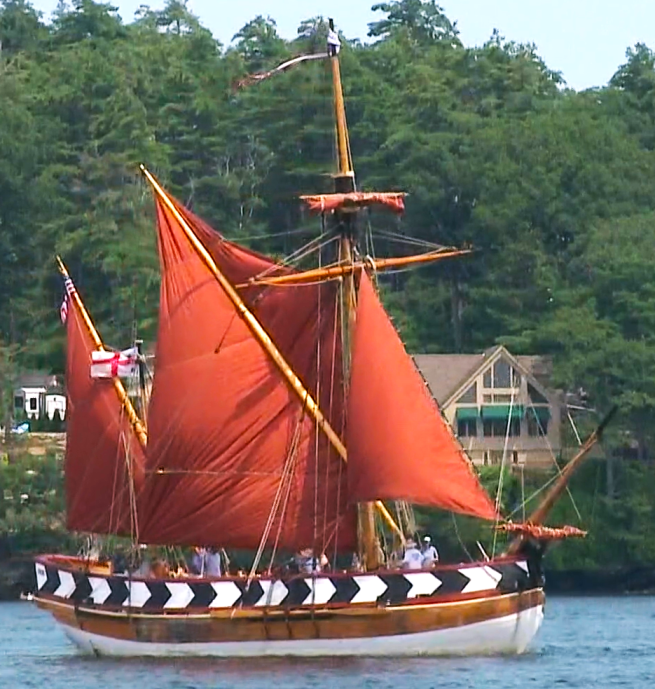
My week on a schooner enlarged my vocabulary.

For instance.

  1. A quarterboard proclaims the name of the ship at the bow.
  2. Quarterdeck, the little raised house behind the main mast, where the wheel is. The forecastle is the one at the other end, up by the bow.
  3. Dropping the hook, meaning anchor.
  4. Gaff, the more or less horizontal spar at the top of the mainsail and foresail. It makes those sheets irregular quadrilaterals in shape rather than triangular.
  5. Beam, the width. Crown, the roll of the deck for water to roll off. Sheer is the cut of the profile, usually voiced with aesthetic appreciation or disproval.
  6. Hatch, with the ladders down into the hold.
  7. Stern, the back, where we steer.
  8. Transom, the flat back of the boat , or, as you know now, at the stern.
  9. Yawl. It can be a kind of auxiliary sail, but in a schooner’s case, usually refers to the yawl boat riding at the stern when it’s not off somewhere on its own.
  10. Windward, meaning the direction the wind’s coming from, and leeward, the direction the wind’s headed. In a heavy wind, the windward side of the ship’s higher, while the leeward one dips toward the water. (When it’s really touching the water, the ship’s “running the rail,” meaning ripping along.)

I also like the term “running on one screw,” meaning propeller, except we didn’t have one.

We won’t even start talking tonnage, which seems to mean a lot for insiders.

Memories of Cincinnati

As I mentioned in a previous Tendrils (June 10), Cincy was the “big city” of my youth, an hour drive to the south once Interstate 75 opened.

Here are some memories.

  1. Music Hall:  Completed in 1878 and newly renovated, including a meticulous shrinking of the breathtakingly gorgeous main auditorium, this Venetian Gothic classic is the home of the Cincinnati Symphony and Pops orchestras, May Festival Chorus, and opera and ballet companies. I treasure the concerts I’ve heard there, often from the second balcony. It’s certainly among the oldest concert halls in America, with the Central City Opera House in Colorado being the closest rival for the title I’ve found so far.
  2. Carew Tower and Fountain Square: The observation tower 49 stories above the downtown, accessed by a “rocket speed” elevator, was my introduction to skyscrapers. It’s architect, William Lamb, went on to be one of the chief designers of New York’s Empire State Building, completed the following year. Fountain Square, in a dark canyon when I knew it, has since been given an airy plaza and become even more of a gathering place.
  3. Taft Museum: This small art collection celebrates one of the residents of the historic 1820 home at the edge of downtown, Charles Phelps Taft, half-brother of President and Supreme Court Justice William Howard Taft, who had accepted his nomination to the candidacy from its portico. The house fronts Lytle Park.
  4. Mount Adams: With the major art museum, repertory theater, Mahoghany Hall bookstore and jazz bar, a family-run Italian sub shop, and a once-famous Rookwood pottery operation at its edge, this was a bohemian center when I knew it.  
  5. Izzy Kadetz: Legendary Jewish delicatessen downtown where customers obeyed the owner’s orders, including, “Eat and get out!” He also charged customers based on their ability to pay.
  6. Zoo: I mentioned the opera in a previous post, and it’s no joke, but there’s more to the zoological and botanical garden. Home of the last known passenger pigeon, the institution has since pioneered species preservation and been a leader in creating habitats shared by various species.  
  7. Union Station: I vaguely remember a childhood train ride from Dayton and our late-night return. The grand 1933 train terminal was considered a masterpiece, one of the last, and today stands as the Cincinnati Museum Center, including the historical, children’s, and natural history and science museums. I think we went to the zoo during the day.  
  8. Riverboats: Several times during my youth, I found myself part of a group taken out on the Ohio River for a paddleboat trip. I heard a real calliope in the process.  
  9. Shillito’s: Cincy’s oldest department store was boldly art deco when my paintings and designs were included in the annual Scholastic Art competition displays on one of the upper floors. It was quite an honor and thrilling. Pogue’s, a somewhat more old-fashioned department store, was also fun to pass through. Shillito’s, Rikes of Dayton, and Lazarus of Columbus eventually became Federated Department stores, which ultimately took over Macy’s, including its name. Got that? Macy’s headquarters wound up in Cincinnati, returning to Herald Square in Manhattan only in 2020.
  10. King’s Island: The amusement park famed for its huge wooden roller coasters is my most recent encounter with the Queen City of the West, as Cincy had become known by 1820.  I remember the park’s earlier incarnation as Coney Island – or Coney Island of the West, to distinguish it from the tip of Brooklyn – where it was prone to flooding from the Ohio River. I did, in fact, visit once on a riverboat outing that originated and ended downtown. I’m surprised to see the first site survives as a water park. The visit to the current operation came while visiting my hometown. Accompanied by my two daughters, we ventured forth to the outskirts of Cincy facing Dayton and had a most memorable day.

My outdated travel wishes

A season in Kyoto, Barcelona, or back in the Pacific Northwest.

Extended genealogical research in England, Ireland, and Alsace.

The Peruvian Andes.

Alaska or Iceland.

Ascending Mount Rainier or Adams.

Weekends of concerts, museums, and theater in Boston.

A week at the Metropolitan Opera.

Visiting friends in Baltimore, New York, and the Pacific Northwest.

Canoeing or kayaking in northern Maine.

On the other hand, I’d still love to experience the Orthodox icons in the churches of Macedonia.

And even some time on Grand Manan Island, New Brunswick,

Recalling some favorite magazines

As an editor and a writer, I’ve long been inspired by a stream of classy, glossy magazines with outstanding illustrations and design supporting sharply edited, masterful writing.

In this category, I’m skipping over purely literary periodicals, even the ones with deep pockets, as well as newsweeklies and many other kinds of magazines.

The ones I’ve admired, as I’m seeing now, all reflected a single editor’s voice and vision, not that I remember all of their names now. Maybe that’s for another Tendril.

For now, here’s what I mean.

  1. The New Yorker. The writing and editing, of course. I was captivated way back in high school – the staff of the Hilltopper even gave me a year’s subscription when we graduated – and still a delight in my retirement, maybe even more, in its current direction. Still, there’s no way to keep up. I should mention, in passing, its assiduous fact checkers, a vexation for many famed writers.
  2. Fortune, back when it was big and classy. Big? The pages were large, like 10 or 11 inches by 12 or 13 inches deep — often on high quality paper, and each issue was fat and thoughtful. Artists were commissioned to create portfolios, with authors to match. It definitely reflected wealth and luxury, unlike other business publications, which often felt pinched. And then the U.S. Postal Service began charging extra for oversize mailings, leading many magazines to shrink their formats. Titles like Life, Look, and Vogue lost their impact, and photographers, especially, took a hit.
  3. New York. Originating as the Sunday magazine of the New York Herald Tribune, this one took off on its own in 1968 after the newspaper’s demise. Brash and definitely connected to everyday life on Manhattan streets, it was an avatar of New Journalism and Push Pin graphics. Still has that cutting edge.
  4. Esquire. By the late ‘60s this former cheesecake vehicle had evolved into a champion of New Journalism and high-impact graphics. Some of the covers remain classic. More recently, Vanity Fair continued in that vein until its solid content evaporated in a demographic desert.
  5. Evergreen Review. Another of the late ‘60s blossoms, this one had a West Coast perspective, openly leftist leanings, and literary ambitions, including Beat poets. Its cartoon serial “Phoebe Zeitgeist” became an underground cult item of a scandalous sort.
  6. Playboy. As a matter of candor, consider its now-classic interviews, plus the fiction, and, yes, the cartoons, a nearly extinct venue these days. The photography was often masterful, no matter the content. The editor in this case did go on to become a pathetic caricature of himself, reflecting the vapid “philosophy” he was espousing.
  7. GEO. This hip German-based alternative to the National Geographic debuted in 1976, distinctive for its green-bordered covers, trend-catching photography, and progressive topics and awareness. The English editions blossomed and then trickled from sight. Much of it, like the international hippie roots it reflected, looks dated today.
  8. New England Monthly. Published from 1984 to 1990, it was an epitome of ambitious, sophisticated, city- and region-based magazines that flourished during the decade. It ran into an identity problem when big advertisers wanted a Greater Boston focus, while important regional issues spilled over into western Massachusetts and Cape Cod as well as Connecticut, Rhode Island, Vermont, New Hampshire, and Maine, where subscribers existed. The final edition featured a devasting account of the high-level executive arrogance regarding the Seabrook nuclear power plant in New Hampshire led to its corporate bankruptcy, rather than the commonly blamed regulations and enraged environmental protests. After revenue shortfalls shuttered the magazine, some of its writers went on to stardom.
  9. Elle. This upstart to established fashion bastions Vogue and Harper’s Bazaar was actually founded in 1945 in Paris as a newspaper supplement but came to prominence with a monthly American edition in 1969. Propelled by Gilles Bensimon’s inspired, fresh, even exciting photography and sharp page layouts that delivered in tight spaces, there was no mistaking this entry from its rivals. Another upstart, Sassy, a feminist teen platform aimed at well-healed Seventeen, lacked gloss and polish but sizzled on editor Jane Pratt’s brilliant assignments from 1988 to 1996, when it finally succumbed to a longstanding boycott by an evangelical women’s organization. As a former lifestyles editor, I found Pratt to be most refreshing.
  10. Harper’s. These days, it rules the roost for me. Its monthly index of seeming random statistics and trends, toward the beginning of each issue, even provided inspiration for these weekly Tendrils.

Ever feel like an imposter?

My first brush with the concept came in a hearing a classical musician talk about his arrival in a major symphony orchestra and looking around at all the talent and amazing sound they were creating. “I felt like an imposter,” he said.

Oh, my, I could identify.

Little did I know of the Imposter Syndrome, a term coined by psychologists in the 1970s.

Rather than go into the details and nuances – there are many, look them up if you wish – I’ll mention ten places it hits me.

  1. Music circles. Yup, despite my extensive knowledge of repertoire and so on, I can find myself cowered at times in choir when a technical issue pops up. We’re singing in what key, now that we’ve hit this chord? What do you mean? Or of course I’m supposed to know which Chopin etude that is, not that I play piano.
  2. Books. No matter being a fairly well-read author, there’s no way I can keep up with the output. “Have you read” has a 99.9 percent chance of a negative answer, even in one of my specialty areas. Reading the New York Review makes me feel like a complete ignoramus. How about you?
  3. Poets. At least few other poets or poetry lovers know of the writers I’m most fond of, even the ones considered major figures. Now, what are their best lines?
  4. News events. Forty years in a newsroom and I still can’t follow it all. Local? Regional? National? International? As for the players’ names? Which leads to ….
  5. Politics. A congressman, for one, faces more proposed new legislation than anyone could ever examine. And I’m supposed to be one up? How about city council issues? Like when I’m having a beer once a week with some fine neighbors?
  6. Cambridge. Despite singing in a chorus with a number of Harvard and MIT grads, they are an inside circle. Being told my portrait hangs in one of the dorms on the Yard – I don’t remember which one – only made things worse.
  7. Quakers. There are circles I know but so many more I don’t. As for keeping up with the current reading? Back to books!
  8. People’s names and faces. I’m really at a loss there most of the time. Sorry.
  9. Money dealings. I’m still baffled by our cell phone contract and the monthly bills. As for dealing with car salesmen or realtors? WTF? A guy’s supposed to be savvy with this, right? Well, that leads to truly painful area:
  10. Male role: Yup, capable of repairing anything, solving any problem, knowing just who to contact when needed.

Tell me I’m not alone. Please?

Memories of places in the town I grew up in

I’ve mentioned a few others, such as the art museum, in other posts here. Now, to add a few more, in no particular order. Again, I’m looking at Greater Dayton rather than strictly inside the city limits.

  1. NCR: The National Cash Register Company’s world headquarters looked more like an open college campus with linden trees and pristine lawns than an industrial jumble behind barbed wire and hurricane fencing. It even had a fine auditorium and pipe organ, used for its gatherings of salesmen but also the concerts of the Civic Music Association – I heard a number of famed musicians there. And I was awarded my Eagle Scout badge and later my high school diploma on its stage. And, oh yes, I can’t overlook Old River, the employee park with the lagoon and boating, a fine miniature golf course, and a huge outdoor swimming pool – when one of my buddies whose father worked at NCR and thus had a pass to the park asked if I wanted to go, there was only one possible answer. Please!
  2. The corner display windows at Rikes department store: The pioneering retailer was the place to shop in town, and anytime we took the bus, say to the library or a movie, we’d wind up checking the latest display – especially at Christmas. During my senior year, some of my art work was used in the background of the featured fashion.
  3. The YMCA: I learned to swim at the indoor pool and sometimes applied my allowance to a grilled cheese sandwich later, over on the men’s side. And then, little kid that I was, I enjoyed the freedom of taking the bus home on my own.
  4. Frigidaire employee park: Thanks to my best friend’s father’s employee pass, we spent many summer nights enjoying free Starlight movies. My dad worked for another General Motors division in town, one that had no such benefits.
  5. Troop trails: My Boy Scout troop had a long hike one Sunday a month, in addition to a primitive camping weekend. Our routes often followed a river or crossed farmlands or even trekked along railroad tracks. I remember especially a few that traced the abandoned Miami-Erie Canal with its mule bank and its eerie remains of limestone locks left in vines and trees.
  6. Suicide Hill: A decent snowfall (quite modest by what I’ve experienced since) meant sledding at Hills and Dales Park. How insignificant the slope looks now, but there were some serious injuries. I had a near call.
  7. Memorial Hall: It really wasn’t designed for concerts, but it’s where the Philharmonic performed, and since my dad had access to tickets, I heard many top soloists. Hard to believe now, actually.
  8. Our big ugly high school: built in the 1960s and long since torn down. In my memory, I recall it more than the older but equally ugly elementary school.
  9. Yellow Springs: Once I got my driver’s license, the bohemian town in Greene County, home of Antioch College, became a welcome retreat. Its funky stores, before funky was a word in my consciousness, were mind-expanding. Nowhere else could we find Earl Grey or gunpowder tea or sticks of incense or perfumed soaps. Then there was the professional summer theater series at the amphitheater, itself a revelation. By that time, I was in love, at last. And that leads to mention of a covered bridge by moonlight: Yes, making out afterward in the moonlight at a covered bridge that’s no longer existent down an unpaved road.
  10. The Art Theater: Where I first saw foreign films, black-and-white alternatives to Hollywood’s commercial concoctions. And then there was the Lemon Tree coffee house next door with its folk music and blues.

My, all that was a world ago in my life.