Why Yankee mariners wintered in the woods

You might think the ideal time to work in a forest would be spring or fall, but that’s not how it’s turned out in logging in the great northern forests of New England and New York state. Instead, the time to be out harvesting trees is deep winter. Yup, below zero around here.

I first learned of this when trying to order firewood after an uncommonly warm winter in New Hampshire. Because the ground hadn’t frozen hard enough long enough, the cutters hadn’t been able to access much of the woods with their heavy equipment. The result was a marketplace shortage.

For contrast, mud season can be notorious, so much so that come spring, logging roads are closed to prevent destruction. Much of Maine, in particular, is either standing water, once the ice melts, or boggy, including soft peat bogs. And in late spring and early summer, hoards of nasty black flies swarm about – the defenders of wilderness, as some contrarians contend.

~*~

Folklorists examining the songs of Maine have noticed that many of the songs from the old lumberjack camps originated at sea. You know, as shanties and the like. At first, these scholars were puzzled, but then they realized that winter was a treacherous time to be out on the water. Many sailors instead headed for the forests, to work in the camps for the season. Somehow, though, any songs originating in the woods failed to travel the other direction.

Historically, the logs were stacked along streams, awaiting the spring melting and surging high waters that the timber could ride to ride millponds. That, in turn, could be exciting, demanding, and deadly work where mariners would continue.

From there, the sailors went back out on the ocean.

Mechanization has changed much of that, on land and sea, but not the reality of mucky soil.

We’ll see what global warming does to the industry.

Reflecting on the upcoming Met broadcast season

Each fall, donors to the Support the Met Broadcasts campaign receive a handsome program guide to the upcoming opera season.

I’ve kept mine, going back to 2005, and find they make a fine reference collection regarding both the plots and performers.

My own listening experience goes back to Joan Sutherland’s first role there in late 1961 or ’62. It was exciting, even through all of the AM radio static of the day.

While much of the core repertoire remains the same, there are also new productions and new or rare works, and it’s interesting to see how these are lined up.

What struck me in the new booklet is how few of the singers’ names I recognized.

When I first started listening, the leading performers were celebrities, often household names and gossip column fodder.

It was a tight circle at the top, in this country and in Europe, enhanced by handsome multidisc LP albums.

Think Pavarotti or Callas.

Well, times have changed, as has the focus. The singers are often more musically informed, and they’re required to physically to act and project their roles in sometimes demanding stagecraft. As for the sets and costumes? This is the height of theater.

The amazing thing is how many fine performers there are now, and they’re active far beyond the confines of the Met and its elite sisters.

There’s a similar shift in the conductors. I recognized only six who will be in the pit. The biggest surprise was seeing the Pittsburgh Symphony’s maestro among them, and he’s considered solid but hardly superstar. (Consider that a compliment, by the way.)

What’s significant is that one-fifth of them are women, one leading two separate operas. The cadre is growing.

What’s missing, though, is American-born conductors. They are active on the symphonic scene globally.

Were they or weren’t they friends?

Back in my undergrad days, I was hired by a retired jazz musician or some such insider to gleam through microfilm copies of the Indiana Daily Student and other sources as research for a bio or history book he was writing in New York.

The project opened my eyes to a wide range of 1920s’ history revolving around Bloomington, especially the legendary cornet player Bix Biederbecke and the Hoosier native Hoagy Carmichael. Yes, the place was a jazz hothouse, hard as that might be to believe.

I wish I still had carbon copies of my correspondence on that effort, but I do remember learning of a hitchhiking trip to a Harvard-Indiana University football game that Carmichael shared with Ernie Pyle, editor-in-chief of the Indiana Daily Student.

Seems it took them three weeks or maybe six to get back to campus from Massachusetts.

It’s a great story, no question, kind of pre-hippie, in this case two future celebrities back before they became famous.

The only problem, I’m not finding any corroboration online. Worse yet, I’m not sure how much Pyle and Carmichael’s timelines overlap. Besides, they were members of different fraternities, lessening the likelihood of a joint spree.

The game happened in October 1927, the same time Carmichael was making the premiere recording “Star Dust” in Richmond, Indiana. Pyle, meanwhile, was likely employed by either the New York Post or Evening World and had married. Some of his details get fuzzy.

I don’t remember who the writer was or whether his book ever came out.

By the way, IU lost, in a 26-6 rout.

Voices return

We’ll be back in rehearsals starting Monday night, and it’s looking exciting.

Quoddy Voices will be preparing Henry Purcell’s “Ode to St. Cecilia’s Day” and works by Florence Price, Randall Thompson, and John Rutter, among others, for a program to be performed twice at the Eastport Arts Center before Thanksgiving.

Excuse me while I start vocalizing. Don’t want to sound rusty.

Reassessing ‘Porgy and Bess’ as an opera

Let’s just say it grows in my estimation every time I hear or see the Metropolitan Opera’s production.

There’s so much packed into its 3¼ hours that the full story can seem unwieldy and overwhelming, but I’m thinking maybe it actually needs to be longer, have more air to allow digestion, with a dinner intermission and perhaps jazz dance/combo interludes inserted at key points in the narrative.

Porgy is not simply the best American opera to date, contrary to the Vienna dismissal of it as a “folk” opera, but, yes, I’d now place it among the top ten ever, in a global view. The grander the reach, the more likelihood of imperfections. Guess where I am on that spectrum?

Quite simply, has any other produced so many hit tunes, especially as jazz standards? Composer George Gershwin held Georges Bizet as an idol, yet has anyone else spawned so many classic offerings from a single stage work? Not even Bizet, nor anyone else I can think of. Just a single hot tune would be considered success. And his have proved incredibly flexible and addictive.

Gershwin had already had a string of Broadway stage successes, but he wasn’t resting on his laurels. No, he agonized over this work and his previously stifled artistic visions. Make that ambitions.

Has anyone else so successfully addressed the realities of drug addiction or prostitution?

Courtesan, as in La Traviata, seems downright respectable in comparison. Bess is raw.

Does anybody else agree Eric Owens and Angel Blue deserve Tonys and Oscars for their performances?


When one seemingly random thought leads to a mental snowstorm

Do you ever have something float into your mind, seemingly at random, only to have a cluster of related bits fly up all around, too?

I recently had that regarding the Los Angeles Master Chorale, of all things.

I had long assumed that it had grown out of a marvelous ensemble, the Roger Wagner Chorale, which I heard twice in my early concertgoing exposure. The touring group consisted of 24 excellent professional voices blended into velvety perfection by a choral conductor who, at the time, was considered one of the two best in America.

Robert Shaw was the other and went on to eclipse Wagner. That’s another story.

In the day, both directors assembled programs ranging from Renaissance to Broadway and Hollywood – Shaw had even been groomed to be successor to Fred Waring at the Pennsylvanians before being veered off into hard-core classical by Arturo Toscanini and George Szell.

A close friend of mine told of his high school choir director’s annual summer trek to study under Wagner, returning with a sharpened sense of diction – something I never really considered until becoming a choir member myself – along with some mysterious but nifty tricks to obtain it. (Wish I knew more now.) And then Wagner faded from sight, not without leaving some highly regarded musical tracks on well-known movies.

In southern California, the Master Chorale had somehow taken on a life of its own and was best known in the wider concert world for its work with the Los Angeles Philharmonic. I rather assumed it had morphed into the orchestra’s in-house choir, like the Tanglewood Festival Chorus with the Boston Symphony, but somehow had roots with Wagner. From time to time I’d hear broadcasts concerts.

More recently, in trying to practice for Quoddy Voices on Zoom, I found myself exploring some incredible warmups and performances on YouTube. I chanced across several of a Palestrina motet I’d performed with Revelsingers in Boston, and it was fun to get out my score and sing along. One tape, though, turned out to be 21 minutes of grueling rehearsal with a rather overbearing, name-dropping guest conductor who never let them get beyond the fourth measure, mostly because of diction issues regarding the Latin. Who did he think he was, I objected. The piece itself barely runs three minutes.

Paul Salamunovich?

Turns out he was the Master Chorale’s recently retired leader, and before that Wagner’s right-hand man. And that sent me piecing all of these random thoughts together in a kind of corrective surgery – or is it more like one of those clear-glass globes you turn over in your hand to launch a snowstorm?

By the way, I had the pleasure of watching Shaw live four times in Cincinnati, Cleveland, and Bloomington. Maybe I’ll get around to posting that experience someday.

Just back from a hike

No ticks, thank God!

The black flies, meanwhile, were in swarms.

~*~

Supposedly the island’s infamous red ants keep the tick population at bay here in Eastport. Fire ants?

Another pestilence.

Still, I’ve learned to inspect carefully for ticks after any outing inland. Somehow, I hadn’t had to face them prior to New England.

Black flies, though, are particularly nasty. They’re tiny and attack first individually around the mouth and nose and then as swarms or small clouds that leave nasty bites from mid-April through mid-July, especially when there’s no wind or you’re away from the sea.

Yes, that sea seems to keep them away from Eastport.

The skeeters will come later.

You don’t see any of this in the L.L. Bean catalog version of Maine.

In the “Black Fly Song” by Wade Hemsworth, made famous by folksinger Bill Staines, the action is placed in northern Ontario, though it’s of little comfort to know the pests range so far across the northern forests.

The lyrics nail the misery so well, For I’m all but goin’ crazy.

The reason, of course:

It was black fly, black fly everywhere
A-crawlin’ in your whiskers, a-crawlin’ in your hair
A-swimmin’ in the soup, and a’swimmin in the tea

As the chorus goes:

And the black flies, the little black flies
Always the black fly, no matter where you go
I’ll die with the black fly a-picking my bones
~*~

It’s true, no joke.

Staines, by the way, lived one town over from Dover, where I was. Small world.

And I should note the bumper sticker: Black Flies, Defenders of the Wilderness.

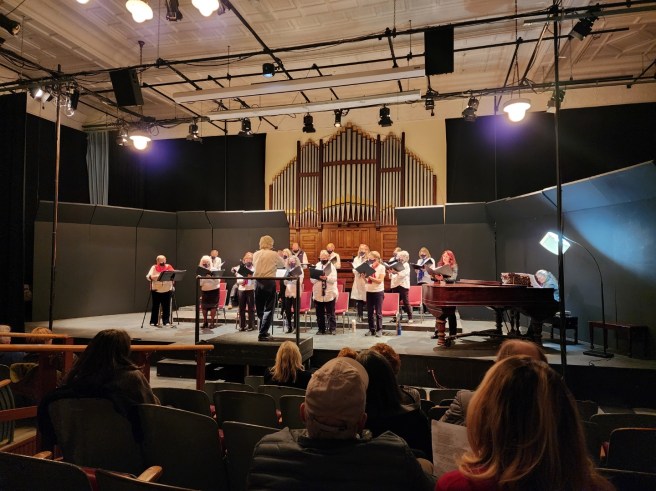
We just did two live concerts!

Even with the masks, it was an incredible experience. Appearing live in concert usually is.

Not every singer I’ve known enjoys performing in public, a situation that can be anxiety-inducing. Yes, even chorus members suffer butterflies. Going on stage or the equivalent is a much different encounter than singing together in a rehearsal space, perhaps even in a circle facing each other.

Wisely, our part of the program was shorter than usual, reflecting the Covid-restricted rehearsal schedule and our return after two years of distancing and general inactivity. Our vocal cords were rusty and have had to get in running order again.

Even after some of the pop standards I’d sung in the Boston Revels autumn equinox affair on the banks of the Charles River, I still didn’t expect to be performing a rock hit, much less a five-part arrangement that was mostly counterpoint with some wildly shifting time signatures. REM’s “Shiny Happy People,” anyone? It’s more sophisticated than I would have believed, even with a bass part that felt, well, like playing air bass guitar.

The Wailin’ Jennys’ “One Voice” and Eric Whitacre’s “Sing Gently” were gorgeous paeans to the art of vocal music made when we unite as one, in this case including singers and audience.

There was the premiere of conductor John Newell’s five-part memorial to longtime Eastport arts inspiration Joyce Weber, “Lux Aeterna.” I hope we did it justice.

The traditional spiritual “Keep Your Lamps” was lively fun with a bouncy piano accompaniment and some fine bass lines, something that’s not always a given.

Dan Campolieta’s passionate setting of Emily Dickinson’s “Will There Really Be a Morning” gave us males a chance to sit out and just listen.

The heart of a concert is the audience, somehow completing the art at hand and making it real. I’ll add there’s a parallel with a readership for a writer or poet or a table of diners for a chef.

The arts center’s upstairs performance space seats about 120, so we were close to an audience of family, friends, and neighbors sharing our love of making music together.

How can I not be looking forward to more?