We’re welcoming the CBC

Longtime regulars to the Red Barn know that I love radio, especially when it involves classical music. Look, I was an avid listener to “educational stations” even before National Public Radio emerged, dialing in marginal ten-watt FM signals from Antioch College or the AM daylight offerings of WOSU from Ohio State University, both of them static laden. And then there was WJR in Detroit, a high-power, clear-channel voice with its own huge staff that included Karl Haas and his “Adventures in Good Music” hour in the morning as well as the Saturday afternoon Metropolitan Opera broadcasts, unless those came during a Redwings hockey game.

Later, living in the interior desert of Washington state, I relied on nighttime AM broadcasts from San Francisco and Calgary, Alberta, not all of it classical. I do remember the Canadian cohosts of one country music show expressing their amazement after a visit to Nashville that folks down there really did speak with “those” accents.

As for what I was saying about static? You came to live with it as part of the show.

Flash ahead, then, to today, when I’m living at the easternmost fringe of the USA. Most of my listening has come from streaming non-commercial stations in Boston and New York or Maine Public Classical. And then, for Christmas, my family gifted me with a Bose sound system to replace my broken components stereo.

As I loaded its radio presets, my otherwise savvy elder daughter confessed her ignorance of AM radio. It ain’t what was, for sure, no matter how much I used to fume at the static resulting when elderly cars came down the street.

Two of the six FM stations I’ve set the Bose to are Canadian Broadcasting Corporation outlets in St. John, New Brunswick, a distance up Fundy Bay from us. I am surprised how clearly their signals come in.

Like National Public Radio in the United States, the CBC is publicly funded and non-commercial. Its main network is primarily news, public affairs, and other talk, while a second is all-music, including classical during the daytime hours.

We’re finding both channels to be refreshing and exceptionally well done.

New York and Washington aren’t the center of their news coverage, for one thing. And the music includes a hefty number of Canadian voices, including a program of contemporary Indigenous music that follows the Metropolitan Opera on Saturdays – the latter with its own host working around what we get in the U.S.

Well, as announcers used to say on TV and radio during the station breaks, “Please stay tuned.”

And we will. There are many varied tastes in this household to match.

Whither the Revels?

EARLIER RED BARN POSTS have touted of Revels as a unique Boston-based arts institution that presents joyous performances blending story, theater, music, dance, literature, history, and much else from many varied world peoples into a magical collective experience. Sound amazing? It’s been. Everyone in our family has delighted in these offerings, no matter how eclectic the theme. As the motto proclaims, “Revels creates musical and theatrical events and educational programs that celebrate cultural and seasonal traditions from around the world, for and with the communities we serve.” It’s even spawned similar groups across the country, as I learned while living in Baltimore and had friends active in the neighboring Washington productions.

While many Revels programs are centered on solstices and equinoxes, the most popular one, far and away, leaves most of the public knowing our organization only as the “Boston Christmas Revels” and then being surprised to hear that Revels Inc. also offers workshops, concerts, pub sings, children’s courses, and a harbor cruise or two throughout the year. I know I’m forgetting some others. That successful “Christmas” identity, for what it’s worth, created a branding problem that’s finally being rectified, in part by rebadging the holiday extravaganza as Midwinter Revels. In addition, let me point out that the flagship attraction has always included many decidedly non-Christian and secular elements, as well as some familiar carols sung by the entire audience. Quite simply, these shows are not about baby Jesus front and center.

My family’s treks from New Hampshire to those Yule pageants in Harvard’s Christopher Wren-inspired Sanders Theatre (which seems to come straight out of Shakespeare or Harry Potter) quickly became a highlight of our year. It meant a day exploring the big city itself as well as across the Charles in cosmopolitan Cambridge, where you could find yourself in amazement at the many languages heard along its sidewalks. We’d always stop at the Harvard Coop for new calendars if nothing else. On those outings the family was introduced to subway rides, bowls of Vietnamese Pho in Chinatown, even the coffee and wine isles of Trader Joe’s back before there was one close to home. How could I forget watching our seven-year-old be absolutely enthralled by a Leonardo da Vinci theme full of Renaissance music in Italian and Latin and featuring Revels legendary founder John Langstaff in what turned out to be his final appearances, not that I could have dragged the kid to a concert of the same program. She was hooked.

Once I retired from the newsroom, I became a charter member of the Revels Singers, a marvelous, non-auditioned community chorus, which then gave me something of an insider’s view of the organization itself, as well as of a broader Harvard University outlook, not that everyone in the ensemble had Yard credentials. It was more of what we might call atmosphere, breathe it in. Believe me, I never imagined being able to sing at such a glorious level. The rehearsals were well worth a two-hour commute down and another two hours home each week.

Just seeing others go through the agony of auditioning for the next Yule show and feeling crushed at being rejected or knowing the sacrifices ahead if they were selected was edifying. So this is what Broadway actors go through? At least they get paid.

But then we faced our move much further to the northeast, plus the Covid outbreak.


LIKE OTHER PERFORMING ARTS arts organizations, the company took hard financial hits from Covid. The highly anticipated 50th anniversary show was scrapped, replaced with a shortened virtual retrospective. That had to hurt, financially and creatively. A renewed outbreak of the vicious virus forced the last half of the next year’s run to be cancelled on short notice. Gone was half of the ticket revenue and related sales of CD albums and related goods in the monumental lobby. In addition, seating for that and the most recent run was reduced due to Covid precautions – down from the 1,000 max that the fabulously intimate auditorium normally packs in. Pre-Covid, sold-out dates were the norm.

On the positive side, Revels began offering online video streaming after the live run, something that allowed us to keep up with the latest manifestations from 353 miles away.

From our perspective, though, what’s resulted is two duds. They just didn’t hold our interest, no matter the quality of the video production.

What worries us is the pandering nature of seeking a more diversified or at least younger audience, even as I applaud shifting from “Christmas” to “Midwinter” in labeling the event. It’s like Netflix or Disney took over.

The first theme in response was set in a decrepit London pub that had just been sold to a naïve American couple. I’m still disturbed by the idea of placing a family-friendly show in a bar, OK? Like “Cheers” from the other side of the Big Pond? Besides, there was none of the mystery and majesty that frame the Revels experience. Quite simply, it felt cheap. The musical line introduced commercial pop tunes known to almost everyone, even me, a far cry from Revels’ usual exotic folk and classical foundation that would take us places we’d never previously imagined. Those tunes were merely predictable, cliché, far from Revels’ usual intrepid discoveries or original compositions. There are many other places ticket buyers can go for a secular Christmas experience, high among them the Boston Pops. So far, at least, Revels has avoided anything Santa. Thankfully. Ho-ho-ho.

The latest entry, set in drab Ellis Island a hundred years back, is even more troubling. The storyline tried to mix Irish Catholics and Czech Jews along with Mexicans already in the USA. It felt forced, artificial, ultimately superficial. Actress Carolyn Saxton was squandered in a preachy, stocky, unessential Spirit of Place role. Hers wasn’t the only polemic that told rather than showed. A “Christmas in the Trenches” sequence was a further reach, even with the German carols, which at least were more seasonal than the Irish “Long Way from Tipperary” and “Wild Rover.” The storyline definitely veered away from any Czech winter opportunities.

The show finally burst free of its wooden action after intermission with some hot Mexican dancing and singing, especially Ricardo Holguin’s flying tenor and fluid movement. If anyone should be in line for David Coffin’s jack-of-all-trades MC replacement (should that ever come), Ricky could be the one. But I am left having no idea what those South of the Border flares had to do with Midwinter.

More troubling was the way that so much we anticipate each year is being reduced in size and impact. The words to “Lord of the Dance” were recast to eliminate the Lord Shiva comparison to Jesus, which has always troubled me, yet in universalizing the thought, it wound up greatly diluting the original. The powerful concluding “Sussex Mummers Carol” was reworded and shortened, and the abbreviated mummers’ play unintentionally announced that winter was already over. So why are we here? I didn’t even see any of the traditional morris dancers, unless they were carrying stag horns. The sword dancers, I’m told, are their own discipline. Praise be, even if for most of their scene, they were five rather than the usual six I remember!

Overall, quite simply, where had the enchantment gone?

I believe that points to a bigger problem for Revels and other arts realms today. Let’s call it the tension between artistic expression versus marketing.


AS BACKGROUND, in Revels’ evolution each year’s holiday show went from a British-centered Christmas party to a celebration with a storyline probing selected national, regional, and cultural themes. Acadian/Cajun was a recent one, with Renaissance Venice for another as well as a northwest Spanish hike on the holy pilgrims’ Way, in addition to Scandinavian countries and then American roots. I think back, too, on an engaging Armenian-Georgia Republic production and another from woolly Russia. Ireland, Wales, Scotland, parts of England, and especially Victorian London also delivered profound entertainments.

At its core, though, are what should be some trademarked, let’s call them sacred, scenes – Sidney Carter’s “Lord of the Dance” that leads the audience out into the Civil War memorial lobby in a serpentine line dance at the intermission, as well as the eerie Abbots Bromley horn dance of stag deer in moonlight once we return to our seats. Add to that the seemingly improvised mummers’ play, a showstopping sword dance, Susan Cooper’s dark-night poem “The Shortest Day” that concludes with “Welcome, Yule!” shouted by the entire audience as they burst into the “Sussex Mummers Carol” blessing that also raises tears and goosebumps with its soaring soprano descant and artificial snowflakes falling from above. In that concluding flash, no choir in Greater Boston is more heavenly, not even the Tanglewood Festival’s with the symphony.

Quite simply, we are disturbed by the tinkering we’re seeing in these essentials. Yes, the Revels are ultimately Anglophile, even Elizabethan or Edwardian, saturated in brocaded deep reds and golds, no matter where the storyline ventures. Don’t deny what’s in Revels’ bones and blood. And don’t ever count me as an Anglophile, no matter how much I’m venting in its defense. Remember, when in Rome …


COMPARED TO OTHER Boston-based arts enterprises, Revels has lacked deep-pockets, despite the sumptuousness of its holiday productions. Its passionate core staff is surrounded by many dedicated volunteers, but aging does mean a change at the helm is in the works, especially with the upcoming retirement of its artistic director a year hence. Something similar has already been transitioning with its music director, the other top creative position, though I’m not convinced it’s securely in place.

In the performing arts, after all, not all of the drama transpires on stage. Revels is no doubt already in the early stages of planning next year’s Midwinter plot and accompanying score.

I would hate to think, as the Bard said, “Our revels now are ended.”
A candid glimpse behind the mask

Don’t know if this is still in the Wikipedia bio page, but it is revealing:

“This man has a very large ego and has hurt the feelings of a choral singer I know. He can be insensitive. Please proceed with caution. This is the ‘kind version’ of what I actually want to say. Thank you.”

Well, the subject did survive seven years as an assistant to a stellar conductor who, according to what I’ve heard from insiders, bordered on sadistic, despite the heavenly perfection of performances under his baton or the public mask of his celebrity.

As I’ve heard said of surgeons, they tend to adopt the operating room mannerisms of their mentors, however tyrannical, outrageous, or circumspect.

Two people I know who have worked under the entry’s subject have only admirable things to say about him.

For now, I’d like to know more about the anonymous person who posted the entry and why. Perhaps as a cautionary tale for all of us in our leadership roles.


Here’s wishing you all could be there

Stephen Sanfilippo is both a wonderful folk musician and a professional historian, two strands that weave together delightfully in his performances and recordings of maritime songs.

He’s a master of the sea chantey repertoire as well as many other seafaring tunes and lyrics – many of which, as he’ll explain, traveled far and wide into the American hinterlands but not back. He does prefer the spelling “chantey” and “chantey man,” for reasons I’ll leave to him to explain. And there are plenty of opportunities to sing along.

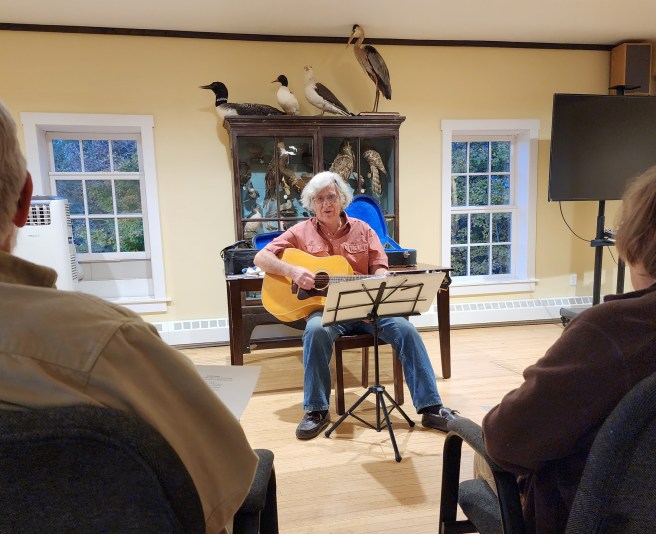
Here’s an invitation to his free appearance on Wednesday, January 25, at 6 pm at the Pembroke, Maine, public library, itself an appropriate venue. (I do love the stuffed birds displayed behind him.) The event will be followed by a series of more monthly concerts. Yay!

From his previous appearances here, I can acclaim this is one more facet of what makes living Way Downeast Maine so special to me.

I never expected so much Donizetti

I’ve posted previously on the outstanding and often original finals’ week programming on Harvard’s student-run FM radio station. Each December and May, the regular schedule shifts to a few weeks of special blocks of classical, jazz, rock, folk, world, and many other strands of music I hadn’t even heard of for something the station has trademarked as Orgy, as in “Donizetti Orgy,” which I’ll explain. For accuracy, we should note that final exams really cover closer to two weeks or a tad more.

One year, for instance, they played everything Bob Dylan had recorded. A few years later, a much shorter sequence introduced many of us to Florence Price, a significant Black American woman composer who has since been receiving a posthumous flowering. The decisions are often based on anniversaries, as happened a few years ago when we got to hear everything Beethoven had ever written, in chronological order. Musically speaking, of course. I have no idea about his letters. A year ago, Schubert got the same treatment, meaning a lot of art songs in German, especially. That one nearly became an Orgy of its own for the baritone Dietrich Fischer-Dieskau, whose son once told classmates what his dad did for a living was make records. Let’s just say that many of these Orgies are highly eclectic.

I did raise my eyebrows in the last round when well over a hundred hours of airtime were devoted to the 225th anniversary of the birth of Domenico Gaetano Maria Donizetti, known largely for a dozen or so marvelously florid operas. Turns out he created nearly 70 operas plus symphonies, string quartets, concertos, piano scores, songs, and so on, which were presented, again chronologically, in big blocks over two weeks. Where do the programmers dig up all of the recordings? Is this really some Harvard grad student’s thesis project?

Donizetti (1797-1848) is renowned, along with Rossini and Bellini, for a specialized style of opera called bel canto, “beautiful singing,” which has had a major revival in the past half-century. Today its embellishments, soaring lines, and vocal athletics have become widely embraced, but back when I was first listening, it was all revolutionary. And, among the three, Donizetti was far and away the most prolific.

What made the series significant to me was the way it revealed an evolution over his 29-year career from formulaic provincial stage comedies to what we recognize as Romantic opera. It filled in a gap in operatic history for me, getting from us classical Mozart to gripping dramatic Verdi and beyond. Composing at fever pitch, Donizetti often churned out four new operas a year, many of them in one-act pieces plus others that recycled earlier material before he reached a more sustainable stride. Think of a rock band or pop artist turning out an album, which is only an hour or so compared to a three-hour opera. Or a movie composer, for that matter, who has to create a similar amount of music. Nobody does four a year, right?

In the broadcasts, Donizetti’s early works sounded serviceable but not memorable. They were built on strings of solo arias, choruses, and recitative, which I streamed while working on my own life. That would mean one character in the spotlight, exit stage, and then another. Laundry, cooking, vacuuming, or washing dishes anyone? You know, everyday stuff, with music in the background. Midway into the series and his career, though, the dramatic level rose immensely and caught me in my tracks, especially with the appearance of ensembles of simultaneous conflicting emotions and motivations. Yes, there were hints of things ahead, like the flash connecting one faintly familiar tenor aria with what would emerge later, with nine high C pings inserted as “Ah! Mes mis,” and eventually launch Luciano Pavarotti into international household fame in 1972. (We did hear him in that role around 6 am the final day, when “La Fille du Regiment” aired from a recording of London’s Covent Garden production with Joan Sutherland and Richard Bonynge costarring.)

Quite simply, those were the flashes when I recognized we had crossed over into everything today’s operagoer anticipates, even with Mozart, Gluck, and Handel remaining glorious within their earlier realms.

Many of the Orgies really are once-in-a-lifetime events. With Donizetti, for example, it’s unlikely that I’ll ever again hear most of what was introduced. Simply tracking down rare pieces would be an overwhelming challenge.

Let’s see what May brings. Those kids at WHRB really do deliver.

Three contradance highlights

All of them regard waltzing, rather than the facing lines that give New England contradances their name.

I should mention that there’s something special about waltzes, which usually come just before the break after the first hour or so and definitely at the conclusion of the evening. In fact, one girlfriend would always grill me about my waltz partners on those nights she decided instead to stay home.

The first memory here involves a dance at the town hall in Bowdoinham, Maine, always special in my experience, especially those when the band centered on three families of musicians.

At the break, as I was conversing with a lovely potential dance partner, I noticed that a young fiddler, maybe six years old, was still on stage and teaching an even younger fiddler some music. It was enough for me to say, “Hey, it’s a waltz, let’s dance,” and we did, soon joined by others. I looked up and saw the amazement in her eyes. You know – If we play, they will dance – as an epiphany.

~*~

Years later, elsewhere, I was telling that story to a fantastic young dancer as we waltzed.

Her eyes lit up.

“So you’re the one!”

~*~

And then, at a Bob McQuillan retrospective honoring the rerelease on CD of an earlier LP, the partner I had for the waltz was named Amelia.

Coincidentally, the same as my step-grandmother, fondly recalled.

And the waltz was titled “Amelia’s Waltz,” composed by Bob for the daughter of a beloved band member.

The same one, it turned out, circling with me and ever so light on her feet.

~*~

I’m getting teary as I relate all this, but there you have it.

Not a bad way to spend a dark Saturday afternoon

This has the makings of a fine Saturday afternoon tradition through gloomy winter around here. Not that it won’t work on a sparkling day, either.

Moose Island Contradance Band. Photo by Rachel A. Williams.

The local contradance band has another monthly performance at the Old Sow grill coming up, and the previous one, as you can see, was a hoot.

It attracted a handful of sit-in musicians in addition to an appreciative audience that packed the house.

Plus, monthly dances at the arts center are set to resume at the end of January after a long Covid hiatus.

Reflections from the stage of the Quoddy Voices concert

Singing in front of an audience is a relatively new experience for me, one arising in my retirement years, mostly through Boston Revels’ top-caliber community chorus and related events.

What I can say is that from the stage, each performance has been thrilling and transcendental, even when not necessarily perfect. Most remarkable is the oneness we sense as a company making melody and harmony.

Before the Covid restrictions and my relocating to Downeast Maine, I was commuting from New Hampshire to Boston as a baritone in the Revels Singers, first under George Emlen and then Megan Henderson. The ensemble ranged from 40 or so to maybe 80 members, depending on the season. Its classical and world folk repertoire was drawn largely from the shows the organization had produced in its more than a half century, with music in nearly 30 languages and spanning a good millennium of history. Many of the arrangements, editions, and original compositions were by our conductors or others affiliated with Revels.

~*~

These days I’m with a much smaller group, Quoddy Voices, which is also led by a fine conductor, pianist, and composer, John Newell, and I’ll proclaim that its standards and abilities are just as high.

We just concluded the second pair of programs with me as a member, and once again I must admit moments of listening to the others in amazement and then wondering how on earth I ever managed to be included. Yes, it’s humbling and challenging.

Technically, we’re a chamber choir – for the concert, 20 singers. Among other things, it means any slipups are more exposed.

(Photo by Jessica J. Williams)

Our program, a Harvest of Song, put us ahead of Thanksgiving and the crowded holiday schedule at the arts center. That meant a shortened rehearsal schedule, but online practice scores of our parts definitely made a difference.

Compared to Revels Singers, our repertoire engages more in works other choirs are also exploring, which led us to three pieces by Florence Price, the first Black American woman to have a symphony performed by a major orchestra. She’s finally being widely discovered, nearly 70 years after her death. From our point of view, her writing is deft, with touches of jazz and flashes of difficulty. The bass line in one score movingly upheld the axiom of less is more.

From living composers we had two widely performed works by Englishman John Rutter, who is admired for pieces that fit the voice like a latex body suit; Californian Frank Ticheli’s masterpiece, “Earth Song”; a lively Calypso in 5-4 time by the now 95-year-old Harry Belafonte; and a haunting 35-year-old Dan Forrest’s setting of a Ralph Waldo Emerson poem.

From old masters we had a deeply reverential motet from Romantic-era Anton Bruckner and sections of Baroque brilliance from Henry Purcell’s 1692 “Ode to Saint Cecilia’s Day,” which foreshadows Handel and his Messiah but with sides of pagan homage, as English poets of the time were wont to do.

We concluded with Randall Thompson’s classic 1940 “Alleluia,” drenched in sadness, as the composer admitted, but becoming quite polyphonic and agitated before introducing a single second word at the end, a seven-part, two-note amen.

While all of these works are widely known in choral circles, all but the Thompson were new to me. I had heard the Thompson only in a broadcast just a year ago and earlier from an old buddy who raved about singing it with his chorus.

Our audiences, as usual, were attentive and enthusiastic.

~*~

So now some of us are scheduled to do some informal caroling before Christmas.

And then, come February, we get to see what our director has in store for us next.