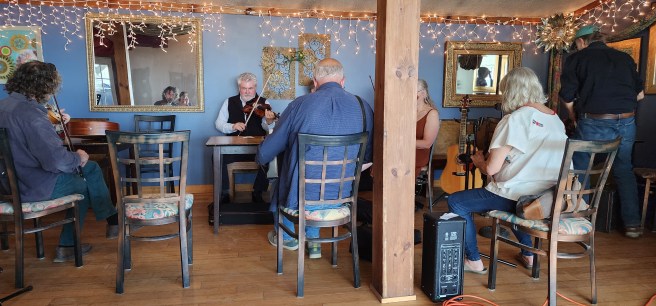
The second-Saturdays afternoon event at a local tavern is already full of fine memories, including a visiting famed Irish fiddler shown here. Its core is MICE, the Moose Island Contradance ensemble. That space was soon filled with other players.
You never know what we'll churn up in cleaning a stall
The second-Saturdays afternoon event at a local tavern is already full of fine memories, including a visiting famed Irish fiddler shown here. Its core is MICE, the Moose Island Contradance ensemble. That space was soon filled with other players.
Most conductors try to make it melodious and strictly in time, constrained by starched shirts and gowns. Seated audiences typically go for that tuneful approach, not that humming along is approved.
What I find more compelling and exciting, though, is when the performance is filled with bubbles, like champagne, and a tad tipsy. One dance partner stepping on the other’s toes. Even better, when there’s some tension between, say, the brass and the strings, with a hint of freedom within the beats, the way one dance partner is a hair ahead or behind the other. Yeah, a little swing, if you will. And a little playful unpredictability.
Well, here we go, in the air approaching another new year.
My choir has been singing a joyous Renaissance piece that translates, in Allen M. Simon’s rendering, as:
Today Christ is born:
Today the Savior appeared:
Today on Earth the Angels sing,
Archangels rejoice:
Today the righteous rejoice, saying:
Glory to God in the highest.
Alleluia.
I first heard it in the second classical concert I ever attended, around age 12, with the velvety Roger Wagner Chorale on tour. Never, ever, did I imagine I’d be part of presenting it myself.
Still blows me away, all around.
In the colonial era, neither the Congregationalists/Puritans at First Parish nor the Quakers/Friends observed Christmas.
So much for singing festive carols or decorating a tree.
The Friends didn’t sing at all, actually, unless it was somehow spontaneous.
At First Parish, meanwhile, a bass viol was introduced in the 1700s to accompany the hymns.
That gave way in 1829 to an organ built by Bostonian William M. Goodrich. In 1878, the instrument was rebuilt and repositioned by Hutchings-Plaisted of Boston, with alterations in subsequent years.
In 1995, a thoroughly revised instrument was unveiled, the work of Biddeford, Maine, Faucher Organ company. A hybrid of the original pipes and of newer electronic and computer elements, it’s a monster machine capable of rattling the house and shaking the bottoms of your feet.
I am glad we simple Quakers don’t have to pay for its routine maintenance, though I am grateful for those who do.
Not bad for holiday festivities, including accompanying a community-wide Messiah sing.
It’s not the only option in town, either. For some, those carols have to wait till the end of Advent, when the Twelve Days begin.
And, for the record, the Greek Orthodox start celebrating Christmas 12 days later.
With the holidays just ahead, we’re coming up on the prime choral season of the year.
Look around, and there are many outstanding groups, not just the big, famed organizations in the footsteps of conductors Robert Shaw, Roger Wagner, Margaret Hillis, or John Oliver, either.
Hit on some of these on YouTube or Vimeo and let me hear what you think.
Thinking about arts performance scheduling and audiences has had me recalling some of the first operas I attended.
They were at the Cincinnati Zoo, at the corner of Erkenbrecher and Vine.
Don’t laugh. The performances were top-flight. The Cincinnati Summer Opera, as it was commonly known, was informally considered the summer home of New York’s Met, and it provided seasonal employment for members of the Cincinnati Symphony Orchestra.
The company had an impressive pavilion on the grounds, and visiting the animals before watching the singers was part of the experience, if you allowed yourself time. I especially remember being amused by the monkey island antics at intermission. And many of the singers, so I’ve read, humorously came to think of themselves as a special kind of animal.
Especially notable was the first time you heard a roving peacock screech. It sounded like somebody was being murdered and could happen at any time during a performance. Veteran singers used to wait to see if newbies could maintain their composure when the cry rang through the theater. In the opera world, this was an inside joke and a rite of passage, at least for those who passed the test.
I’ve been trying to remember how long the season ran, but there were usually four performances a week – one production on Thursday and Saturday, and another on Friday and Sunday, if I have it right. In the late ‘60s, that spanned six to eight weeks, best as I can recall.
Think of that – 12 to 16 different productions each year. Only a few big houses in the world surpass that.
But at its height, there were 18 different offerings over 61 performances in a ten-week season. Where did that many operagoers come from out in Ohio and neighboring Kentucky and Indiana?
The tradition originated in 1920, making the Cincinnati Opera Association the second-oldest opera company in the U.S., and continued until moving into the renovated and air-conditioned Music Hall in 1972, where the season still happens each summer, though on a much different scale.
One of the unanticipated developments in my life after I retired from the newsroom was that I became an amateur choral singer, first as a charter member of Revels Singers in Boston and now with the much smaller but no less excellent Quoddy Voices.
In that, I’ve been blessed to work under four incredible music directors and also experience a few other fine conductors, each bringing something unique to the enterprise.
Still, the newest vocal maestro is truly one of a kind, yet still of the highest standards.
When he stepped up to the task in September, he handed out stacks of sheet music from four or five different sources, a very wide range of repertoire, maybe 30 pieces in all.
We set about sight-reading these, and I found myself getting teary as I recalled earlier experiences. Leadbelly’s “Bring Me a Little Water, Sylvie” was a staple of the Boston Revels’ autumn equinox Riversing along the Charles River, and backing up our teens’ choreographed routines was always exciting. “Wild Mountain Thyme” always ended the spring equinox concert, with David Coffin leading the audience gathered into a large circle, holding hands. “All God’s Critters (Place in the Choir)” raised many other memories, especially of Quaker children but also with the composer himself, who lived just outside Dover. And then there was Sweelinck’s joyous “Hodie,” my introduction to polyphony at the opening of the second classical concert I ever attended, the Roger Wagner Chorale around 1960. Never, ever, would I have imagined actually singing that – well, not until the past few years.
~*~
While I’m relatively new to being a member of a musical ensemble, I can say it’s a remarkable identity to assume. We expect to be followers, even with our own grumbling in the back row.
And that’s where Gene threw us a curve ball this fall. He wanted our opinion in what pieces we want to do, including those on our upcoming holidays concerts.
As others said, “The conductor’s always come in with the the pieces and said this is what we’re going to perform. Let’s get started.” To which, in our new situation, they added they were feeling a bit disoriented and perhaps even dismayed.
Well, he did want us to rate the pieces before us, something like a homework assignment, so here’s what I added to my ratings sheet:
“I’m guessing that many of the others will be leaning toward pop/rock songs they’re familiar with and find fun. As you see, I lean the other way, looking for pieces that stretch me to explore and achieve more. Looking at scores from the bass line is a fresh perspective. The tenors and ladies typically get most of the action while we’re stuck in the basement. (No pun intended.) Or even sidelines. I don’t mind holding a drone note in modal music, including Eastern Orthodox services, but what I’ve seen in the pop/rock harmonies seems pretty rote, uninventive, or shallow with little to hold my continued interest, especially if we were to do some deep rehearsal.
“On the other hand, doing one-time run throughs, perhaps with an audience, could be a fun community event, our own version of a pops concert. Summertime, even?
“Or even a hymn sing?
“Still, you asked, and thanks for that. And you’d still get my vote if we were selecting a music director. (My, that was an experience with my previous choir down in Boston.)”
~*~
I am happy to report that the Renaissance and other classical repertoire that I favor came in at the top of the stack, but there’s also a healthy blend outside of my usual comfort zone. The process did cut into our concert preparation time, but I’m confident we’ll catch up.
This really is a fun group to be part of, and that runs top to bottom and back up. I’d say things are percolating.
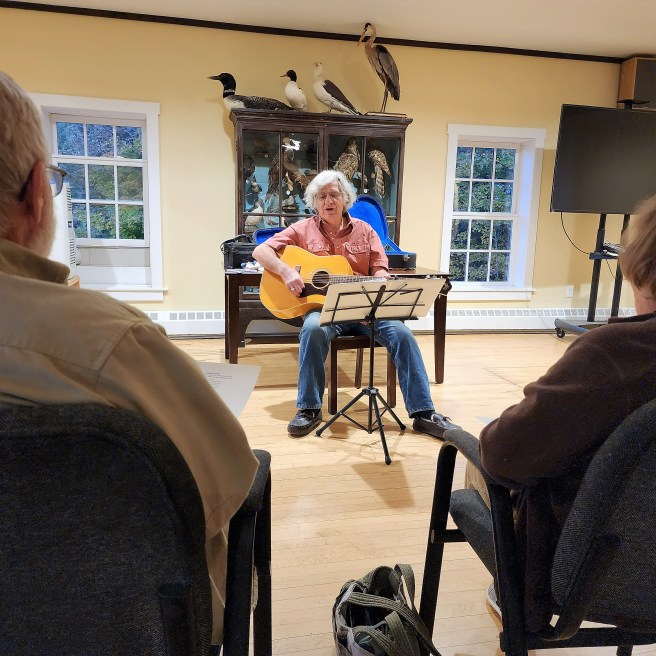
As you can see, Stephen Sanfilippo is more than a maritime historian. He can sing his research findings. Small concerts like this one upstairs at the Pembroke public library are one of the delights of living Way Downeast.
One of the benefits of donating even a modest amount to the Metropolitan Opera’s broadcast fund is that you receive an annual schedule booklet, 36 colorful, glossy pages with the casts, broadcast times and estimated lengths, and summaries of the plots. The booklet arrives a month or two before the next season begins, and I keep mine as wonderful future references.
The upcoming Saturday matinee broadcasts, which start airing on Dec. 9, have already been controversial, due to the company’s shifting focus toward increased contemporary and sometimes realistically gritty works. The first presentation of the season, in fact, is Florencia en el Amazonas, inspired by the writings of Gabriel Garcia Marquez and only the third Spanish-language opera to be performed at the Met. (Carmen, after all, is in French and will be heard on Jan. 27.) Other works from our own era are Dead Man Walking (Jan. 20), X: The Life and Times of Malcolm X (Feb. 3), Fire Shut Up in My Bones (April 27), John Adams’ opera-oratorio El Nino (May 4), and The Hours (May 18).
That unprecedented string of operas by living composers doesn’t mean the usual masters aren’t on the menu. Mozart (3), Wagner, Verdi (4), Puccini (3), Bizet, Gounod, Donizetti, Johann Strauss Jr., and Gluck are all in the lineup, with two of the dates yet to be announced. Conspicuously absent is Richard Strauss.
Two of the archived presentations feature my favorite-ever conductor, Max Rudolf: Mozart’s Le Nozze di Figaro on Dec. 30, with Victoria de los Angeles and Cesare Siepi, and Donizetti’s L’Elisir d’Amore on April 6, with Luciano Pavarotti, Judith Blegen, and Ezio Flagello. As one conductor once told me, Rudolf could have been famous, if he had wanted that. At the Met, he worked largely behind the scenes as Rudolf Bing’s artistic administrator before going to Cincinnati and rebuilding that city’s great orchestra.
Also of note is that the long-running broadcast series has a new sponsor, the Robert K. Johnson Foundation, only the third in its history. The series was underwritten by Texaco from 1940 to 2003, followed by Toll Brothers luxury homebuilders (2005 to 2023).
Gee, have Texaco’s red-star gas stations been gone from the landscape 20 years already?
Even tradition changes.
As long as we’re at the Common Ground Fair in Unity, Maine, let me mention a few presentations today that go beyond the solid fare of food, forestry, livestock, fleece and fiber.
For instance, a home funeral demo is followed by discussions on green cemeteries and community death care teams for those interested in alternatives to costly funeral traditions. There’s also a blacksmithing demo and a hands-on assembly of a ¼ scale timber barn. Chicken first aid could be amusing, as could the basic of breeding your own pigs.
Of special interest to me are the two contradances, a traditional shape-note sing (hope I remembered to pack my Sacred Harp hymnal) alas at the same time as an Indigenous storytelling session, and three Maine legends appearing together: folksinger Noel Paul Stookey, comedian Tim Sample, and guitarist David Mallett.
I’ve sung in the choir behind Stookey twice and can say he’s an amazing person and musician.
 Jnana's Red Barn