From a Scroll of Improvisation

The premise: So much of my writing has resulted from distillation, revision, compression, and concision, often as a matter of collage or thesis/antithesis/ synthesis opposition and release.

The pieces of this scroll, in contrast, are envisioned as longer, free-flowing outbursts without structure or topic, a matter of simply letting the writing stream where and how it will. Perhaps my Dialogues are my closest antecedent, although I could throw in Ned Rorem’s journals or John Cage’s diary or Keith Jarrett’s solo improv concerts. I like the story about one of those performances, where Jarrett came out and sat for some time, unable to begin. As the audience grew restless, someone called out to the stage, “D sharp!” or some such; the pianist turned, said “Thank you,” and began.

While I anticipate these to emerge as prose, their spirit should be poetry. Whatever the key or time signature.

~*~

To start slowly, or even slow, with a single note. Not even a chord. A word or two, cryptically without context. Sit in place, melting.

Where was I, then? Or you?

De Tocqueville set out to define America, that is the United States, as some overriding commonalities. What conceit, though I suppose we might do the same regarding Europeans, as if Italians and Danes resemble each other in many ways. Yes, I boldly spent a week on the Olympic Peninsula followed by a couple of years digesting the place and its peoples. More recently, the decades of investigating New England have proved more elusive. Even my native Midwest is far more varied and nuanced than I would have suspected. Explore the world? My focus becomes more and more this place I inhabit along the Cocheco.

The falling water, splaying on rock below. The mills. My own small tract, now covered with new snow. Birds at the feeder. Skittering.

What do I know of anything? Of anyone? Just who am I, and how did I ever arrive here, with this woman and her daughters? All these squirrels and buried black walnuts.

Each shell, a note. Each snowflake, another. Cry out, unheard against the wind.

Some Maine towns were named after Sacred Harp tunes

New Englanders sometimes joke that a town name will be found repeated in five of the six states of the region. It can be confusing. You know, people moving from one place to a new one but keeping the town name.

Maine, however, has its own twist, since much of the settlement occurred after the American Revolution, especially in the early 1800s, when “singing schools” became a popular community activity. Many of these were related to church life and the spread of four-part harmony hymn singing. So what if someone else had claimed the town name you had hoped to repeat, here was a fresh source.

Today many songs in a hymnal carry a title reflecting the words, but in earlier times the name identified the music itself – many of their lyrics can be transported from one composition to other scores within a given syllable-count system anyway.

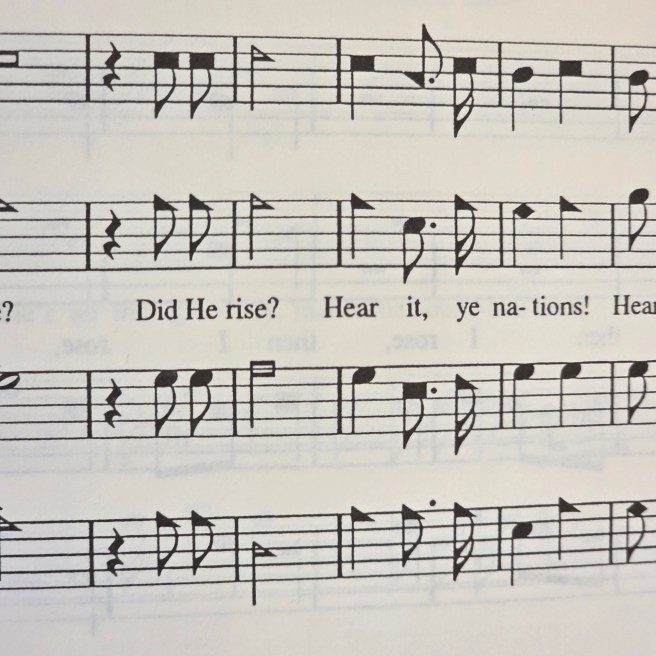
That older tradition is continued today in a style of a four-part cappella singing called Sacred Harp, reflecting the title of the hymnal of shape notes that it used. Shape notes, should you ask, are not all of the round kind you see in most musical scores. Instead, some are little flags called fa; others are little boxes called la; or diamonds called me but spelled mi; and the round notes are called so. And there are no instruments, not even harps, much less pianos or organs, in this often rowdy tradition.

So much for that arcane sidetrack. Back to the song names.

I had assumed that the composers applied them to honor where they were written or some such. “Detroit” is one that always makes me smile.

At any rate, during a sacred-harp singing session a while back, it was mentioned that some Maine towns were actually named for the tunes, rather than the other way around.

Bangor was one. Though not in the Sacred Harp collection, the tune was written in 1734, “Oh very God of very God,” and influential. The Maine city was incorporated in 1834 from what had been known as Sunbury or Kenduskeag Plantation. The name “Bangor” is said to have been taken from a Welsh tune. Voila!

Now, for ten examples drawn from the shape-note collection. The name of each tune and town is followed by its date of composition and then the first line of the text it accompanies in the Sacred Harp collection, the date of the founding of the town, and then by something about the Maine community.

  1. Chester: 1770, “Let the high heav’ns your song invite”; settled in 1823, the town north of Bangor had 201 households in the most recent tally. The name, however, came from an arrival from Chester, New Hampshire. No dice for the hymn, then.
  2. China: 1801, “Why do we mourn departing friends”; 1774, with the name being chosen by Japheth Washburn. He wanted to call the town Bloomville, but people from a town of that name objected, saying that the similarity could cause confusion. Washburn then settled on the “China” because it was the name of one of his favorite hymns. Today, the summer youth camp of New England Yearly Meeting of Friends (Quaker) is on the town’s China Lake.
  3. Enfield: 1785, “Before the rosy dawn of day”; about 1820, originally called Cold Stream. A third of the town is occupied by Cold Stream Lake. A possibility.
  4. Liberty: 1800, “No more beneath th’ oppressive hand”; incorporated in 1827. Another possibility.
  5. Milford: 1760, “If angels sung as Savior’s rest”; incorporated in 1833 from what had been known as the Sunkhaze plantation. Milford is a town name found across New England.
  6. Newburgh: 1798, “Let ev’ry creature join to praise”; settled about 1794 and incorporated in 1819, it is spelled like the town along the Hudson River in New York, which probably influenced the naming of both the hymn and the Maine town.
  7. Northfield: 1800, “How long, dear Savior, o how long”; the town was settled about 1825 and incorporated in 1838. Thus, a possibility.
  8. Oxford: I’m not sure about the hymn’s date, “Shepherds rejoice, lift up your eyes,” though when the town incorporated in 1829, the honor went to the university town in England. Well, that left the other famed university town, which also has a hymn title in the Sacred Harp collection, “The Lord will happiness divine.” In the second case, the name came up at a town meeting when the community was preparing to be set off from Ripley. The 11-year-old daughter of the household where the discussion took place was asked to suggest a name for the new town. She proposed the name Cambridge, from the English town of the same name about which she had just been reading. It was applied in 1834.
  9. Poland: 1785, “God of my life, look gently down”; when the town was incorporated in 1795 from Bakerstown Plantation, early resident Moses Emery was given the privilege of naming the town. He had always been fond of an old melody called “Poland,” found in most of the collections of ancient psalmody, as the history goes. Today the place is best known for the Poland Springs bottled water brand.
  10. Portland: 1802, “Sweet is the day of sacred rest”; the Maine city was set off as a town in 1786, named after an isle off the coast of Dorset, England. Alas for the influence of the hymn, though it may have been the other way around. The city in Oregon, should you wonder, was named in honor of the one in Maine in an 1844 toss of a coin. Otherwise, the Pacific Northwest city would have been Boston, which somehow doesn’t seem to be a tune name.

There are arguments that some of the hymns were named after Maine towns. Just consider Mars Hill, 1959, or Mount Desert, 1985.
If you’re speaking of dances, for me, it’s New England 

My definition: contra, English country, squares, and rounds, or folk rather than ballroom or rock – though a tango fascinates, I do the Swedish  hambo, when a partner appears at one of our contradances.

~*~

This note came from before I discovered the line dances at Dover’s annual Greek Festival and then the “secret” of dancing them. The event took place every Labor Day weekend, though I did come to find other opportunities to dance in Greek circles.

All of them to date, though, have been in New England.

George Bernard Shaw wasn’t shy in sounding off on classical music

The famed English playwright was also an esteemed music critic, though he wrote under the pseudonym Corno di Bassetto, 1888 to 1889, before moving on to a more respectable newspaper for four years. There, he signed his reviews G.B.S.

For perspective, he was an ardent advocate of Richard Wagner, which put him in opposition to Johannes Brahms.

Here are some sharp notes.

  1. “Hell is full of musical amateurs.”
  2. “A man who can tolerate Bach and Scarlatti on a modern piano can tolerate anything.” (He was the first converts to the original instruments camp of early music.)
  3. “Nine times out of ten, when a prima donna thinks that I am being thrilled by her vibrant tones, I am simply wrestling with an impulse to spring on stage and say ‘My dear young lady, pray don’t. Your voice is not a nail, to be driven into my head.’”
  4. “There are some experiences in life which should not be demanded twice from any man, and one of them is listening to the Brahms Requiem.”
  5. He did concede some points. “Mind, I do not deny that the Requiem is a solid piece of music manufacture. You feel at once that it could only have come from the establishment of a first-class undertaker.”
  6. He redefined the scope of the job, saying “I purposely vulgarized musical criticism, which was refined and academic to the point of being unreadable and often nonsensical,” or more to the point, “I believed that I could make musical criticism readable even by the deaf.” To wit:
  7. “Handel is not a mere composer in England: he is an institution. What is more, he is a sacred institution. … Every three years there is a Handel Festival, at which his oratorios are performed by four thousand executants, collected from all the choirs in England. The effect is horrible; and everyone declares it sublime. … If I were a member of the House of Commons, I would propose a law making it a capital offence to perform an oratorio by Handel with more than 80 performers in the chorus and orchestra, allowing 48 singers and 32 instrumentalists.” He was way ahead of his time on the size issue.
  8. Many of the musical affectations of the time drew his fire. Regarding one imposed on a Mozart aria, he commented, “The effect of this suburban grace can be realized by anyone who will take the trouble to whistle ‘Pop Goes the Weasel’ with the last note displaced an octave.”
  9. To him, a “poor performance was a personal insult to be treated accordingly.”
  10. Still, stridently avoiding pale cliché, he did praise those who surpassed his standards. Describing one singer, he wrote, “I was consoled by a human caress after an angelic discourse.”

In the larger span of time

Being a classical music fan induces a peculiar sense of history. If you love fine paintings or theater or literature, you may encounter something similar.

I found some of this being stirred up while sitting through a concert where Debussy was the oldest music performed. He was still considered “modern” when I began attending concerts in 1959 or so. He died in 1918, shortly before my parents were born. Not that far back, then.

For additional perspective, some major Romantic-era composers like Tchaikovsky, who died in 1893, or Saint-Saens, 1923, or Puccini, 1924, weren’t all that distant from me at the time, though it seemed they were much more ancient, say closer to Mozart. The span between them and me at the time would fit into my own life now.

I do recall hearing a live performance of the Tchaikovsky fourth symphony under Lukas Foss and the Buffalo Philharmonic and during the rapturous applause afterward have the gentleman sitting beside me lean over and say, “You should have heard it under Reiner in Cincinnati, as my wife and I did.” That would have been only 50 years after its composition, and this was 30 or so years later.

What is striking me is how much harder it’s been for new music to catch on since then. I don’t think it all has to do with the attempt to write in more original – and often strident – styles.

There’s also a looping of generations, as would happen when a ten-year-old heard something from someone who was 80 relating something he or she had heard at age ten from an 80-year-old’s encounter at age ten with an 80-year-old from age ten. It wouldn’t be hard to have two-century span at hand.

Now, as for naming compositions from the last 50 years that have entered the standard repertoire, it would be a shockingly short list.

Slatkins and the Hollywood String Quartet

From what I saw of the classical music scene in America when I was growing up, the West Coast in general and Los Angeles, in particular as its primary metropolis, were seen as something of a backwater, despite some of the city’s celebrity musicians such as violinist Jascha Heifetz, pianist/composer Sergei Rachmaninoff, and serialist composer Arnold Schoenberg.

In the classical field, the city’s music-making was dismissed as subservient to the film industry. There wasn’t even any opera, in contrast to San Francisco.

That perception has changed, especially since the opening of the Walt Disney Concert Hall along with the Los Angeles Philharmonic’s rise under Esa-Pekka Salonen and Gustavo Dudamel to what prominent critics have deemed the most important orchestra in the nation.

Meanwhile, LA’s earlier life is getting reconsideration these days, thanks to the Slatkin family and its history that centers, especially, on the Hollywood String Quartet.

Here’s why.

  1. The quartet, drawn from film industry musicians but known largely through its recordings on Capitol Records, was critically acclaimed as the best string quartet ever in America. But because of conflicting schedule demands among its four members, it was unable to tour outside of California except on rare occasion. That did dampen their awareness in the larger artistic world. Listen to their recordings, though, or view their only video performance on YouTube, and the case is compelling. We can argue about the amazing American ensembles that have come since. These days, I’ll say simply the Hollywood Four remain unsurpassed but are now rivalled, which I see as a blessing. And here I had dismissed their name as somehow celebrity gloss.
  2. Let’s start with the first violinist, Felix Slatkin. Born in St. Louis, Missouri, to a Jewish family from Ukraine, he studied violin under Efrem Zimbalist and conducting under Fritz Reiner at the Curtis Institute in Philadelphia. It doesn’t get any better than that. At age 17 he joined the St. Louis Symphony Orchestra as assistant principal violinist before becoming concertmaster for Twentieth Century Fox Studios, where he soloed in several acclaimed soundtracks. He and his new wife also cofounded the quartet in 1939. As a conductor, he founded the Concert Arts Orchestra, comprised largely of studio musicians, and led the Hollywood Bowl Orchestra, local professionals in the summer season. He recorded widely on the Capitol label with both the quartet and the two orchestras. He was also Frank Sinatra’s concertmaster and conductor of choice. He died of a heart attack at age 47.
  3. His wife was a New York native of Russian Jewish extraction, Eleanor Aller, the principal cellist of the Warner Bros. Studio Orchestra. Not only was she the first woman to hold a principal chair in a studio orchestra, hers was a position no woman held in any of the major orchestras of Europe or America, due to her sex. Kudos on the breakthrough. Oh, yes, she did make her mark as a soloist on major soundtracks as well as on the concert stage. Shortly after their marriage, the couple established the Grammy-winning quartet while continuing to work as studio musicians.
  4. Today, their son Leonard is the best-known family member. American conductors have faced an uphill battle against Europeans when it comes to prestigious positions, but this Slatkin has earned a well-placed distinction. At the early age of 33, he was offered the music directorship of three fine American orchestras and chose St. Louis over Minnesota and Cincinnati, in part because of the support the management offered in his development. As he led St. Louis to world-class recognition, many highly acclaimed recordings followed. Later appointments had him heading the National Symphony of Washington and those of Detroit, Nashville, and Lyon, France, as well as the BBC Symphony. He also had significant roles in Chicago, at the Aspin festival in Colorado and Blossom festival in Ohio, and even in Las Vegas. It’s quite a resume, even before getting to opera.
  5. Over its 22-year span, the quartet had two second fiddles and two violists. The original second violinist was Joachim Chassman, joined by violist Paul Robyn. With the outbreak of World War II, the quartet disbanded when the three males enlisted in the military. When the quartet resumed in 1947, Paul Shure replaced Chassman. Alvin Dinkin took over the viola chair in 1955.
  6. All of the members were leading studio musicians during a period noted for its vibrant, lush movie scores. How could that not influence their chamber music as well? They were all Jewish, trained at either Juilliard or Curtis, and of relatively the same age.
  7. Frank Sinatra, yes, Ol’ Blue Eyes, was accompanied by the quartet on several acclaimed records during the ‘50s. He even became a close professional and personal family friend of the Slatkins. For perspective, listen to Chuck Granata’s contention that “In Slatkin, Sinatra found a kindred spirit, as the violinist’s immaculate playing paralleled what Sinatra sought to achieve with his voice; serious listeners will note many similarities comparing Sinatra’s and Slatkin’s individual approaches to musical interpretation. One hallmark of the HSQ was its long, smooth phrasing which was accomplished through controlled bowing techniques; Sinatra utilized breath control to realize the same effect. Likewise, where Felix would frequently add slight upward portamento to a critical note and neatly strike an emotional chord, the singer would often inflect a note upward or downward or seamlessly glide from one key to another.” Friends, that’s real music-making.
  8. Capitol Records played a supportive role. Based in Hollywood, the label recorded not just Sinatra during this period but also most of the quartet’s albums and Felix’s Hollywood Bowl and Concert Arts Orchestra vinyl disks. It’s an impressive list.
  9. The parents did have a rivalry. Son Leonard was awed by his father’s being able to pick up the violin after three or four weeks of neglect (due to conducting demands) and still polish off the Tchaikovsky concerto or some other demanding solo work in contrast to his mother, who practiced up to five hours a day just to maintain level. He said it was a cause of resentment. Understandably. He also pointed out that his father’s bowing arm control was unsurpassed, something the video confirms.
  10. Victor Aller, Eleanor’s brother, appeared with the quartet as pianist. He studied at Juilliard under Josef Lhevinne and became a distinguished film industry pianist and manager.

My first encounter with the quartet was, I vaguely remember, on a Contemporary Records release I found at the Dayton Public Library, perhaps with a very young Andre Previn on piano. Alas, I find no reference to it now. Son Leonard’s rise as a conductor would have come much later.

When you’re lost in a fog, listen to this

Lighthouses do stir the hearts of many coastal residents and tourists, though foghorns have long provided at least as much foul weather warning for seafarers along the coasts. These horns do get overlooked, though.

Do note:

  1. The earliest known form of a fog signal comes from ancient China around 250 B.C.E., where bamboo pipes produced sound warnings in foggy weather. The concept was later adopted by other early civilizations such as the Greeks and Romans, who used trumpets made from animal horns or bronze. It was one way to keep musicians employed.
  2. Small cannons or other explosives were later used, though they were labor-intensive and time-consuming. Not much bang for the buck, ultimately.
  3. In 1851, a powerful steam whistle in Liverpool was first used, according to one version. As Emma Sullivan’s account at Working-the-Sails.com goes, “Its thunderous blast cut across thick curtains of fog with astonishing clarity.”
  4. Scotsman Robert Foulis apparently kept tinkering. While walking home one foggy night, he heard his daughter practicing piano and realized the lower notes she was playing came through most clearly. That led him to create what would become the first automatic, steam-powered foghorn in 1859 in New Brunswick, Canada, though the credit long went to others. The one in Canada, generally considered the first foghorn, remained in position on Partridge Island and in use until 1998.
  5. Crucially, lower notes have longer wavelengths, which allow them to pass around obstacles better than high notes do. As a result, the water droplets of fog do not diffuse the low notes as much as they do the upper ones. So the explanation goes.
  6. More common designs have relied on compressed air to create the booming alarm. Each of these horns requires a clever interplay of air pressure, diaphragms, and acoustic amplifiers. Other horns have used vibrating plates or metal reeds, somewhat akin to a modern electric car horn. Others forced air through holes in a rotating cylinder or disk, much like a siren. That may be why I’ve been unable to find much in the way of illustrations.
  7. More recent versions include electronic sirens and acoustic transducers. I’ll save the technical mechanics and their history for discussion in a museum setting or the like.
  8. A horn typically has a “sound signal” or frequency pattern, say an initial blast of about four seconds followed by a pause of a minute or so. This originated with a semi-automatic operation achieved by using a coder, or clockwork mechanism, to open valves for the air, giving each horn a timing characteristic to help mariners identify them. Today it’s probably computerized.
  9. They come in different sizes and shapes, depending on their mission and situation. Many but not all are associated with lighthouses, where the beacon of light can be obscured by heavy rain as well as fog. Many others, though, are on ships to warn others of their presence or even under bridges.
  10. Some foghorns can be heard up to eight miles away. Maybe not in a storm.
That little pillar at the right, sitting at the base of the Cherry Island Light in New Brunswick, Canada, is likely the foghorn we hear 2½ miles away in Maine. For anyone interested, it seems to be pitched at G on the musical scale.

My favorite radio program at the moment

It’s called “My Music,” a Saturday morning staple on the CBC Music FM radio network.

For two hours each week, a notable Canadian classical musician is invited to share his or her favorite music. Not all of it’s classical, either. Sometimes it’s a pianist or a violinist or even a conductor or composer. Some are quite famous in musical circles, while others are fairly obscure. Organ, clarinet, harp, percussion, and varied ethnic instrumentalists have hosted as well. And there are some amazing singers, not all of them opera.

Sometimes they stick to their particular niche, but I especially enjoy the ones who venture far beyond that.

It’s quite touching when they honor their parents, siblings, teachers, and friends with their selections, and quite enlightening why they explain what makes someone they admire stand out. As I said, it’s not always classical. Canadian jazz pianist Oscar Peterson turns out to be a huge influence.

I do wish classical stations in the U.S. had a similar program. To attempt this on a national level would be too overwhelming. Part of its joy is a small-town feel. Basing one in Boston or Los Angeles or Chicago might even be too big.

Bloomington, Indiana, would be a natural, or San Francisco, or even a whole state like Minnesota.

Whaddya think?