When it comes to a home, how did you settle on the ‘right’ place?

Two dozen years ago, in our previous homebuying round, I created a list of 20 definitive items we could rank on a scale of one-to-five, only to discover that the particularly hot sellers’ market and our price cap rendered the exercise useless. The harsh reality simply didn’t present us choices to evaluate. The best we could do was simply check off Yes or No. If a place passed, we then had to beat other bidders to the punch. Forget quality and personal style. Was it habitable in its current condition? Did it fit our needs?

For the record, we were not, then or now, seeking an idealized suburban house with a white picket fence and an immaculately manicured yard. As you can imagine from this blog, we were open to something funky or organic, what some would even define as “character,” a place that could breathe and grow with our lives.

In the end, we simply lucked out, as you see in the Red Barn postings from New Hampshire.

In our recent downsizing to the other end of Maine, we had a less pressured, more leisurely pace in the market. High on my checklist was walking distance of downtown, the health center, and the arts center, plus a view the ocean, even only a glimpse between neighboring houses, and a workspace for my writing and related projects, though that could be much smaller than before, now that I’ve largely moved away from paper.

Other participants had their own priorities, including a large garden with full sunlight. As for a kitchen? Let’s just say that potential can be a checklist item of its own.

Neighbors and security are largely a wild card.

And, three years later, after several false starts, we made a bid that was accepted.

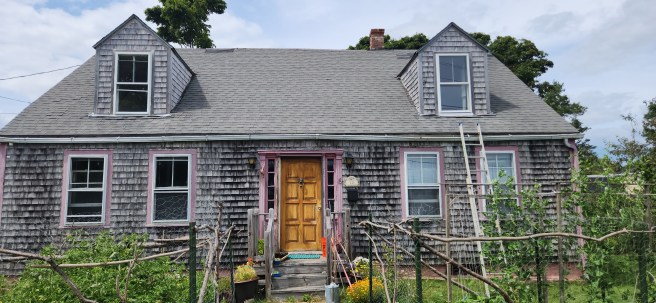
What we knew was that the place needed a lot of remedial work. And, oh yes, it had lots of potential.

In our recent homebuying round, a right property hadn’t popped up to a consensual acclaim. Some dwellings were closer to demolition than restoration. Others had been renovated in ways that were simply puzzling – a prime memory was the placement of the only bathroom behind a master bedroom. One modest house had four, maybe five, stairwells, enough to leave me lost indoors – I’m still intrigued by the quirkiness though I can’t pick out the place now from the exterior. Let me also admit that passing on an 1820s’ residence I really liked was ultimately the smart decision. The last one had been owned by the publisher of an early newspaper here, though that wasn’t the only thing I liked; once the kitchen deficiencies were made obvious, I understood why I was in the minority in that case.

As for the winner of our quest, I must admit the house didn’t grab my attention, not until the larger vision was shared with me.

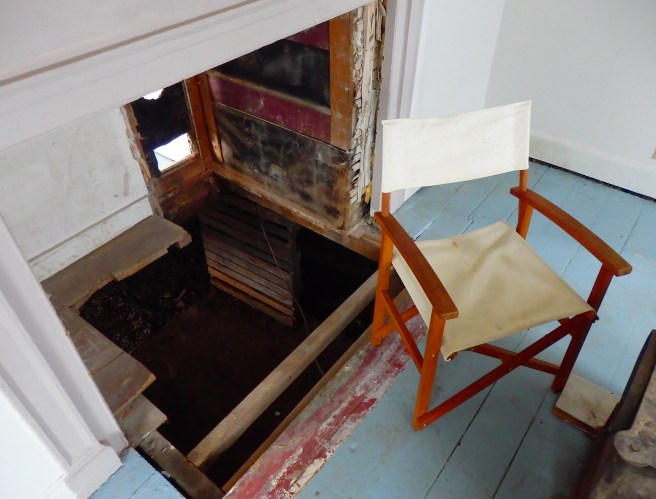
The listing had been on the market for the previous three years or more. It needed work, serious work, but it felt good inside, as others have told me afterward, even though the house is cold through much of the year, as I’ve even read in the archives of the local newspaper. A strong attraction is the natural light throughout the rooms. Our house inspector was impressed that the bones were good, especially the foundation – up to 18 inches thick in places. Were we up to the challenge of reviving the place? Life’s an adventure. I expected our low bid to meet rejection.

Instead, the seller accepted, clearing out most of our cash savings.

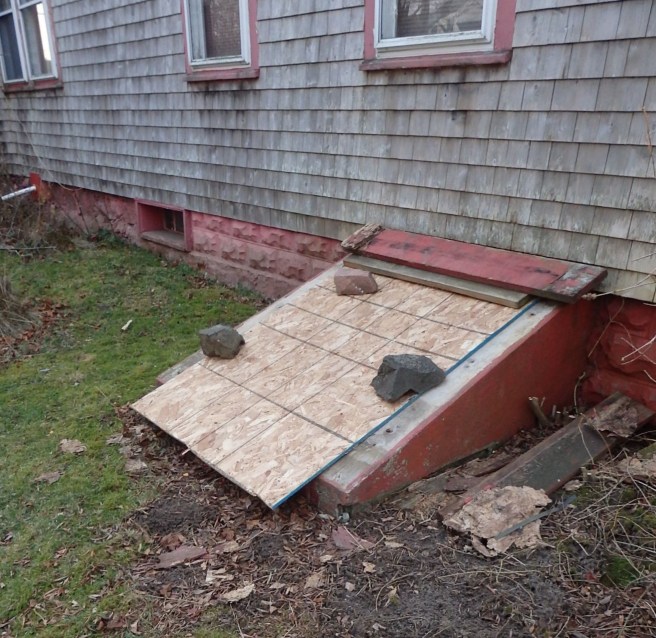
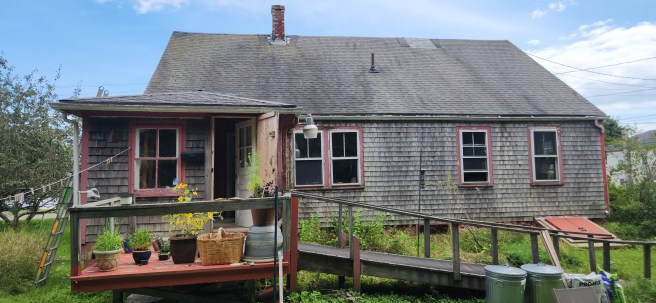
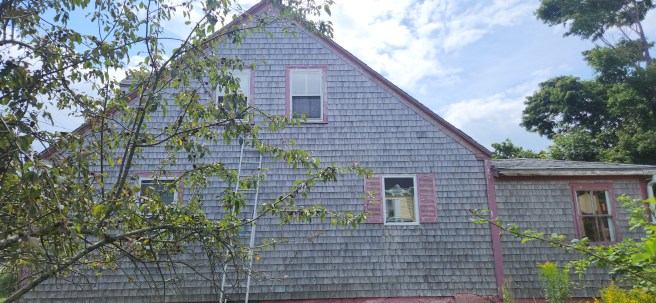
So here we with a classic cedar-shake siding full Cape dating from around 1830, although the real estate blurb placed it in the 1860s.

What has amazed me is the other participants’ envisioning of the renovations for this new venture. Not just the big, bold actions that inhibited my own thinking, but also many details that deliver a pleasurable, significant impact.

And that’s the beginning of this old house renovation story. As it unfolds, I hope you’ll pipe up with ways you’ve made your own dwelling a home a sweet home. Or, for that matter, of how your own projects required three times as much time and money than your best estimates presented.

Whatever the case, please enjoy the upcoming posts over the year. Not that it will be the only series here at the Barn this round.

Like those Christmas shopping receipts piling up

Now that our house renovation has begun in earnest (you’ll be reading about that in upcoming posts), the delivery order invoices are creating a file.

I do wonder if I’ll be able to make sense of them at some future time. They’re more cryptic than many of my poems.

Consider “¾ T&G Advantech 4×8.” What? That’s tongue-and-groove plywood. Forget the price, per unit or all together. They do make those martinis in Manhattan look cheap. Not that I’m going there.

The collapse of NBC

I don’t mean the cracker company, either, the one known as Nabisco, for National Biscuit Company. Or was that Baking?

No, I’m thinking of what was once the broadcasting monolith, first in radio and then in television, the one that projected a peacock logo at the onset of color programming.

The financial struggles for traditional mass media in the digital age are well-known, but broadcasting has been hit perhaps even more drastically than newspapers.

As a child of the ‘50s and ‘60s, I’m still shocked at the disappearance of AM radio, especially its powerhouse clear-channel signals. My daughters, savvy as they are in tech matters, don’t even know what AM is. These were coveted media, and getting a license for even a daytime frequency in a metropolitan market could be a coup. Think of WKRP in Cincinnati for the insider view. Instead, though, owners have allowed many of these to go silent. As for FM? The real competition is from streaming and satellite.

We gave up our TV years ago after realizing that whatever we wanted to watch was available online. Still, I was stunned the other day to discover that NBC no longer has an on-the-air outlet in Boston. That was unthinkable. Nobody would give up a network affiliation and go independent. Yet, as I learned, it isn’t anymore.

The trigger came the other morning when I was gazing at my Yahoo news feed and clicked on the latest Patriots football gossip from NBC Sports Boston, one of the primary regional sources. Wait, I thought. Why isn’t this identifying a station? Or at least a channel?

And that’s when I went down the proverbial online rabbit hole and found out that the once mighty network exists solely on cable in the nation’s tenth largest media market. Even the Tonight Show.

As for its entertainment lineup?

There are good reasons we’re turning to the new seasons at Amazon, Netflix, Hulu, etc. Besides, we can watch those shows at our convenience, not the network’s.

I must admit finding it hard to keep up with all of these changes. How about you?

WWJD in practice?

Quakers advise living in simplicity, but it can be complicated.

For example, how do we feel about heated car seats?

Especially if the car already came equipped with them?

And, for extra points, was purchased used?

As another example, how about eating fresh scallops in season? Sure, they’re expensive but also so heavenly. Cooked at home, a dinner can be priced out around the cost of a meal at McDonald’s these days and will likely be healthier. The morsels are also so simple to cook, if you’re paying attention.

If you’ve worked through the Money Talks exercises on my Chicken Farmer blog, you know I’m a believer in simple luxuries, things my frugal wife labels as Quality of Life improvements. These can be as simple as a great cup of coffee savored in the morning, rather than a full pot gulped habitually. Or a fine sweater purchased at a yard sale that still gets compliments a dozen years later.

Looking closely also points to many conflicts we see as First World problems, things that upset spoiled Americans and Europeans and the rich in other realms but are utterly beyond the reach of most of the world’s people. You know, even having a car.

Those could prompt a Tendrils here at the Red Barn, but I’m passing for now. I mean, some folks are upset having to eat leftovers while the majority of the global populace is going hungry.

My most recent round with this arose over the funeral arrangements for someone who was not exactly in our family but still being handled by one of us rather than one of hers. As I was saying about complications?

Without getting into the details, I can say that hers, shaped by family and friends’ expectations, easily cost many times more than a Quaker burial would have – and the memorial service itself would have been free and far more personable.

When I go, I definitely want any earthly wealth to go to my family and worthy endeavors than being poured into the ground. OK?

Now, back to those car seats. How do we feel about air-conditioning in the car?

Election reflections

These shoulder elections, where nobody’s running for national office, are still important.

In small places like Eastport, getting someone to run even unopposed for local office can be a challenge. We had all the bases covered, although the surprise was when a write-in candidate won one of the two city council seats.

I can’t imagine that happening in a bigger setting, but who knows. A write-in for president? My!

Statewide, a radical proposal to take over the two widely hated electrical utilities failed. Big money is hard to comprehend, even if we’ll be paying it one way or the other. The frequent storm outages won’t be going away, nor will the continuing higher-than-national bills customers here receive. Somehow, I don’t think the issue will be going away, despite the lopsided tallies.

Just how much do those emergency home generators cost altogether, anyway, as insurance against the current setup? It’s not that many households before we’re talking billions.

Otherwise, the initiatives moved in a progressive direction, including the right-to-repair measure.

I am relieve to see opportunities for right and left to come together at a local level, however gingerly.


Maine voters face two hot issues 

The Pine Tree State has a tradition, so I’m told, of placing complex issues on the statewide ballot because many of the elected state representatives and senators are afraid of negative reactions in a controversy.

Normally, public officials are expected to thoroughly investigate the issues and come to a reasoned decision. That’s why we elect them. Instead, shifting this responsibility to a general public that is rarely fully informed can be like rolling the dice.

This year, there are two issues of special note along those lines.

One is the so-call Right to Repair Act, which would prohibit manufacturers from keeping replacement parts and technology from independent repairmen. I’m still bummed by HP’s ink replacements policy – your machine shuts down if you try to use over-the-counter cartridges. Apple computer users have their own experiences. I know the list of big businesses’ proprietary efforts is growing.

The other issue is Pine Tree Power, which would have the state take over Maine’s two largest electrical utilities. Mainers have some of the highest electrical bills in the country accompanied by some of the longest and most frequent outages. Folks are still worked up over being cut off for weeks years ago after some storms before Central Maine Power got the lines working again. Despite the already high rates, CMP and Versant, the utility in our part of the state, both received permission this past summer to hike the bills another 20 percent. The utilities have lined up 15 times as much money for advertising than the grassroots effort has, no surprise there, and the campaign has a lot of emotional scare. What should be obvious is that somebody’s expecting to be repaid handsomely by staying in power (sorry for the pun). They’re not doing the customers any favors there, either.

So, when you’re checking the news reports tomorrow night or the following day, check the Maine results. They could be enlightening. Or, should we venture, shocking.

Living on $10,000 a day. Or even an hour.

The thought crept upon me the other morning as I was pondering simplicity and frugality.

Yeah, look at the flip side.

I remembered reading a recent New York Times piece on a Long Island boutique that catered to billionaires and noted the owner’s insight that they spent differently. I shrugged it off then but come back to it now.

Suppose your after-tax income came to $3½ million a year? That would be nearly $10,000 a day. (I did miscalculate and put that at $100k a day, a more interesting figure. Still!)

For perspective, the median pay for S&P 500 chiefs was $14.5 million last year, in contrast to an average $56,000 earnings for American workers.

The No. 10 guy on the list, Tim Cook at Apple, came in at $99 million in salary, benefits, and bonuses. More than $240,000 a day. That is, $10,000 an hour.

Ahead of him were the CEOs of companies like Alphabet, Peloton, Live Nation, Sarepta Therapeutics, and CS Disco, plus four I recognized. Please, can somebody tell me what the head of Pinterest is doing to make him pocket $123 million for the year? A tad under $337,000 a day?

As one scion of affluence told me a half century ago, there isn’t much real difference between a $20,000 car (today’s prices) and a $200,000 vehicle, as far as everyday performance goes. Let me add, today’s median family car is far superior to the luxury vehicles back then. Air conditioning? Seat warmers? Cruise control?

As I played with the $100,000-a-day figure, nearly twice the yearly earnings of real workers, I realized how little of that was needed for everyday expenses, even at inflated expectations – how many houses does one need, anyway, or how many hotel suites while traveling? What came into focus was the vanity opportunities: collections of antique cars, paintings, sexual playthings, political hobnobbing. Just name it and claim it.

And that’s where it gets scary, even when you scale back to $10,000 a day.

Conservatives like to quote Lord Acton’s “Power tends to corrupt and absolute power corrupts absolutely,” while they pursue the maximization of their personal wealth, which intensifies their power and, thus, corruptedness. Per the logic.

Renting a luxury yacht – $100,000 a week plus expenses, last time I looked – is peanuts in comparison. As is a private jet. They might even be business expenses, paid by the company.

Well, F. Scott Fitzgerald did quip, “Let me tell you about the very rich. They are different from you and me.”

But I am wondering what he’d make of today’s mutations.

What would you do, given that much at hand?