Our home’s new backbone was surgically inserted

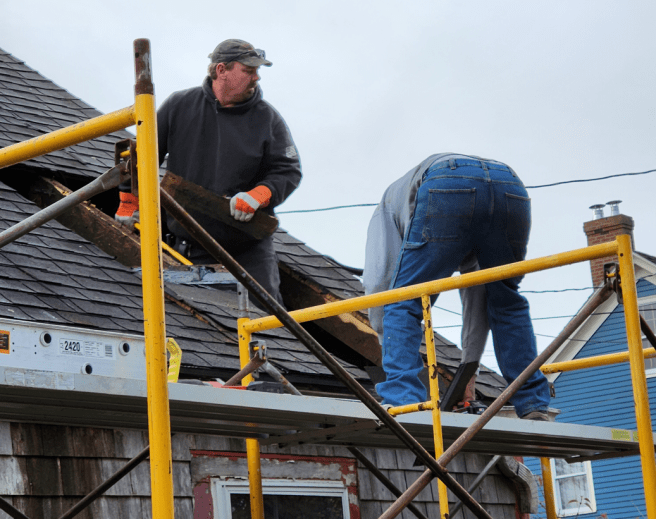
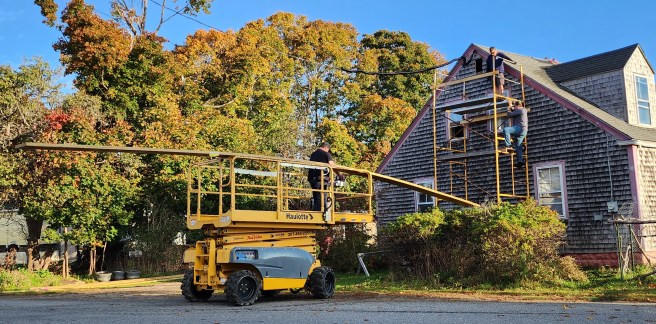
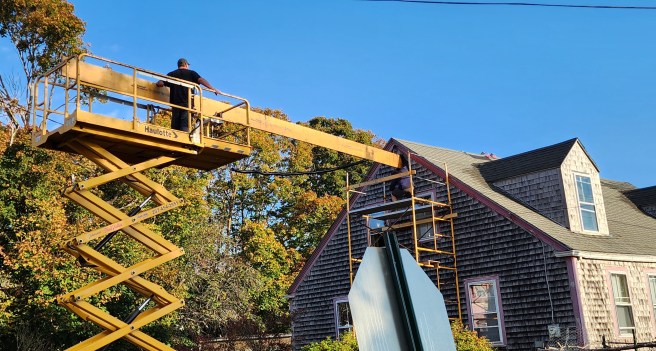
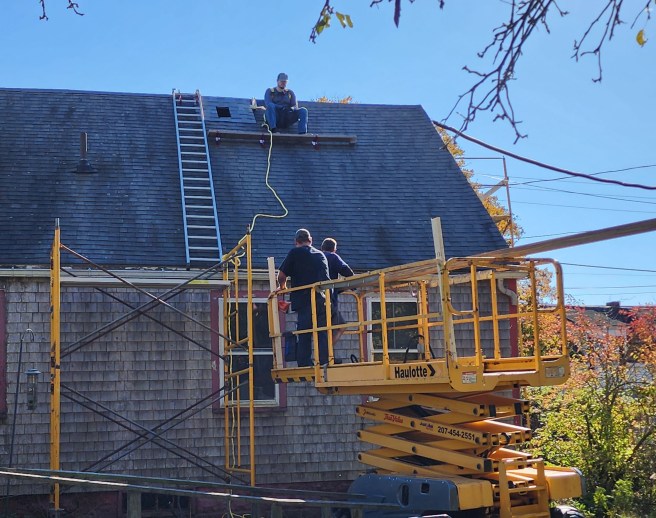
The last Saturday in October arrived clear and cool. We were now officially a month into the project, and Adam showed up with a crew of three for the dramatic operation of inserting a ridgepole. It was rather like laparoscopy, if you want to consider the small incision he made near the top of a street-facing gable.

Here’s how it went.

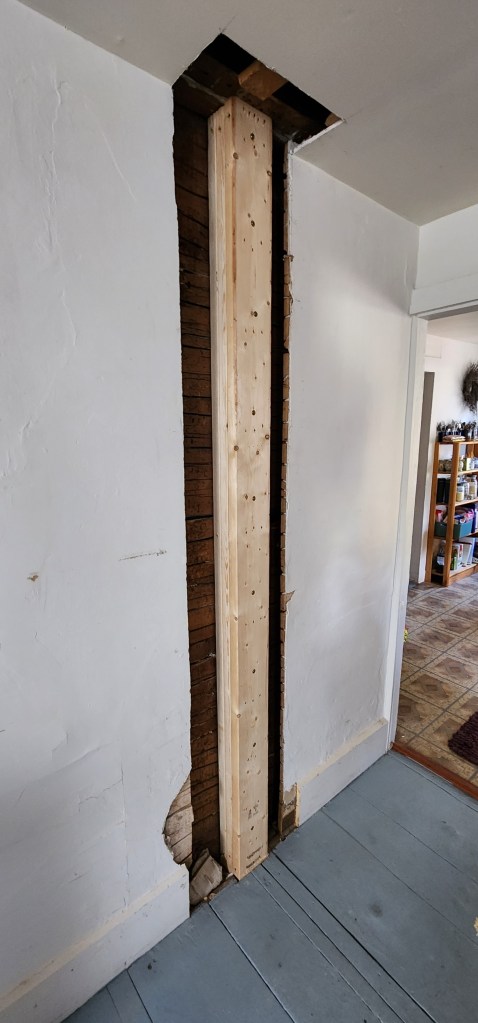
There was also the column to insert.


There was no anesthesia.

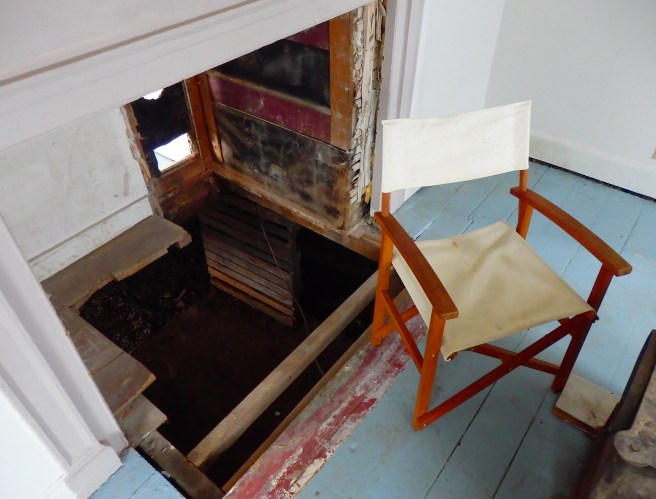
As for a big hole in the middle of our house

While waiting three years for our big renovations to transpire, I often joked that living here was like camping. I won’t go into the list now, but I did accept defects that could have greatly raised my blood pressure if they weren’t already on the to-be-addressed list.

I could even go into the pro-gentrification argument that if big repairs weren’t being undertaken, these dwellings were well on their way to collapse.

Our renovation, daunting as it is, remains a minor effort compared to a few others in town, including true mansions being brought back from the brink. One is a fussy restoration project to keep the place as close to historic accuracy as possible, apart from wiring and a kitchen upgrade. Another is to improve its Victorian social showcase qualities.

I’m also finally understanding why so many old houses out in the surrounding countryside have been left to fall in. They simply weren’t worth the cost of upgrading, not when you could build newer, better, even closer to the world for less.

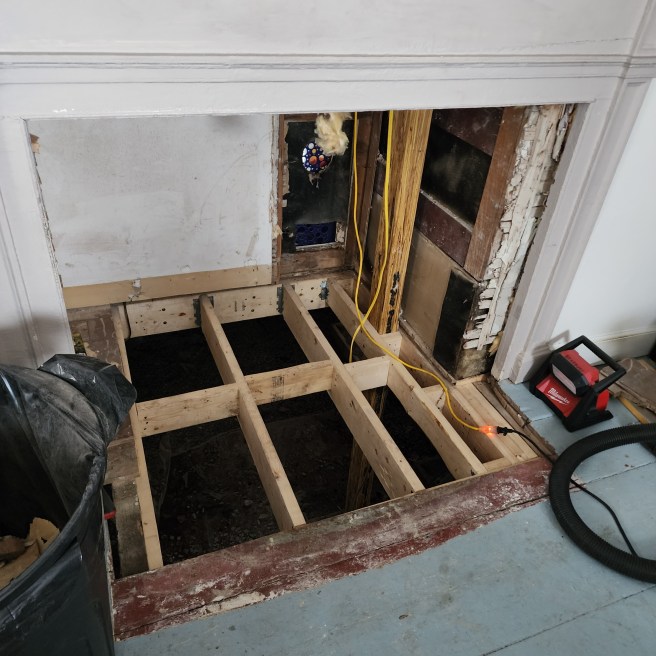
One of the annoyances we had tolerated was the big cavity where the second chimney had stood – the one that was about to collapse when we bid on the house.

We had passed on an offer to rebuild the brickwork, no matter how charming a working fireplace would have been. The chimney would have limited our remodeling options on the second floor, or so I argued, and without it, we do have a 2½-by-5-foot space to develop into a closet or something on the main floor. Patching the floor itself would be a huge improvement, as well, rather than having a light covering that couldn’t bear weight.

The cavity now provided a place where that 28-foot-long LVL column could run down through the house, as well as some new electrical wiring.

And, during a later break, Adam even fixed the holes.

Yes, step by step, it was all coming together.

At last, getting set for the big magic trick

Three weeks into the project, I noted my wonder at how quickly the work was going.

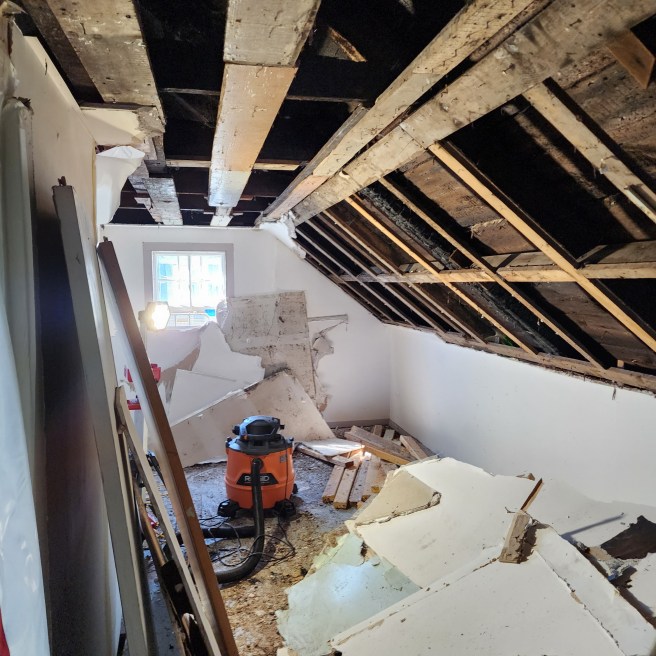
The back half of the upstairs interior was now exposed, giving us a sense of how much flooring and headspace we would be gaining. And we could see all of the rafters. Unobstructed? Adam had set up an impressive indoor workshop on the back half of the second floor, while the front two rooms clustered many of our possessions, now under plastic.

That said, I also noted my concern at how slowly the work was going.

The old roof over the back half of the house was still in place, and the clock was ticking down toward winter.

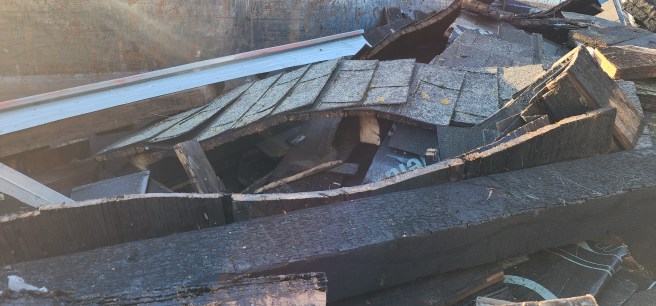
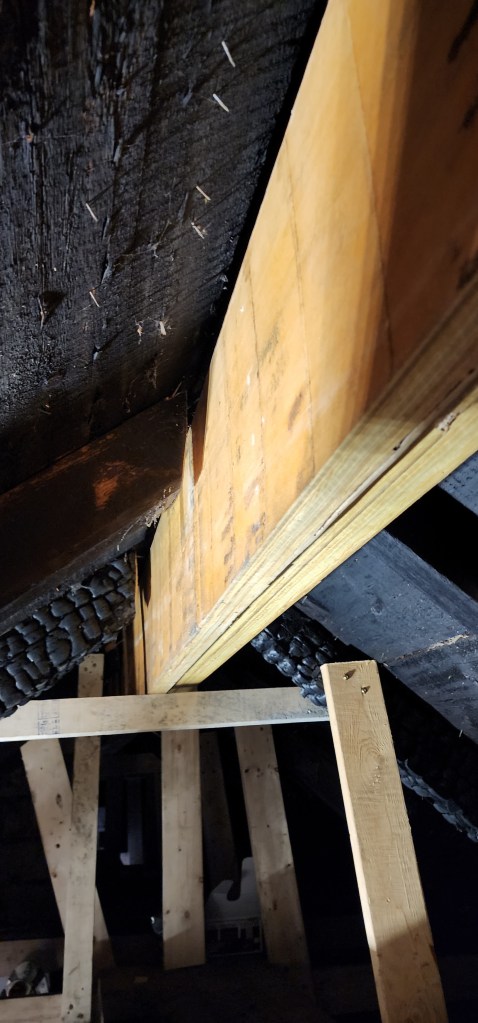
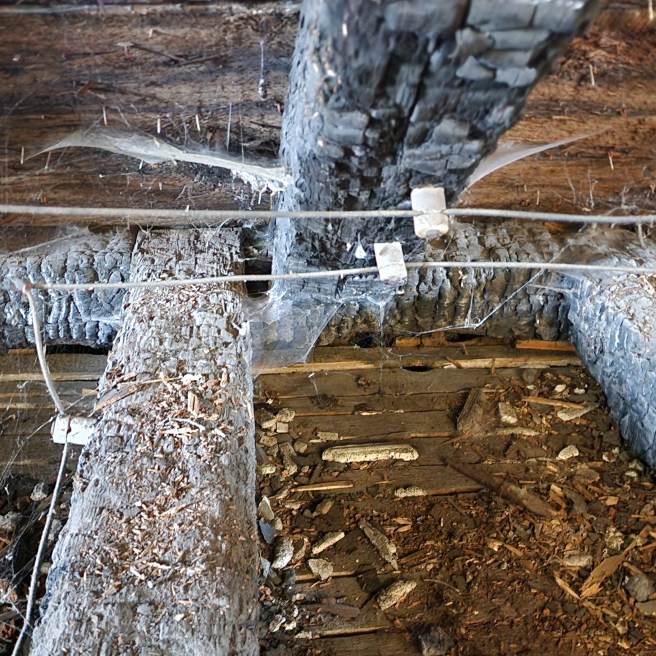
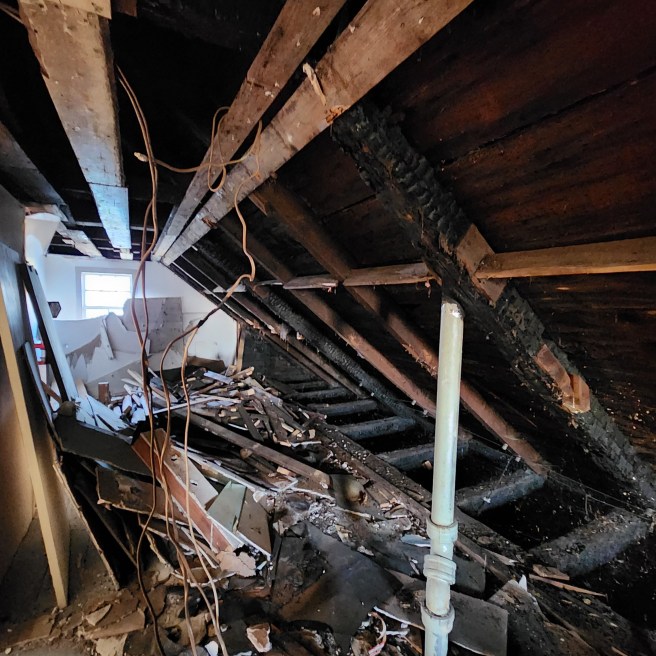
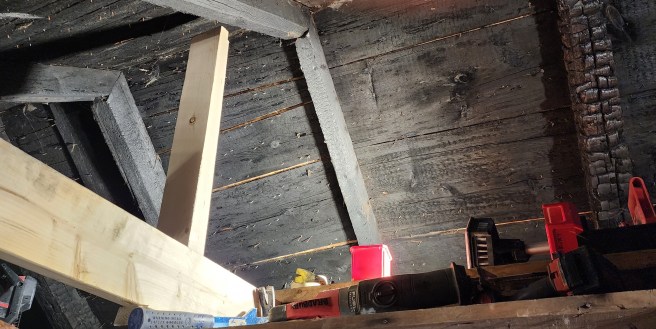
What dawned on me as I gazed up toward to the peak of the rafters was that the ones from the back – which were about to disappear – secured the ones at the front of the house, the half of the roof that would have to stay well in place into late spring or early summer. A few of those charred rafters would actually be remaining like forever, a nod to history and all that.

In a flash, the urgency of the new laminated ridge pole and supporting columns made sense. Without them, the whole roof would come crashing down and, in turn, there would be nothing to hold up the new one. One earlier contractor’s proposal for premade trusses to create a gambrel roof on both sides now became comprehendible – so that’s what he meant? We weren’t exactly communicating, and his results wouldn’t have been our first choice. As we were hearing, not every carpenter today knows how to frame a roof from scratch.

~*~

The key to achieving this was a recommended custom-made laminated veneer lumber ridge pole running the length of the house. Or more accurately, three pieces that would be joined together once they were inside and raised into position. Each one was 1¾-by-14-inches by 40-feet and weighed 280 pounds.

In addition, another custom-made LVL 3½-by-3½-inches by 26-feet was delivered for the remaining supporting column. That one would run down the cavity where our second chimney had been, the bricks that had been on the verge of collapse when we bought the place.

~*~

The new ridge pole would have to slip in where the rafters from each side were now overlapping. What would hold them up as he sawed them asunder? The answer was temporary framing underneath.

We were really, really glad Adam knew what he was doing, though we suspect he was losing some sleep over it. We do know he was doing his research and some thorough calculations.

had
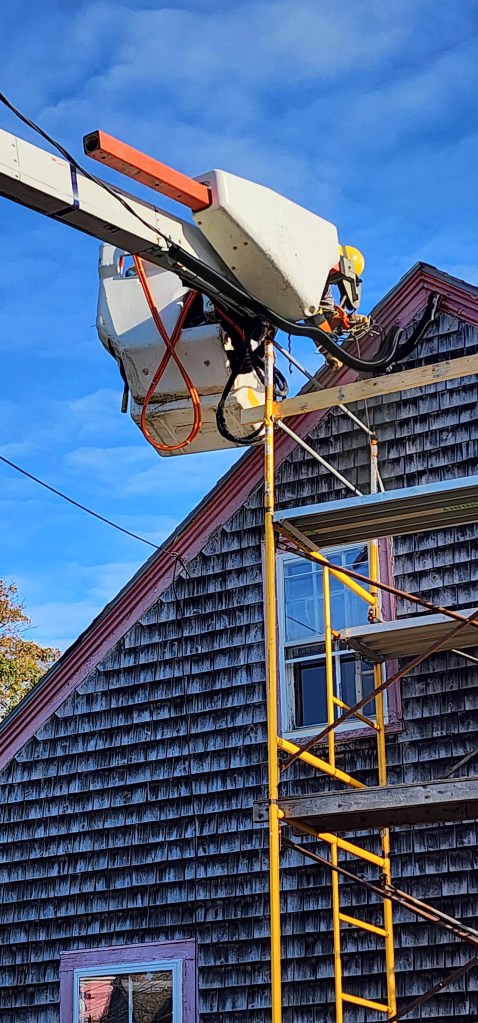
The electrical line coming into our house had to be moved to one side of the gable to allow for the ridge pole to come into the house. That meant getting the utility to come out for a free service.

Inside, our contractor was making cuts accurate to one-sixteenth of an inch. Sometimes the beam below, cut in the early 19th century, varied by a half-inch within the length of the two-by-sixes they would be supporting.

We were beginning to appreciate the fact that Adam was our contractor and not just our carpenter/electrician. He was making the arrangements and phone calls. Viking Lumber was making nearly daily deliveries from Machias.

After working largely solo, he lined up a crew to manage the pieces into the upstairs floor and then higher once inside. There was also the matter of a rented lift, positioned outside.

A lot of coordination had to come into place, even before discovering the power line coming into the house needed to be moved. Hello, Versant?

He had additionally expertly erected scaffolding by himself.

At that point, it really felt like this was happening.

So here we were, Week Four, the end of October, and the laminates were arriving – all four pieces. Well, make that five – Hammond Lumber had ordered a wrong size for the column and had to rush the corrected order down to our site.

Preparing to reframe the top of our house while we still lived below

This was turning into a more serious project than simply raising the roof.

Had we merely replaced the covering itself – either with asphalt shingles or upgrading to metal – without expanding our usable floor space on the second floor, we would have been glossing over serious structural issues. It’s a miracle the roof held as long as it did. One insurance company had cancelled our homeowner’s policy when it saw the photos of the roofing, and another insisted on a replacement within a year. That route would have been a very expensive band-aid in the end.

We had a dream of making better use of that space, as you’ll see. And now, after three years, we finally had someone to pull the project off.

As a starter. Adam needed to address some serious structural issues.

Was anything holding our roof up? It may seem strange to find that concern intensifying as we set out to remove it and its rafters, but we would need something to keep half of it up while the other half got ripped away. As an additional complication, we’d be living in the house rather than gutting it and starting over.

The absence of a ridge pole meant there would be nothing to hold up the front half of the roof when the back half came away for the new. Its lack also meant the existing ridge wasn’t straight but rather serpentine.

Adam had to make room for a ridge pole between the existing rafters. It was tedious and required some precise calculations.

Structurally, all the weight of the roof for nearly 200 years was directed outwardly to the walls – and, as he was finding, they weren’t exactly perpendicular.

Now he needed to have something to support the weight of the ridge pole and roof, too. That meant constructing four columns from the crown of the roof down to the cellar – one on each end of the house, the other two spaced in-between. That required going through two floors as well, plus building concrete pads in the cellar.

This was time-consuming work, and he was racing winter weather. We had reason for concern.

As these findings sank in, we realized our earlier option of just putting new shingles on the existing slope would have done nothing for real issues lingering underneath. Even without raising the back wall or consolidating the dormers in front, we would have had a larger problem waiting to erupt overhead. Living beside the ocean exposes us to many gale-force blasts. It’s a wonder the roof hadn’t gone years ago.

After taking some deep breaths, we appreciated what our contractor was telling us. Now, just exactly where was the center of the roof or the alignment down under? He did have some amazing laser tools to determine that.

We were really glad Adam was a pro, maybe more than the others working in town. He was definitely earning our trust and respect.

Mysteries were lurking behind the walls and above the ceiling

When Adam set about ripping out the drywall upstairs – and immediately filling his first dumpster in the process – the emerging picture soon presented a number of challenging hurdles. I’ve mentioned the lack of a ridge pole and matters regarding rafters, plus the wiring situation. This wasn’t going to be nearly as straightforward a project as I hoped.

The dumpster, by the way, was a new step for me. Back in New Hampshire, our carpenter hauled the debris to the transfer station in his pickup – or I burned what I could in the side yard. We even used a lot of the ripped-out sheetrock and plaster to “sweeten” our garden pH. How much would the alternative cost us, anyway?

I’ll say it was a bargain, especially considering the time that would be lost if Adam were driving that to the trash transfer station an hour away.

Adam’s selective demolition led to a small collections of old wallpaper examples. Meanwhile, a hippie-dippy yellow crab painted under some of the later wallpaper, alas, couldn’t be preserved, not that I quite wanted that. Mine was the minority vote. Still, we’d love to know the story of its creator – a kid? – and its inspiration.

More puzzling were the broken bricks in the walls and joists away from the chimneys. Huh?

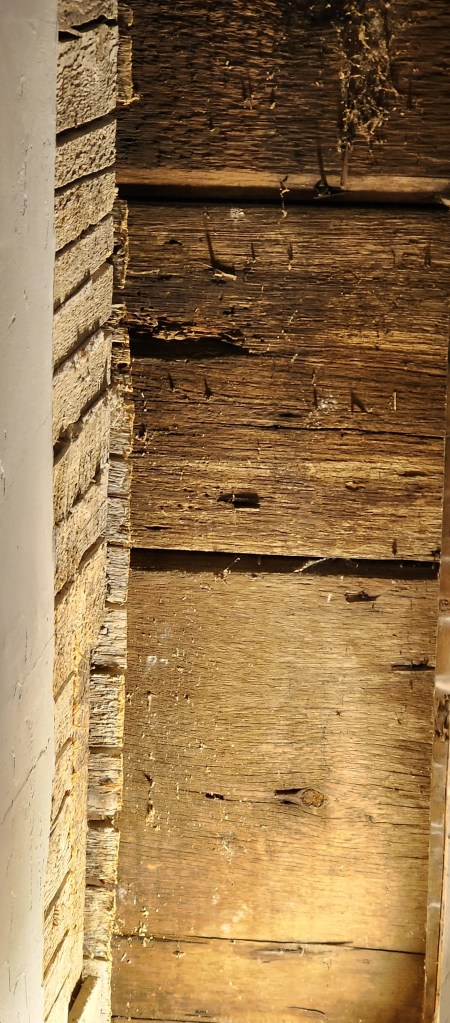
Or, more impressive, finding some of the exterior sheathing is more than 18 inches wide. Try buying that today.

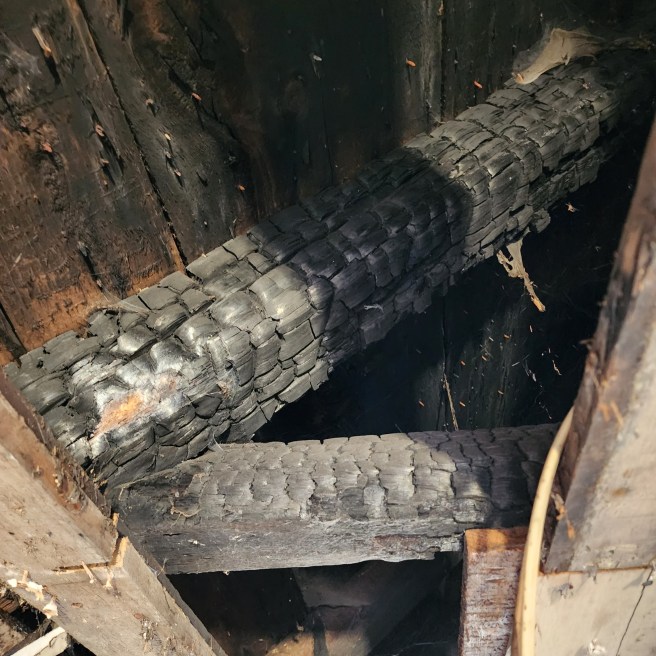
The fire damage was more extensive than we had imagined. Not just the historic downtown fire of 1886, charring our rafters but not setting them ablaze, but also a later chimney fire that charred the insulation off electrical wiring that we were still using.

What if the char damage on the beams and rafters wasn’t superficial but went deeper into what we assumed was still solid wood? (We were relieved to find out just how much good lumber remained inside.)

We’re left wondering. Did a fire originate in one of two wings once attached to the house and then spread to the roof? Sounds like an archaeology problem to tackle sometime ahead.

In addition, earlier carpenters here didn’t seem to do much measuring. I had to ask Adam, “So how does it feel to be correcting 200-year-old work?”

He gave me a look.

As I said, Adam set to work with determination and within a day filled the first dumpster.

Beyond the fire damage, he uncovered more knob-and-tube wiring to contend with than we had wished.

But to our surprise, Adam is not only a master carpenter but also a licensed electrician. This was sounding too good to be true.

We weren’t exactly living in a war zone

Starting this project was like being buckled into a big roller coaster, say the legendary Son of Beast just north of Cincinnati, or finding yourself pregnant, or so I’ll presume, either way resigning yourself to going along for the ride, wherever. Well, in either of those examples there is a destination, and we’re assuming there’s a fine outcome here, too.

I had no idea how much I didn’t know the morning Adam showed up with his tools.

Let me relate how relieved I was to learn that we could still live in our house during the renovations. Stories circulated of people who not only arranged for accommodations where their crew could live during big renovation projects but also had to clear out themselves for the duration.

Look, our financial pockets aren’t deep. We’re addressing my lifetime savings, unless my novels somehow turn out to become blockbuster bestsellers, even at this late date.

Taking more than a few deep breaths, then?

Adam hit the ground running.

At the end of Day One.

And Day Two.

Once we were underway, I was impressed by the measures that were taken to minimalize the spread of dust and debris and I would like to acknowledge those.

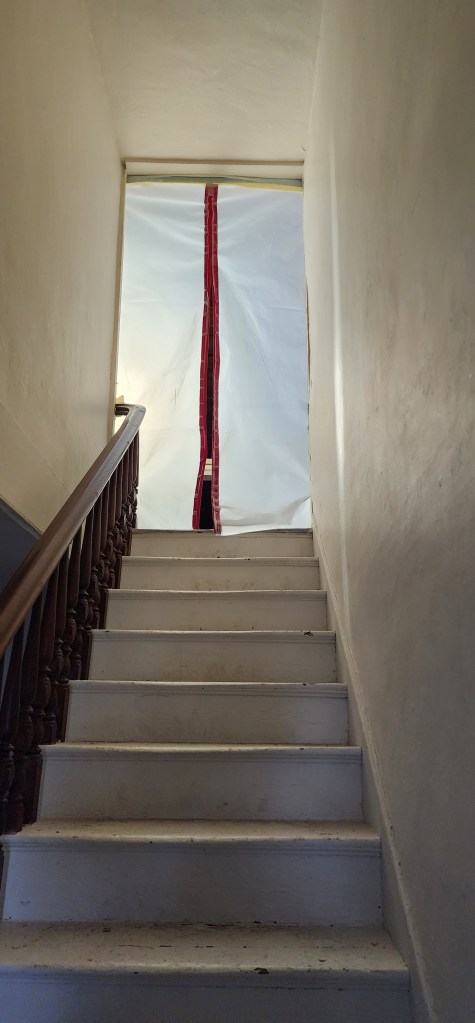
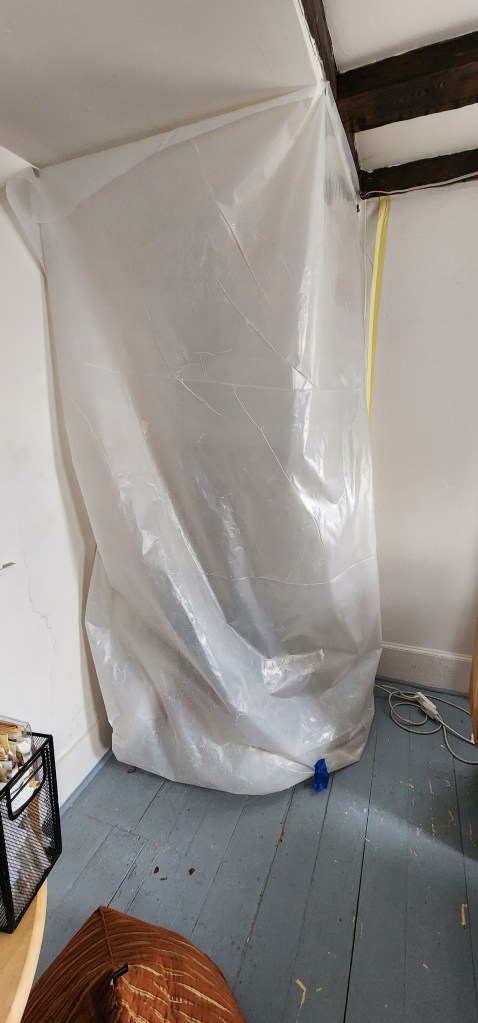
The zipper doorway to the second floor was the first step. And when working on the main floor, Adam erected clear-plastic envelopes he could work within. Made me think of the so-called “state rooms” on the historic schooner I sailed on last summer, where every inch was treasured. Adam’s power vac became a familiar sound.

It wasn’t the only place he was fastidious. I would never get my sawing accurate to 1/16 of an inch, especially not when dealing with an old beam underneath that was a half-inch shorter on one side.

Do note, a lot of unsung artistry goes on in projects like this. As well as a lot of weird shit, done by rank amateurs, those whose weird decisions you discover along the way. Long ago, on projects on our little city farm back in Dover, we realized there are many, many very good reasons for modern building codes and for the inspectors who ensure they’re followed.

Also appreciated were the health measures of venting the upstairs or wearing earplugs and a face mask. Our previous carpenter, back in Dover, discovered the hard way about the alternative, hearing loss, and maybe the lungs, too. I don’t know what to advise about plumber’s knees, either.

By being able to be present when all this was happening, I did get to follow the action. I’ll hope you, too, finding that entertaining.

Hard to believe, but it’s really happening

With a sense of despair regarding the roof project and our lack of a contractor on the horizon, we went ahead and set about erecting raised garden beds for what would be my third summer of dwelling here. We would try to leave some space for a contractor to get at the house, should we ever, ever, find someone.

During one of the inevitable conversations with passers-by while installing the garden and its fencing, a trusted neighbor mentioned that she had just had some carpentry done by a former student, someone who had returned home after living and working away. She gave us his name and phone number, and an introductory conversation followed.

Yes, he could do the project, and he thought in could start at the end of August. I was startled when he said that was the upcoming August, not a year off. Could it truly be?

Naturally, there were delays while he wrapped up some other commitments, but we did find ourselves in a stunned state of disbelief when work finally began in earnest at the beginning of this past October. We finally had a contractor who not only showed up on the morning he promised, but also on the dot of the hour.

He hit the ground running, methodically, precisely.

At the heart of our big project is a new roof on the house. Not just the asphalt shingling, which itself has needed replacement – we could have found someone to do that – but the actual shape of the supporting rafters themselves. To gain much-needed interior space, the walls on the second floor are being raised. That structural work’s the complication. And how, as you’ll see.

When we were considering making an offer on the house, we were told to check out the rafters for signs of charring, a consequence of the 1886 fire that destroyed the canneries, wharves, and downtown. Sure enough, ours was one of the homes suffering damage though left standing.

A few weeks before starting on the renovation, our contractor stopped by with his mentor slash consultant for a closer look. More concerning, from their point of view, was the lack of a ridge beam. The rafters from each side were simply mitered together. In addition, they were further apart than current coding would permit.

Our project would be taking place in two phases – the back half of the roof last fall and the front half in the spring. Without a ridge pole, there was nothing to hold up the remaining half and nothing to support the new raised framing.

You’ll discover where that leads.


We were on hold – as in stuck – even with our money shrinking in the bank

Our gloating over our timing of selling our previous house at the giddy peak of a hot market soon darkened when we realized two nationwide tides were running against us as we tried to move ahead in our current dwelling. One was the soaring price of construction materials. The other, as inflation kicked in, was the erosion of the purchasing power of our working nest egg.

If it were only me here, I could pretty much survive quite nicely in two rooms. One of them was what I came to call my dorm, the quarters where I slept in one half and wrote in the other. The second chamber was the kitchen. That left our north parlor, with the video screen and two sofas, and the south parlor, as a guest room and storage.

When it’s been two of us, the space situation became more problematic, especially with just one small bathroom.

We still didn’t need the upstairs for much, except when others visited. We certainly didn’t want to pack in too much storage until the new roofing and reframing were done. Everybody we approached about the overhead project was booked out a year or two ahead, and most of them declined to commit to another. One who promised to the job then backed off for a season, so we waited, only to be ghosted in the end.

Whether it was just me here or maybe four of us fulltime, the overhead work and much more needed to be done. It couldn’t be put off forever.

In the absence of a dependable contractor, we did inch ahead on a few fronts.

One was a large garden shed that cost us half-again as much as it would have a few months earlier. I can joke that it’s my new barn, though it’s not red and is much, much smaller than the namesake for this blog. Still, it’s surprising what a difference it makes – almost like a garage without parking for a vehicle or two.

Another concern was a classic wood-burning cookstove that occupied the heart of the kitchen and was an inefficient supplemental heat source. Besides being a major weight on our sinking floors, it had a stovepipe feeding downward into our surviving chimney, which was also used by the furnace, a violation of current building codes. I saw the stove as a both fire and health hazard. It had to go. Distinctive it was, both as a liquor cabinet/bar and as a fun place to stash junk food and other treats for visiting family to raid, I’m glad it did find a new home, as I explained in Chief Doe-Wah-Jack’s Pride and Joy, June 10, 2022.

And then, as you may have followed here last year, we went ahead with some raised garden beds. I do wish you could have tasted some of the harvest, and I’m happy to repeat that the ravenous deer around here did not penetrate our improvised barriers, unlike the previous summer at the community garden.

Living in these conditions has carried a sense of camping. You know, as in not quite permanent. I haven’t even described our makeshift kitchen setup or the rain dripping inside windows or the cramped, windowless bathroom.

All the same, I can say I’ve never felt as much at home as I have here. Maybe that has something to do with the abundant natural light in the first-floor rooms. Or maybe with my life in general. Or maybe the lingering good vibes of Anna M. Baskerville. Or more likely, all three.

But that couldn’t go on forever. Repairs and renovation needed to be done, if only we could find an available superman. I mean, this is my fourth winter in this place and I wasn’t the only one aging. I could sense it in the walls, too.

Hope I’m not sounding whiny.


Our first steps were bottom up

Back in New Hampshire, our veteran carpenter/electrician had proclaimed how fascinating he found the underpinnings of an old house – what people usually call a basement, though in New England, it’s more likely to be a cellar. I’ll explain the difference someday, if I haven’t already in an early blog post. Rick said probing around the underbelly gave him insights into the soul of the residence.

He would have been impressed by our new residence at the other end of Maine, a post-and-beam full Cape with a mostly stone foundation up to 18 inches thick.

From our previous homebuying experience, which landed us in an 1890s three-story New Englander, we knew we’d face some immediate issues. At our new address, the ones that we able to address all involved the cellar.

  • First was the removal of a chimney that had lost half of its supportive brick arch in the cellar. The rest looked ready to go at any moment. Many of its bricks above had already collapsed into the Franklin fireplace, presenting a puzzling serpentine pattern. We insisted the chimney be removed before we closed on the house transaction. A temporary patch in the roof then covered the chimney hole.
  • Next was a rusty fuel oil tank. One of its four legs was missing. The tank was replaced.
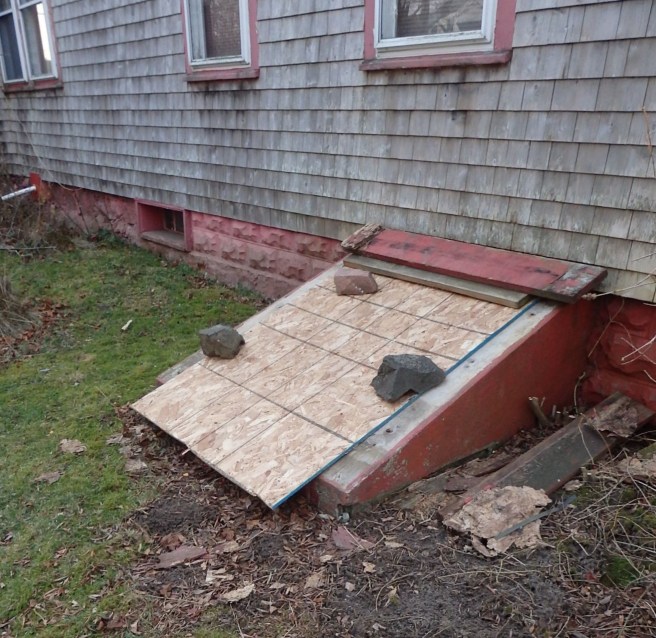
  • Third was a bulkhead door. The previous cover had rotted away and, in its absence, the entry was blocked by stuffed green trash bags, which were removed before we signed off on the deal. When we moved in, that entry was a gaping hole with no cover at all. We couldn’t leave an opening like that. We’re still surprised we didn’t have raccoons or, worse, rats living down below. A strong metal bulkhead door now secures that portal.


A temporary measure to cover the bulkhead.

The major issue needing to be addressed was the condition of the roof, as the insurance company insisted.

Complicating the situation was our intention of raising the rafters themselves and changing the two dormers to gain more usable and much needed space on the second floor.

The big problem was finding a contractor to take on the project. You’ll hear more on that in later installments of this series.

We simply couldn’t afford to replace the existing roof cover only to rip it off in a year or two. So we were in an anxious limbo, one that intensified with every blustering nor’easter.

In the absence of someone willing to tackle the roof and its restructuring, we did eventually find a carpenter to address the serious floor sloping on the main floor. I do joke about being able to tell through my bare feet that I’m in an old New England house even if I’m blindfolded, so I’m not surprised our floors weren’t dead level. But structural sinking is another concern, and raising portions of the downstairs floor 5½ inches did cost us surgeon’s rates – or “away” pricing, as others told us later. It’s still not perfectly flat, but ours is an old house. For a view of that work, see Now Leveling Our Cape, posted March 8 of last year.

One benefit was that we can now use the washing machine without having it walk during its spin cycles into the cavity where the chimney had been and then crash into the cellar.

Maybe you remember the definition of a sailboat as a hole in the water into which your pour endless amounts of money.

An old house is a hole in the ground into which … as perhaps you already know.


When it comes to a home, how did you settle on the ‘right’ place?

Two dozen years ago, in our previous homebuying round, I created a list of 20 definitive items we could rank on a scale of one-to-five, only to discover that the particularly hot sellers’ market and our price cap rendered the exercise useless. The harsh reality simply didn’t present us choices to evaluate. The best we could do was simply check off Yes or No. If a place passed, we then had to beat other bidders to the punch. Forget quality and personal style. Was it habitable in its current condition? Did it fit our needs?

For the record, we were not, then or now, seeking an idealized suburban house with a white picket fence and an immaculately manicured yard. As you can imagine from this blog, we were open to something funky or organic, what some would even define as “character,” a place that could breathe and grow with our lives.

In the end, we simply lucked out, as you see in the Red Barn postings from New Hampshire.

In our recent downsizing to the other end of Maine, we had a less pressured, more leisurely pace in the market. High on my checklist was walking distance of downtown, the health center, and the arts center, plus a view the ocean, even only a glimpse between neighboring houses, and a workspace for my writing and related projects, though that could be much smaller than before, now that I’ve largely moved away from paper.

Other participants had their own priorities, including a large garden with full sunlight. As for a kitchen? Let’s just say that potential can be a checklist item of its own.

Neighbors and security are largely a wild card.

And, three years later, after several false starts, we made a bid that was accepted.

What we knew was that the place needed a lot of remedial work. And, oh yes, it had lots of potential.

In our recent homebuying round, a right property hadn’t popped up to a consensual acclaim. Some dwellings were closer to demolition than restoration. Others had been renovated in ways that were simply puzzling – a prime memory was the placement of the only bathroom behind a master bedroom. One modest house had four, maybe five, stairwells, enough to leave me lost indoors – I’m still intrigued by the quirkiness though I can’t pick out the place now from the exterior. Let me also admit that passing on an 1820s’ residence I really liked was ultimately the smart decision. The last one had been owned by the publisher of an early newspaper here, though that wasn’t the only thing I liked; once the kitchen deficiencies were made obvious, I understood why I was in the minority in that case.

As for the winner of our quest, I must admit the house didn’t grab my attention, not until the larger vision was shared with me.

The listing had been on the market for the previous three years or more. It needed work, serious work, but it felt good inside, as others have told me afterward, even though the house is cold through much of the year, as I’ve even read in the archives of the local newspaper. A strong attraction is the natural light throughout the rooms. Our house inspector was impressed that the bones were good, especially the foundation – up to 18 inches thick in places. Were we up to the challenge of reviving the place? Life’s an adventure. I expected our low bid to meet rejection.

Instead, the seller accepted, clearing out most of our cash savings.

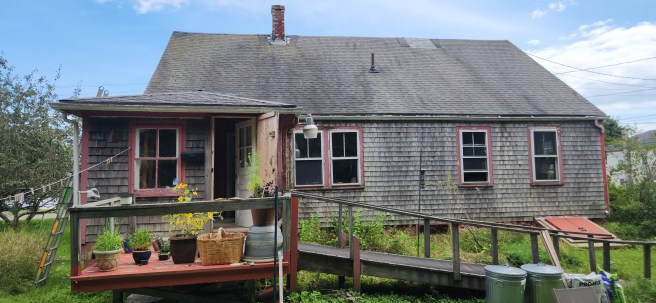
So here we with a classic cedar-shake siding full Cape dating from around 1830, although the real estate blurb placed it in the 1860s.

What has amazed me is the other participants’ envisioning of the renovations for this new venture. Not just the big, bold actions that inhibited my own thinking, but also many details that deliver a pleasurable, significant impact.

And that’s the beginning of this old house renovation story. As it unfolds, I hope you’ll pipe up with ways you’ve made your own dwelling a home a sweet home. Or, for that matter, of how your own projects required three times as much time and money than your best estimates presented.

Whatever the case, please enjoy the upcoming posts over the year. Not that it will be the only series here at the Barn this round.