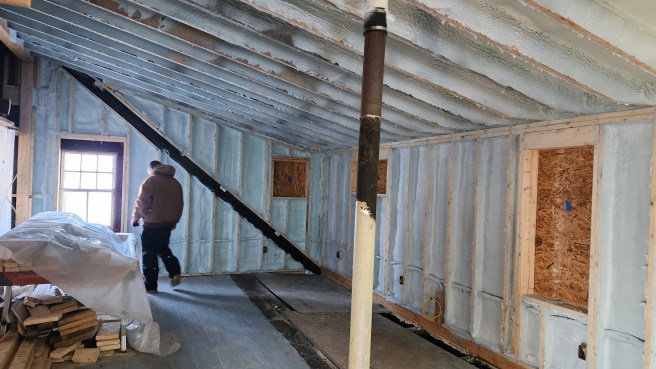
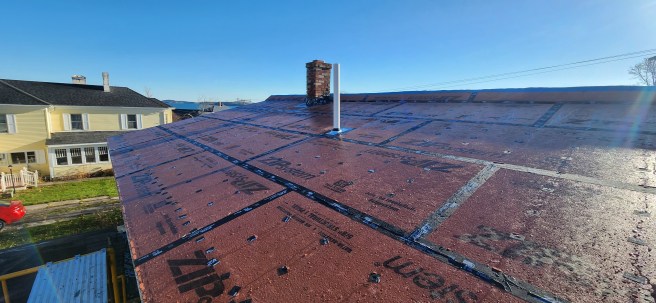
It wasn’t cabin fever, exactly, but somewhat close

The new year introduced what seemed like slow-motion forever, a superficially sluggish pace that lasted all winter.

The reality was that there were a lot more parts and details to attend to in a project like this than met the eye. As for patience? It’s a skill, as I’m observing.

Cutting the openings in the exterior for the new windows and then framing them inside and out was one example. One step required each window to be perfectly leveled and then sealed into place. It wasn’t nearly as smooth-going as you’d imagine. And that was even before Adam uncovered the rot under the north gable window. One more delay for repair.

I have to admit the varied sizes I’d chosen and their emerging views did give me a sense of confirmation and satisfaction, as did looking at the scope of the full back half of the upstairs.

Some of our new casement windows resemble what are called transom or awning windows.

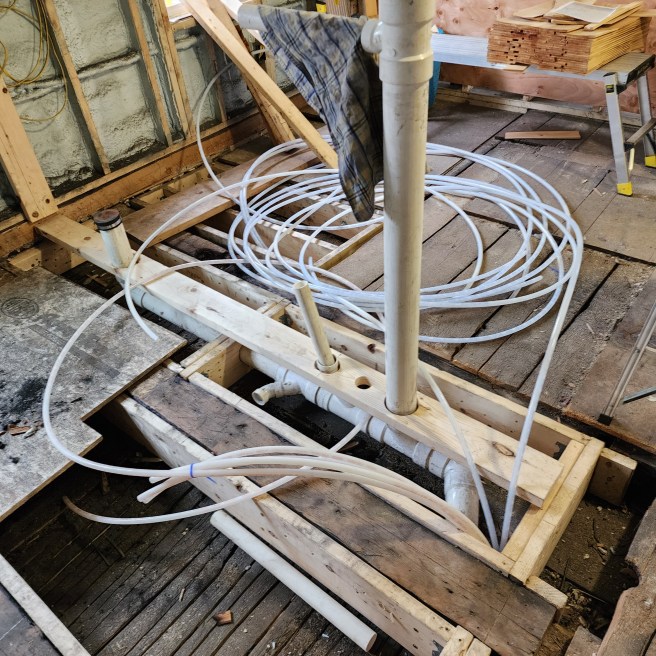
Pulling up flooring to permit rough fitting for the piping in the bathroom and adjoining laundry room was another example, one we’ll cover in an upcoming post.

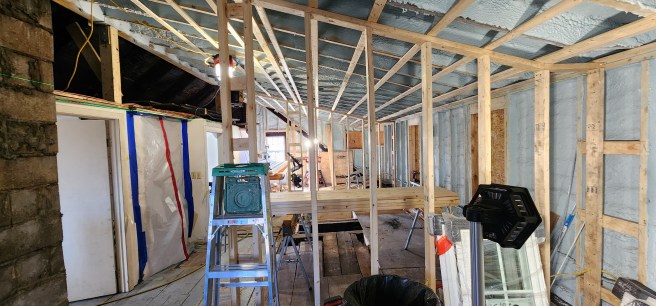
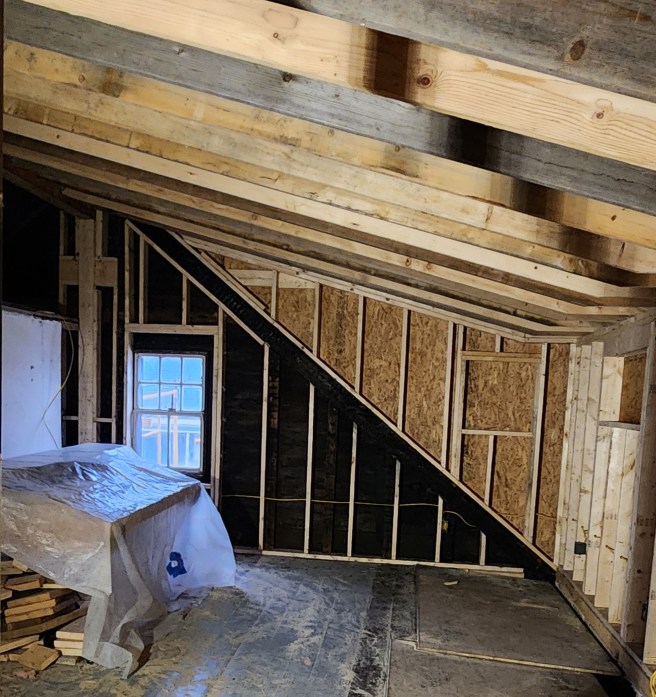
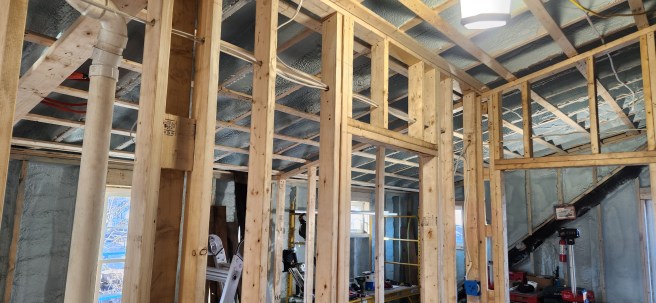
Framing for interior walls.

An unexpected discovery was a spider’s nest of tangled electrical wires, itself a violation of building code, but something that then led to the shock that none of our “modern” wiring on the first floor was grounded. Among other problems. Addressing that situation detoured Adam for more than a week, but it included a redesign of the wiring in the cellar, too.

That project was on our longer agenda, but it wasn’t something to ignore. I am delighted that we can now plug in three-prong wires without having to resort to those crazy converters for the two-prong sockets. As it turned out, none of our surge protectors would have worked when plugged into the old system.

It’s a huge relief knowing that’s all in our past now.

You’ve already seen photos of the knob-and-tube lines we found in the rafters. Some of those then led back to outlets on the first floor – connected by nothing more than stripping the main line and taping over the new wrapping. We already knew from experience that most of the first floor, plus the cellar lights, were on one circuit. Running the bread toaster and another energy hog could easily overload that, sending me flashlight in hand to reset the circuit-breaker in the cellar.

Our carpenter also found a junction box set in the upstairs floor – another violation of today’s building codes.

And here I’d been concerned about our lack of three-prong grounded outlets? Oy vey.

Of course, we’re looking to correct all that. My, are we.

In the end, the whole house was rewired.

Framing for the two bedrooms and the bathroom and laundry room also took time and care, as did the strapping for the drywall on the ceiling to come. For now, there were the electrical lines, outlets, and switches to install, once the holes were routed in the future walls.

The addition was really happening.

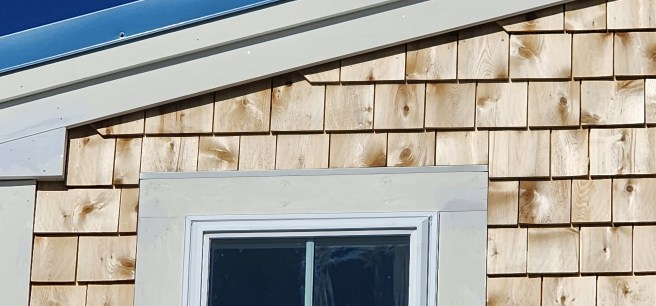
Outdoors, the back half of the house was surrounded by scaffolding. Although the first cedar shakes were applied to the new exterior early on, continuing was a random activity based on fair weather. The exterior work had to do more with flashing and the underside of the roof overhang. More details, as you’ll see in coming posts.

How much would have to be more or less finished before tackling the front half of the upstairs? Instead, we were trying to find crannies downstairs to move our possessions still parked overhead, but Adam also needed more workspace. It was amazing how many tools and related equipment he had there. Even his construction lighting was impressive, before we considered the permanent fixtures.

If I was looking for a halfway point, I was sensing the path ahead was more complicated. We still had plans for downstairs, too, if any of our nest egg remained.

Welcome to our learning curve and money jitters.

~*~

One thing we were discovering was that there are far more parts to house than you’d imagine.

All along, we kept hearing mysterious pounding and shaking overhead, the whine of power saws and the thumping of an air compressor, along with falling timber or worse. I learned not to anticipate taking a nap during what other’s consider normal working hours.

Remembering the student strikes of ‘70

News reports of protesting students seizing administration buildings on college campuses do bring back memories, and I know I’m not alone.

While there had been earlier seizures of campus facilities in the late ‘60s at schools like Berkeley, Columbia, and Ann Arbor, Michigan, the killing of four protesters at Kent State on May 4, 1970, and two more at Jackson State on May 14 triggered student strikes across the country.

The causes ran deeper than just the ongoing warfare in Vietnam and surrounding countries, do note. My novel, Daffodil Uprising, reflects my experiences in Indiana.

The making of a hippie

While I’m not about to engage in comparisons of today and back then, I am fascinated in the focus on university funding in the current protests. My novel saw that as a crucial factor back then, too – it wasn’t just Dow Chemical, either.

Of special concern, now and back then, is the depth of frustration that finally erupts as rage and revolt. We can assume there are elements in the current actions that go back well before the current Gaza crisis, and not just in the Middle East.  They need to be addressed.

I believe that many of the problems in contemporary America can be traced back to unresolved issues from the late ‘60s For now, I’ll leave it at that.

For any of you interested, my book is available at the Apple Store, Barnes & Noble’s NookScribdSmashwords, Sony’s Kobo, and other fine ebook retailers, and at Amazon in both Kindle and paperback.

As if there would be a calm after the storm

The two weeks before Christmas got more than a little frantic around us, even without all of the holiday buildup. The renovation tradesmen were on a collision course. The spray foam crew gave us a date they would be in town for a bigger project down the street – they would dovetail us into the afternoon – but that meant the windows on the back half upstairs would have to be framed and the electrical outlets along the exterior wall would have to be in place before they arrived. We would also have to be out of the house for 24 hours afterward while the toxic vapors subsided.

Our contractor and his accomplished accomplice worked through the weekend to meet deadline.

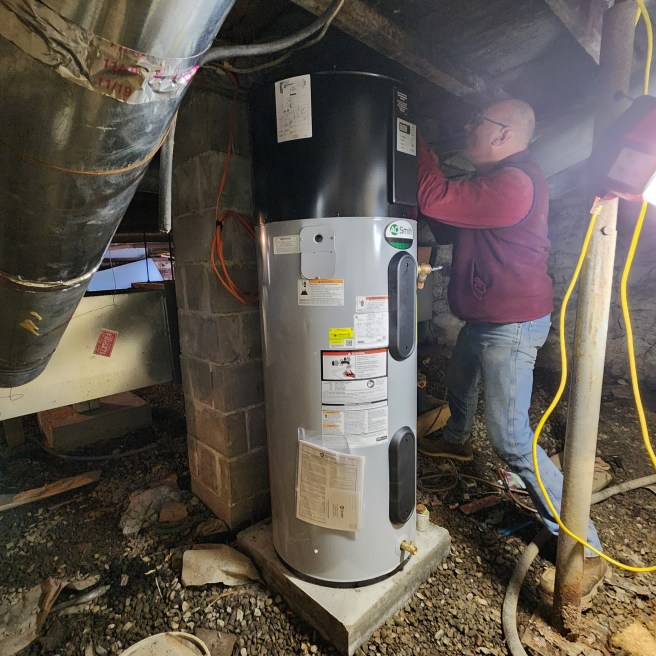
We also had a plumber on-site – you don’t try to reschedule those guys, do you? It’s hard enough to get them at all. First, he was moving a cold-air duct for the new wood-burning stove and its metal chimney, accompanied by moving the water heater to make way for that metal chimney. As long as we were dealing with the water heater, we advanced our anticipated shift to a heat-exchange unit, which should drastically reduce our monthly electrical bill. While he was at it, he replaced the old sump pump and its precarious hoses. Some of those photos have already appeared in this series. We were delighted that the new stove and chimney were in place and working by Christmas Eve, when the rest of the family was visiting.

What I haven’t mentioned is the hurricane-force storm that hit a week before Christmas, pushing back the foam-installation crew by two days – along with our Airbnb reservation. (The tempest hit right after my choir’s two concerts, as if I needed any more activity.)

And then there we were, welcoming family and putting up the tree on Christmas Eve, this time in front of a warm fire.

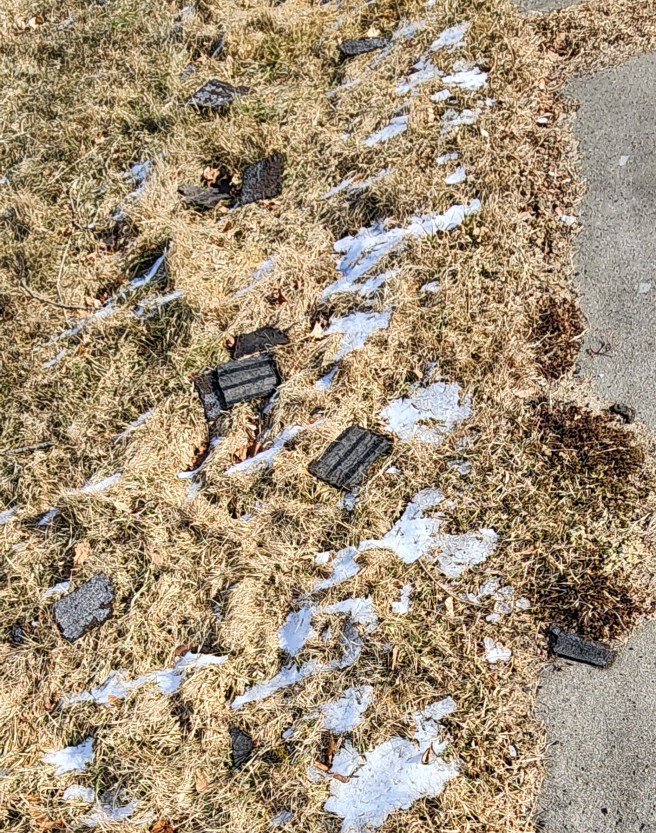
Our lawns, walkways, and streets are littered with asphalt roof shingles, thanks to some intense winter storms.

The region sustained two similarly intense storms, back-to-back on January 10 and 13, along with widespread power outages. Having a wood stove meant we wouldn’t be freezing.

Our roofing held, front and back, unlike many of the others around town. Asphalt shingles popped up in our yards and along the streets like dandelions in springtime, but few of them were ours. Even new buildings suffered. Not that we could sit back smugly. Our front roofing was still precarious, awaiting the next big step of transformation come springtime. And here the insurance company had insisted three years earlier we had to replace it pronto?

We were tempted to leave the space open.


With the windows framed and now outlined by the foam, we had a much clearer idea of how the upstairs was shaping up. In looking at the space, we found ourselves wondering if maybe we should just leave it as one big room. We let that dream give way to more practical thoughts, including gaining a second bathroom.

We did, though, decide to have the new ceiling rise with the roofline rather than be flat. It’s not quite as step as a cathedral, but who’s quibbling? It means the new bedrooms will be more like a tent or small pavilion rather than bland boxes.

It’s not like our project’s so unusual in the bigger picture

Those of you who have constructed a house from scratch must be looking at our renovation like it’s peanuts. And, in many ways, it is. We weren’t starting with talks with an architect or even inspecting an undeveloped site beforehand. No, that must be truly thrilling. There’d be none of the frustration of trying to retrofit your dream into what others had done before you, either.

For the record, we did look seriously at a couple of undeveloped sites in town and played with the challenges, but they were beyond our means, leaving us to always lament the spectacular views that others now enjoy while also wondering how we would have managed the timing.

Still, to be fully honest, I have to say what’s unfolded before us is truly exciting, at least from our end. That kinda brings me back to that adage about writing about what you know, or at least what you find most fascinating at the moment.

But it’s also humbling. Just consider how much of daily existence we take for granted, at least in the so-called developed world.

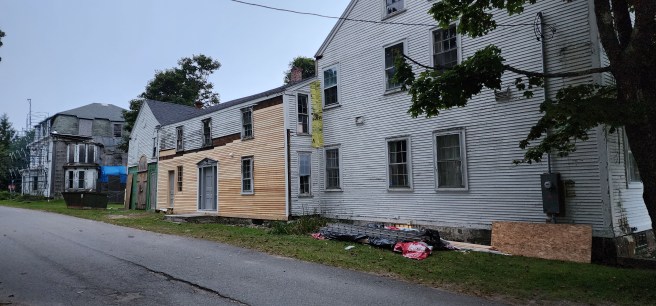
The Isaac Hobbs mansion, off to the far corner of our block, is undergoing a thorough restoration. Half of it was about to cave in when we bought our property, but that’s no longer the case. The new owner wants to be historically accurate, as far as possible. In contrast, we want ours to be more livable. Besides, most of the period detail was ripped out decades ago.

A further block up the street, a more spectacular upgrade is being given to the circa 1807 federal house Aaron Hayden built and General Samuel D. Leavitt transformed into mansard mansion in the 1880s. It had fallen into foreclosure before its bold new owners came to town on the heels of Covid.

Leavitt was also Eastport’s first mayor.

Reader, beware, if you must.

I wasn’t expecting to have the plumber in this early in the game

As I said, the best place in the house for our new woodburning stove was occupied by a large cold-air intake duct for the furnace. We needed a plumber to move the vent over a few feet. “Piece of cake,” as we were told. Well, he needed a carpenter, too. We were already covered there. Ditto for the electrical.

In addition, as I’ve explained, the best pathway for the wood stove’s metal pipe chimney ran right through a cubbyhole where our water heater sat. We were already intending to replace the unit for a more efficient heat-exchange model anyway, so we bumped that up in the timeline. As long as the plumber was in, right?

And while Thomas was at it, the float on our old, jerry-rigged sump pump had begun sticking, causing the cellar to flood, so that could go, too. No problem, he’d replace that at the same time.

If we like him, there’s a lot more ahead – a kitchen remodel, a new bathroom upstairs, and then remodeling the little one downstairs that’s way too outdated. Oh, yes, and the outdoor faucets.

Its pad was installed earlier.

So that’s how the heat-exchange water heater was installed in the cellar, under the old, inefficient water heater. Adam, our contractor, handled the new concrete footer and the electrical wiring. We’re told it should also dehumidify our cellar. Now that’s a happy bonus!

And all this was wrapped up the day before Christmas Eve.

As an added complication, we were getting a woodburning stove

Considering the frequency and length of electrical outages in Maine, having an emergency heat source in place was a high priority. I’ll explain later what derailed us from going directly from an emergency generator. Wood heat was the more obvious answer for us, but the big obstacle was that we didn’t have a usable chimney. We couldn’t just run up to Tractor Supply or Tru-Value, pick out a cast-iron stove, plug it in, and breathe a sigh of comforting relief.

Instead, we needed some professional advice, and that’s where we were stymied. Local inquiries led nowhere. The nearest wood stove and fireplace dealers were 2½-hour drives away.

Since Ellsworth has two, that’s where we headed. The smaller dealership was far more helpful than the other – and it referred us to a nearby chimneysweep who, after we approached him, did agree to install a stove for us as well as, more crucially, addressing the chimney situation.

While a previous woodburning cook stove in the kitchen had vented into the same flue that the furnace uses, that’s now contrary to building code.

Tim confirmed that our best smoke-venting option was to run an insulated metal chimney pipe straight up next to the existing brick one. At this point, with our upstairs about to be torn apart and the rafters exposed, we wouldn’t be disrupting anything there. Our ultimate placement of the stove itself would require moving a water heater and a cold-air vent in the floor. Not that big of an issue, now that we had a contractor. Glory be!

As for the existing but inefficient hot water heater? That advanced our planned acquisition of a heat-exchange water heating unit, but just where?

That’s when Adam, our contractor, lined up a license plumber, Thomas. You’ll be meeting more of him later.

~*~

Back to the central decision, which stove?

From my days in the Pacific Northwest, I was impressed with the pioneering Norway’s Jotul brand, a view reenforced by our purchase and intensive use of a small model in New Hampshire two decades ago.

Still, looking for maximum efficiency of our new stove, I was pressed to research other available options. After all, a lot has happened in the interim. And how, as I discovered.

Since our stove was also for a power-outage alternative and not just supplemental heat, wood pellets were out of the question. Alas, perhaps. A pellet fire isn’t quite the same when it comes to simple repose.

Two new considerations for me were cast-iron versus straight metal. The former takes longer to warm up but holds longer. The latter, the opposite.

Since much of our usage Way Downeast involves offseason chilly mornings and evenings in spring and autumn, the metal models gained an advantage over cast iron. We’ll see how that holds.

A complicating factor was catalysts, which would require attention every few years – and, more critically, by whom? By this point, Jotul slipped from the picture.

From my book Quaking Dover, I knew that soapstone and other heat sustainers worked as efficiency boosters, but in this round, the added cost and weight didn’t fit our setting.

Vermont Castings, which had been our principal rival to Jotul, fell from consideration over quality control issues, as other, newer, brands came to the fore: Ambiance, Blaze King, and HearthStone, among them.

We did have to quibble about how our stove would look and function in our situation, but in the end, after a thorough review of the efficiency specs, sizes, and prices, we went with a Lopi model, one from an enterprising Pacific Northwest outfit.

Alleluia. We even got it installed before deep winter kicked in.

Second floor.
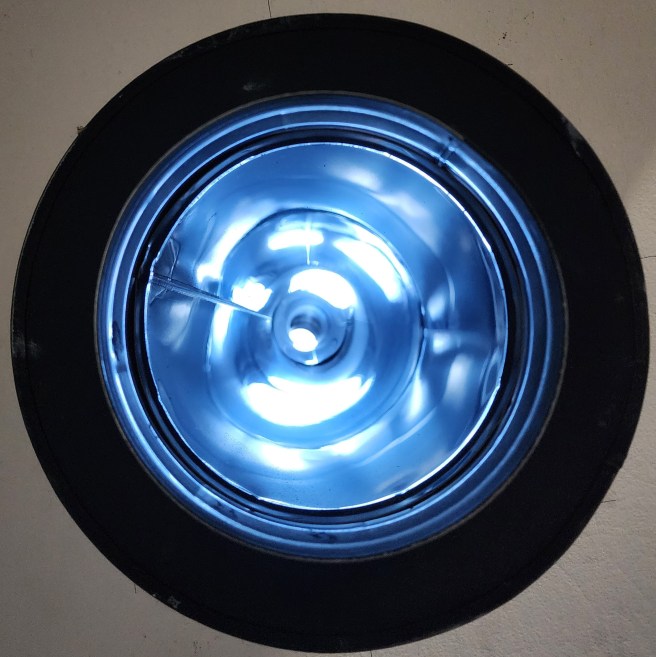
A view up the pipe before it was capped.
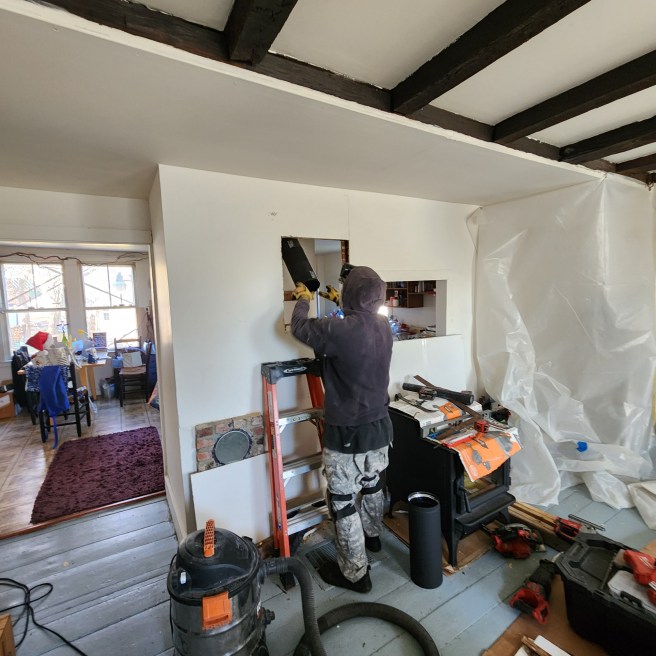
Meanwhile, on the ground floor.

And there it was, just in time for Christmas.

~*~

Let’s be honest. The new stove wasn’t entirely about emergency heating. It was mostly about having the utter pleasure of wood warmth. It was even about reducing our onerous fuel oil bills, even before we add heat-exchange units upstairs.

After waiting three years to get the renovations underway, the unfolding events sometimes felt chaotic. So much happened at once.

Still, looking at the glossy brochures, I’m left thinking there’s a much bigger picture left to be presented. Sitting back against the unrivaled comfort of a wood fire and reading in my favorite chair is an unsurpassed pleasure in my book. This was a definite improvement over our previous winters.

As a slide flash, as a writer I’m reminded about the adage, “Write only about what you know.” Is there anything like this in a novel? Or even a movie? Maybe the bearskin rug in front of a fire as a photo?

By the way, we never heard back from the other stove dealership. The bigger one. We do have an affinity for smaller is beautiful, especially when it’s family-centered.
Next up, a set of chain-reaction decisions

The roofing wasn’t the only thing taking place. We had to make some more key decisions regarding the next steps.

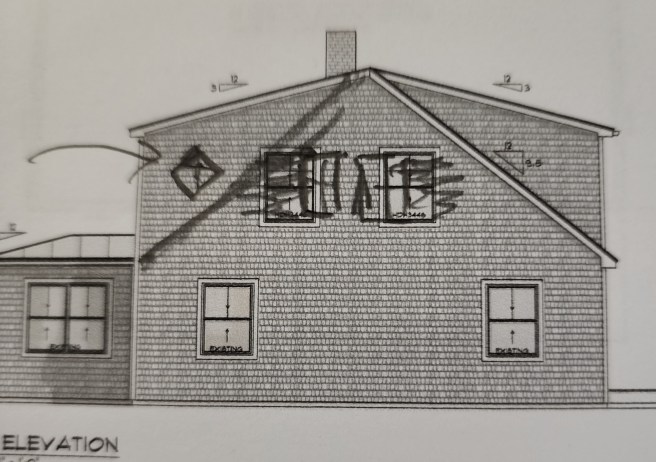
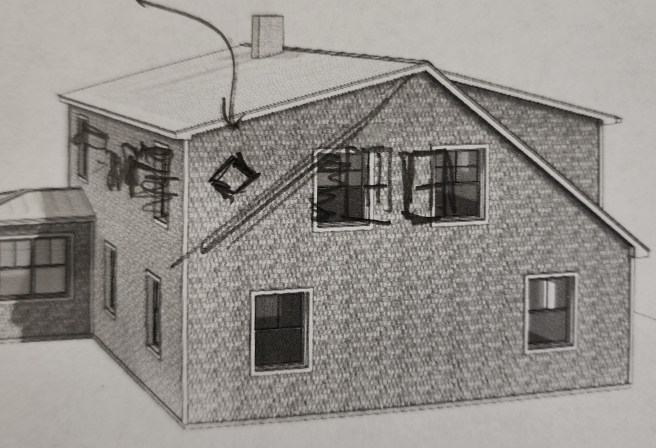
First was settling on the size and shapes and placement of windows in the back half of the house. We’ll examine those later. The glossy catalogues had a wide range of types and sizes, but no prices. For now, Adam needed to know where to frame them.

To do that much, we had to finalize our upstairs layout, at least roughly. A new bathroom and laundry room were part of that, details to come later.

Getting that far included electrical outlet placements along the exterior walls.

Those were steps that had to be taken before the spray-foam insulation crew showed up – which they did, two days after promised and leaving us with a nonrefundable Airbnb reservation. On top of that, we were required to be out of the house for 24 hours after they finished. Back to the Airbnb reservation. The crew’s deadline here was also contingent on a bigger job they were doing downtown – the two brothers live an hour-and-a-half from Eastport. We were second in line.

Before.

And after. Note that a diamond window in the corner is no longer in the plan.

Weatherproofing the new exterior came next

We now faced some related decisions, beginning with the kind of roofing.

Our preference was for standing seam metal, but we were concerned about the price. It would, however, allow for a lesser roof pitch, and that would give us more headroom, and that was in addition to its added durability.

Asphalt shingles may be less expensive, but we live in a heavy winds-prone town. The forecast seems to have gale warnings every other day, at least for small craft out on the water. After a strong storm, the streets and yards are littered with blown-away shingles, even from new houses.

As I said, living beside the sea exposes us to a lot of wind.

~*~

The next decision involved the color. There were more standard color options than I’d thought from casual observation.

We liked bright red and the bold cobalt, at least for homes out in the country, but ours is tucked into a tight neighborhood and we wanted to continue to blend in. Our goal was something subtle but still classy. The color of the metal would also determine the shade of trim we would be applying later, maybe around the foundation, too.

We settled on a pale blue, which we find is common around the neighborhood.

There was far more to do up there than we could see from the street, and far more steps than simply putting the metal sheets down.

With condensation as a consideration, a vapor barrier went up. Strapping and rigid-foam insulation boards were fitted and secured. A weather-resistant fascia went around the trim. As did flashing.

And finally, we had the metal roofing itself.

After several setbacks from bad weather, Adam and Keith worked like maniacs over the weekend to have it securely in place before a hurricane-force storm – and then Christmas, a storm of a whole other nature.

~*~

As for the exterior walls, new cedar shake shingles were a given.

Extending the back wall, at last

Week 7 brought the dramatic steps that would be seen from the street. This is a small town, after all, and people would talk. Fortunately, all we heard was approval and admiration.

As another plus, the weather turned in our favor, a week without rain.

As an added blessing, Adam, our exacting contractor, was joined by Keith, a simpatico master carpenter (even mediocre ones are hard to find around here). Fortuitously, they melded into a relentless team that raised the back wall, crafted new rafters, and encased the roof like clockwork.

Doing that precisely to an old freeform house like ours required many adjustments akin to sculpting, which these two performed with great understanding and patience.

The new wall would be sitting atop an old wall that was serpentine in length and height. It required a lot of precise correction.

The week ended with the thrill of seeing back half of our greatly expanded upstairs actually buttoned up days before Thanksgiving and the wintry weather to follow.

The front half will have to wait till spring, but there’s plenty to do before then. Much more, actually, than I wanted to consider.

So far, no lipstick. And then? Zip, zip, zip!

After a week or more of finetuning the ridgepole and columns, Adam was ready for more drama. It was time for the old roof and rafters to go.

By now, much of the time the work was mostly loud reverberations punctuated by pounding and thuds within the top half of our house. Most of it mystified me. It often sounded like a war zone, especially when the air compressor kicked in. Not that I’m complaining.

Here we were, six weeks and thousands of dollars later and nothing we’d done was of the sort that would appear on a flip-this-house kind of a video streaming channel – the superficial changes that one local inspector we know dismisses as “lipstick.”

You do have to love an old house. Or, for perspective, an old lover.

Now we faced the decisive moment. Off with the back half of our upstairs!

A large, “rolling” dumpster was in place.

That saw appeared like the fin on a shark.

And then the roofing was removed in panels.

We got an idea of what a deck up there would be like.

The dumpster quickly filled.