EVEN FOR A BUCK OR LESS

Going through our bookshelves the other day, I was struck by how many of my first paperbacks were picked up for under a buck, new. How many, in fact, came in at under a half-buck. These were serious literature, mind you.

Yes, gasoline cost about a quarter a gallon, too, but just compare the impact of inflation over that period. While regular gas now runs up to $4, those fifty-cent paperback titles are now listing around $16, plus – more than twice as much inflation, relatively speaking.

Newspaper and magazine prices have also spiked, for a variety of reasons beginning with the cost of paper itself and distribution.

My concern as both a reader and a writer is that the figures for traditional publishing have simply become too prohibitive to take risks on unknown talent. For instance, I’m very unlikely to shell out $25 for a hardback novel, yet if that title doesn’t sell sufficiently, we’re unlikely to see the trade paperback, which can still be borderline prohibitive for modest incomes.

Public library budgets, meanwhile, keep getting shaved, forcing reductions in both new acquisitions and the staffing and open hours.

All of this means you’re less likely to find a new voice you find personally exciting. It’s all about blockbuster sales for one title rather than a wide offering catering to quirky interests and pleasures. And it’s not just commercial publishing.

Not long ago an official of an academic press related the painful decision they’d made regarding an important history manuscript that would not sell more than 400 copies, according to their marketing research. And so, in the absence of a major subsidy (such as an underwriting grant), the volume would not appear.

Since much of my own fiction falls in the category of “experimental” literature, the response I’ve received from some literary agents and presses has been that the work deserves publication but that it’s not “economically viable.”

The threshold for economically viable, I should point out, has been rising steadily through the four decades I’m reviewing.

I remember hearing the novelist Wright Morris in a televised interview where he said how lucky he was to have a niche following where a press run of eight-thousand copies was sufficient to support him. That’s hardly the case today, especially when the field has been consolidated into two publishing houses handling the bulk of American fiction.

*   *   *

Even so, hundreds of new novels appear every week, many of them from small presses run as a labor of love. Few of the authors will get any notice, even though some, as I’ve found over the years, are a fine alternative to the cookie-cutter work typically found in commercial fiction. At least the Internet is opening new opportunities to be heard and discovered – and even for readers to pick up a fresh writer for a few bucks once again.

So who are you reading these days you feel speaks directly to you? Or whose style bristles in ways you find delightful? And how did you come across this author in the first place?

Maybe his or her successful niche following is around the corner if we all talk about literature as if it counts in our time. Just maybe.
WIND BLADE

100_8492

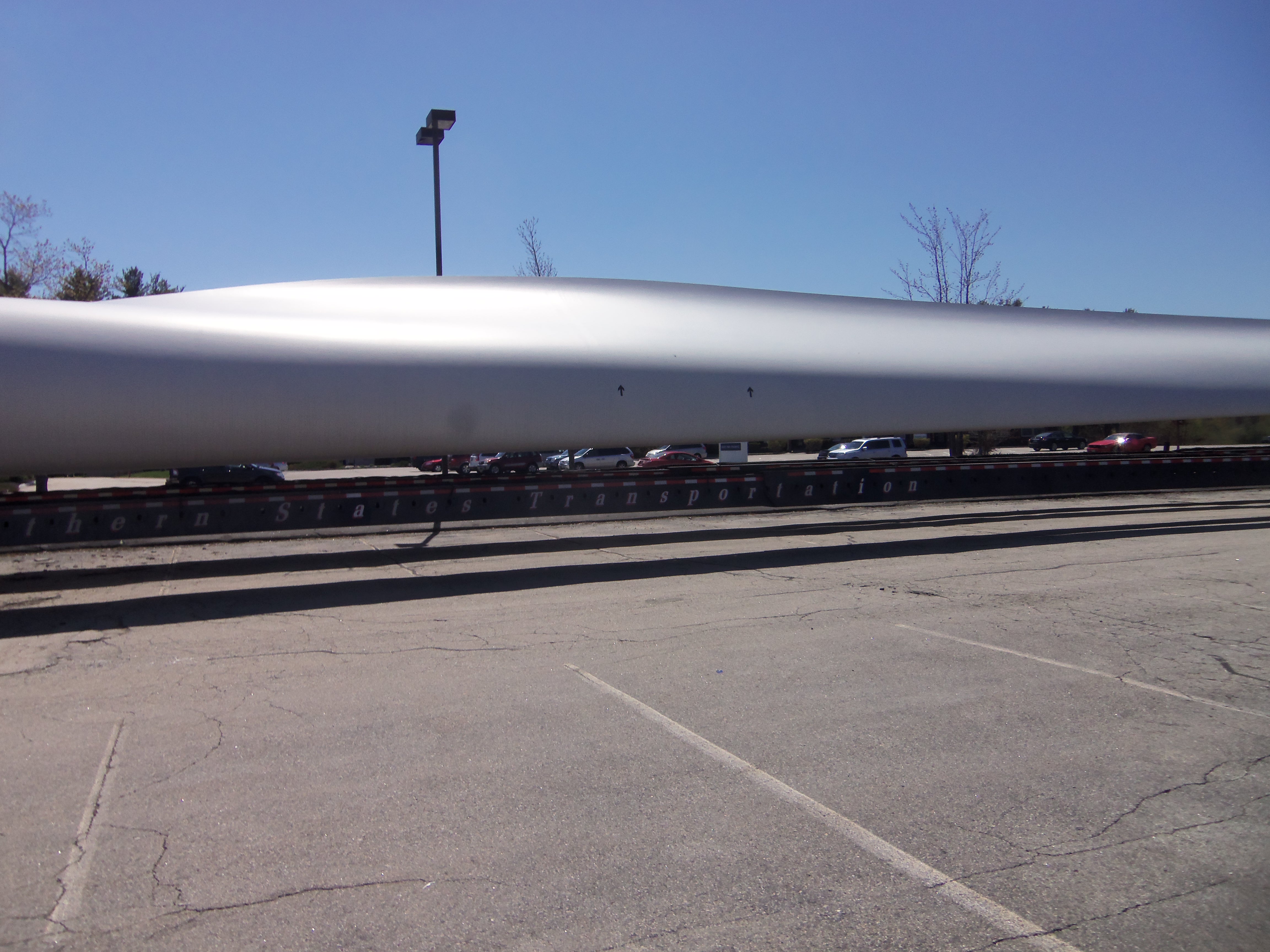
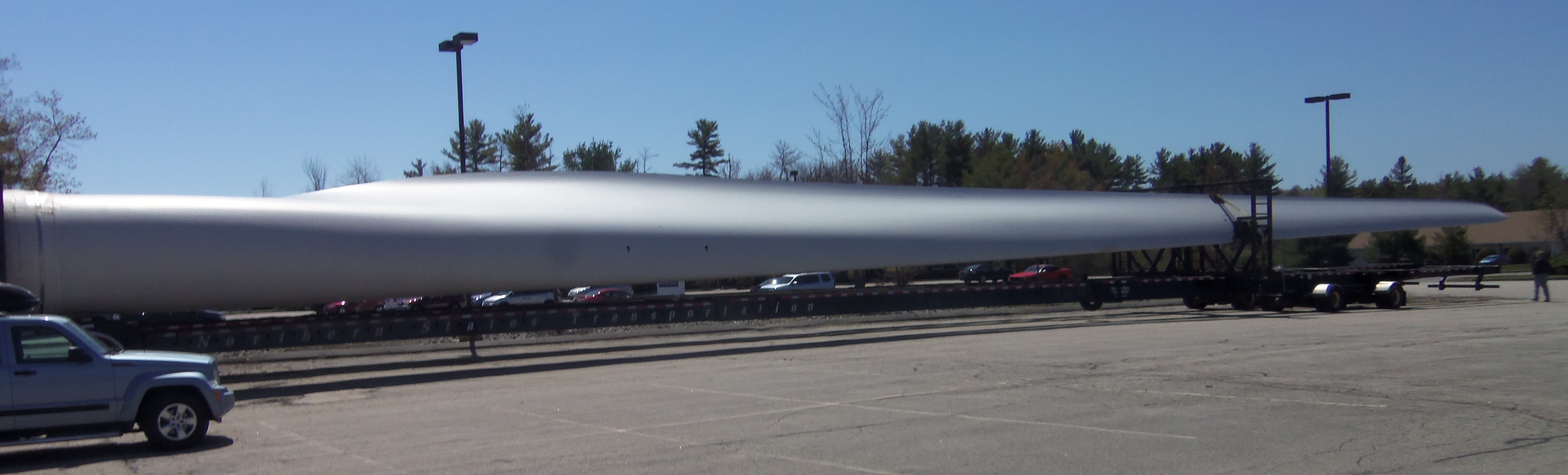
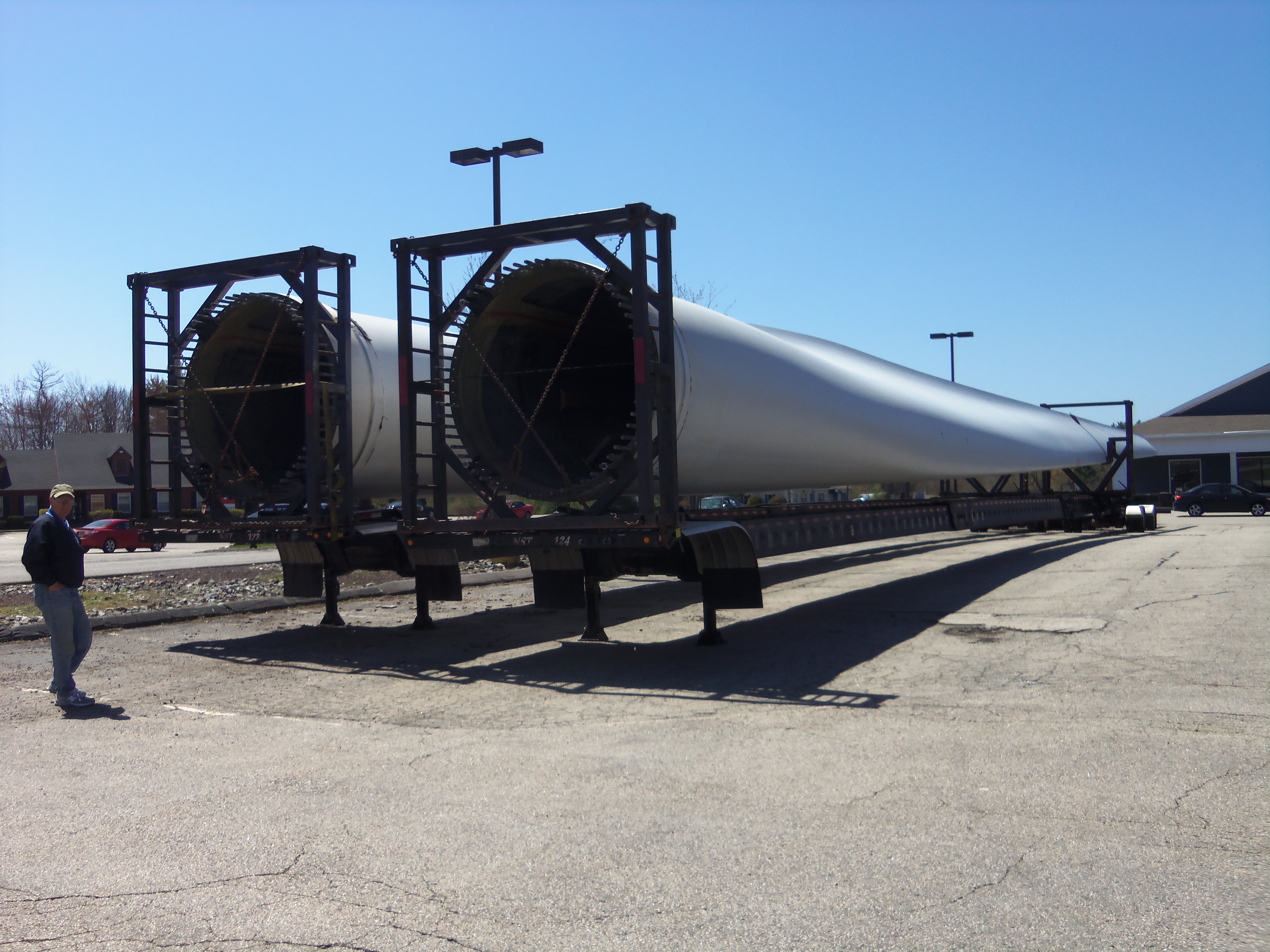
Several months ago, while driving on Interstate 95 to Boston, a remarkable view caught my eye. Headed in the opposite direction was a very long trailer, one at least three times longer than the usual tractor-trailer rigs. A few miles down the road, I glimpsed another. And then a third.

They were blades for wind-powered electrical generators being erected atop several ridges in Maine. Perhaps you’ve read some of the controversies erupting over proposals to build these “wind farms” in suitable locations across the country. But this was the first time I got an inkling to the size of each tower.

Earlier this month I came across two similar propellers, this time settled in a parking lot, no doubt waiting for a few more to join in a caravan. Even before being erected on a summit, they’re an amazing sight. Somehow, the gleaming sun on the metal reminds me of watching whales lolling in the ocean. Whales, you may recall, were the source of the oil used to illumine many homes in early America. They were another source of energy from New England.

100_8486

100_8490

Social status versus social value

You see the lists from time to time: America’s richest individuals or families.

You also see how proud people are about finding loopholes to cut their own taxes or lobbying for another advantage over the rest of the public.

Seems we’ve had it wrong. We should be according that respect to America’s top taxpayers. Yes, let them compete for the status of being the most generous Americans, the ones who step forward for their country. We could even break this out by occupation, for extra Top Ten lists. I’d even be in favor of having a monument in Washington inscribed with their names.

Let the rest of them be considered shirkers.

POSITIVE AND NEGATIVE POTLATCH

Among the coastal tribes of the Pacific Northwest was a custom known as the potlatch. Essentially, it was a way for the wealthiest members to enhance their status by redistributing the wealth downward. Starting with blankets and maybe a festive meal.

But then things got out of control. The way things do at a party when you forget about tomorrow, again.

Still, you first need to know everyone in the village and the fact it’s your home. Yes, the way families and neighbors just might function together.

Even so, remember. Maybe it was all Coyote’s fault, after all.

THE SHRINKING PAGE

l look down on the newspaper page and think how narrow it’s become – about half of the width of the pages I designed at the beginning of my career. The broadsheets of today are about the width of tabloids back when.

It’s all cost-saving measures, of course. Like the shrinking candy bar. Yes, I remember when the joke circulated, “It’s hard to find a nickel candy bar for a quarter these days.” Ditto, for the cola.

So we keep hearing the economists warning about inflation. Not a word, you notice, about the corresponding deflation of the product itself.

TOO BIG TO WHAT?

When you invest, even if it’s just for retirement, you’re told to diversify your risks.

Why is it, then, that it seems OK to keep having big corporations merge into less and less competition? During the Bush I and Bush II regimes, we saw what that meant for the banking industry: big bailouts on the taxpayers’ tab.

We were, after all, faced with another Great Depression.

Seems to me it would be far healthier to spread the risks here, too: break out into smaller companies – which would make more of them, too.

Along the way, there would be fewer layers of high management – and think of all the savings in executive pay along the way.

Those who advocate a free market need to remember: any company that’s too big to fail without taking down the rest of the economy is a threat. Period.

ON TURNING SIXTY … FIVE!

The milestone demands some acknowledgement, or at least a hard assessment of my life to date. To be honest, when I graduated from college, I hardly expected to survive past my mid-thirties, and the way things were going, maybe I wasn’t far off the mark. On the other hand, I never anticipated the turns this journey has taken.

For one thing, I rarely thought of journalism as my lifetime career, but rather as a steppingstone to something else. While the field could be exciting at times, getting caught up in the management side of the business took a toll, and the more recent downward spiral of the professional publishing industry in general is downright frightening.

I had envisioned myself either returning to my hometown and writing for a newspaper that no longer exists, or else working in the heart of a large metropolis with its range of concerts, galleries, lectures, and theater, possibly after going back for a law degree. Of course, neither way opened, but the ashram route did. And I, who started adulthood somewhere between agnostic and logical positivist, was now on a spiritual pathway that would lead me to Quaker practice.

As I look back on my adult life, the only thing that has made sense has been this spiritual evolution. Each of the geographic moves, ostensibly in pursuit of a career, actually introduced the next step in an expanding faith and practice. Now my generation is having to move into places once filled by the “mighty old oaks” who came before us – the most troubling aspect being that we are, all these years later, still the younger members of Meeting or, for that matter, much of literature and the fine arts.

The craft of writing has itself has taken its own curious twists within this; while the poetry and fiction have often arisen in the discipline of keeping my skills sharp in the face of the daily grind, and thus have often veered toward the “experimental” side of literature, they’ve also served as a tool for investigating the unfolding experience – something quite different from trying to “create” a poem or story. Examining a situation honestly and directly, rather than trying to be ironic, cute, entertaining, or ideologically correct, is one of the consequences; on the other hand, you’re constantly measured against some standard of innovation. It ain’t easy, balancing the two.

Nevertheless, I’ll confess to a lot of remaining frustration. All of the unfinished work before me, for instance, or the difficulty in achieving successful book-length publication, despite having more than a thousand poems and short stories published in literary journals, at this point, on five continents. On a more personal level, I could look at all of the social skills to be fostered, to say nothing of a round of grandparenting, should that happen.

Even so, as I told my wife a few months back, I have nearly everything I’ve wanted, though it resembles none of what I imagined. The crux here is in being receptive and grateful, which proves surprisingly elusive when we’re in the middle of the usual swirl.

*   *   *

This is something I wrote for myself at sixty. And here it is, with a few tweaks, five years later. Just as applicable.

ABOUT THAT ADVANTAGE

Where I live, you’ll often hear about the “New Hampshire Advantage,” which argues that the state’s economic growth is a consequence of its lack of income and sales taxes. Don’t get me wrong, I enjoy not paying extra at the store. But I also know that the sharp difference in my rent in Manchester, when I arrived, and what I was paying in Baltimore was caused by the property taxes here. When I added my Baltimore and Maryland income taxes to my rent there, it equaled what I was paying here. Voila! You’ll pay one way or another. The question is where and who bears the brunt of the cost.

The real New Hampshire Advantage is its proximity to Greater Boston and the economic powerhouses connected with the Harvard Business School and the Massachusetts Institute of Technology. Nearly half of the New Hampshire population that has a job commutes south each morning to workplaces across the border. The better-paying jobs, in fact. It’s largely a one-way flow, too. If lower taxes were a real stimulus, the entire Granite State would be booming, which is hardly the case in our economically depressed North Country or the Connecticut River’s Upper Valley. Just take a look around Berlin or Claremont and all their devastation.

Still, public services cost money, and the dynamic is that anything requiring labor is going to cost increasingly more. In economics, it’s called the Baumol effect, after a study of performing arts institutions.

New Hampshire is no exception. The real question is just where the additional state revenue will come from, and that always returns us to ill-fated proposals for an income or sales tax.

But complicating any income-tax discussion in the Granite State is the matter of reciprocity: normally, you pay a state income tax where you work rather than where you live. And normally, there are roughly equal numbers of workers commuting between two states to balance the equation. But that’s not the case in New Hampshire. So an income tax to lower property tax bills, as it’s usually framed, would mean either that the cross-border commuters would have to pay twice, both at the workplace and then at home, or that those folks who both live and work within the Granite State would have to subsidize the break given to the others.

It’s a genuine conundrum. Advantage? Beggar-thy-neighbor works only so long.