The poems in this rant aren’t in my usual voice, but they do address today’s political precipice, only from a slightly earlier historical perspective. And yes, that’s scary.
For this month only, I’m offering the ebook for free at Smashwords.com during its annual July sales sweep. What do you have to lose? Remember, it’s free.
Just go to my Jnana Hodson author page at Smashwords.com.
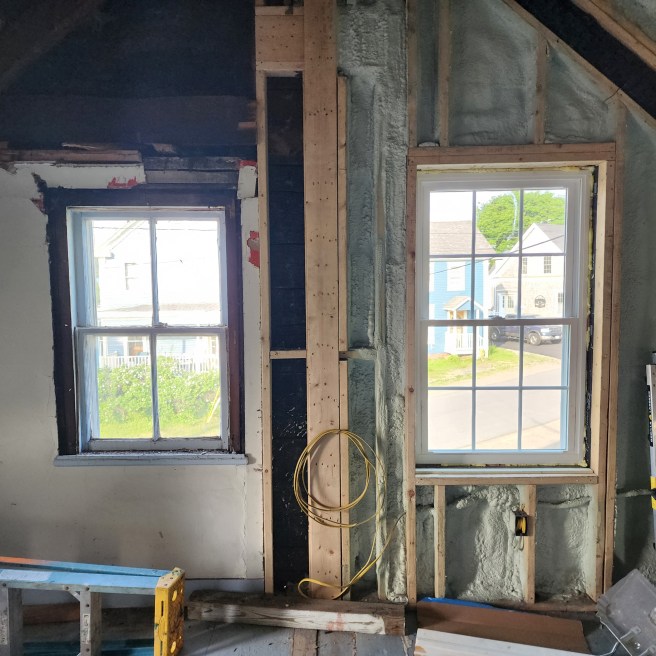
The new window, right, replaced a smaller one like the two-over-two at the left in the gable of our upstairs. The smaller one will soon be upgraded as well, and a closet will be inserted into the space between them to divide the bedrooms. The new double-hung sash windows match the ones downstairs in size. The amount of additional light and the enhanced views already amaze us.
The poems in this rant aren’t in my usual voice, but they do address today’s political precipice, only from a slightly earlier historical perspective. And yes, that’s scary.
For this month only, I’m offering the ebook for free at Smashwords.com during its annual July sales sweep. What do you have to lose? Remember, it’s free.
Just go my Jnana Hodson author page at Smashwords.
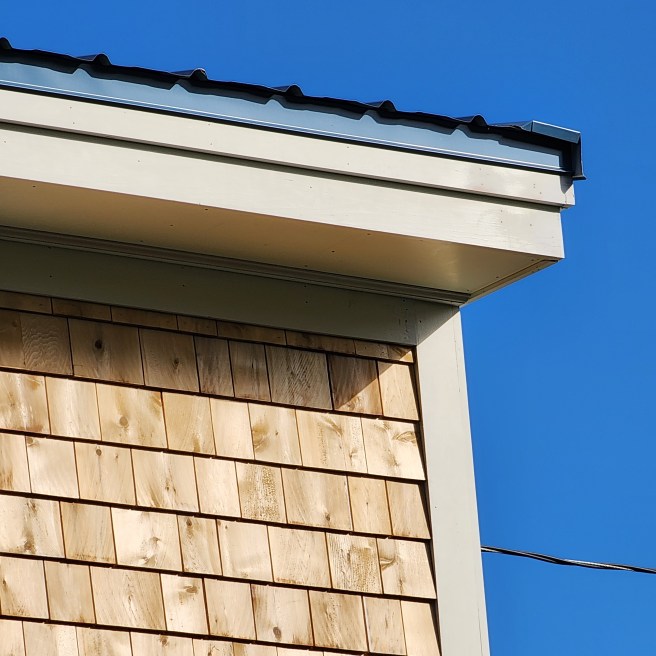
Looking up at the new roof’s overhang and fascia gives me a feeling of satisfaction. Far more labor, care, and skill went into these layers than I would have imagined. Our contractor is not one for shortcuts. He certainly intends for this dwelling to stand erect for another 200 years or more.
When it comes to the past few months on the house renovation, there hasn’t been much to show.
Our contractor has been trying to align the removal of the front half of the upstairs to some favorable (meaning dry) weather, and that has been tricky. Plus, he has to line up a crew to participate in the most labor-intensive steps.
The electrical work has been continuing details, ultimately leading to rewiring about everything, including the discovery that the house was not grounded – period. Well, that’s been fixed, and a temporary strip for the main line coming into the house has been installed in preparation for the removal of the front roofline itself.
Then there was some work for other clients, including a new metal roof for the neighbor who recommended him to us. We can’t begrudge him that. A few other jobs were essentially trades in time with the carpenter who has been assisting him here in the bigger stuff. You know, I help you on your projects and then you help me on mine. That makes sense, too.
Oh, yes, and he really did get a well-earned week of family vacation in South Carolina.
Now the scaffolding is in place around the front of the house, gutters have been removed, and other obstacles are cleared away. But the demolition phase had to be delayed a couple of weeks when he discovered that all the dumpsters around here have been reserved nearly a year for the vendors and related events at Eastport’s big Fourth of July and homecoming week festival. We are expecting the dumpster on the fifth or sixth or even the following Monday.
Well, that hiccup did create an opening to remove the rickety ramp and accompanying deck at our back door and to start an enlarged new deck and stairs there. Again, not much to show at the moment unless you want the beginning of a step-by-step instruction manual.
The plumber, meanwhile, has been off in Indiana supervising the piping installation in a new lithium factory. He’s back in town and promises to be on our project next week, to our big relief.
Still, it’s hard to believe we’re 30 weeks into this venture.
Somehow that rainbow seen through the scaffolding at the front of the house feels appropriate.
When Adam came downstairs with this, I felt it was validation for a bit of history I had just come across online.
This was the backside of a baseboard.
He does look like something of a space alien here, adding to the time machine impression. But a full dinner for $1.50 and up? That does seem surreal today.
The sign was one of several he had uncovered while removing baseboard upstairs. The writing had faced the wall. Yankees are notorious for frugality of the sort that wastes nothing, if possible.
I had just started researching the history of our house, starting with the property deed transactions at the courthouse in Machias. One of our predecessors had owned and operated a well-known restaurant. Her obituary also described her as an exacting carpenter, so here was a piece of evidence.
I’ll save her full story and those of the others for later in this series, but let’s just say, the house was beginning to look a lot older than we’d suspected when we bid on it.
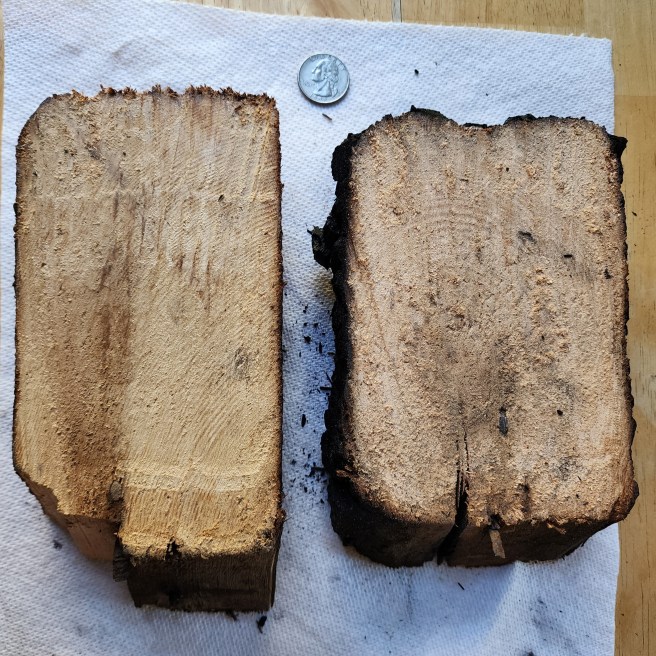
For example, hand-split oak lathing like this had gone out of use by 1830, or so we were told. This piece was extracted when carving out space for the toilet and bathtub.
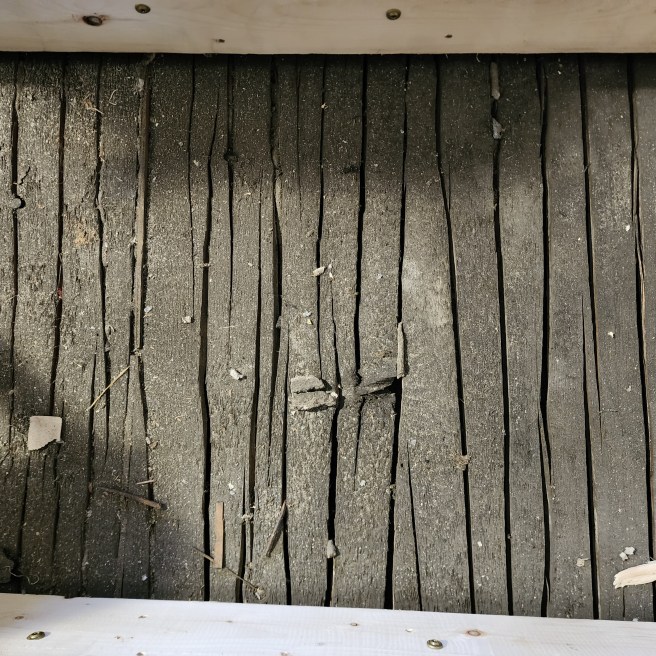
Hand-split oak lathing went out of usage by 1830, I’ve been told. Ours was also charred by a house fire, possibly one from a nearby chimney.
The burn marks on the underside of the flooring also suggested another serious house fire.
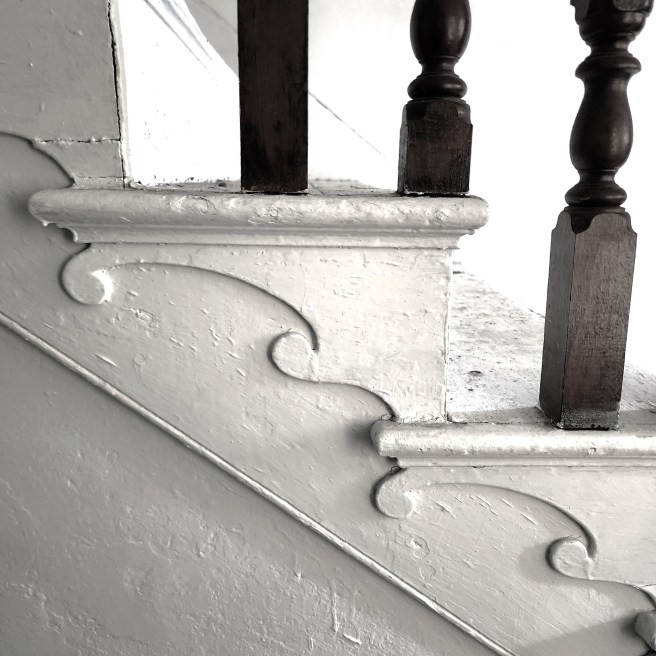
Another detail is the molding on the side of our stairs. The same pattern is found on other houses in town from the 1830s and 1840s.
I’m assuming this was from an update to the house.
And, from a technical point of view, ours wasn’t a post-and-beam house but rather timber framed, meaning wooden pegs held the big pieces together – and the weight of the structure didn’t come down the inside walls.
The old wood was denser, too, than what you’d buy today.
Any expectation of having the back half of the upstairs finished before starting on the front slowly faded from reality. We definitely wouldn’t be moving goods from downstairs or storage into the new space anytime soon.
Just look at the ridgepole and it was obvious Adam would need to have elbow room to work freely up while attaching the new rafters before any wall could go in.
The rafters and roofing to the right of the new ridge pole are about to come off. It’s a miracle they’ve stayed up as long as they have.
He did have to demolish the drywall and framing that had separated the front and back rooms, and with that came my realization that putting up new drywall any time before the entire upstairs was ready for that phase of work was premature. As would be painting the walls, ceilings, and floors. Duh!
Adam’s big shock came when he exposed the top of the existing dormer and found that there was nothing to speak of holding the descending rafter. What were they thinking?
The rafter was simply cut short when the dormer was added. The plank under it was insufficient for the weight sitting upon it.
It was one more impending disaster that had somehow kept ticking until being defused now.
~*~
The front half promised to be less complex than the previous section. There was no plumbing and only two rooms rather than four. On the other hand, the top of the stairs might add some complications.
Our project was envisioned by other family members and my being included in their dream felt, well, adventurous. They had some definite ideas and strong opinions but were also practical, frugal, and flexible. I would have been content to leave well enough alone, if only their thinking and style hadn’t continued to impress me as we marched forward.
Remember, these are my retirement years, unlike theirs. I’ve been downsizing and discovering how much I can live without. I had some big dreams in the previous move, and when they didn’t manifest, I refocused.
Look at all that extra room.
But then, as our new dwelling was stripped of half of its top half, a reality began to excite me: my bedroom and studio workspace were shaping up as something entirely new, tailored for me. I wouldn’t be trying to fit into some previously existing room but rather shaping one to my own preferences. I thought of windows that would allow more bookshelves and wall for artwork yet still flood the room in natural light. The ceiling would feel airy, even though one side would be lower than ideal for me – in this case, we’d make it play into the angle. There would be abundant electrical outlets, too.
No longer would I have a washing machine in one corner, but rather I would have a door between my bed and the household access to the bathroom. Yes, privacy! I would miss the proximity to the kitchen and my overhearing phone-call details of our shared daily life here – that room is the hub of life in our home – but I would also feel freer to dial up the opera when others were also in the house.
We had already agreed to keep the flooring rather rustic, more or less matching the existing planks, and the walls white, to enhance the natural light. That left window coverings and trim color for accents. I was leaning toward blue, especially indigo I associate with Japanese fabric.
The big question was just how much of my goods I could fit into the room and perhaps how much might go into the emerging guest room, the mirror-image at the other end of the hallway.
We’re keeping the charred rafter exposed, a souvenir of the downtown fire of 1886..
As we pondered the emerging space, we opted to go for cathedral ceilings rather than flat and later, as a quirky touch, to keep the charred rafters at either gable exposed when the drywall went up.
These two rooms were starting to feel more like nests, actually. Not that there’s anything wrong with that.
In our big renovation project, I kept returning to the criticism of architecture as “boxes with holes punched in them.” I think the objection was by master Ludwig Mies van der Rohe – and yet I also return to the rigidity of Frank Lloyd Wright, who left nowhere for a building to grow. His houses could be like living in a tomb, or at least a temple to his visionary and snake-oil-charmer ego. And here we were with a classic New England Cape undergoing a bid for survival in the 21st century.
Well, as Mies van der Rohe, a celebrated pioneering 20th century architect, also said, “God is in the details.” Nowhere, perhaps, is that more apparent than with windows. He created whole walls of them before that style became cliché. Besides, how else, do we admit natural light and its reflection on the passing seasons into our interior existences?
In coastal Maine, where we’re renovating our full Cape, discretion is more the rule, especially considering our frequently fierce winds off the ocean. As I’ve said earlier, we love the light in this house and, for that matter, the whole town that emerged after the American Revolution.
Even so, art as we know it now was nowhere in their conscious thinking.
A Cape is a relatively economical house, but it has some drawbacks. The upstairs is cramped, cold in winter, and stuffy in summer. As you’re seeing in this series, the necessity of replacing our roof covering disclosed some serious structural problems that would have required redress even if we weren’t intent on maximizing the usable space on the second floor.
This double-hung sash window is slightly bigger than the one it replaced, something that makes a world of difference in the view.
Now, for the window details.
Upstairs, we could have gone for the same-sized windows that we have downstairs, but the back half of our second floor – facing northwest – also presented additional considerations.
One was the relatively low height of the back wall – 82 inches, just shy of seven feet. The downstairs windows wouldn’t have fit the room quite same here as they did downstairs.
Another was the fact that in the two expanded bedrooms, I wanted to maximize the wall space. I had a lot of books and recordings coming out of storage, so shelving came at a premium. Above that, I was hoping for decent opportunities to display visual art. Eastport is an artists’ mecca, and the natural light is spectacular. Oh, let me apologize for being repetitive.
That led me to consider windows that are horizontally broad but vertically short. You know, a band, rather than a drop. The first ones I found are called transom or shed windows, but, as the details mentioned, they don’t open for ventilation. Eventually, I determined that awning windows would do the trick. You really do have to learn the vocabulary.
The existing gable-end windows would be replaced with larger on the size of the double-hung sashes downstairs. No problem. I’m actually amazed at the expanded view that creates, along with the boldness in contrast to the timid existing windows. Yeah, these look great, from inside and from the street.
The back interior corners, though, promised to be darker (that is, dismal) than I desired. A small diamond window – a common architectural touch around here – would be perfect – the only problem was that those panes would have to be custom-made, and we decided the additional cost wasn’t for us at this time. A small casement window in a conventional flat framing came in at a third of the price. Plus, it would open for additional ventilation.
I would have preferred continuing the awning windows across the back, but the two coconspirators in this project instead convinced me to use two smaller double-hung windows for the bathroom and laundry room.
I’m psyched to see how these parts play out.
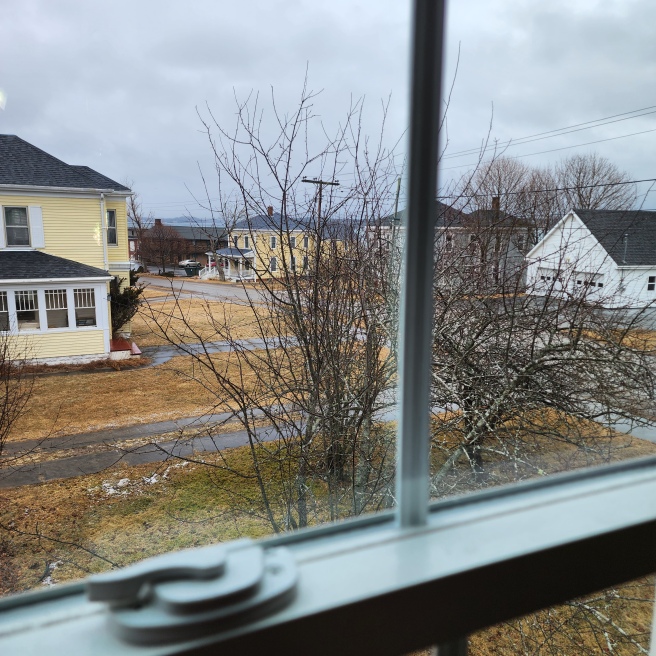
The view from the awning window was new to us. It does give you a sense of the village where we dwell.
~*~
The technical aspects of windows can be quite daunting. They could inform another post or more, but let’s skip that.
Our contractor expressed a preference for two brands – one nationally known, the other locally made and reasonably priced. We went with Mathews Brothers’ Spencer Walcott style.
As for sizes? Their lower-end style offers 134 standard sizes of double-hung windows alone. Beyond that, custom sizes are available.
The fun choice will the window that goes over the front doorway, but that was still off in the future.
~*~
By the way, I do love another Mies van der Rohe quote: “Architecture is a language. When you are very good, you get to be a poet.”
Seeing the detailed work going into our old house, I’m coming to see how they fit.







 Jnana's Red Barn