Some manmade problems will never go away

Bad decisions can have long-lasting consequences.

One here in Maine was the application of industrial sludge containing PFAS to nearby farmlands. At the time, it was touted as form of recycling. Today, you don’t dare drink water drawn from the wells.

The problem’s not unique to Maine.

Here’s the take.

  1. These ” perfluoroalkyl and polyfluoroalkyl substances,” more commonly known as “forever chemicals” or “forever pollutants,” have been around since the 1940s. As the nicknames suggest, they don’t break down naturally. They may take hundreds or even thousands of years to decompose.
  2. There are more than 9,000 known PFAS compounds, with 600 currently used in the U.S. in countless products to make them resistant to oil, heat, stain, or water.
  3. They’re found in everything from cosmetics and outdoor gear to firefighting foam and carpet treatments to non-stick pans and other cookware to dental floss and food wrappers and even fast food.
  4. They’re found in water, the ground, the air, the ocean floor, wildlife, and the human body.
  5. In humans, they’re seen leading to higher risk for kidney or testicular cancer, increased cholesterol levels, higher blood pressure, high cholesterol, thyroid disease, pregnancy-induced preeclampsia, and damage to the liver and immune system.
  6. The Department of Defense has allocated $1.5 billion for cleanup at its sites around the country.
  7. PFAS have been reported in thousands of private wells near military facilities, while a recent report concludes that they’re likely found in the most of the public water Americans drink. Other studies report slightly lower rates.
  8. Researchers are searching for ways to filter them out of the water supplies, but that leads to another problem: What do you do with the stuff left behind in the filter? It won’t go away.
  9. Incinerating it has similar risks. Breaking up the longer strands can result in shorter strands, that would then pollute the air, soil, and water. And some, like Teflon, can withstand temperatures of 500 degrees Fahrenheit.
  10. The use of ultraviolet radiation and possibly microbes to break down the substances is emerging as an affordable glimmer of hope.

Sometimes this recalls a recurring and troubling dream

The dream itself isn’t so uncommon, or so I’m told.

In my case, it involves trying to go somewhere or finish a project, as in meeting a deadline, except that interruptions and complications keep popping up.

Quite simply, like Zeno’s Paradox in philosophy, the finish line becomes more and more elusive and then impossible to cross. You can never get all the way there.

So that’s how I sometimes feel looking all that remains to be done on this old-house project, even before I confess to myself that I don’t even know about many of the other items on the list.

List? Where is it? Which one?

Let’s not get too giddy yet

Having the upstairs buttoned up was our original goal.

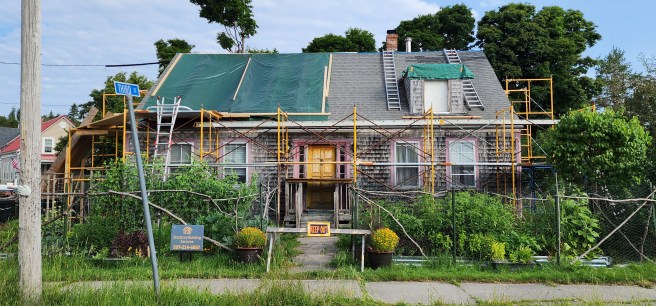
People on the street can now see our intentions.

The roof is securely covered and we’ve gained more than 400 square feet of usable floor space. (Let’s see, with new home construction averaging $153 a square foot, according to a recent New York Times story, that would cost a bit over $40,000. Renovation, as we’re finding, can run well beyond that. I won’t say how much.)

We’re far from finished, I hate to confess. The front interior still needs to be framed, wired, and spray-foam insulated. Dry wall needs to go up and be painted, the new bathroom and laundry room plumbing fixtures installed, and something done with the flooring. We’re willing to keep the last item on the funky side as a historical touch. We’re still not sure about heating the space, either, though we’ve already found it has been comfortably warmed from downstairs, and perhaps we’ll hold off on a washer and dryer.

As for gutters? There’s more.

Downstairs, we’re looking at replacing the windows – 13 or 14, depending – and the front and back doors. Bigger is a kitchen redo, plus the tiny bathroom. And that leaves the back parlor to be tweaked into a combination dining and crafts room.

As for my remaining life’s savings? We have some difficult discussions ahead.

Touching up the chimney and foundation

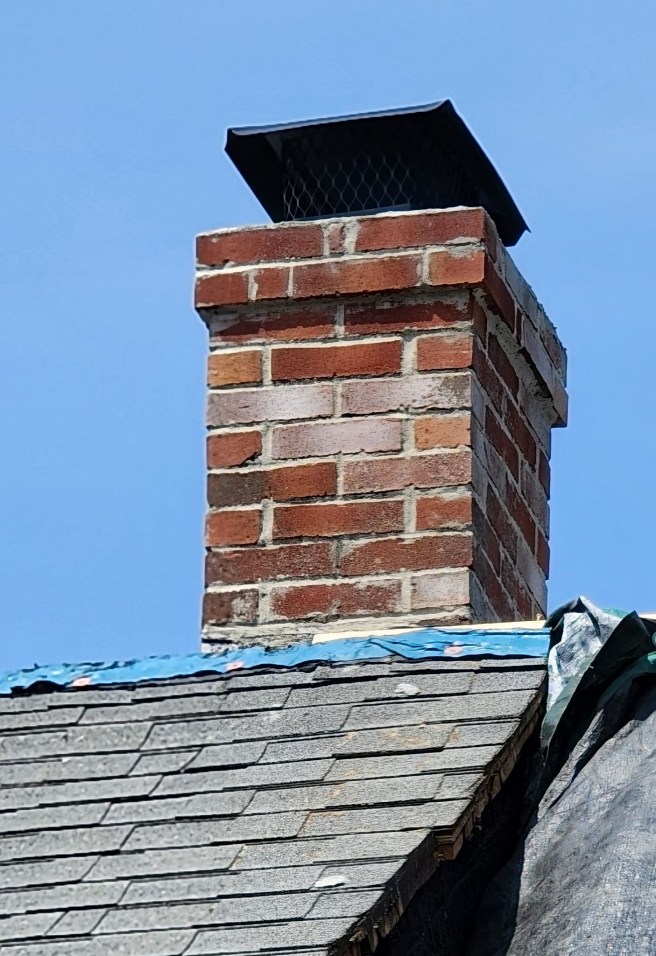
As all of the activity was picking up overhead, a mason our contractor had contacted earlier in the season showed up to touch up the top of our chimney and add a protective cap.

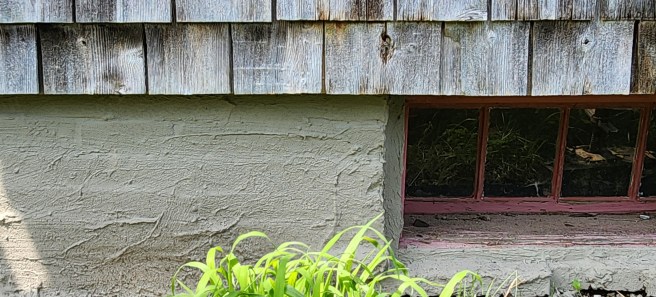
While Jason was at it, the exterior of the foundation could finally get some attention – the foundation itself was in good shape, thank you, despite the appearance from the sidewalk, but the housing inspector we had when bidding on the property suggested this as “something to do down the road.”

And it turned out, Jason the mason and his sidekick, Roger, could also relocate our new wood stove and its metal chimney to the corner of the front parlor. I was outvoted on that one (I hate taking steps backward) but will concede that the position will be safer and the flue will have a straighter shot to the sky, meaning less creosote buildup.

The chimney wound up needing a rebuild from the roofline up, but the results look great.

The foundation, meanwhile, got more than new mortar and concrete – it got a coating of Flex-Coat, too, which covered up the pink paint we had planned to replace anyway.

We had considered blue or perhaps gray as the new color, but seeing the gray in place sealed our decision. Somehow, it makes the place look more solid.

We do feel reassured seeing craftsmen who take pride in doing good work, and that includes taking extra steps on details joyfully.

Our new upstairs front half takes shape

Do we need say how excited we’re feeling?

Let’s look at the continuing progress from the inside.

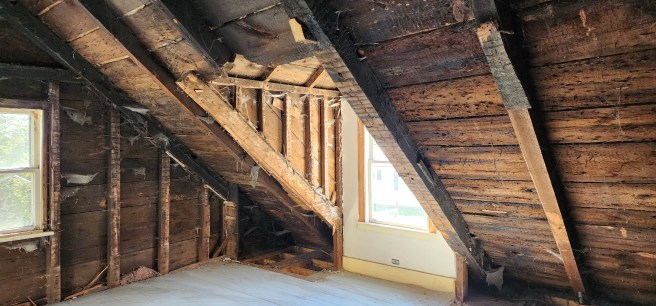
The northern half of our front upstairs with the small dormer still in place but the ceiling already gone.
And then with the plaster, lathing, and drywall gone.
We finally got to see what was between the stairwell and front. No hidden treasures or bodies, as it turned out. But we could finally see from one of the front bedrooms to the other.
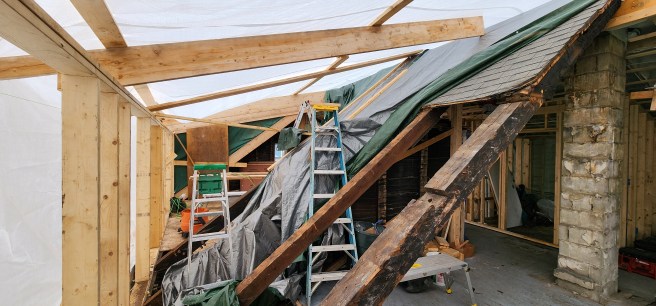
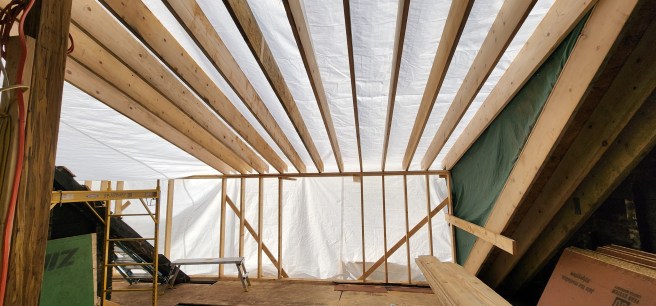
A spate of wet weather presented a challenge on how to proceed with the “dustpan” dormer that was replacing the old roof line. The answer was by working under a large white tarp. Here you can see a new rafter going into place atop the new front exterior wall. The final old rafters and last bit of asphalt roofing are about to removed.
Here the new rafters are in place under the white tarp. Compare this in the south front bedroom to the first photo in this series.
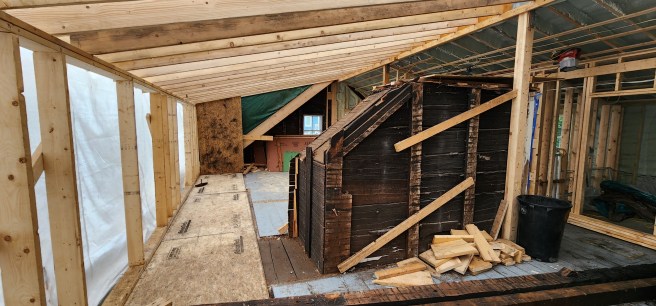
The front upstairs interior stands free of obstruction apart from the old shell around the stairwell.

Next steps will be the roofing, foam insulation, windows, siding, trim, and flooring.

Can this really be happening?

Considering historical accuracy, too  

The two small dormers in the front bedroom were more of a pain to remove than you’d expect. That part was labor intensive, and they weren’t even braced to handle the weight load of the rafters above them. No, those had merely been sawed off. We have no idea how the heavy slate roofing that came later didn’t crush everything beneath it. (I’ll save that history for later.)

The dormers apparently weren’t added until after 1850, anyway. (Again, an explanation that can wait for later.)

The cedar-shake siding came even later, maybe the early 1990s. For a while before that, it was green asphalt siding. Yes, like what you might see on a roof.

The house color by 1830 was yellow, though we haven’t yet found any evidence of that.

All of that gives us more leeway for redesign, no?

With the front of the house, we’re keeping the outermost panels of the original roofline in recognition of the Cape Cod style. In the renovation, though, we still needed to upgrade the support beneath them, even before replacing the roof covering.

The dormers, by the way, were not identically distanced from the ends of the house. There was a half-foot or so difference. Did they not have tape measures? Make that yardsticks?

The single, big dormer will be a dramatic change, inside and out.

Here it comes!

Away she goes, Act 2

Removing the old asphalt roofing and underlying sheathing and replacing them with standing-seam metal roofing promised to be an encore act of last fall’s drive on the back half of the house. A dustpan, or shed, dormer, connecting what had been two small dormers would be the biggest design difference.

This time the work would be in full view on a central pedestrian-friendly thoroughfare. By now, the renovation is a widespread topic of conversation, year-round residents and summer people alike. Yes, one more aspect of small-town living.

Once again, new rafters would replace the old ones, many of them charred in the 1886 downtown fire as well as a later chimney fire or two. And the new 2-by-12s would be more numerous than the old 3-by-4, 4-by-5, and 5-by-6 beams they were replacing. They would also be up to building code rather than sporadically placed. Better yet, they would be solidly joined to a ridge pole and the four central structural support columns our contractor had inserted last fall. Earlier episodes of this series discuss the intricate work of getting those significant details into place.

Once underway, this phase turned into something more than a quick encore. Removing the two dormers had its own complications, and then a series of rainy day forecasts prompted Adam to concentrate on the south end first rather than the full roof in one sweep.

Further complications came in finding the sheathing was doubled, unlike the back, and a desire to salvage as much of the timber as possible. Some folks in this project are hoping to make a dining room table or some such to recognize the home’s heritage.

Our thinking about this project has definitely changed. Adam is really rebuilding the top half of our house, not merely remodeling it. We’re most impressed. Technically, it’s still post-and-beam aka timber framed.

Would I have gone along with all this if I had known about all this at the outset?

We really didn’t have much choice. As we’ve been discovering, there was so much trouble just waiting to happen. Fortuitously, we’re addressing it all proactively rather than in a panic after an overhead disaster.

We’re no longer tempting fate, are we?

Reshuffling the deck   

The unexpected complication of discovering that all of the dumpsters in town were tied up until after the big Fourth of July events forced our contractor to delay the demolition of the front half of our upstairs. Our attention turned instead to the back of the house, where a wheelchair-ramp and small deck were seriously deteriorating. Think of it as a safety issue.

The project would fit into the interim.

Unlike a previous owner, we didn’t need the ramp. Basic stairs would do in their place, and that would free up more of our small yard. The existing deck, meanwhile, was too small for our needs, and my coconspirators already had dreamed up designs that included a ground-level apron. For now, we would focus on the upper level just outside the mud room door.

The old deck top and ramp walkway were deposited at the far side of the backyard, where they will serve as a platform for stacking our next firewood delivery, keeping the split wood off the soil itself.

The deck structure itself became more involved than I had imagined. This house renovation is, after all, a vast education for me.

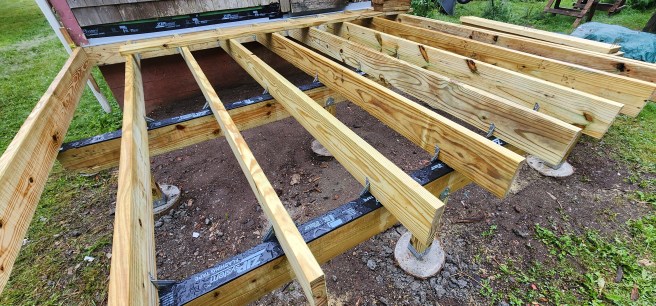
For starters, the new concrete footers were more deeper than the amateur ones and large rocks previously used. Three feet rather than a foot max. No wonder the deck was sagging. I wasn’t surprised there, but I was definitely impressed by seeing the new ones done right.

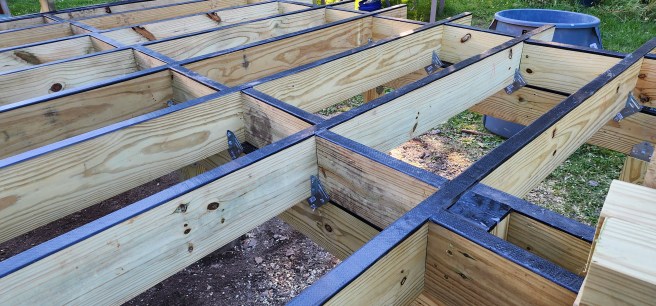
The underpinnings for the new top were another matter. No 2x4s or X-bracing this time. I wondered if Adam was overbuilding this, but he assured me this was according to code and would support a roof, if we decided at some point in the future to turn this into a screened-in porch. OK, I’m on board.

Carpentry really is about building boxes, as I once heard. The framing above became the rigid system below, awaiting the deck top and railing.

The results so far really are redefining our backyard and its uses. Dining out there without having to consider those nasty fire red ants under your chair is a definite step forward.


As a counterpoint to the political conventions

The poems in this rant aren’t in my usual voice, but they do address today’s political precipice, only from a slightly earlier historical perspective. And yes, that’s scary.

For this month only, I’m offering the ebook for free at Smashwords.com during its annual July sales sweep. What do you have to lose? Remember, it’s free.

Just go to my Jnana Hodson author page at Smashwords.com.


A few more inches each way add up

The new window, right, replaced a smaller one like the two-over-two at the left in the gable of our upstairs. The smaller one will soon be upgraded as well, and a closet will be inserted into the space between them to divide the bedrooms. The new double-hung sash windows match the ones downstairs in size. The amount of additional light and the enhanced views already amaze us.