Why you don’t get bids with a binding contract

That’s also a warning if you do find a contractor who will present one on a project like ours.

Experienced tradesmen should know there are too many surprises when you’re dealing with an old house. The only way for them to come out ahead with that factor is by cutting corners or – as often happens – ghosting the client altogether.

Doing the job right, on the other hand, takes the amount of time it demands.

There’s an artistry in working with an existing old house.

~*~

That said, you better be prepared to deal with the expenses that do come up.

On our contractor’s end, when I look at all of the tools and equipment that’s been parked in our house, I’m surprised he’s making any money on this project. Much of his gear is very pricy, and we don’t even see the hidden costs, like insurance.

Dealing a new deck, just for fun

While awaiting the delivery of the windows for the front upstairs – once we had definitely decided on their size and placement – Adam turned to one of our optional side projects, redoing the back deck.

The ramp leading to it was becoming a safety hazard, and the existing deck was tiny and sinking.

The replacement and steps are a huge advance.

The windows arrived, and that put a hold on the bigger plan, for a lower deck on two sides below. It would be one way to keep Eastport’s red ants at bay when we’re dining outdoors, as well as less lawn to mow. Pluses on both counts, right?

Would Adam get back to it before the ground froze? We were facing a time crunch, and the interior was the priority, followed by the cedar shake siding.

~*~

Coincidentally, we found a mason who was able to get to repairing the top of our chimney – it really was in precarious shape – and touching up the exterior of our foundation. We wound up with a layer of supporting cover compound, too.

Our plumber had also installed three outdoor spigots and removed the one we previously had. It was leaking badly anyway and was on the side of the house where it was least useful.

Progress was taking place, just not always of the most noticeable sort.

We did revise the design while underway

Maybe it was a good thing that we didn’t have too much detail in the CAD design we ordered from a local lumberyard. Initially, that was a miscommunication between our contractor and us, plus a looming deadline for a building permit.

The upshot was that as we watched the space open, our vision transformed. We saw new possibilities.

The first big one opted for cathedral ceilings in the four bedrooms. No big problem, said Adam.

Also, we wanted to leave the charred exterior rafters visible in the two back bedrooms. They were evidence of the 1886 downtown fire that started on the waterfront just below our house. They also reflect the original roofline, which we had now raised. And they were dramatic.

Alas, once we realized how labor-intensive (i.e., costly) keeping that touch visible would be, we opted to forgo it.

In another change, the windows in the bathroom and laundry room went from transom-style to narrow vertical.

The ceiling in the upstairs hallway was originally going to be flat, but we liked the feel of having it follow the roofline. Classy.

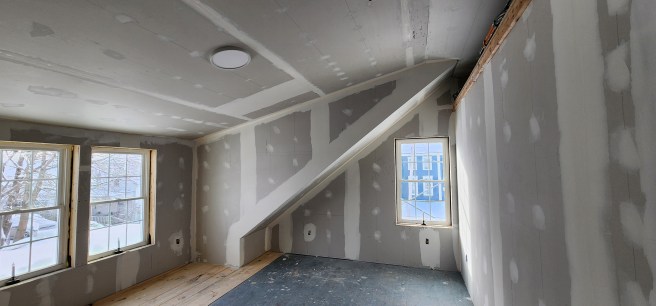
In the two front bedrooms, the width of the two side roofline panels was halved when we saw how much the original, aligned to the old dormers, really confined the rooms. The purpose of the panels was to keep a sense of the original profile of the house as seen from the street.  What we wound up with does the job.

Note the way the loft over the neighboring closet makes the ceiling look even airier. The slope of the original Cape roof doesn’t run bluntly into that wall.

After that, the windows in the front two bedrooms went from spaced apart to being placed together, centered between the two pairs of windows below.

And there were some big tweaks in closet arrangements between bedrooms. The two smaller bedrooms got larger closets while the two bigger bedrooms got open loft above those.

As I’ve said, none of the bedrooms wound up looking like rectangular boxes with holes for windows punched in.

We did encounter so many unanticipated details. Things like molding, the placement of light switches, even the door latches – you usually open them with your right hand, it turns out. I’d never thought about it. How about you?

~*~

Did we see things an architect wouldn’t? I like to think so.

Watching the rooms take shape was especially exciting

There were moments when we wondered about leaving all of that space open – just one big room. Maybe something like an artsy loft apartment. But then we returned to our projected needs and the plan at hand.

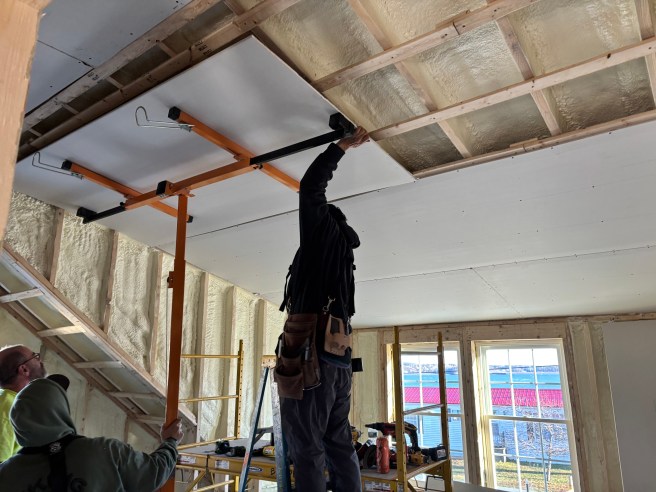
As the framing and wiring and flooring moved along, as well as the drywall itself, our hopes of painting the interior in the weeks between Thanksgiving and Christmas got pushed back till after New Year’s. Still, we were able to sleep some of our visiting family up there in primitive conditions as the drywall taping and mudding dried, thanks to a flurry of action just before Christmas.

The two front bedrooms are nearly twice as large as ones in the back. No surprise there, since the back half also has a small hallway and the bathroom and the laundry room.

Altogether, we have twice as many electrical outlets up there than we do on the first floor. And twice as much natural light.

As for the views? Sometimes breathtaking.

The good news is that the upper level, which prompted all of this work and expense to date, is largely complete.

Yay! Yes, Phase One is in place. The part that demanded we do something, or at least have it done.

~*~

Not surprisingly, this first phase cost about three times what we budgeted and took at least three times as long as we planned. Sadly, it is a rule of thumb in these undertakings. We have arranged refinancing to assure the work will be finished in the months ahead while we have our beloved contractor, rather than trying to reschedule later, but other projects we intended were reconsidered.

Working solo, as many of the carpenters do around here, meant our contractor was moving along at a slower pace. The good news came in the appearance of an enthusiastic apprentice two or three days a week, along with a helper as needed.

Immediately ahead of us was painting the ceiling, walls, and floors and then moving our stuff out of storage and up from downstairs.

In the coming weeks, we’ll be looking at specific areas of the work inside.

At this point, we did take time to review our budget and resources, and consider modifying our direction as needed. Just getting the upstairs under control was a huge relief and accomplishment, one much larger than I had anticipated.

~*~

The most maddening item involved moving the wood-burning stove from one corner of the front parlor (aka living room) to another. It made sense for several reasons, safety for one, but also straightening out the stainless-steel chimney pipe to allow for more room in the kitchen and bedrooms above. Getting a subcontractor back to finish the job was another matter, one not uncommon problem around here, as we’re finding.

That stove is an important factor for us when it comes to the frequent electrical outages in Maine, at least in all but the summer months. And it is a major improvement in heating the house through our cold winters.

Maybe if we had decided on the emergency generator back when?

There are tradeoffs, after all.

As for the placement of electrical light switches or which way the doors opened?

Right-handed or left? Have you ever considered that? You just reach and hope, right?

~*~

We were far from finished, of course. The kitchen remained a priority, along with the adjoining mudroom. And the downstairs windows, with all of their rotting, did need to be replaced. The small downstairs bathroom and tweaks to the other rooms could, if necessary, be put on hold. Not that we’d prefer.

In the bigger picture, we’re hoping the extensive renovation of our old house assures its continuance for another 200 years or more.

A surge of activity after seemingly nothingness

In the renovation, we had periods were seemingly nothing was happening but then, BLAM!, things suddenly moved on all fronts.

This was especially true when we were at the mercy of other tradesmen and their schedules – plumbers, high on the list.

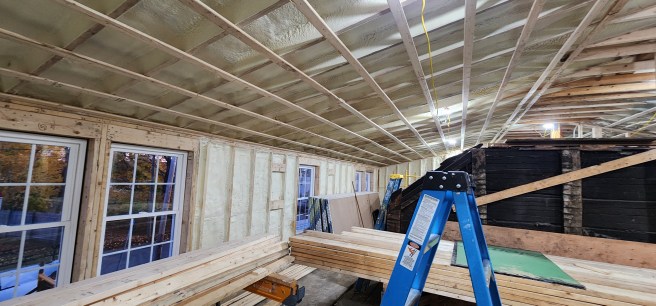
One of those involved the crew that would do the sprayed foam insulation on the front half upstairs. We decided to go with a different company than the one that had done the back, in part because the new one got back to us with a bid promptly, unlike the other. Not only that, they could get to work for us sooner than later.

That did put some pressure on Adam to get the electrical wiring and outlets in the framing before the crew showed up, so it was crunch time there.

But then the electrical panel in the basement blew out.

We were without power going into the weekend. And without heat.

Adam did have an amazing storage battery that we plugged the refrigerator into while he patched the old system.

As he said, the only thing holding the panel together was rust and spider webs.

This came only months after he had rewired the pretty much the whole house, everything but the panel and circuit-breaker box. They were scheduled for later.

And then, the whole town lost power for a few hours, all just before the weekend and the foam-spray guys on Monday.

As a further complication, we had to be out of the house for 24-hours after the foam application. We got a two-night reservation near West Quoddy State Park, in a delightful cabin overlooking Lubec Channel and all the way up to a corner of Eastport. We were so close to home and yet a world away.

The bad news came when we determined the extent of damage done by the power surge. Four of our surge protectors were fried, as was the outlet to our washer (for a while, we thought it was gone), and then a unit in our furnace was also kaput – requiring a night call for service.

It was quite a whirlwind for us.

That sprayed-in foam insulation also covers the wiring. It’s amazing.

We still needed a new electrical panel and, while they were at it, a new circuit-breaker box, too. Adam called in some allies to tackle that, and they got to us quicker than usual. The problem was getting the electric company to come promptly to cut off the power to the house and restore it.

Whew, it did happen, though the utility forgot to include a ladder with the first truck it sent out.

~*~

Perhaps this is the time to explain why we passed on the Generac backup when we moved to town. You might get a charge out of this.

Most of us, at least in the industrialized world, take reliable electrical wiring for granted. An old house, especially if you’re updating it, can remind you otherwise.

I’ve already mentioned the hot topic that Maine is prone to widespread electrical power outages. The state does have some arcane accounting details that likely abate the problem, but I’ll spare you the common rants about our utility companies and their higher-than-average rates.

One upshot is that many houses around here have emergency generators emplaced to kick in at the outbreak of an outage. Sometimes we hear that before we realize our lights and other conveniences are out.

We nearly got one ourselves, despite the high price. The tripping point turned out to be where to put the unit itself, its concrete pad etc., but especially the propane tank – a much bigger one than we thought necessary. The only viable site in our yard was in the heart of our best full sunlight, a spot we deemed more valuable as a future garden bed.

That didn’t rule out a smaller portable Honda generator in the future, though it wouldn’t go into service automatically and requires attention for the duration of an outage.

Better yet, the portable battery Adam lent us looked like the ideal solution for us, especially after we found one on sale.

We’re thinking between that and our wood stove we can ride out the typical outage.

We’ll see.

The upstairs front half wasn’t nearly the snap we expected

Now, to update you on much of the demolition and rebuilding that transpired while we engaged in uncovering the history of our old house. Or as I can now say with confidence, our historic house. I do hope you enjoyed reading those findings.

While I’m confident we do not have ghosts in our crannies, unlike some of our neighbors in theirs, I can say that after learning of the families who previously resided here, I am conscious of the earlier residents’ imprints. Our is not just any old house, then, but a manifestation of Eastport itself. I do wonder how the parade of earlier inhabitants would react to what we’re doing to the home. The few still living whom I’ve spoken with have been encouraging. And Anna M. Baskerville is, I hope, smiling over all of it.

My biggest lesson to date is that ours is an ongoing project, a work-in-progress, far from finished much less ever perfect. Still, we keep trying to come a bit closer to that ideal.

~*~

As we entered 2024, we still had the front half of the upstairs to rip away and enlarge.

The biggest hurdle was already behind us — the insertion of the ridgepole the length of the roof and the four supporting columns. It was needed to hold up the old front rafters until they were replaced, and needed afterward, as well. The new front rafters would connect to it.

This round promised to be a piece of cake in comparison to what came before. There would be no plumbing to contend with.

We now knew how the roofing would come off, as well as the way that removing the knee walls would extend the wall of the new dustpan dormer out further than the two small dormers that were becoming history. Also, the color of the new metal roofing was already decided.

We even knew the brand and style of the windows.

If only it went that easily.

~*~

We anticipated resuming full-force in the spring, but it was closer to the beginning of summer. Our contractor had a few earlier commitments to follow up on, for one thing, and then rainy weather forecasts set us back, for another, as well as health issues for our hardworking contractor.

And then those little dormers turned out to be far more complicated than expected. When they were added, apparently sometime after 1850, the rafters above them were simply severed, with no structural support. Adam was appalled. What were they thinking? How did it ever hold up, especially once a slate roof was added?

Weather didn’t cooperate, either. And then when all the debris would have been generated, we couldn’t get a dumpster – turns out they get booked out a year ahead around here for the town’s big Fourth of July festivities. Who’d a thunk?

And there were other delays.

Our plumber, for one, wound up on a big project out in Indiana and then another in Seattle. He promised to be back.

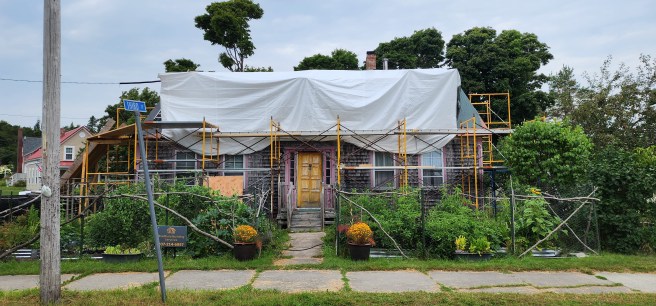
Some people thought we staged this as a theatrical statement, but the big tarp was a desperation replacement for several smaller ones – and it, too, got torn up in some fierce weather. We had some water “raining” in the two front parlors, despite the best efforts otherwise.

The roofing, eaves, window framing, new electrical lines, and spray-foam insulation all took time.

And there was the delay when the electrical panel in the cellar blew out and had to be replaced, along with the circuit-breaker box.

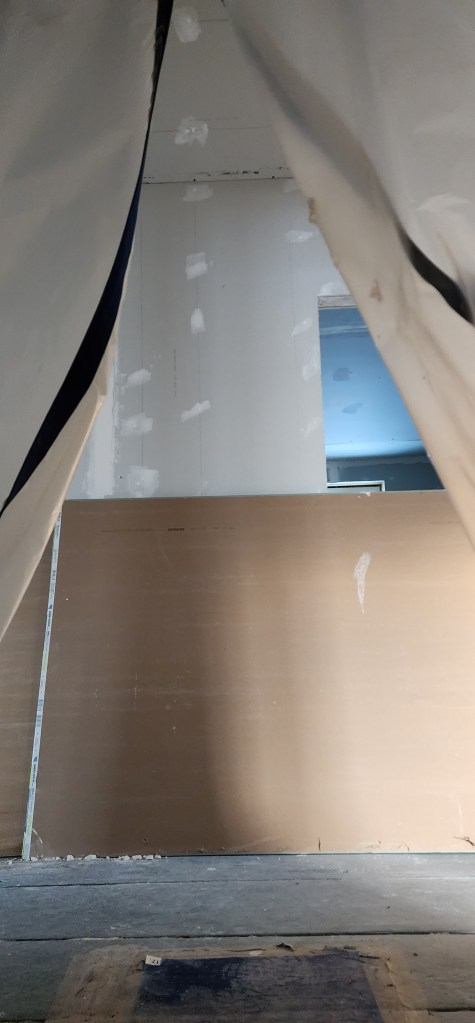
The upshot was that the front upstairs wasn’t buttoned up until Halloween, a bit over a year after we set forth, and then interior framed and drywalled finished just before Christmas.

Many people told us that was moving quickly by Eastport standards.

Uh-huh.

It has been an adventure, one that fluctuates wildly between elation and despair.

If you’re dreaming of  a vacation in Maine, please consider …

The weather can be iffy, even in summer. Your week by the beach may be mostly rain and or fog. Plan accordingly. There’s nothing wrong with hunkering down with a good novel when you’re away from everyday distractions.

Where I live the ocean is too cold for swimming. Period. Even before factoring for the currents. Further south and west, this can be iffy.

Black flies. They’re early summer, to mid-July. Inland, especially. You’ve been warned. They’re even worse than swarms of mosquitoes.

As for your expectations? A more laid-back lifestyle perhaps with antiquing is one thing. If you have kids in tow? That’s another. Hope they enjoy the outdoors.

If you go for a whale-watch anywhere, what you wind up seeing is what you are given that day. The best part may be simply the cruise out and back from the prime ocean. There are no other guarantees.

In many destination locations, retailers are faced with a six-week business model. Restaurants, lodgings,  and stores have to cover most of their year’s expenses in those few intense weeks and then hold on through the rest of the year, if they stay open at all. Prices will be higher than you might like.

Nightlife may very well mean looking at stars.

Price check alert

He promised lower prices. Here are ten you can bet will go up because of his promise of “lower taxes.”

  • Fuel. As in gasoline, diesel, and home heating oil. We pump and refine some in the United States, but not nearly enough to meet demand. When demand outstrips supply, as basic economics theory contends, prices go up. It’s part of what’s ironically known as a free market.
  • Coffee and tea. Imported and subject to new, stiff tariffs.
  • Vanilla. Ditto. Along with a lot of other spices and flavorings.
  • Chocolate. The beans are imported, as are some chocolate products. If you were considering cocoa as your new beverage of choice, think again.
  • Olives. Yes, we raise some, mostly California, but the U.S. is not in the top five olive-growing countries. Spain and Italy top that list. As for olive oil, which many fine cooks consider essential and which nutritionists tout as healthy? There will be suffering.
  •  Cars, SUVs, trucks, and parts. It’s a complex picture, but you can’t build new factories and hire and train workers overnight.
  • Electronics. Ditto.
  • Clothing. Check those labels. As for building factories and hiring and training workers? Once again, it won’t happen overnight.
  • Wine and spirits. Yes, we make these in the USA, too, but imports are major. There are no substitutes when it comes to discriminating tastes. And here’s another case of demand outstripping supply in a so-called free market.
  • Bananas. Most of them come from plantations in countries formerly controlled by American owners. You know, banana republics.

One place prices seem to be going down is stocks.

And do I have a deal for you!

Today, for many Americans, is defined as After-Christmas Sales rife with “big savings.”

The one I’m opening to you is even free.

Smashword’s annual Year-End ebook bonanza is into its second – and final – week, and I’m offering you five of my novels at no cost. Pick one or all or something in-between. They’re all different.

It’s your chance to pick up these ebooks at no risk. If you like the stories, perhaps you’ll leave a brief review and five stars at the website, just to encourage other readers who come along in the future.

The titles are Daffodil Uprising, when youth across the country went freaky; Pit-a-Pat High Jinks, with lovers and friends setting forth in premature adulthood; Subway Visions, with wild rides through the Underground; What’s Left, as a bereft daughter tries to make sense of her bohemian parents and close-knit Greek family; and Yoga Bootcamp, where Asian spirituality sizzles in a back-to-the-earth funky farm not far from the Big Apple.

It’s still a good time to give yourself a present. This one carries my blessing. For details, go to Smashwords.com.