How do we make a living without seriously compromising our beliefs? The military-industrial complex has extensively penetrated nearly all facets of American society. Not even the universities are immune. And corporations, in their quest for ever higher short-term profits, incur other moral difficulties. Law? Medicine? And so on. Until we as Friends resolve this, we are likely to face either accelerated decline in membership or inability to maintain our testimonies, which are eroding too rapidly as it is.
Where do we turn? Retreat into farming? Farmers aren’t surviving. As the French novelist inquired more than a half-century ago: Where are the shoemakers in the Society of Friends nowadays?
Professionals, as hired guns: rootless, living by our wits: how fast can you dance, pardner?
Considerations of just how much her family could both own and effectively manage led them instead to make strategic loans and investments to help local entrepreneurs – people they knew as neighbors and friends. In my novel What’s Left, I was tempted to get into lists of microloans her uncle Dimitri might have made for counterculture ventures, but I backed off instead. There’s enough suggestion of that as it is.
As one line, no longer in the book, expressed it:
More than anything, we’re creating partnership in a network of kindred souls.
Well, I’m still fascinated with butterfly economics and economic multiplier effects and similar arcane concepts, but fiction is more about, well, heart to heart. Big shifts in the final text were made.
~*~
That’s not to say Cassia’s family didn’t also invest as a partner in startups, where it might also lend some of its business support expertise on payroll or taxes before selling its interest to the founders once the operation was up and running. It’s something they did with the bookstore and Manoula’s publishing house.
I could see many of their microloans going to people whose work touched on their own – farmers and gardeners, cabinetmakers or plumbers, recording studio technicians, among others.
Well, what’s wrong with small-is-beautiful?
Imagine yourself approaching Dimitri and requesting up to $100,000 to make the world a better place. (Maybe it’s not even for a loan – the family has also established a foundation that makes grants for worthy projects.) What would you do with the money?
I know where I’m getting the candy rocks and gummy fish to decorate my gingerbread lighthouse this Christmas. And it’s also a great place for guys to find great little gifts for the significant other in their life, something that usually confounds us. It’s even a fun place to take her on a stroll around town. (Think cheap date.) You can sit in air-conditioned comfort while savoring the yummy ice cream. Or even keep a bunch of kids happy.
We’re hoping Lickees & Chewies Candies & Creamery catches on. It seems to have its act together, blending several types of economically marginal stores into one.
Key to everything is its location, across from the Children’s Museum of New Hampshire and above Noggin’s toys on the ground floor of the historic Cocheco Millworks downtown. The one drawback is that the entry is on the other side of the building, away from those two kid magnets.
But once you’re inside, you’ve entered a whole different world. It smells richly mysterious, largely from the chocolate bakery. There are maps with pushpins where customers indicate where they’ve visited from, and there are metal rings on strings you can swing toward hooks in the wall if you’re feeling playful.
There are more classic games in the sitting area, which includes a large round table suitable for a birthday party, actually. Or just resting or looking at the views out the window.
So one part of the operation is the ice cream counter, with an emphasis on creamery. But remember, this place is loaded with candy, as in toppings.
Then there’s the old-fashioned candy store itself, with about every brand you can imagine. The entrepreneurs don’t proclaim their organization or knowledge of the field, but it’s there – Southern candies in this part, German in that – even before you get to the saltwater taffies. Many of the smaller wrapped bits haven’t been a penny apiece for sometime, but that’s its groove anyway. After all, the idea is to fill your own bag.
Yet another part is the fine chocolatier. This is where to find a gift to impress, maybe even a new client. And there’s plenty of room to grow to the side.
They make the most of the historic textile mill space. The ceilings are tall, with bare wood posts. The lighting is warm, tasteful, with some German Black Forest kinds of surprises befitting a fairy-tale atmosphere in the evening.
It’s been here a year already, but I’ve just discovered it. I’m definitely anticipating getting back before Christmas.
The main entrance does make for an impressive approach. It’s almost like crossing a moat.Inside is a rich mixture awaiting leisurely exploration.Lingering is no problem.Anyone else love fresh turtles? Lickees & Chewies come in almond, cashew, or pecan, for starters.I want to call this Penny Lane.
Not long ago, or so it seems, I posted a Tendril on 10 cars I’ve had in my life. (I was going to say “owned,” but one was a company car.)
Guess I’ll have to make that 11 now.
My 2002 Toyota Camry fell victim to rust damage, which would have kept it from passing state inspection. It also needed new tires and an oil pan or some such. Besides, the key worked only on the driver side – not the trunk or passenger door – and the costly air conditioning coolant disappeared after a month or so of summer and, oh yes, the ignition did freeze up several times in recent winters. I know I’m overlooking other defects.
Still, it was paid for and I was hoping to hit 300,000 miles.
Alas, I bit the bullet and agreed to let go now at 283,000 miles. Gee, 17,000 short – I wanted just one more year.
In its place is a 2016 Chevy Sonic. I’m downsizing, for sure, but I no longer have a long daily commute or kids and their gear at home, and my wife’s Prius is what we’ll use when there’s more than one passenger.
I’ll spare you the calculations and experiences of used-car shopping, but will say that maybe if I’m lucky, this will be my last car purchase. Who knows?
Or by then we may just be into the revolutionary era of self-driving vehicles.
In the meantime, I still have a long way to go in catching up with all the new technology on the dashboard.
Wendell Berry’s two Muses (Standing by Words – highly recommended – page 204): “There are, it seems, two Muses: the Muse of Inspiration, who gives us inarticulate visions and desires, and the Muse of Realization, who returns again and again to say, ‘It is yet more difficult than you thought.’ This is the muse of form.
“The first muse is the one mainly listened to in a cheap-energy civilization, in which ‘economic health’ depends on the assumption that everything desirable lies within easy reach of anyone. It is the willingness to hear the second muse that keeps us cheerful in our work. To hear only the first is to live in the bitterness of disappointment.”
Here, a different slant on work from an unabashedly Christian poet and essayist. (North Point Press, San Francisco, 1983.)
In giving Kenzie that three-day weekend once every four weeks in the new novel Pit-a-Pat High Jinks, I was leaning on a work schedule I had on a newspaper out in Ohio. I sure wish I had it when I was living Upstate New York and assigned to a typical split week like his in the story. It was brutal.
Of course, in this round of revision, I was looking ahead to his experiences in my new Subway Visions. He would now have a chunk of time to head off to the Big Apple and return home.
As I reflect on my own forays into the city and its mass-transit tunnels, I think I made as many trips during my time in Ohio as I had in a similar period when I was living only four or five hours away from the metropolis. In other words, Kenzie gets in a lot more time on the underground tracks than I ever had.
Living an hour north of Boston, as I do now, I can admit to spending far more time on its subway system that I had in New York’s. And I’ve also relied on the systems of Philadelphia, Chicago, and Washington in the years since I drafted the original Subway Hitchhikers.
Have you ever had a special twist in a work schedule that had an impact like this?
In my new novel, What’s Left, her father (Baba) has an influential role in transforming the family restaurant even though he’s new to the business. But he’s not alone.
~*~
Here are some passages I cut from the final version:
Baba is an active participant in that year of intense planning, before heading off for his focused Dharma training, those three years in the Tibetan monastery followed by his permanent return here.
…
My search reveals to me how much Baba contributed to the final result. As a visual artist addressing challenges beyond the kitchen itself, he’s amplified the wisdom Dimitri displayed in bringing him on board – and all of his touches fill me with pride.
…
Reflecting on Baba’s contributions to the project, what impresses me most is his sensitivity to the underlying unity. What emerges simply feels right and natural.
~*~
In a traditional business school case study, the spotlight would likely fall on Baba’s future brother-in-law, Dimitri.
One of the themes running through my new novel, What’s Left, is an acknowledgement of what I’ve sometimes called “guerrilla economics.”
In one passage in an earlier draft of the story, I argued:
On the other hand, he just might learn along the way that the Amish keep to their ways not because they’re entirely sold on horsepower and kerosene lamps but because of the hedge their style puts around them, enabling them to keep their families and communities intact against the onslaught that’s devouring everything else.
Well, the Amish do provide the Swiss cheese essential to the family’s signature Streetcar sandwich, but there’s more. They’re a model of community, something Cassia’s family is also trying to do beside the college campus.
~*~
You can’t have it all – it’s an essential lesson when it comes to money issues if you want any freedom. Besides, where would you store it all? Who would even dust or polish it?
Again, this subject runs beyond the scope of my new novel, but there is a question of just how much is enough. For Cassia and her parents, they’re comfortable living modestly while successfully working in their world. And, no, they don’t live out by the country club or buy a new car every year, even when Cassia might see that as the way “normal” people might live.
What sacrifice would you be willing to make to pursue your dreams? (Give up your cell phone? Your laptop?) And what would you find’s essential to keep?
~*~
Greek Orthodox icon of the Virgin Mary of Mount Athos (and details) created by Father Vasileios Pavlatos in Kefalonia, Greece using the technique of Pyrography. (Via Wikimedia Commons.)
In earlier times, so I’ve heard, a normal house on Cape Cod used forty cords of hard pine firewood a year. That was back before chain saws or splitting machines, so felling the trees and cutting them to fit a fireplace or stove was largely handwork, even before getting around to stacking. My muscles and back ache just thinking about it.
Mind you, a typical Cape was not a large dwelling – two over two, as they say – or two rooms downstairs and two under the rafters above.
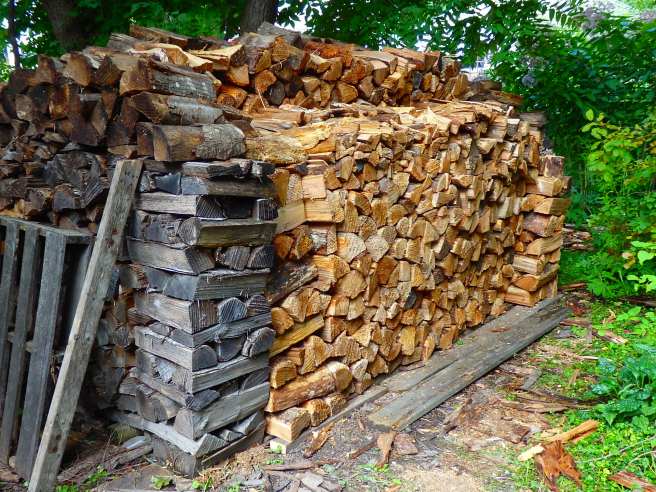
Like many New Englanders, we heat part of our house with wood. It also functions as backup for energy outages, just in case. Since we live in a small city not far from forests, obtaining firewood is rarely a problem. I have no idea what it’s like in a city like Boston or Providence, but the going rate here, delivered, is $300 a cord.
Imagine needing forty cords to get through a year – that would cost $12,000 a year … for a small house! And we think $2,500 a year for natural gas is excessive? I’ll have to ask around to see what folks using fuel oil or propane are shelling out, but it’s still bound to be cheaper than the Colonial alternative.
Two cords of new firewood sit stacked inside a seasoned shell in early September/ Stacking it was a lot of work, but not nearly as much as earlier generations put in on their yearly supply.


 Jnana's Red Barn