Wendell Berry’s two Muses (Standing by Words – highly recommended – page 204): “There are, it seems, two Muses: the Muse of Inspiration, who gives us inarticulate visions and desires, and the Muse of Realization, who returns again and again to say, ‘It is yet more difficult than you thought.’ This is the muse of form.
“The first muse is the one mainly listened to in a cheap-energy civilization, in which ‘economic health’ depends on the assumption that everything desirable lies within easy reach of anyone. It is the willingness to hear the second muse that keeps us cheerful in our work. To hear only the first is to live in the bitterness of disappointment.”
Here, a different slant on work from an unabashedly Christian poet and essayist. (North Point Press, San Francisco, 1983.)
In giving Kenzie that three-day weekend once every four weeks in the new novel Pit-a-Pat High Jinks, I was leaning on a work schedule I had on a newspaper out in Ohio. I sure wish I had it when I was living Upstate New York and assigned to a typical split week like his in the story. It was brutal.
Of course, in this round of revision, I was looking ahead to his experiences in my new Subway Visions. He would now have a chunk of time to head off to the Big Apple and return home.
As I reflect on my own forays into the city and its mass-transit tunnels, I think I made as many trips during my time in Ohio as I had in a similar period when I was living only four or five hours away from the metropolis. In other words, Kenzie gets in a lot more time on the underground tracks than I ever had.
Living an hour north of Boston, as I do now, I can admit to spending far more time on its subway system that I had in New York’s. And I’ve also relied on the systems of Philadelphia, Chicago, and Washington in the years since I drafted the original Subway Hitchhikers.
Have you ever had a special twist in a work schedule that had an impact like this?
In my new novel, What’s Left, her father (Baba) has an influential role in transforming the family restaurant even though he’s new to the business. But he’s not alone.
~*~
Here are some passages I cut from the final version:
Baba is an active participant in that year of intense planning, before heading off for his focused Dharma training, those three years in the Tibetan monastery followed by his permanent return here.
…
My search reveals to me how much Baba contributed to the final result. As a visual artist addressing challenges beyond the kitchen itself, he’s amplified the wisdom Dimitri displayed in bringing him on board – and all of his touches fill me with pride.
…
Reflecting on Baba’s contributions to the project, what impresses me most is his sensitivity to the underlying unity. What emerges simply feels right and natural.
~*~
In a traditional business school case study, the spotlight would likely fall on Baba’s future brother-in-law, Dimitri.
One of the themes running through my new novel, What’s Left, is an acknowledgement of what I’ve sometimes called “guerrilla economics.”
In one passage in an earlier draft of the story, I argued:
On the other hand, he just might learn along the way that the Amish keep to their ways not because they’re entirely sold on horsepower and kerosene lamps but because of the hedge their style puts around them, enabling them to keep their families and communities intact against the onslaught that’s devouring everything else.
Well, the Amish do provide the Swiss cheese essential to the family’s signature Streetcar sandwich, but there’s more. They’re a model of community, something Cassia’s family is also trying to do beside the college campus.
~*~
You can’t have it all – it’s an essential lesson when it comes to money issues if you want any freedom. Besides, where would you store it all? Who would even dust or polish it?
Again, this subject runs beyond the scope of my new novel, but there is a question of just how much is enough. For Cassia and her parents, they’re comfortable living modestly while successfully working in their world. And, no, they don’t live out by the country club or buy a new car every year, even when Cassia might see that as the way “normal” people might live.
What sacrifice would you be willing to make to pursue your dreams? (Give up your cell phone? Your laptop?) And what would you find’s essential to keep?
~*~
Greek Orthodox icon of the Virgin Mary of Mount Athos (and details) created by Father Vasileios Pavlatos in Kefalonia, Greece using the technique of Pyrography. (Via Wikimedia Commons.)
In earlier times, so I’ve heard, a normal house on Cape Cod used forty cords of hard pine firewood a year. That was back before chain saws or splitting machines, so felling the trees and cutting them to fit a fireplace or stove was largely handwork, even before getting around to stacking. My muscles and back ache just thinking about it.
Mind you, a typical Cape was not a large dwelling – two over two, as they say – or two rooms downstairs and two under the rafters above.
Like many New Englanders, we heat part of our house with wood. It also functions as backup for energy outages, just in case. Since we live in a small city not far from forests, obtaining firewood is rarely a problem. I have no idea what it’s like in a city like Boston or Providence, but the going rate here, delivered, is $300 a cord.
Imagine needing forty cords to get through a year – that would cost $12,000 a year … for a small house! And we think $2,500 a year for natural gas is excessive? I’ll have to ask around to see what folks using fuel oil or propane are shelling out, but it’s still bound to be cheaper than the Colonial alternative.
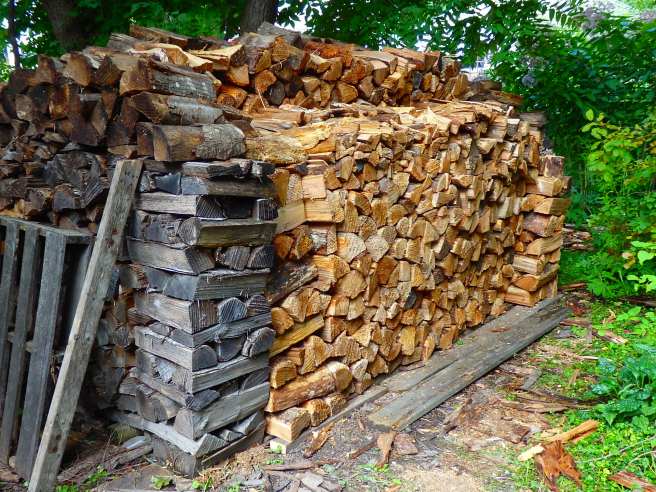
Two cords of new firewood sit stacked inside a seasoned shell in early September/ Stacking it was a lot of work, but not nearly as much as earlier generations put in on their yearly supply.
Across New England, the spire on city hall typically had prominent clock. Its purpose, I’m told, wasn’t just civic pride.
No, it was to keep the mill owners in check, just in case they were tinkering with their own clocks to squeeze unpaid time out of their workers.
It’s comforting to know the town fathers could stand up to corporate powers. Most of the owners, by the way, lived far from these sources of their wealth. Many of them were Boston Brahmins clustered around Harvard.
In honor of the workers and those who stand up for them, Happy Labor Day.
At one point in earlier versions of my new novel, What’s Left, I envisioned her family using their financial resources to drive an alternative local economy. The concept survives in the final version of the book, although this passage was boiled way down and many of the details changed:
Dimitri admits our enterprises will operate at the fringes of the economy.
He anticipates other extensions. We’ll encourage other friends to open a bakery. A guitar maker will join in a folk music shop. Rural skills like chair-caning and quilting will find a market here. Not everything we encourage will be quaint, as we’ll discover. Technology might include not just Baba’s darkroom and cameras but recording studios, computer designers, and solar entrepreneurs as well.
~*~
Or, as I noted in another now-deleted passage:
With patience, we’ll assure our dilapidated neighborhood just off campus undergoes rebirth.
~*~
Money issues – especially of an emotional, theological, and personal nature – are a topic I believe worthy of deep discussion. Just look to my Talking Money series archived at my Chicken Farmer I Still Love You blog for inspiration. Admittedly, they’re too big for this novel, though now I’m beginning to wonder about another, maybe as a series of telephone conversations? Please, somebody talk some sense into me!
(Oh, my, now I’m recalling that “financially secure” line in the old personals ads and still wondering exactly what the women meant by that – a guy who has a regular job with benefits or a seven-figure portfolio instead?)
Thinking of operating at the fringes of the larger economy, though, good things can happen. Where do you imagine an infusion of “greenback energy” might empower you or your friends to better the world as we know it?
~*~
The town of Fira on Santorini photographed from the roof of the Archipelagos Restaurant. (Photo by Rennett Stowe via Wikimedia Commons.)
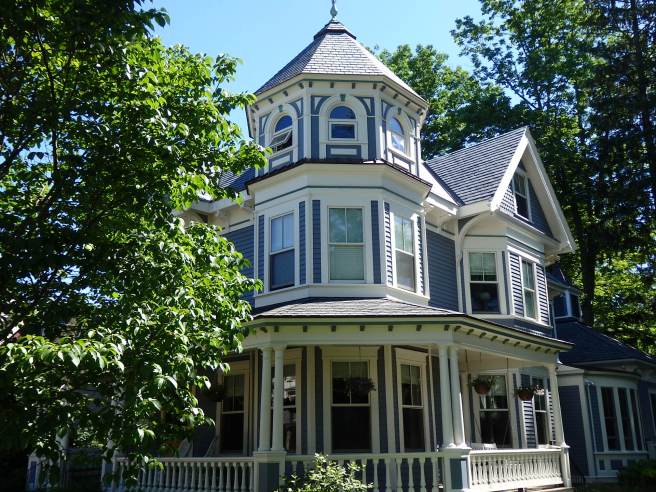
A large Queen Anne-style house with a distinctive witch’s hat tower something like this is the headquarters for Cassia’s extended family in my new novel, What’s Left. If only this one were pink, like hers.
In my new novel, What’s Left, the family’s nest egg was built by living on one income – in a single household – while everyone worked at the restaurant. The surplus went into savings and investments. Once the kids come along, their earnings also go in the pooled income, to be drawn out for college or marriage. Over time, as the family grows, the house has parents, grandparents, kids, aunts, uncles, and cousins. What a circus!
As for pocket money? Take it from the till? Some places, yes. And some places, no.
They’re about to start over, in a way, when Cassia’s father-to-be shows up.
A large Queen Anne-style house with a distinctive witch’s hat tower something like this is the headquarters for Cassia’s extended family in my new novel, What’s Left. If only this one were pink, like hers.
Imagine that your father or mother had started a successful business and you’re in line to inherit it.
What would you want it to be? What would you enjoy doing?
In my new novel, What’s Left, the family business is built around a restaurant and related rental properties nearby.
But there are all kinds of other options. What do you suggest?