RUNNING THROUGH CHEATGRASS

The grass grew tall in tawny tufts. One bunch here, another over there. Sometimes in the company of sagebrush.

~*~

Here a man will learn to pace himself more steadily. To watch for the rattlesnake, especially at river’s edge. To recalibrate his vision to the American Far West, where natural beauty assumes such spectacular proportions few notice the thinness at hand. The spider will teach all this. Clarity, like the desert itself, strips away to essentials. Sweeps away clutter. In what appears sparse, the man will gaze for episodes of miniature grace. Even elegance.

~*~

Kokopelli 1For a free copy of my newest novel, click here.

DESERT DANCES

Appealing to the heavens for rainfall was only one of the reasons for dancing. Your feet could pray as well as your hands in this landscape.

~*~

Somehow, the novice begins dancing, if only in his head. Something simple, at first, until familiarity gains ground. Feet, legs, torso, arms, and hands eventually follow. A reel leads into a jig. Thought and emotions balance. Head and heart dialogue. With confidence comes freedom. More and more, the aspirant concentrates on partners or the group or motion itself, rather than his own next step or position. The music becomes more textured, until the hornpipe stands as the liveliest structure. So it’s been in this landscape. This is not just any desert, for there’s nothing generic about any detail encountered closely. With both people and places you come to know dearly, you find nuances and subtle contradictions will blur any sharp image. It’s easier to describe someone or something you meet briefly than what you know intimately. To say desert is dry and sunny misses the point, especially if you arrive in winter. At first, like so many others, we didn’t even consider this valley as desert, for it has no camel caravans or mounds of shifting sands with Great Pyramids on the horizon. One word or phrase can be misleading. Even the Evil Stepmother from folklore and fairy tales must have possessed some redeeming qualities. Could we be more specific than “evil”? Simply selfish? Or was she mean, jealous, domineering, afraid of whatever, from the wrong party? Suppose she was really a victim of some deep abuse? The portrait changes. Has anyone detailed how she dances? In the end, it’s either entertainment or worship, depending on the individual’s orientation.

~*~

Kokopelli 1For a free copy of my newest novel, click here.

LILACS

So when did this appreciation begin? When I lived in the orchard house, we had a big lilac bush at the corner of the yard – the one where the bees swarmed from the hive that one day.

But I think the real change happened that spring after my first marriage collapsed and I was finally in love again. I crowded the house with those cut blossoms and their fragrance. It’s enough to make me picture a blue silk kimono.

That was years ago, and many miles. Yet the lilacs are more precious than ever.

As I said at the time, when I lived in that last apartment, I vowed if I ever bought my own place, I’d get cuttings from a friend whose lilacs likely descended from the first ones brought to North America. Of course, I didn’t, and the owner has since moved into a retirement center.

Even so, these days, we have our own, screening the Smoking Garden from the street. One lilac had, in fact, grown as tall as the house – but hollow. It’s been work, restoring them to flowering condition.

Still, there’s nothing more luxurious than lilac cuttings arrayed in the bedroom, with their heavenly aroma.

So quickly, they pass.

INTO THE GREAT PLAINS

To grow a leafy tree requires more than thirty inches of rainfall or its equivalent each year. If you drive west across the United States, you can cross an imaginary line that passes through the Dakotas, Nebraska, Kansas, Oklahoma, and Texas, and beyond it deciduous, or leafy, trees are quite rare. Soon, so are conifers, the evergreens. Irrigation becomes a fact of life if you want to raise food or flowers or even a lawn.

The Great Plains eventually pass into desert – and you might be surprised to discover that most of Oregon, Idaho, and Washington state is actually desert. The rainy belt is little more than a thin band along the Pacific-facing side of the Cascade and Olympic mountains.

Quite simply, it’s a different world from the one most Americans know.

~*~

As for the Great Plains, let me recommend Kathleen Norris’ Dakota. It’s a unique and marvelous book.


LEONARD SPRINGS: WHAT’S HIDDEN UNDERFOOT

One set of my poems of return, discovery, and loss is centered on the Leonard Springs which were hidden a half-dozen miles from the university I attended in my first sustained leap from my native Ohio.

On my return, we lived at the edge of town rather than on campus, and the springs were in a ravine just over the edge of our view from the kitchen. Few knew of their existence. Now, as I find online, they’re a public park and treasure.

~*~

Much of southern Indiana sits atop a thick limestone bed, some of it quarried for the construction of large-scale buildings worldwide. Over the ages, the bedrock has been riddled as slightly acidic water chiseled passageways and cave systems below the ground surface. Learn to read the landscape with this awareness and you come to recognize the widespread karst features, including sinkholes where cavern roofs have collapsed – some could easily hide a large truck or even a barn. There are also the sinking streams that vanish back into the earth as well as open mouths concealed in fields and forests that would swallow an unwary trespasser. So this hardness is laced with underground mystery and motion.

I already possessed some familiarity with this terrain from childhood camping and hiking trips, and had even crawled through some small caves in nearby state parks. Commercial caverns had also instilled an awareness of the otherworldly character of underground chambers and passageways. But this time, as I now lived off-campus on Leonard Springs Road, far to the other side of town, I was newly married and free to explore. After residing and laboring in the foothills of Upstate New York, the Pocono Mountains of Pennsylvania, and the flats of what had once been the Great Black Swamp of northwest Ohio, I had come back to Bloomington as a research associate. This sojourn would be all too short – a little more than a year and a half, though not by design – but long enough to acquaint me with the hardscrabble backcountry and its peculiar character.

Our garden sat in one sinkhole, and our waste water probably flowed into another (there’s no accounting for our landlord’s septic system). While I’m not a caver (as many spelunkers prefer to be called), I did become intrigued by the meandering channels beneath the meadows and woodlands beyond our house. From what Roger Pfingston writes more recently of his neighborhood on Stouts Creek, a similar locale a few miles to the north, I can suspect that much of the Leonard Springs terrain has since been ripped up and developed into housing.

What I leave, then, are field notes of the layering I experienced then, and a testimony. The poems in Green Repose present these. For your own copy, click here.

Green Repose 1

FAREWELL TO THE SWITCHBOARD

At the office, we had the farewell to the switchboard operator who’d been replaced by the new phone system – someone who had been there when I arrived two decades earlier.

Oh, the weird calls we’d get, the ones she usually screened yet some still managed to slip past her.

The woman from California, “Can you tell me what state New Hampshire’s in?” and I wanted to reply, “How the hell did you get this number?”

All of the ones wanting to know my opinion, as if it mattered.

Or the drunks or the individuals convinced of this conspiracy or that. Especially late at night.

As the publisher told one, “What do you think this is, a call-in radio show?”

Listen. We’ve got work to do, rather than yap. Piles and piles of work.

~*~

Oh, my, the telephones! They become a chorus of their own in my novel, Hometown News.

Hometown News

FROM THE FLAT GRAY FIELDS

As I said at the time …

Standing in the blank fields of Ohio … gray March … the utilitarian cemetery … beside my mother’s grave, knowing soon my father, too, would be planted here.

As it turns out, not as soon as I envisioned. He recovers somewhat. Several years later, I return to the spot, this time with my sister. We explore more, find other great-great-grandparents buried in a cemetery two or three miles away – not at all where I previously thought.

This time, I begin to appreciate the section numbers of township maps, as I place my ancestors’ farms, how often they abutted each other. How many, only a mile or two from this spot, back when these lands were mostly forested.

A native, a student at a then-new state university, a journalist who worked on three of its daily newspapers (each in a different quadrant of the state), I’ve spent a third of my life in Ohio. Married there and, a few years after returning, divorced; nearly married there again, too. Many of my ancestors, I’ve learned, settled Montgomery County in its first decade.

Yet, reviewing my creative writing – the poetry, fiction, and essays – I find little that’s directly about Ohio. Curiously, those few passages typically appear in pieces about other places – Indiana, Washington State, the East Coast. What instead becomes apparent is the fact that my roots remain, complexly and paradoxically, embedded in Ohio. Unavoidably, in my years as an exile, much of my writing comes out of those Buckeye origins. Whether my years away have been the result of forced expulsion (job market, especially) or of self-chosen escape, I nevertheless carry inevitable values, images, and expectations that are not just Midwestern, but more distinctly, those of the Miami Valley. As I’ve delved into my ancestry, moreover, I find also a forceful sub-current of dissenting religious practice and witness in overlapping Dunker (Brethren), Quaker, and Mennonite farming circles planted there – and to these, mysteriously, it would seem, I’ve returned in new settings.

Surveying material currently available for submission turns up very little with even the word “Ohio” in it. (Some fiction, essays, and genealogical writing need more revision before their release.) The five poems enclosed (an offer of first North American serial rights for work you select) do, however, spring deeply from the state – not just the land, but also the emotions. Maybe it’s a sense of the lovers, who were also Buckeyes. Maybe the awareness of mechanical work and objects. Maybe the crossroads nature of the state, looking west (in one poem, the prairie that stretches into Illinois) as well as east, to Baltimore and New York (as in “oysters”) or even, as stated, England. Maybe the underlying naïve outlook that becomes vulnerable to betrayal. Or the dreams of acting (hints of Broadway or Hollywood). Whatever the combination, something of the state is compressed into the fabric of these pieces.

Here’s hoping they work for you.

~*~

For the record, they didn’t.


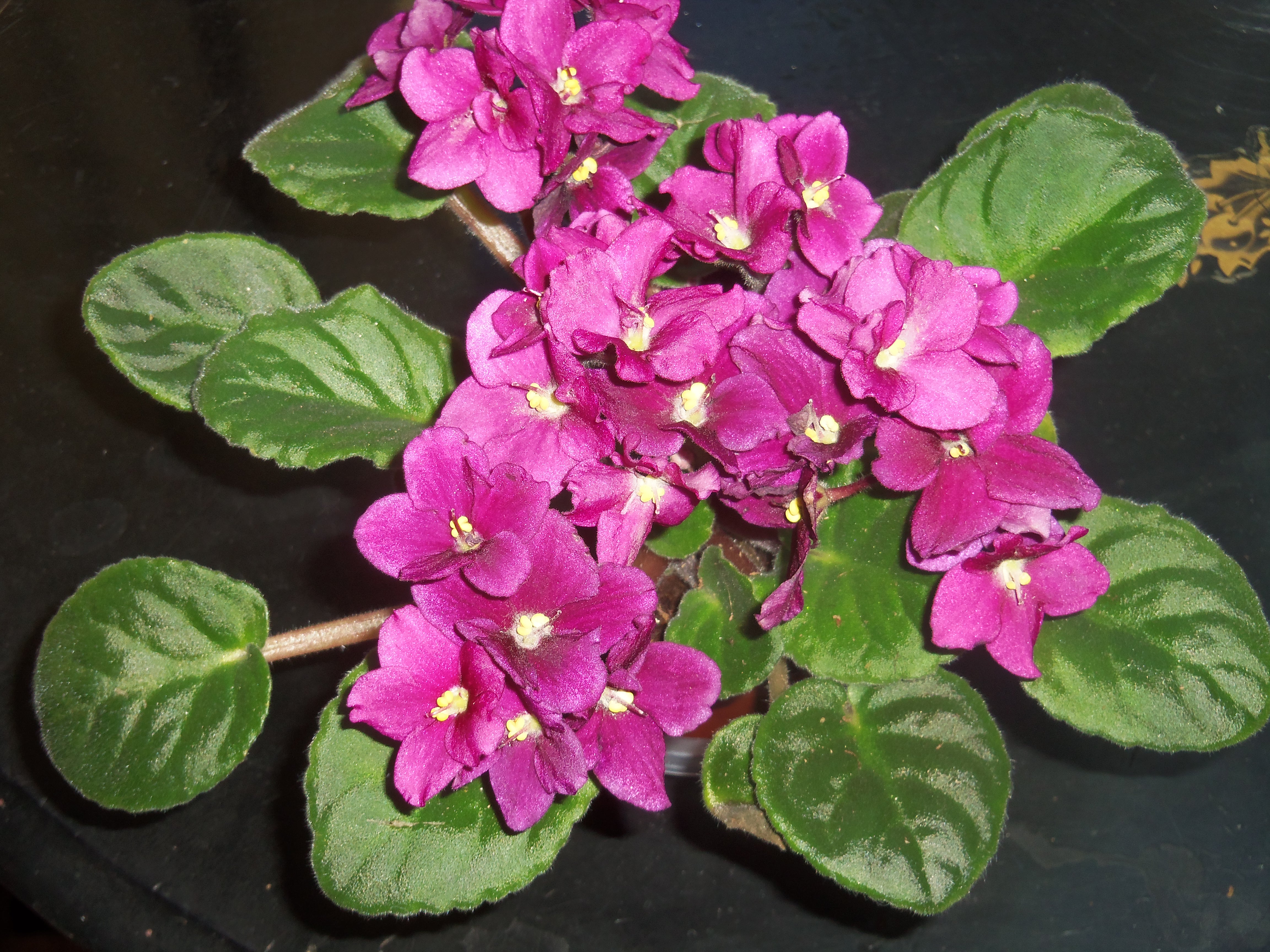
AFRICAN VIOLET

Simply lovely.
Simply lovely.

Can’t see an African violet in bloom without thinking of the calm reading room at the Lilly Library in Bloomington, Indiana. You had to be buzzed in from the museum displays, and the difference in air pressure was noticeable. And there, in the midst of some of the rarest books and broadsides ever printed, a librarian kept potted violets on the thick sills of its windows.

At the time, I was reading a lot of Samuel Johnson in the original. Pinpricks, coffee stains, and all.

ALL THE EXTRA TOUCHES ADDED UP

Another of the nation’s once-remarkable papers was the Des Moines Register. It assumed a thoroughly statewide focus, with locator maps pointing out where many of the communities were and an amazing ability to note where anyone mentioned in a national story had ever lived anywhere in Iowa. The front page had an old-fashioned, authoritative appearance with a prominent, staff-produced editorial cartoon and block-letter capital-letter banner headline. I appreciated the frequency of national and international stories that carried the byline, “Combined Wire Services,” meaning a copy editor had spent several hours comparing Associated Press, United Press International, New York Times, and other dispatches to glean details to rewrite into a more comprehensive report. All of that, of course, cost money.

Statewide newspapers began cutting back as the costs of distribution soared, combined with a recognition that nearly all of the advertisers – the principal source of revenue – were aiming at only the major metropolitan area.

It wasn’t just statewide coverage, either, that has been curtailed. Most of the biggest papers have since shuttered their foreign offices and cut back on national reporting, as well.

You can as easily say they’ve cheapened the product, but that’s a longer term issue.

~*~

For a surreal, playful, and often gallows-humor trip within one young and ambitious newsroom, pick up my novel, Hometown News.

Hometown News

CAPITALIST INTERVENTION

You know the Front Page tradition. But how much do you see about behind-the-scenes reality where newspaper reporters and editors are instead besieged by the very corporations that have gobbled up newspaper after newspaper, and city after city? My novel follows a band of idealists recruited to a family-owned newspaper by the promise of professional excellence and a competitive spirit. Through ever-more demanding workdays and a twist of fate, they ultimately overpower a monolithic neighboring rival, only to see their smiling publisher sell out to a media conglomerate. As their moment of glory disintegrates into surreal management games, unethical directives, and excruciating budget cuts, they struggle to save as much of their hard-won victory as possible – and painfully come to know themselves, their trade, and their neighborhoods in a much different light than they had just months earlier.

Hometown_News

~*~

To find out more about Hometown News or to obtain your own copy, go to my page at Smashwords.com.